
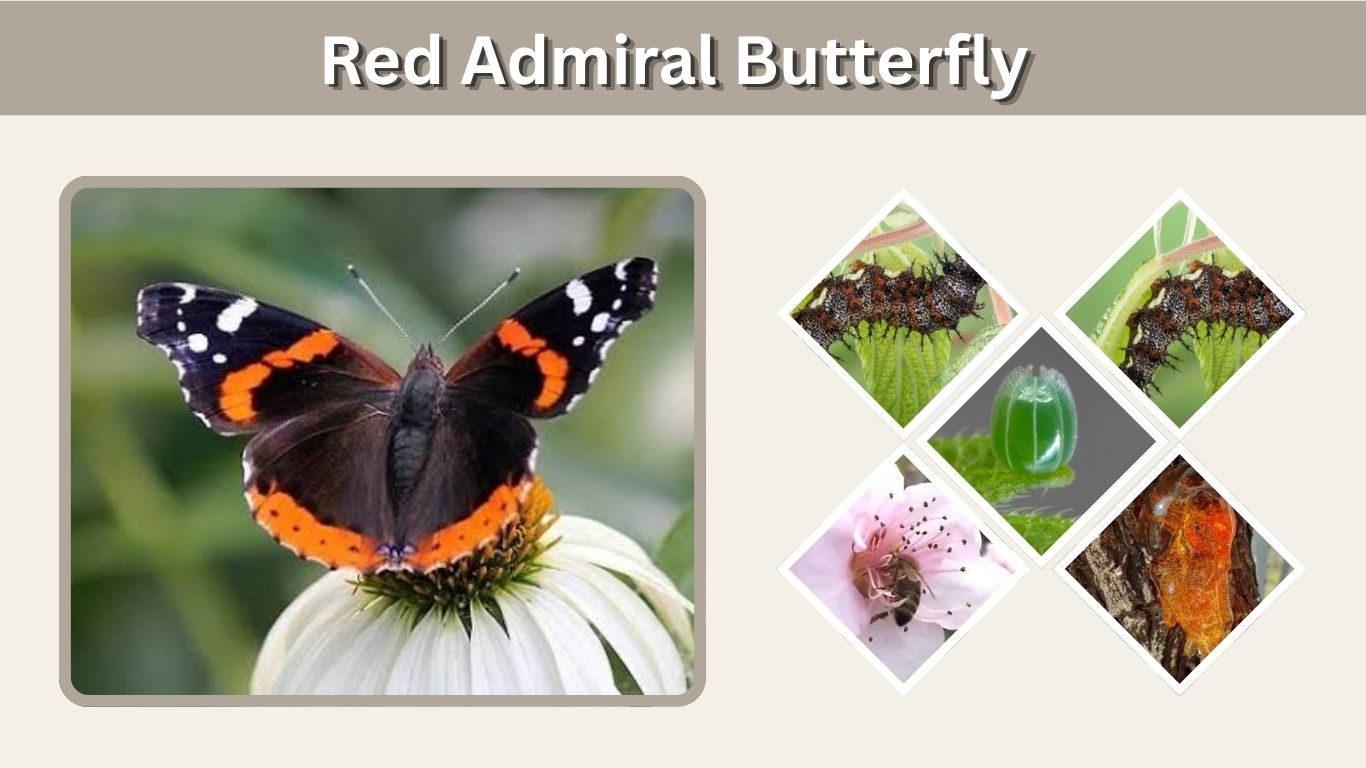
The Red Admiral butterfly (Vanessa atalanta) is a striking butterfly known for its black wings, bright red-orange bands, and white spots near the forewing tips. It occurs across much of North America, Europe, North Africa, and parts of Asia, where it visits gardens, woodland edges, parks, and open countryside. Red Admirals are strong fliers and may migrate considerable distances. Their caterpillars depend heavily on nettles as host plants, while adults feed on nectar, tree sap, and overripe fruit.
What Does a Red Admiral Butterfly Look Like?
Red Admirals are easy to recognize when their wings are open. Their bold combination of black, red-orange, and white separates them from most other butterflies. When their wings close, however, the underside becomes much darker and more camouflaged.
Red Admiral Butterfly Identification
Typical features include:
- Black or very dark brown upper wings
- Broad red-orange bands across the forewings
- Red-orange border on the hindwings
- White spots near the tips of the forewings
- Mottled brown and gray underside
- Wingspan of roughly 2 to 3 inches
- Fast, direct flight
- Strong territorial behavior in some adults
The underside of the hindwings looks very different from the brightly colored upper surface. Its mottled pattern helps a resting butterfly blend into bark, leaves, and other natural backgrounds.
Male vs Female Red Admiral Butterfly
Male and female Red Admirals look extremely similar, making visual identification difficult.
Males are often somewhat more territorial and may repeatedly patrol or defend sunny locations while waiting for females. Females spend more time searching for suitable host plants on which to lay eggs.
Unlike some butterfly species, there is no dramatic color difference between the sexes.
Red Admiral Butterfly Habitat and Range
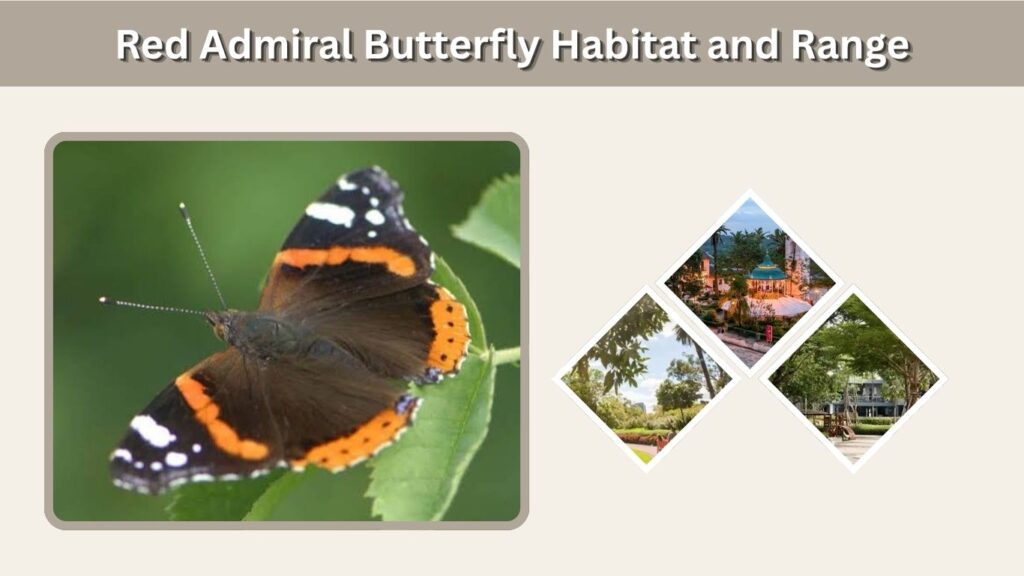
Red Admirals are adaptable butterflies that can live in many different environments. They are often seen in gardens and urban parks as well as more natural habitats.
Their strong flying ability also allows them to move into regions where they may not remain throughout the entire year.
Where Red Admirals Live
Common habitats include:
- Woodland edges
- Forest clearings
- Gardens
- Parks
- Meadows
- Wetlands
- Riverbanks
- Roadsides
- Agricultural edges
- Open countryside
- Areas where nettles grow
In North America, they occur from Canada through the United States and southward into Mexico and Central America.
They are also widespread across Europe and occur in portions of North Africa and Asia.
Red Admiral Butterflies in California, Florida and Northern States
Red Admirals occur in California and Florida as well as states such as Illinois, Indiana, Ohio, Michigan, Minnesota, and Massachusetts.
Numbers can vary dramatically from year to year because of migration and weather.
In warmer climates, adults may remain active for much longer portions of the year. Farther north, they become much more seasonal.
Red Admiral Butterfly Caterpillar
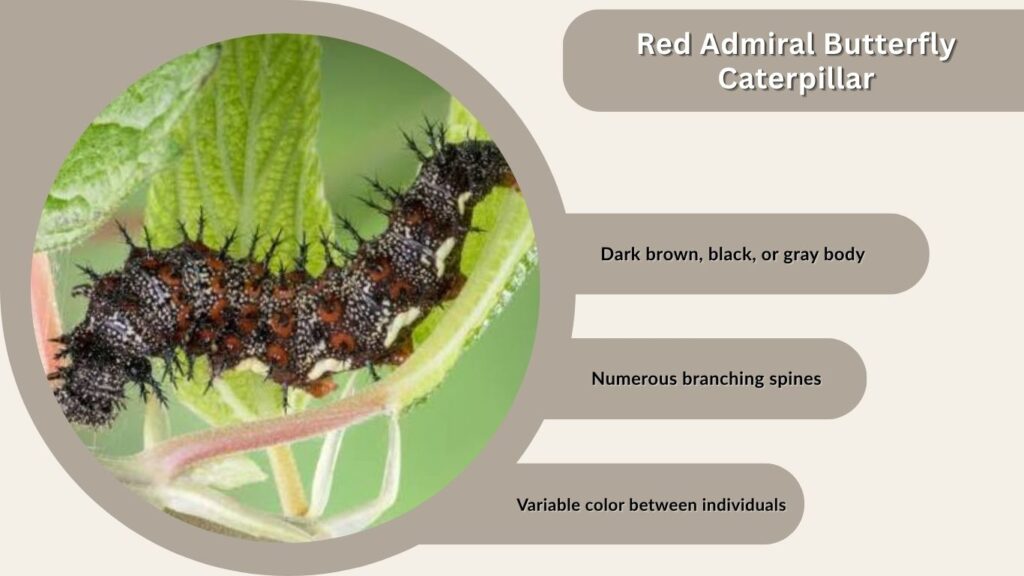
The Red Admiral caterpillar looks very different from the adult. Larvae are generally dark, spiny, and variable in color. They usually live within shelters made by folding or fastening together the leaves of their host plants.
Red Admiral Caterpillar Identification
Look for:
- Dark brown, black, or gray body
- Numerous branching spines
- Small pale or yellowish markings
- Variable color between individuals
- Caterpillars hidden inside folded leaves
- Strong association with nettle plants
Despite the spiny appearance, Red Admiral caterpillars are not considered dangerous to humans.
The spines mainly provide protection against predators.
Red Admiral Butterfly Host Plants
The most important host plants are members of the nettle family.
Common examples include:
- Stinging nettle
- Wood nettle
- False nettle
- Other plants in the nettle family
Females usually lay eggs individually on host plants.
After hatching, the caterpillar feeds on the leaves and often creates a protective shelter by folding a leaf around itself.
Red Admiral Butterfly Life Cycle
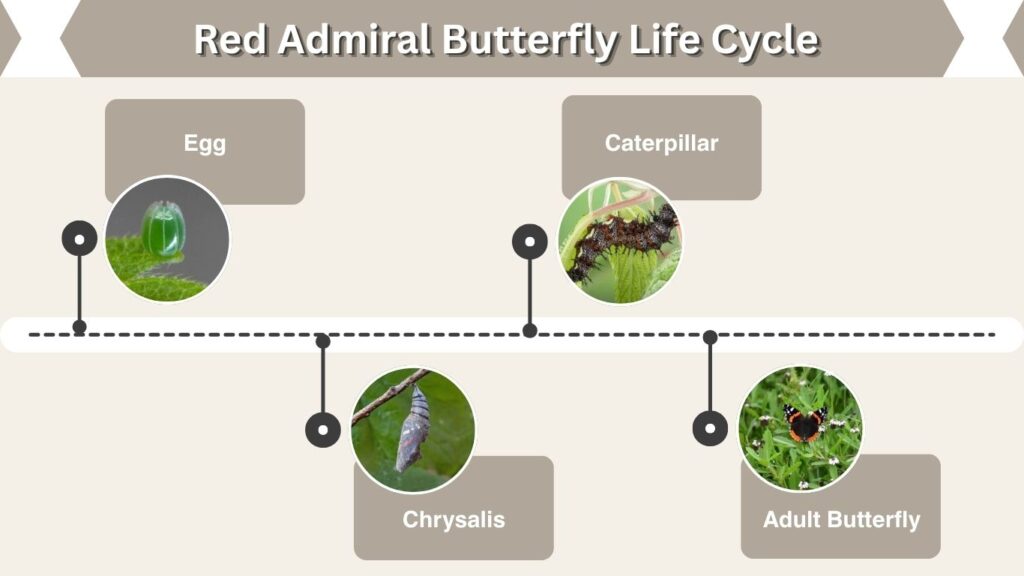
Like all butterflies, the Red Admiral undergoes complete metamorphosis. Development passes through four distinct stages.
Temperature and environmental conditions strongly influence how quickly development occurs.
Four Life Cycle Stages
The stages are:
- Egg – A female places a small egg on a suitable host plant.
- Caterpillar – The larva feeds heavily and grows through several molts.
- Chrysalis – The caterpillar transforms into a pupa.
- Adult butterfly – The fully formed butterfly emerges and begins feeding and reproducing.
People sometimes call the pupal covering a cocoon, but butterflies form a chrysalis, not the silken cocoon typically associated with many moths.
Red Admiral Chrysalis
The chrysalis usually hangs from vegetation or another protected surface.
It can appear brown, gray, or golden and often has metallic-looking markings.
This camouflage makes the chrysalis difficult for predators to detect.
After development is complete, the adult emerges, expands its wings, and eventually begins flying.
What Do Red Admiral Butterflies Eat?
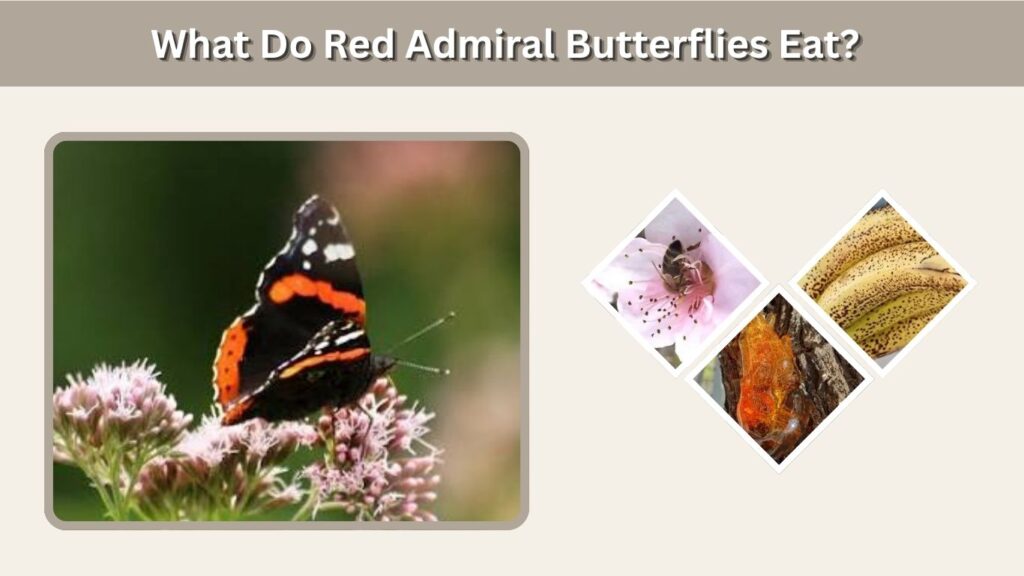
Adult Red Admirals have a surprisingly varied diet. They visit flowers, but they may also prefer fermented fruit, tree sap, and other sugary liquids.
Red Admiral Butterfly Food
Adults may feed on:
- Flower nectar
- Tree sap
- Overripe fruit
- Fermenting fruit
- Plant juices
- Honeydew
- Moisture and minerals from damp ground
Popular nectar flowers can include asters, milkweed, goldenrod, buddleia, and other nectar-rich blooms.
Rotting fruit can sometimes attract Red Admirals even more strongly than flowers.
What Do Caterpillars Eat?
Caterpillars mainly eat nettle leaves.
Because the adult and larval stages eat completely different foods, a butterfly-friendly garden ideally provides both nectar plants and suitable nettle host plants.
Do Red Admiral Butterflies Migrate?
Yes. Red Admirals are strong migrants, although their migration behavior is more flexible and irregular than the famous migration of Monarch butterflies.
Large movements may occur during favorable weather.
Red Admiral Migration
In North America, many individuals move north during spring and early summer.
Some populations later move south as colder conditions approach.
European populations also perform extensive seasonal movements, including movement between northern Europe and warmer regions farther south.
Weather patterns can cause unusually large numbers of Red Admirals to appear in certain years.
How Long Do Red Admiral Butterflies Live?
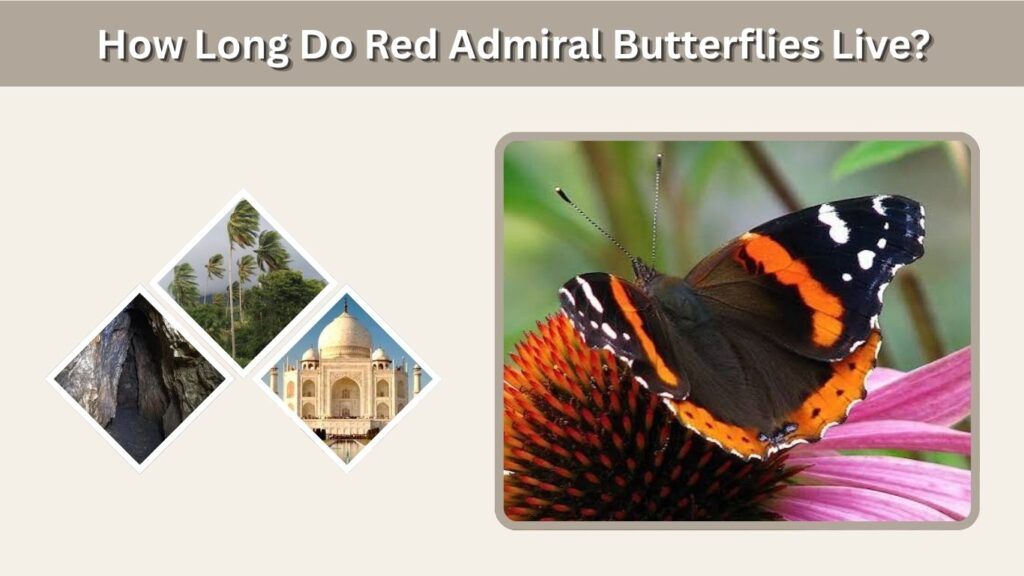
The exact lifespan varies depending on season, climate, and whether an individual migrates or overwinters.
The adult butterfly may live from several weeks to several months under favorable conditions.
Do Red Admirals Hibernate?
Some adults can survive winter in protected locations in relatively mild climates.
They may shelter in:
- Tree cavities
- Buildings
- Rock crevices
- Dense vegetation
- Other protected spaces
During warm winter days, adults may occasionally emerge and fly.
In colder regions, migration and recolonization are often more important than local overwintering.
Are Red Admiral Butterflies Rare?
Red Admirals are not generally considered rare. They are widespread and can be quite common when conditions are favorable.
Their numbers can fluctuate substantially, however.
Are Red Admirals Endangered?
Red Admirals are not generally regarded as globally endangered.
Local populations can still be affected by:
- Loss of host plants
- Habitat destruction
- Pesticide use
- Extreme weather
- Changes in climate
- Reduction of nectar sources
Leaving some nettles in suitable parts of a garden can provide important habitat for their caterpillars.
Red Admiral vs Similar Butterflies
Several butterflies can be mistaken for a Red Admiral because they combine orange, red, black, or white markings.
Painted Lady vs Red Admiral
A Painted Lady is generally more orange overall and has a complicated network of black and pale markings.
The Red Admiral has a much darker black background with a single strong red-orange band across each forewing.
Peacock Butterfly vs Red Admiral
The European Peacock butterfly has enormous colorful eyespots on all four wings.
Red Admirals lack these large eyespots and instead show distinctive red bands and white forewing spots.
New Zealand Red Admiral
The New Zealand Red Admiral is not the same species as Vanessa atalanta.
New Zealand has its own Red Admiral, Vanessa gonerilla, which has different markings and a naturally restricted distribution.
Red Admiral Butterfly Meaning and Symbolism
There is no scientifically proven spiritual meaning associated with seeing a Red Admiral butterfly.
However, butterflies have long been used symbolically because of their dramatic transformation during metamorphosis.
Common Symbolic Meanings
People sometimes associate the Red Admiral with:
- Transformation
- Personal change
- Renewal
- Hope
- Strength
- Love
- Memory
- Spiritual connection
- New beginnings
Some traditions also interpret seeing a Red Admiral after someone dies as a symbolic reminder of that person.
These ideas are cultural or personal beliefs rather than biological facts.
Interesting Red Admiral Butterfly Facts
The Red Admiral has several unusual characteristics beyond its striking appearance.
Quick Facts
- Its scientific name is Vanessa Atalanta.
- Nettles are its primary caterpillar host plants.
- Adults can migrate long distances.
- Caterpillars construct shelters from leaves.
- Adults sometimes prefer rotting fruit over nectar.
- Both sexes look very similar.
- Red Admirals can be territorial.
- Their closed wings provide excellent camouflage.
- Some adults may overwinter in mild climates.
- They occur across multiple continents.
FAQs
1. Is a Red Admiral butterfly rare?
No. Red Admirals are generally widespread and common, although their abundance can change significantly between seasons and locations.
2. What is the Red Admiral butterfly host plant?
Nettles are the primary host plants, including stinging nettle, wood nettle, and related species.
3. Are Red Admiral butterflies poisonous?
They are not considered dangerous or poisonous to people. Their caterpillars also do not have medically significant venomous spines.
4. How long does a Red Admiral butterfly live?
Adult lifespan varies, but individuals may survive from several weeks to several months depending on temperature, migration, food availability, and overwintering conditions.
5. What does seeing a Red Admiral butterfly mean?
Biologically, it simply means the butterfly is using the area for feeding, migration, breeding, or resting. Symbolically, some people associate it with transformation, hope, love, remembrance, or renewal.