
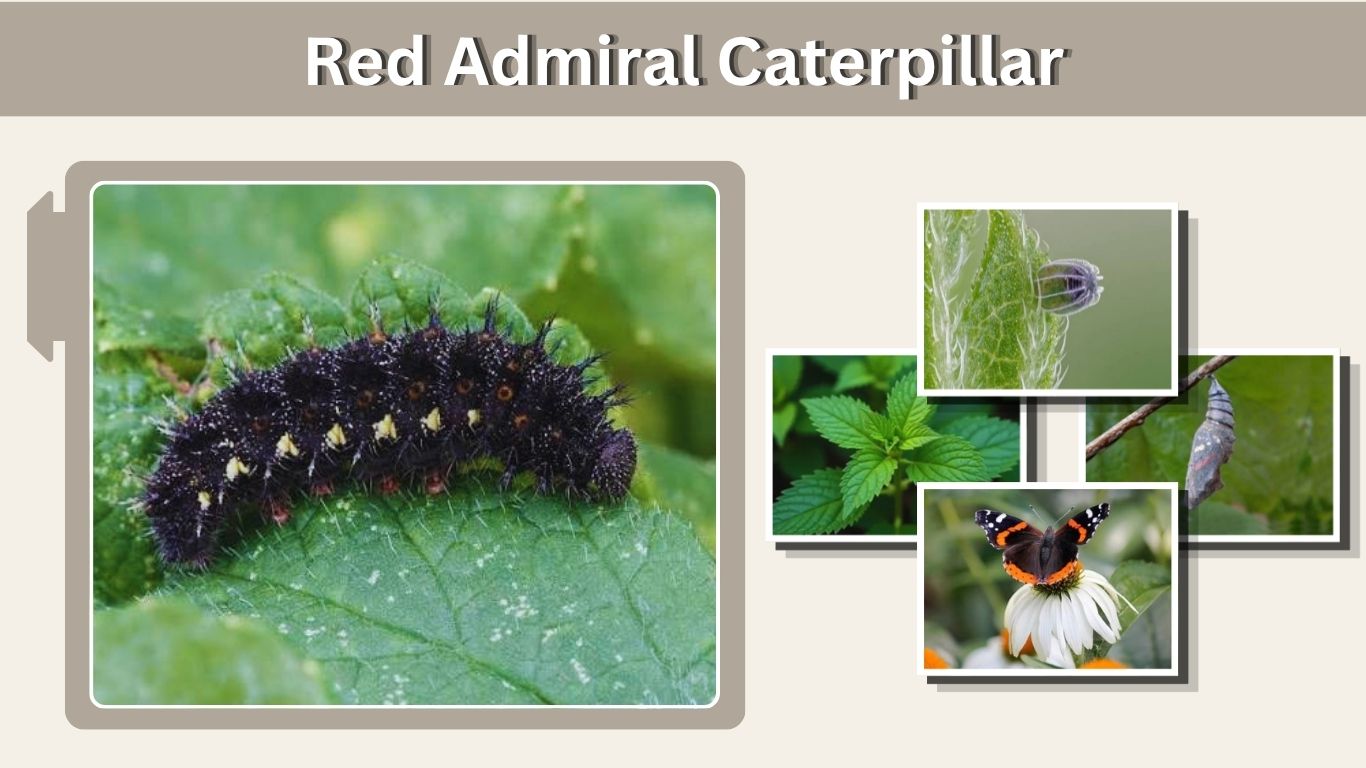
The Red Admiral caterpillar is the larval stage of the Red Admiral butterfly (Vanessa atalanta). It is usually dark brown or black, covered with branching spines, and commonly found feeding on nettles. These caterpillars often hide inside folded leaves that they fasten together with silk, making them easy to overlook. Despite their spiny appearance, they are not considered dangerous to people. This guide explains Red Admiral caterpillar identification, food, host plants, life cycle, chrysalis, care, and whether they can sting or cause harm.
What Does a Red Admiral Caterpillar Look Like?
Red Admiral caterpillars vary considerably in color, especially as they grow through different instars. Most have dark bodies covered in rows of branched spines, but some may appear grayish, brown, or partially yellow-green.
Red Admiral Caterpillar Identification
Look for these features:
- Dark brown, black, or gray body
- Numerous branching spines
- Small pale or yellow spots
- Yellowish markings along the sides in some individuals
- Thick body compared with very young larvae
- Dark head
- Spines arranged in rows
- Often hidden inside folded nettle leaves
The spines give the caterpillar a threatening appearance, but they are mainly defensive structures.
Red Admiral Caterpillar Size
Fully grown Red Admiral caterpillars can reach roughly 1 to 1.5 inches long before pupating.
Young larvae are extremely small and may be difficult to see without carefully examining host plants.
As the caterpillar grows, it sheds its skin several times. Each growth stage between molts is known as an instar.
Red Admiral Caterpillar Host Plant
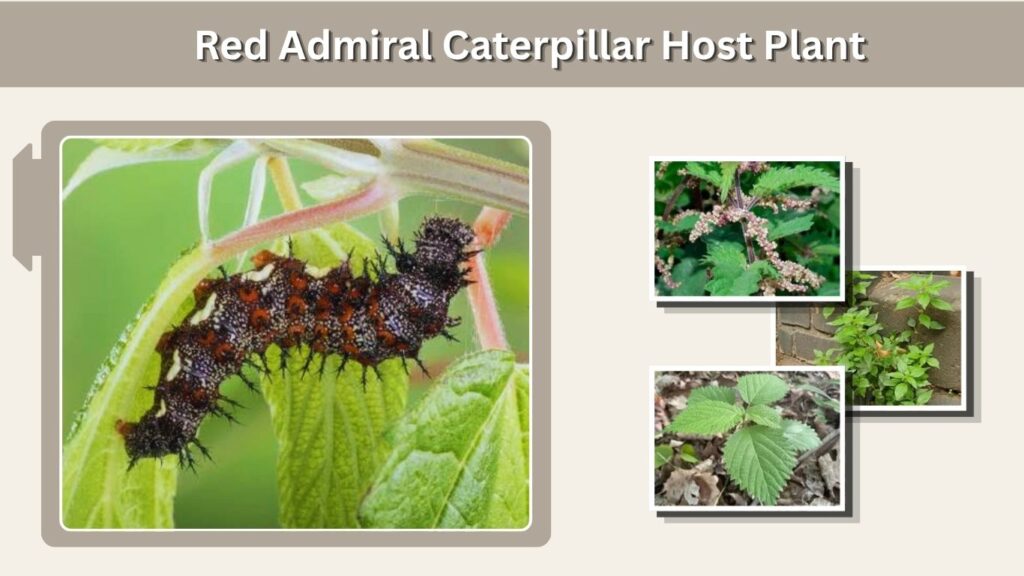
The most important host plants for Red Admiral caterpillars are members of the nettle family. Female butterflies search for suitable plants before laying eggs, and young caterpillars begin feeding shortly after hatching.
Common Host Plants
Red Admiral caterpillars commonly use:
- Stinging nettle
- Wood nettle
- False nettle
- Pellitory
- Other plants in the nettle family
Stinging nettle is one of the most important and widely used host plants.
A healthy patch of nettles can support several caterpillars during the breeding season.
Why Nettles Are Important
Adult Red Admirals can drink nectar from many different flowers, but their caterpillars are much more selective.
Without suitable nettle-family plants, females have nowhere appropriate to lay their eggs.
For this reason, gardeners who want to attract Red Admiral butterflies may allow a small patch of nettles to grow in an undisturbed area.
What Do Red Admiral Caterpillars Eat?
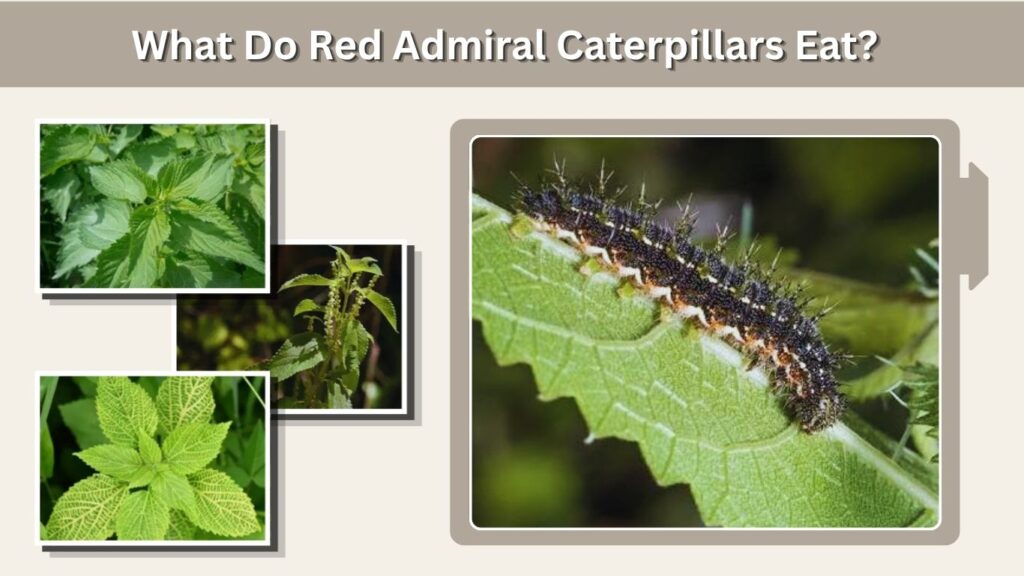
Red Admiral caterpillars primarily eat the leaves of their host plants.
They do not normally switch freely between unrelated plants, so providing the correct food is essential if you are caring for one.
Red Admiral Caterpillar Food
Good natural foods include:
- Fresh stinging nettle leaves
- Wood nettle leaves
- False nettle leaves
- Other confirmed local nettle-family host plants
Fresh leaves should be free from pesticides or other chemical treatments.
If a caterpillar was found feeding successfully on one specific plant, it is usually best to continue offering that same plant.
How Caterpillars Feed
Young caterpillars may eat small portions of leaves while remaining hidden inside a protective shelter.
Older larvae consume larger amounts and can noticeably chew the edges or surface of nettle leaves.
Because they grow quickly, healthy caterpillars may spend much of their time feeding or resting between feeding periods.
Why Do Red Admiral Caterpillars Fold Leaves?
One of the most interesting Red Admiral behaviors is building a shelter from the host plant.
The caterpillar uses silk to pull parts of a nettle leaf together, creating a small protected space.
Benefits of a Leaf Shelter
The shelter can help:
- Hide the caterpillar from birds
- Reduce visibility to parasitic insects
- Provide protection from weather
- Create a secure resting location
- Keep the larva close to its food source
As the caterpillar grows, it may abandon one shelter and construct a larger one.
Finding folded or rolled nettle leaves with silk inside can therefore be a good clue that Red Admiral caterpillars are present.
Is a Red Admiral Caterpillar Poisonous?
Red Admiral caterpillars may look dangerous because of their spines, but they are not generally considered poisonous or venomous to humans.
Their appearance is mainly defensive.
Can a Red Admiral Caterpillar Sting?
Red Admiral caterpillars do not have true stingers.
Their branching spines are not comparable to the venomous spines found on some medically significant caterpillars.
Still, people with sensitive skin may prefer not to handle them unnecessarily.
It is better to observe the caterpillar on its host plant or gently move it using the leaf it is sitting on rather than directly touching it.
Red Admiral Caterpillar Life Cycle
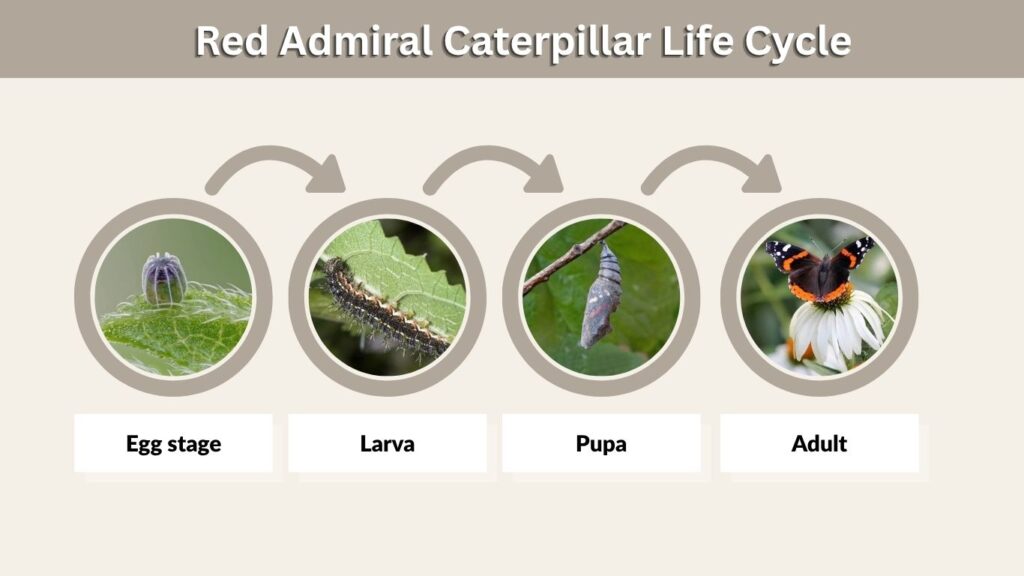
The Red Admiral develops through complete metamorphosis. This means it passes through four very different stages before becoming an adult butterfly.
Red Admiral Life Cycle Stages
The stages are:
- Egg – A female lays an egg on a suitable host plant.
- Caterpillar – The larva hatches, feeds, and grows through several instars.
- Chrysalis – The mature caterpillar transforms into a pupa.
- Adult butterfly – The Red Admiral emerges, expands its wings, and begins adult life.
Development speed depends heavily on temperature and environmental conditions.
Warm weather generally speeds up growth, while cooler conditions can slow development.
Red Admiral Caterpillar Instars
The caterpillar passes through several instars before pupation.
Early instars are tiny and may create small leaf shelters.
Later instars become much larger, darker, and more heavily spined.
During each molt, the caterpillar sheds its old skin and emerges with a larger body.
Red Admiral Caterpillar Chrysalis
When fully grown, the caterpillar stops feeding and begins searching for a protected place to pupate.
It attaches itself to a surface using silk and hangs downward before transforming into a chrysalis.
What Does the Chrysalis Look Like?
A Red Admiral chrysalis may appear:
- Brown
- Grayish
- Tan
- Mottled
- Decorated with metallic gold-looking spots
Its shape and coloration provide excellent camouflage against dead leaves, stems, and other vegetation.
The chrysalis hangs from a small silk attachment until the adult butterfly is ready to emerge.
Is It a Cocoon?
No. Red Admiral butterflies form a chrysalis, not a cocoon.
A cocoon is usually a layer of silk built around the pupa by certain moth species.
Butterfly pupae are generally exposed as chrysalides without a thick surrounding silk covering.
How to Care for a Red Admiral Caterpillar
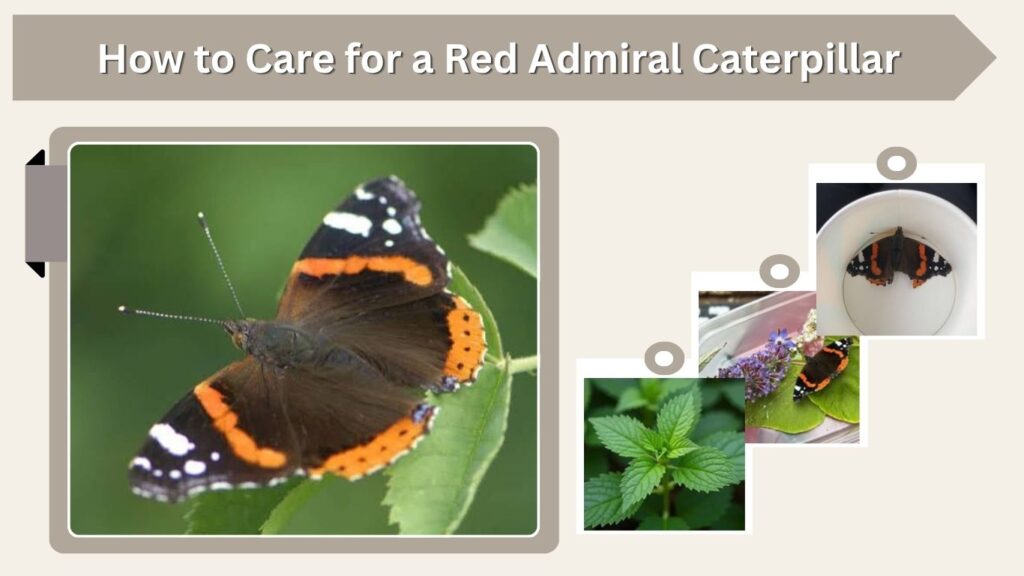
If you find a Red Admiral caterpillar and want to observe its development, keeping conditions simple and close to its natural environment works best.
Basic Caterpillar Care
Provide:
- Fresh untreated nettle leaves
- Good ventilation
- A clean container
- Enough vertical space
- Fresh food replaced regularly
- Dry surfaces rather than excessive moisture
- Stems or surfaces for pupation
- Protection from direct overheating sunlight
Remove old leaves and droppings regularly to reduce mold.
Avoid spraying the enclosure heavily with water because excessive humidity can encourage disease.
What to Do When It Stops Eating
A mature caterpillar may suddenly stop feeding and begin wandering around the enclosure.
This often means it is preparing to pupate.
Provide vertical surfaces or stems where it can attach itself safely.
Once it forms a chrysalis, avoid unnecessary handling.
Red Admiral Caterpillars in the UK and North America
Red Admirals occur across a broad geographic range, and their caterpillars may be found anywhere suitable nettle host plants grow.
In the UK, they are closely associated with stinging nettles.
In North America, caterpillars occur across many states and provinces, including areas such as Indiana, Pennsylvania, and much of the northern and eastern United States.
When to Look for Them
The best time depends on local climate.
In warmer regions, several generations may occur during the year.
Farther north, caterpillars are most commonly found during the warmer months when adult butterflies are breeding and fresh host plants are available.
Interesting Red Admiral Caterpillar Facts
Red Admiral caterpillars have several behaviors that make them especially interesting to observe.
Quick Facts
- Their scientific species name is Vanessa atalanta.
- Nettles are their main host plants.
- They build protective leaf shelters.
- They pass through several instars.
- Their spines are not venomous.
- They become a hanging chrysalis before adulthood.
- Chrysalis coloration can include metallic-looking spots.
- They are well camouflaged despite their spiny bodies.
- Adults look completely different from the larvae.
- Caterpillars eat leaves, while adult butterflies feed mainly on liquids.
FAQs
1. What does a Red Admiral caterpillar look like?
It usually has a dark brown or black body covered with branching spines and small pale or yellowish markings.
2. What do Red Admiral caterpillars eat?
They mainly eat nettle-family plants, especially stinging nettle, wood nettle, and false nettle.
3. Are Red Admiral caterpillars poisonous?
No. They are not generally considered poisonous or venomous to people.
4. Do Red Admiral caterpillars sting?
No. Their spines may look intimidating, but they are not true stingers and do not inject venom.
5. How does a Red Admiral caterpillar become a butterfly?
After completing several larval stages, it stops feeding, attaches itself to a protected surface, forms a chrysalis, and later emerges as an adult Red Admiral butterfly.