
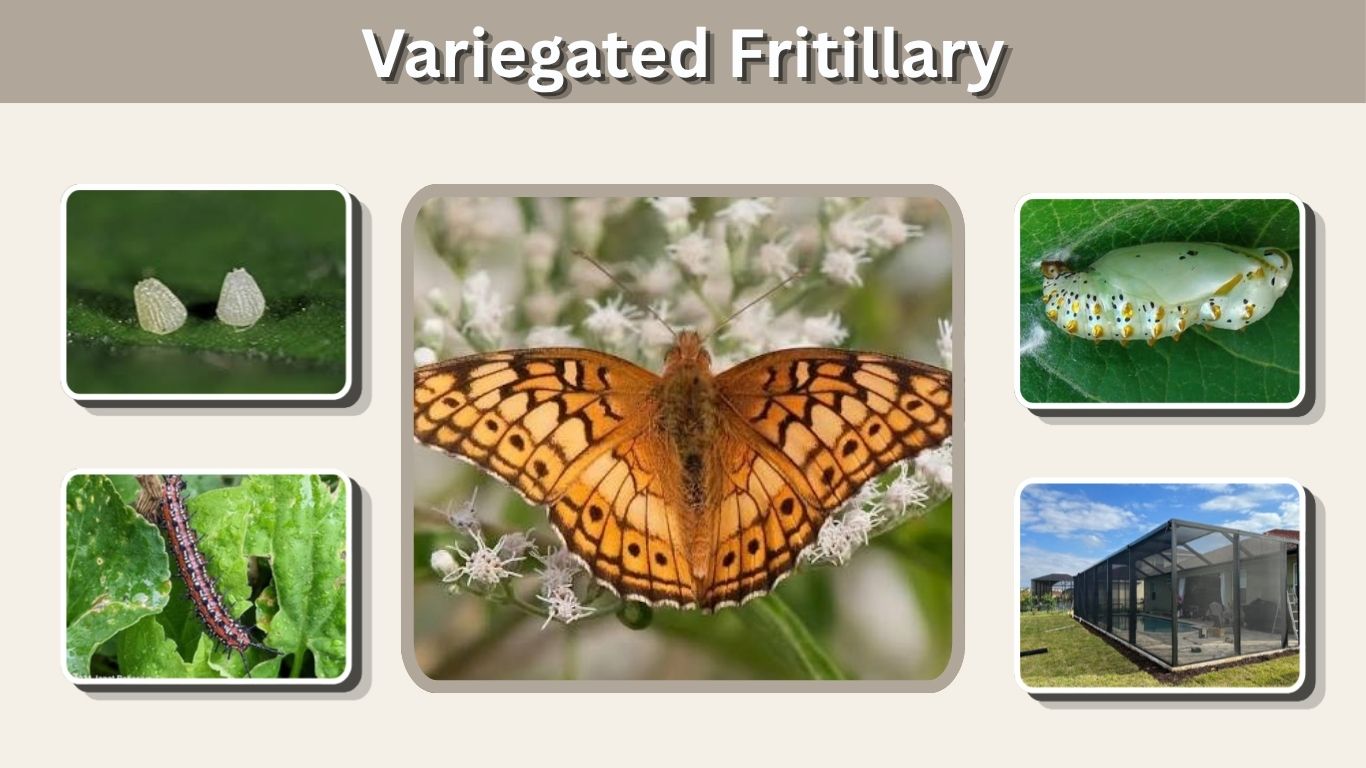
The variegated fritillary (Euptoieta claudia) is an orange-and-brown butterfly found across much of the Americas. Its striped caterpillar feeds on several host plants, including violets and passionflowers, before forming a striking metallic-looking chrysalis. Because its appearance overlaps with other fritillaries, identification can be confusing at every stage. This guide explains its markings, range, habitat, host plants, life cycle, size, and seasonal movement. You will also learn how to support these butterflies in your garden and why a spiny caterpillar is not necessarily a stinging one.
Variegated Fritillary Identification
The variegated fritillary butterfly belongs to the brush-footed butterfly family, Nymphalidae. Its patterned wings can resemble those of several orange butterflies, so color alone is not enough for identification. Check the wing edges, upper markings, and especially the underside of the hindwings. Caterpillars and chrysalises provide different clues, making photographs of each stage useful for confirming what you have found.
Adult Butterfly Features
Adults have a wingspan of approximately 1.75–3.2 inches, or 4.4–8.1 centimeters. Males and females look similar.
Look for these identifying features:
- Orange-brown upper wings crossed by dark markings and veins.
- Black spots near the outer wing margins.
- Angular wings with slightly scalloped hindwing edges.
- Mottled hindwing undersides without metallic silver spots.
Caterpillar Appearance
The variegated fritillary caterpillar has a reddish-orange body, lengthwise markings formed by white dashes and black spots, and rows of branched black spines. Two long black projections rise from its head. These features are more useful than color alone when identifying a caterpillar.
Variegated Fritillary Range and Habitat
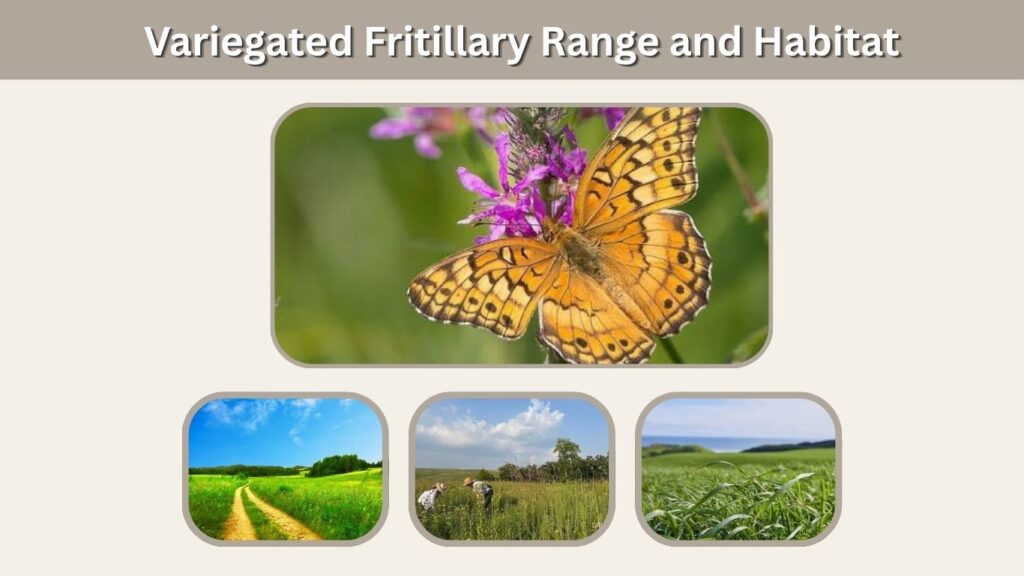
The variegated fritillary range extends across parts of North, Central, and South America. In North America, its presence changes with the seasons: butterflies spread northward during warmer weather, while southern areas support longer periods of activity. A butterfly seen in a northern summer garden is therefore not necessarily part of a population that survives the winter in that same place.
Where to Look
Search sunny fields, prairies, pastures, roadsides, and open woodland. Flower-rich gardens can also attract visiting adults. The species occurs south to Argentina, while seasonal immigrants reach much of the United States and southern Canada.
Activity varies geographically. Butterflies may fly throughout the year in southern Texas, but northern sightings are more seasonal. Local climate matters more than a single nationwide “butterfly season.”
Variegated Fritillary Host Plants and Diet
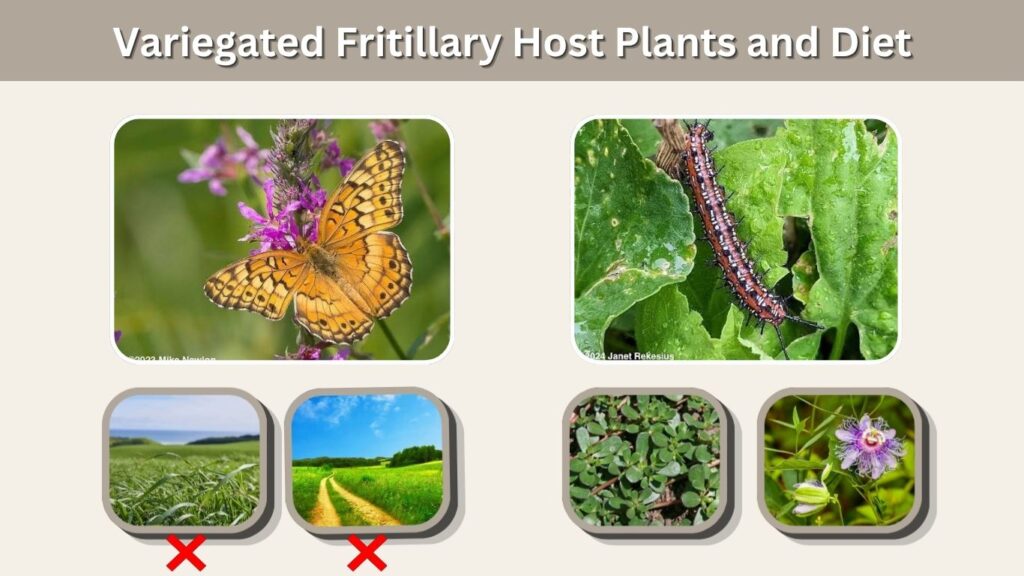
Finding the right variegated fritillary host plant means looking beyond flowers alone. Caterpillars need suitable foliage to eat, while adult butterflies visit flowers for nectar. A garden can attract adults without supporting their young. Providing both resources gives the species more opportunities to feed and reproduce, but not every plant sold as butterfly-friendly is an appropriate food source for caterpillars.
What Do Variegated Fritillary Caterpillars Eat?
Recorded host plants include:
- Violets and pansies, belonging to Viola.
- Passionflowers, belonging to Passiflora.
- Common purslane.
- Mayapple.
- Certain stonecrops and moonseeds.
Host use varies, so a plant’s membership in one of these groups does not guarantee that every species or variety will be suitable.
What Do Adult Butterflies Eat?
Adults visit nectar-producing flowers such as coneflowers, zinnias, milkweeds, and clover. A butterfly drinking nectar from a plant does not necessarily mean its caterpillars can eat that plant’s leaves. This distinction is important when choosing plants for a butterfly garden.
Variegated Fritillary Life Cycle and Chrysalis
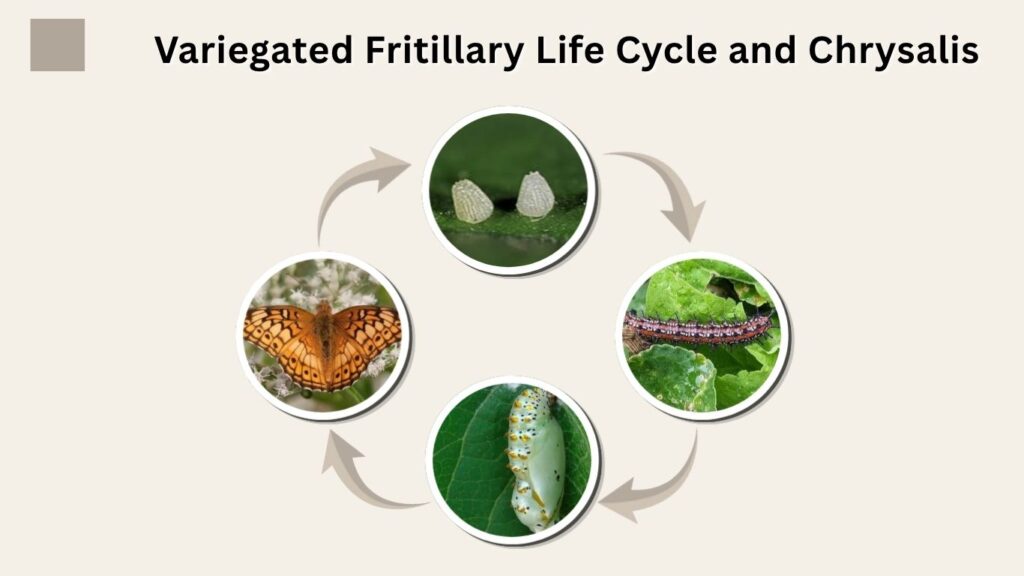
The variegated fritillary life cycle includes four stages: egg, caterpillar, pupa, and adult. The caterpillar is the feeding and growing stage; the chrysalis is where transformation into a butterfly continues. Development depends on temperature and other conditions, so a calendar estimate is only a guide. Watching changes in appearance is more informative than expecting every individual to follow identical timing.
The Four Life Stages
- Egg: Females place eggs singly on host-plant leaves or stems. Hatching can occur in approximately three days.
- Caterpillar: The larva feeds and grows, shedding its skin as it develops. Reported development from hatching to pupation takes around 19–27 days.
- Chrysalis: The insect enters its pupal stage. Adult emergence has been reported after approximately nine days.
- Adult: The butterfly emerges, expands its wings, and eventually feeds and reproduces.
These are reported development times, not fixed deadlines for every individual.
What Does the Chrysalis Look Like?
The variegated fritillary chrysalis can appear silvery white or pale green, with black markings and raised, gold-colored features. Its jewel-like appearance is particularly distinctive.
Although people search for a “variegated fritillary cocoon,” chrysalis is the correct term. A chrysalis is the butterfly’s pupa, whereas a cocoon is a silk covering around a pupa.
Supporting and Raising Variegated Fritillaries
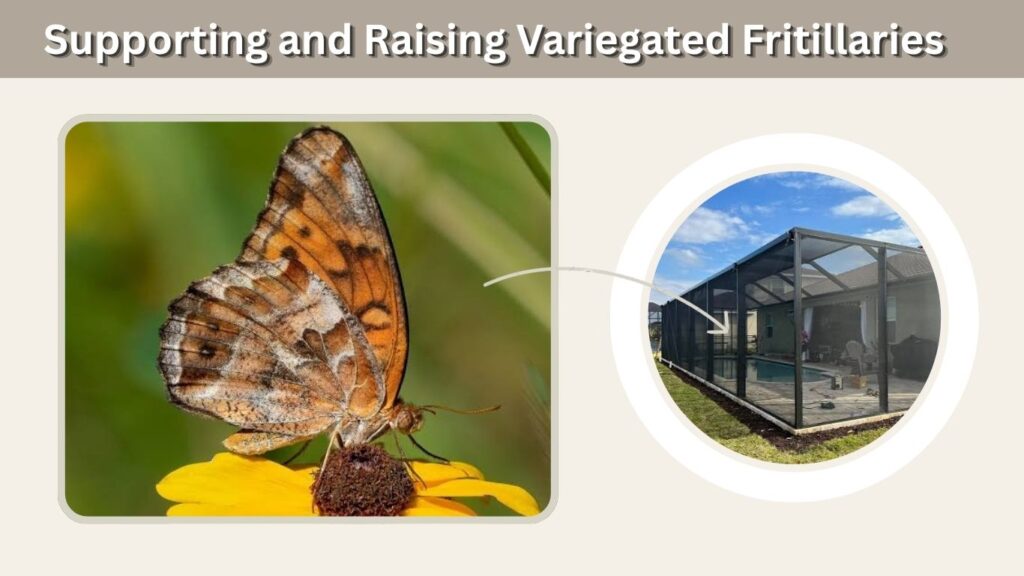
Supporting wild caterpillars starts with leaving their food plants available. A patch of violets can be as useful as a carefully designed flower bed. If you choose to observe a caterpillar in an enclosure, its needs are straightforward but ongoing: fresh food, ventilation, cleanliness, and space. Raising butterflies requires regular attention, especially when growing caterpillars begin eating much more quickly.
Basic Caterpillar Care
- Use a screened enclosure that allows airflow and prevents escape.
- Offer fresh leaves from a confirmed host plant.
- Replace wilted foliage before the caterpillar runs out of food.
- Remove droppings and other debris regularly.
- Minimize handling and leave a forming chrysalis undisturbed.
The Butterfly Society of Virginia describes successful rearing using screened cages, violet leaves, passionflower foliage, and regular cleaning. Its account also emphasizes how much time feeding and maintenance can require.
Supporting Them Outdoors
For a simpler approach, retain suitable host plants and provide flowers that bloom at different times. Avoid spraying insecticides around caterpillars and their food plants. Accepting some chewed leaves is part of maintaining a garden that supports butterflies through their whole life cycle.
FAQs
Questions about variegated fritillaries often involve look-alike species, caterpillar safety, and the differences between males and females. These details are worth checking before labeling a photograph or moving an insect. The answers below address five common points of confusion. Remember that a single feature, such as orange wings or black spines, rarely provides enough information for a reliable species identification.
Are Variegated Fritillary Caterpillars Poisonous?
Their spines are not reported to deliver a sting. However, “non-stinging” does not establish that a caterpillar is safe to eat. Observe without unnecessary handling, and prevent children or pets from mouthing it.
What Does “Variegated” Mean?
Variegated means displaying different colors, patches, or markings. The name suits this butterfly’s patterned upper wings and mottled undersides.
How Do You Separate Great Spangled and Variegated Fritillaries?
Check the hindwing underside. Great spangled fritillaries have conspicuous silver spots; variegated fritillaries have mottled markings without those silver spots.
Do Male and Female Variegated Fritillaries Look Different?
They look similar, sharing the same general wing pattern. An ordinary photograph may not provide enough detail to determine sex confidently.
How Long Does a Variegated Fritillary Butterfly Live?
Huntsville Botanical Garden lists an adult lifespan of roughly two to four weeks. This refers to the butterfly stage, not the entire period from egg to adult.