
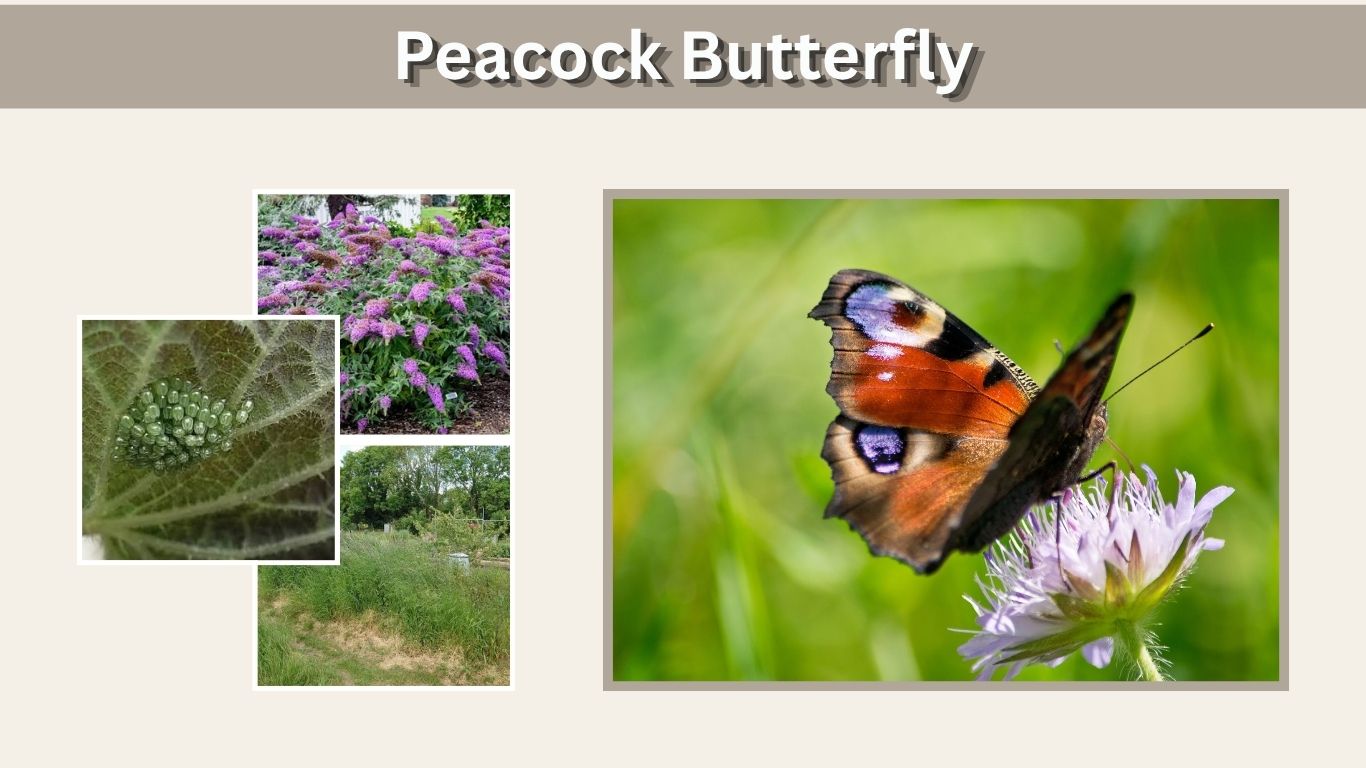
The peacock butterfly is one of Europe’s most recognizable butterflies, famous for the large eye-like markings on its wings. Scientifically known as Aglais io and formerly called Inachis io, this colorful species uses its dramatic wing pattern to confuse or frighten predators. Peacock butterflies live in gardens, woodland edges, meadows, and other flower-rich habitats. Their caterpillars usually feed on nettles, while adults visit many nectar-producing flowers. Below, you will learn how to identify peacock butterflies, where they live, what they eat, and how their life cycle works.
What Is a Peacock Butterfly?
The peacock butterfly belongs to the family Nymphalidae, which includes many familiar brush-footed butterflies. It is native across much of Europe and parts of temperate Asia. The species gets its common name from the prominent eyespots on its wings, which resemble the decorative eyes found on peacock feathers. These markings also provide an important defensive advantage.
Scientific Classification
- Common name: Peacock butterfly
- Scientific name: Aglais io
- Former scientific name: Inachis io
- Family: Nymphalidae
- Order: Lepidoptera
- Type: Brush-footed butterfly
- Primary caterpillar host plant: Stinging nettle
Taxonomy can change as scientists study evolutionary relationships, which is why older books and websites may still use Inachis io.
Is the European Peacock Butterfly the Same Species?
Yes. The name European peacock butterfly generally refers to Aglais io. It is commonly called simply the peacock butterfly throughout much of Europe.
However, names such as white peacock butterfly, banded peacock butterfly, and peacock swallowtail refer to completely different butterfly species. Similar common names can cause confusion, especially when identifying butterflies from photographs.
Peacock Butterfly Identification
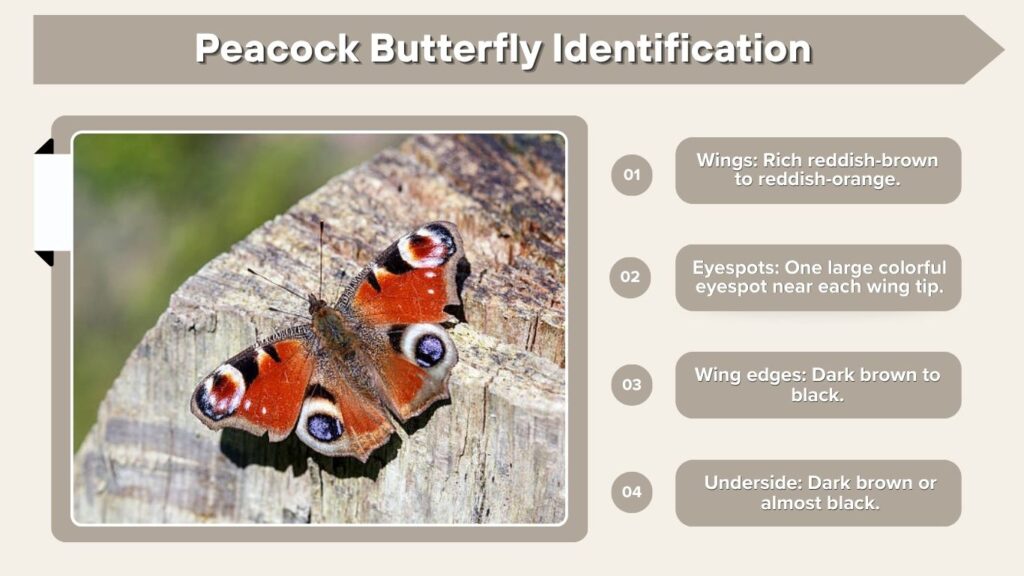
Adult peacock butterflies are relatively easy to recognize when their wings are open. Their combination of reddish coloration, dark borders, and enormous eyespots is distinctive. When resting with their wings closed, however, they appear dramatically different because the undersides are dark and resemble dead leaves or bark.
Identification Features
- Wings: Rich reddish-brown to reddish-orange
- Eyespots: One large colorful eyespot near each wing tip
- Wing edges: Dark brown to black
- Underside: Dark brown or almost black
- Body: Dark and covered with fine hairs
- Wingspan: Commonly around 6–7 cm
- Resting appearance: Leaf-like when the wings are closed
The eyespots contain combinations of blue, black, yellow, and cream. Their striking appearance becomes especially noticeable when the butterfly suddenly opens its wings.
Male vs Female Peacock Butterfly
Male and female peacock butterflies look extremely similar. Unlike some butterfly species, they do not have strongly contrasting male and female wing patterns.
Females may sometimes appear slightly larger, particularly because they need additional body capacity for egg production. Reliable sex identification usually requires closer examination than ordinary field observation allows.
Is the Peacock Butterfly Rare?
The peacock butterfly is not generally considered rare across much of its European range. It can be locally abundant wherever suitable nettles, flowering plants, and overwintering locations are available.
Its numbers can vary considerably between seasons. Weather, habitat conditions, food availability, pesticide use, and local land management may all influence how many adults are seen during a particular year.
Habitat and Range of Peacock Butterflies
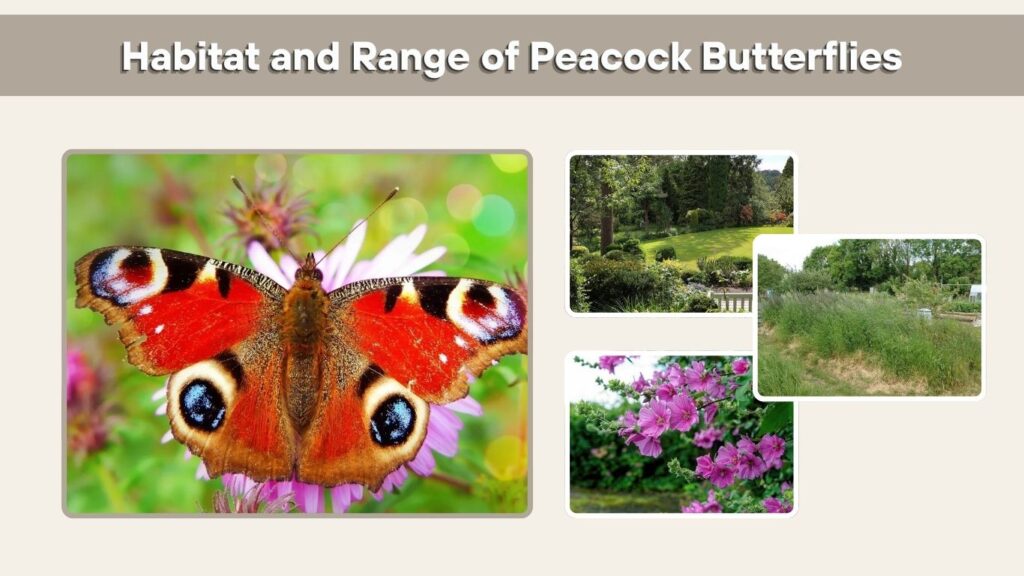
Peacock butterflies occupy a wide range of environments because their caterpillar food plants and adult nectar sources are common. They are especially associated with sunny areas near vegetation rather than completely open, exposed landscapes. Gardens can also provide valuable habitat when flowering plants and nettles are allowed to grow nearby.
Where Do Peacock Butterflies Live?
Their range includes much of Europe and extends eastward through parts of temperate Asia. They may be seen in countries ranging from the British Isles across continental Europe and farther into Asia.
Typical habitats include woodland clearings, hedgerows, meadows, field margins, parks, riverbanks, gardens, and countryside paths. Adults frequently move between habitats while searching for nectar, mates, or suitable egg-laying locations.
Preferred Habitat Features
Peacock butterflies benefit from habitats containing:
- Sunny sheltered areas
- Patches of stinging nettles
- Nectar-rich flowers
- Woodland edges
- Hedgerows and field margins
- Protected places for overwintering
Because adult butterflies can travel beyond their breeding sites, seeing one in a garden does not necessarily mean caterpillars are developing nearby.
Peacock Butterflies in Gardens
Gardens can attract peacock butterflies from spring through autumn. Adults commonly visit plants with accessible nectar and may spend considerable time feeding when flowers are abundant.
Butterfly-friendly gardens are most useful when they provide nectar across several seasons. Leaving some nettles in a quiet sunny location may also provide potential breeding habitat for females searching for caterpillar host plants.
What Do Peacock Butterflies Eat?
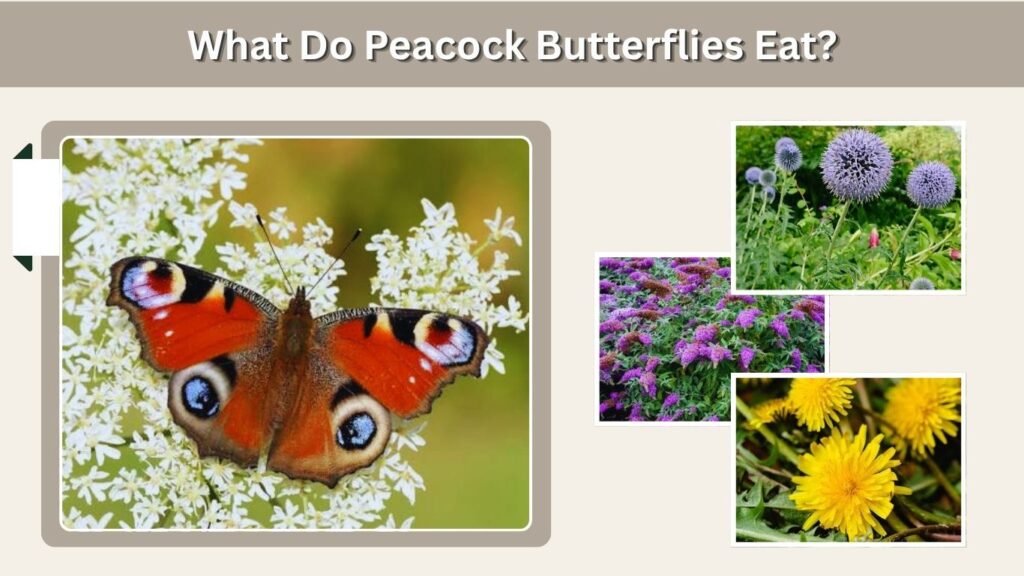
Diet changes significantly between the larval and adult stages. Caterpillars need nutrient-rich leaves for rapid growth, while adults depend mainly on sugary liquids for energy. This division allows young and adult butterflies to use different food resources and reduces competition between the two life stages.
Adult Peacock Butterfly Diet
Adult peacock butterflies drink nectar from numerous flowers. Depending on season and location, they may feed from:
- Buddleia
- Thistles
- Dandelions
- Knapweed
- Marjoram
- Ivy flowers
- Other nectar-rich garden plants
Late-flowering plants can be particularly important before adults enter winter dormancy because butterflies need energy reserves to survive colder months.
Peacock Butterfly Caterpillar Host Plants
Stinging nettle is the major host plant for peacock butterfly caterpillars. Females deliberately search for healthy nettle patches before laying eggs.
Young caterpillars initially remain together and feed communally. As they grow larger, they become more independent and may spread through the nettle patch.
Their dependence on nettles demonstrates why plants sometimes considered weeds can have major ecological value.
Peacock Butterfly Caterpillar and Life Cycle
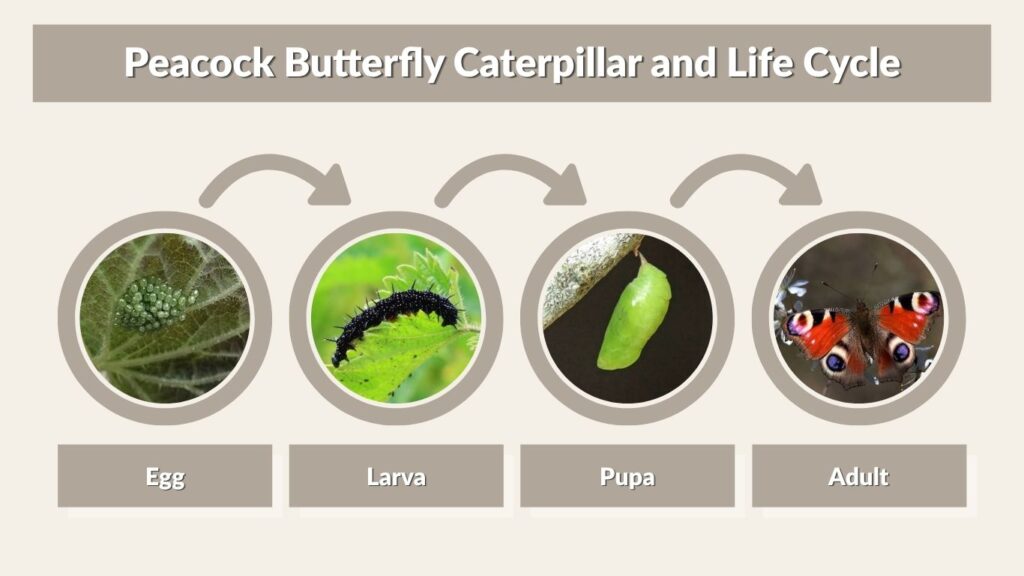
Like other butterflies, the peacock undergoes complete metamorphosis involving egg, larva, pupa, and adult stages. Timing varies with climate and local conditions. The species has an unusual advantage compared with many butterflies because adults can survive the winter, allowing the same individuals to appear again when spring temperatures rise.
Four Life Cycle Stages
- Egg: Females deposit groups of small eggs on suitable host plants, particularly nettles.
- Caterpillar: Dark caterpillars hatch and feed heavily as they pass through several growth stages.
- Chrysalis: Mature caterpillars attach themselves to vegetation before transforming into pupae.
- Adult: Fully developed butterflies emerge, expand their wings, and begin feeding and reproducing.
Warm weather generally speeds development, while cooler conditions can slow the process.
What Does a Peacock Butterfly Caterpillar Look Like?
Peacock butterfly caterpillars are mostly black and covered with noticeable branching spines. Numerous tiny white spots occur across their bodies.
Despite their intimidating appearance, their spines are primarily defensive structures. They are very different from the dangerous stinging hairs associated with certain other caterpillar species.
Young larvae often produce silk and remain together in groups, making colonies easy to notice on nettle patches.
Overwintering
One fascinating feature of the species is adult overwintering. Rather than dying before winter, many adults enter a dormant state in sheltered locations.
They may hide inside hollow trees, sheds, barns, caves, wood piles, or other protected spaces. When temperatures rise in spring, surviving butterflies become active again, feed, mate, and begin another generation.
How Peacock Butterflies Defend Themselves
The peacock butterfly’s wing pattern is more than decoration. Its appearance plays an important role in predator avoidance. When the butterfly is resting, its dark closed wings provide camouflage. When disturbed, it can suddenly expose the colorful upper surfaces, creating a dramatic visual change that may surprise an approaching predator.
Eyespot Defense
The four large eyespots may make the butterfly appear larger or resemble the eyes of another animal. A predator approaching what seemed to be an inconspicuous resting insect can suddenly encounter four conspicuous circular markings.
This startle response may provide the butterfly with enough time to escape. Research on peacock butterfly predator defenses has supported the idea that the eyespots can reduce attacks from some predators.
Camouflage Defense
With its wings closed, a peacock butterfly appears brown-black and relatively featureless. Against tree bark, dead vegetation, or dark sheltered surfaces, this coloration makes it much harder to detect.
The combination of camouflage while resting and startling coloration when threatened gives the species two different defensive strategies.
Interesting Peacock Butterfly Facts
Peacock butterflies have several behavioral and biological characteristics that make them especially interesting to butterfly enthusiasts. Their seasonal activity, adult overwintering behavior, caterpillar colonies, and spectacular eyespots have also made them useful subjects for studies of insect survival and predator-prey interactions.
Quick Facts
- Peacock butterflies can overwinter as adults.
- Their caterpillars mainly eat stinging nettles.
- Newly hatched caterpillars often live in groups.
- Adults possess four prominent eyespots.
- The wing underside provides excellent camouflage.
- Inachis io is an older scientific name still commonly encountered.
- Gardens can provide both nectar and breeding habitat.
- Adults reappear on warm spring days after overwintering.
FAQs
What is the scientific name of the peacock butterfly?
The accepted scientific name is Aglais io. The species was previously widely classified as Inachis io, so both names may appear in older references.
What do peacock butterfly caterpillars eat?
They primarily feed on stinging nettles. Females usually select healthy nettle patches as locations for laying their eggs.
Where do peacock butterflies live?
They occur across much of Europe and parts of temperate Asia. Common habitats include woodland edges, meadows, hedgerows, gardens, riverbanks, and field margins.
How long does a peacock butterfly live?
Adults can survive for many months because they overwinter rather than dying at the end of summer. Exact longevity varies depending on weather, predators, food availability, and overwintering success.
Is a white peacock butterfly the same as a peacock butterfly?
No. The white peacock is a separate butterfly species found in the Americas. The European peacock, Aglais io, has reddish wings with four large colorful eyespots.