
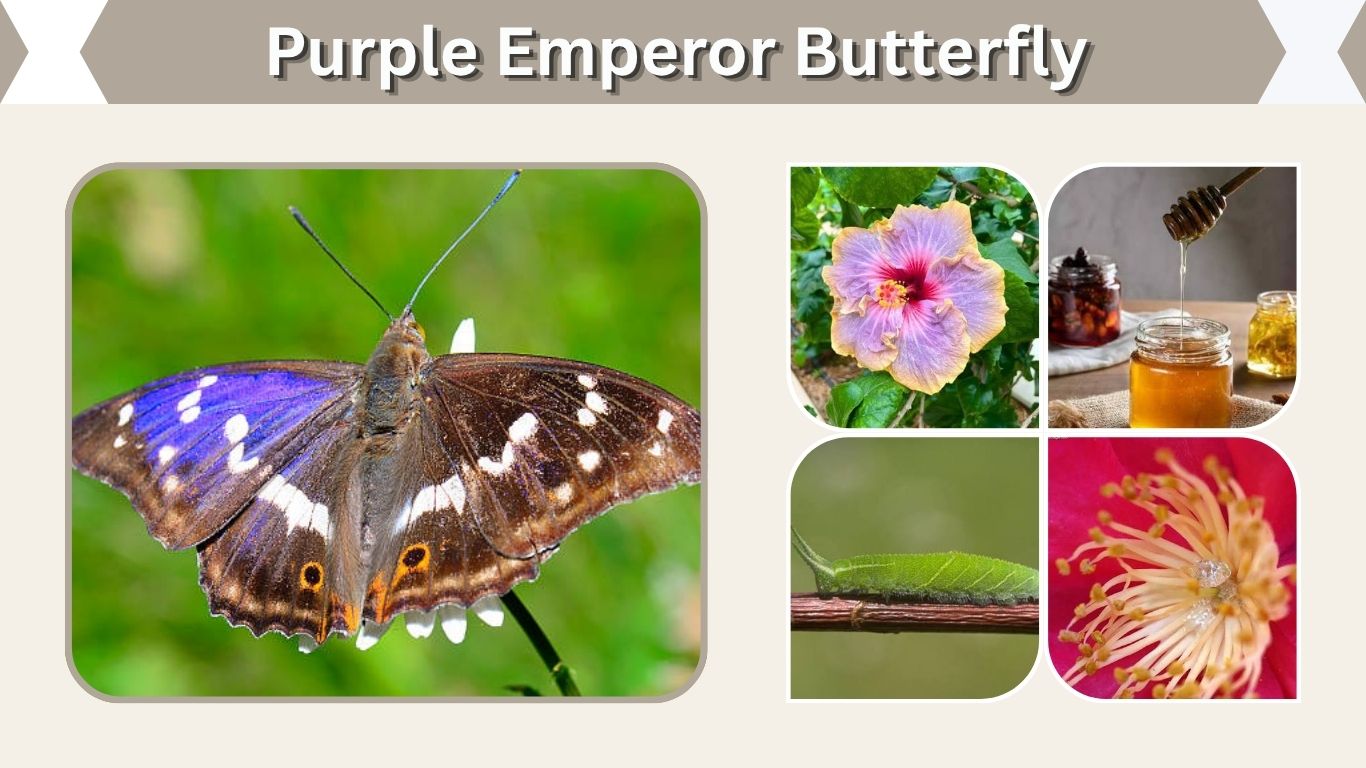
The purple emperor butterfly is a large woodland butterfly best known for the violet sheen on the male’s wings. Its scientific name is Apatura iris, and its behaviour is just as striking as its appearance. Adults spend much of their time around treetops, while green, horned caterpillars develop on willows below. This guide explains how to identify males and females, where the species lives, what it eats, and how its life cycle unfolds. It also distinguishes the purple emperor from the great and lesser purple emperors.
Purple Emperor Butterfly Identification
A purple emperor may look almost black until sunlight catches its wings at the right angle. White markings provide useful identification clues even when the purple disappears. Females have a different appearance, so an identification guide should include both sexes. Look at size, wing pattern, and habitat together rather than assuming every large, dark woodland butterfly belongs to this species.
Features to Look For
- Family: Nymphalidae, the brush-footed butterflies.
- Wingspan: Approximately 7–9 centimetres, with females generally larger than males.
- Male colouring: Dark upperwings with an iridescent blue-purple sheen.
- Female colouring: Brown upperwings without the male’s conspicuous purple reflection.
- White markings: Bold bands and spots across the wings.
- Underside: Brownish patterned wings, including an orange-ringed eyespot on each forewing.
Why the Wings Look Purple
The male’s purple sheen comes from microscopic structures in its wing scales interacting with light. This structural colour changes with the viewing angle.
Consequently, a male can look purple in one photograph and dark brown in another. Both images may accurately show the same butterfly. A side view of closed wings also hides the upperwing sheen.
Where Does the Purple Emperor Butterfly Live?
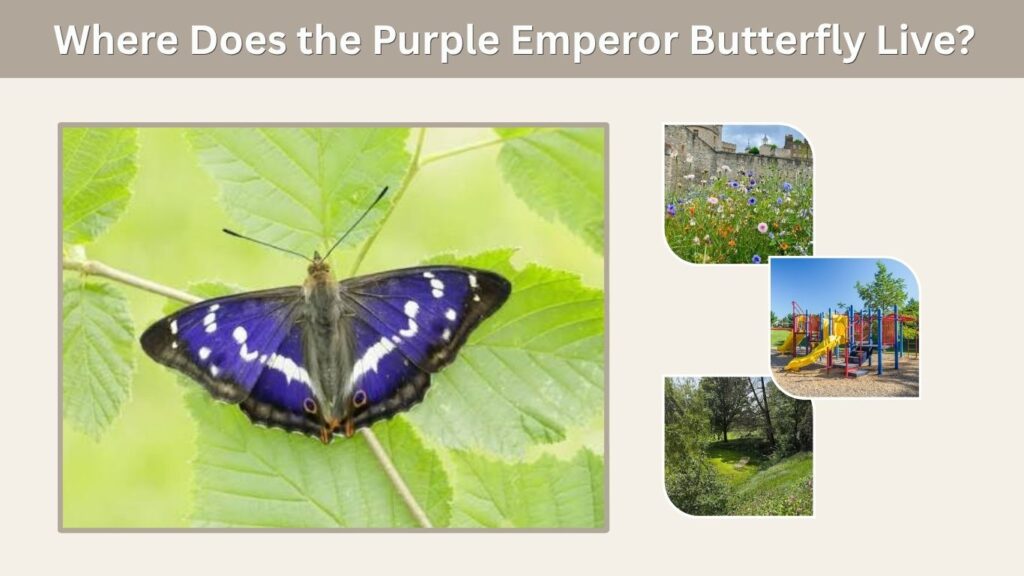
Purple emperors inhabit wooded landscapes across parts of Europe and temperate Asia. In Britain, their main strongholds lie in southern and central England. Although associated with tall trees, they also need suitable willow growth for breeding. Mature trees, scrub, sheltered edges, and sunny openings together provide feeding sites, display areas, and host plants needed at different stages of their development.
Woodland and Willow Habitat
Adults often gather around oak canopies, but the caterpillars feed on willows. Goat willow and grey willow are particularly important in Britain.
Sallow-rich scrub can support substantial populations. Knepp in West Sussex illustrates how allowing willow scrub to develop can create valuable breeding habitat. The relationship between tall display trees and larval food plants explains why woodland structure matters.
When and Where to Watch
- Choose summer: British adults generally fly between June and August, often with good opportunities in July.
- Scan above you: Watch treetops and sunny canopy gaps with binoculars.
- Check the ground: Males sometimes descend to damp tracks during the morning.
- Use local records: Recent sightings help identify active sites and seasonal timing.
Weather affects emergence and activity, so calendar dates provide guidance rather than a guarantee.
What Does the Purple Emperor Butterfly Eat?
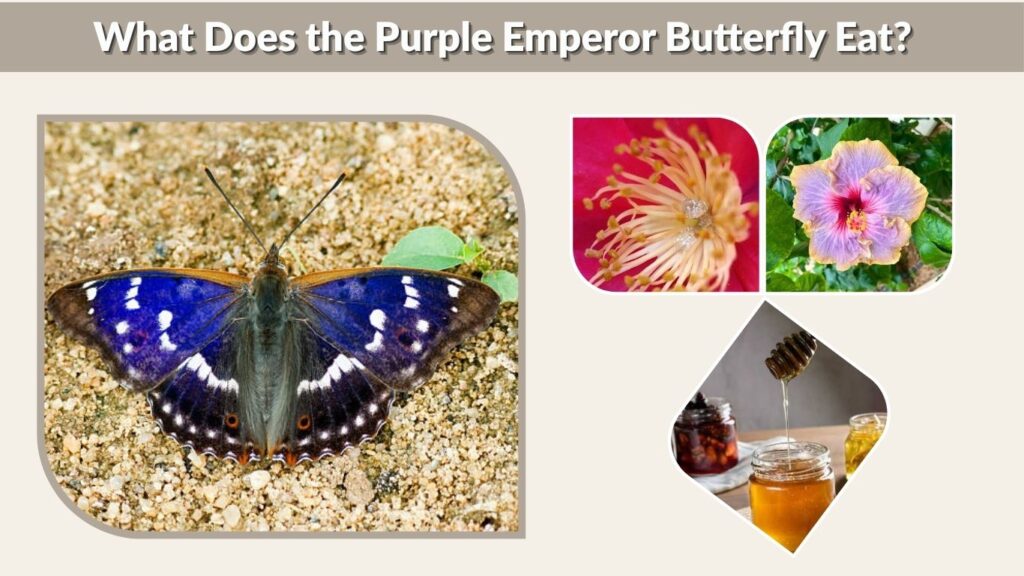
The purple emperor’s diet often surprises people expecting a butterfly to visit flowers. Adults obtain food from tree sap and aphid honeydew, and males may investigate damp ground or animal remains. Caterpillars have a completely different diet based on leaves. Separating adult feeding from larval feeding makes it easier to understand why the species needs several resources within its habitat.
Adult Food Sources
- Tree sap: Adults drink liquids from damaged or leaking trees.
- Aphid honeydew: Sugary droplets provide another food source around the canopy.
- Damp ground: Males can obtain dissolved salts from moist surfaces.
- Dung and carrion: These provide additional substances that attract feeding butterflies.
The butterfly uses its proboscis to take up liquids. Seeing one on a dead animal does not mean it is tearing off pieces of flesh.
Caterpillar Food Plants
Purple emperor caterpillars eat willow leaves, especially goat willow, Salix caprea, and grey willow, Salix cinerea. They do not eat the oak leaves beneath which adults may gather.
Protecting host plants therefore matters throughout the year, including when caterpillars are small or inactive.
Purple Emperor Butterfly Caterpillar and Life Cycle
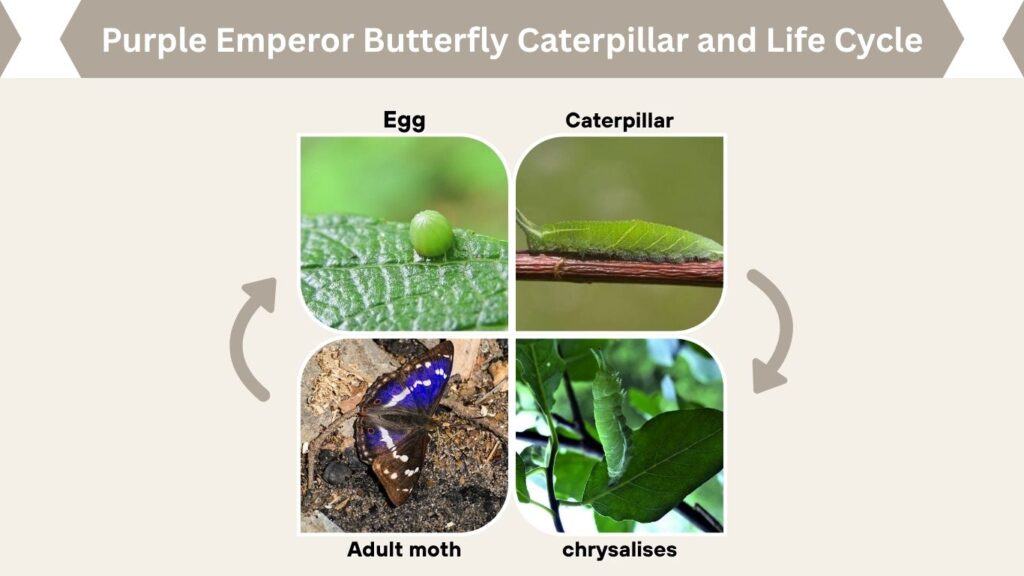
The life cycle includes eggs, caterpillars, chrysalises, and adults, with one generation annually in Britain. Much of the insect’s life passes before its colourful adult appearance. Caterpillars survive winter on their host trees and continue developing the following spring. This seasonal pattern means winter vegetation management can affect butterflies that will not emerge until the next summer’s flight season begins.
Eggs and Caterpillars
Females lay eggs individually on suitable willow leaves. The growing caterpillars are green, with pale diagonal markings and two prominent horn-like projections on the head.
Their shape and colouring help them blend into foliage. They commonly rest along a leaf’s central vein and feed mainly at night, making casual daytime searches surprisingly difficult.
Surviving Winter
As autumn approaches, caterpillars stop feeding and adopt brownish winter colouring. They shelter on willow twigs, where their appearance helps them blend with the background.
They remain in the caterpillar stage through winter. Feeding resumes when conditions improve and fresh leaves become available in spring.
Chrysalis and Adult Emergence
After completing its growth, the caterpillar forms a pale green chrysalis suspended from vegetation. Its shape resembles a leaf, helping conceal this immobile stage.
The adult emerges during summer and expands its wings before flying. The new generation then feeds, mates, and lays the eggs that begin another annual cycle.
Behaviour, Adaptations, and Conservation
The purple emperor combines conspicuous adult displays with well-hidden immature stages. Males patrol high perches, while caterpillars rely heavily on camouflage. These different behaviours help explain why a woodland can hold butterflies that visitors rarely notice. Conservation needs to account for the entire life cycle, including the scrub and small trees that may otherwise be removed during routine habitat management.
Why Males Chase Other Butterflies
Males gather around favoured treetops, sometimes called master trees, and defend display territories. They chase rival males and may pursue other flying animals that pass nearby.
These aerial encounters relate to competition around mating sites. Their forceful flight contrasts with the quiet behaviour of caterpillars resting unnoticed on willow leaves.
Protecting Breeding Habitat
Retaining suitable sallows is one of the most practical ways to support breeding populations. Clearing every patch of scrub can remove essential food plants even when mature woodland remains.
Habitat management should preserve a mixture of trees, willow growth, and sheltered openings. Visitors can help by observing without collecting and submitting photographs and locations to local butterfly recording projects.
Great Purple Emperor and Lesser Purple Emperor
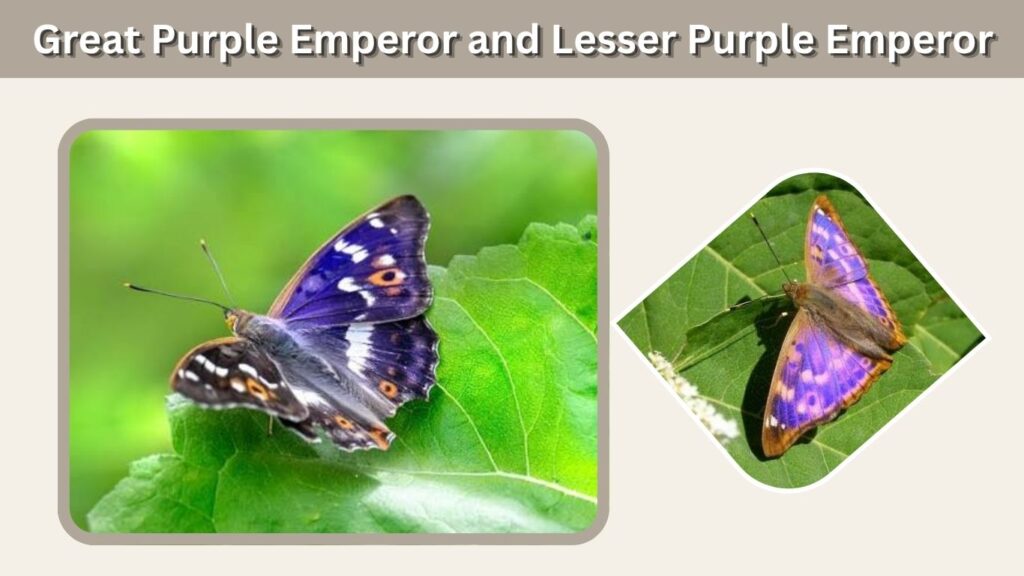
Several butterflies share the emperor name, but they are not interchangeable. The purple emperor discussed here is Apatura iris. The great purple emperor belongs to another genus, while the lesser purple emperor is a closer relative. Checking scientific names is especially useful when comparing photographs from different countries or reading advice about caterpillar food plants, distribution, and seasonal behaviour online.
Great Purple Emperor Butterfly
The great purple emperor is Sasakia charonda, an East Asian species particularly associated with Japan. Males display striking blue-purple areas alongside contrasting pale and coloured markings.
Its caterpillars feed on hackberries, including Celtis sinensis. Advice about raising Apatura iris on willow should therefore not be applied automatically to this species. Similar common names do not mean identical breeding requirements.
Lesser Purple Emperor Butterfly
The lesser purple emperor is Apatura ilia. Males also show iridescent colouring, but its wing pattern differs from Apatura iris.
For identification, compare complete upperwing and underside patterns rather than relying on apparent size or the presence of purple alone.
FAQs
People often encounter purple emperors through photographs before seeing one outdoors. That can lead to confusion about colour, rarity, lifespan, and similarly named plants or insects. These answers address those distinctions while keeping the focus on the living butterfly. Unless another scientific name is given, the information below refers specifically to Apatura iris rather than every butterfly called an emperor.
Is the Purple Emperor Butterfly Rare?
It is localised and often difficult to observe, especially in Britain. Some suitable sites support strong populations, so its reputation for rarity partly reflects its elusive canopy behaviour.
How Long Does a Purple Emperor Butterfly Live?
The adult stage is brief, generally lasting a few weeks rather than months. The complete life cycle spans roughly a year in Britain, including the caterpillar’s winter dormancy.
Is a Purple Emperor the Same as a Peacock Butterfly?
No. The European peacock is Aglais io, recognised by reddish wings and large eyespots. The purple emperor has different wing markings, behaviour, and caterpillar food plants.
Will a Purple Emperor Butterfly Bush Attract It?
A plant sold as “Purple Emperor” butterfly bush does not guarantee visits from this species. Suitable willows and the surrounding habitat matter more than a matching plant name.
What Does a Purple Emperor Butterfly Symbolise?
In personal artwork or tattoos, it might represent transformation, distinction, or royalty. Such meanings are interpretations chosen by people; the species has no single universal symbolic meaning.