
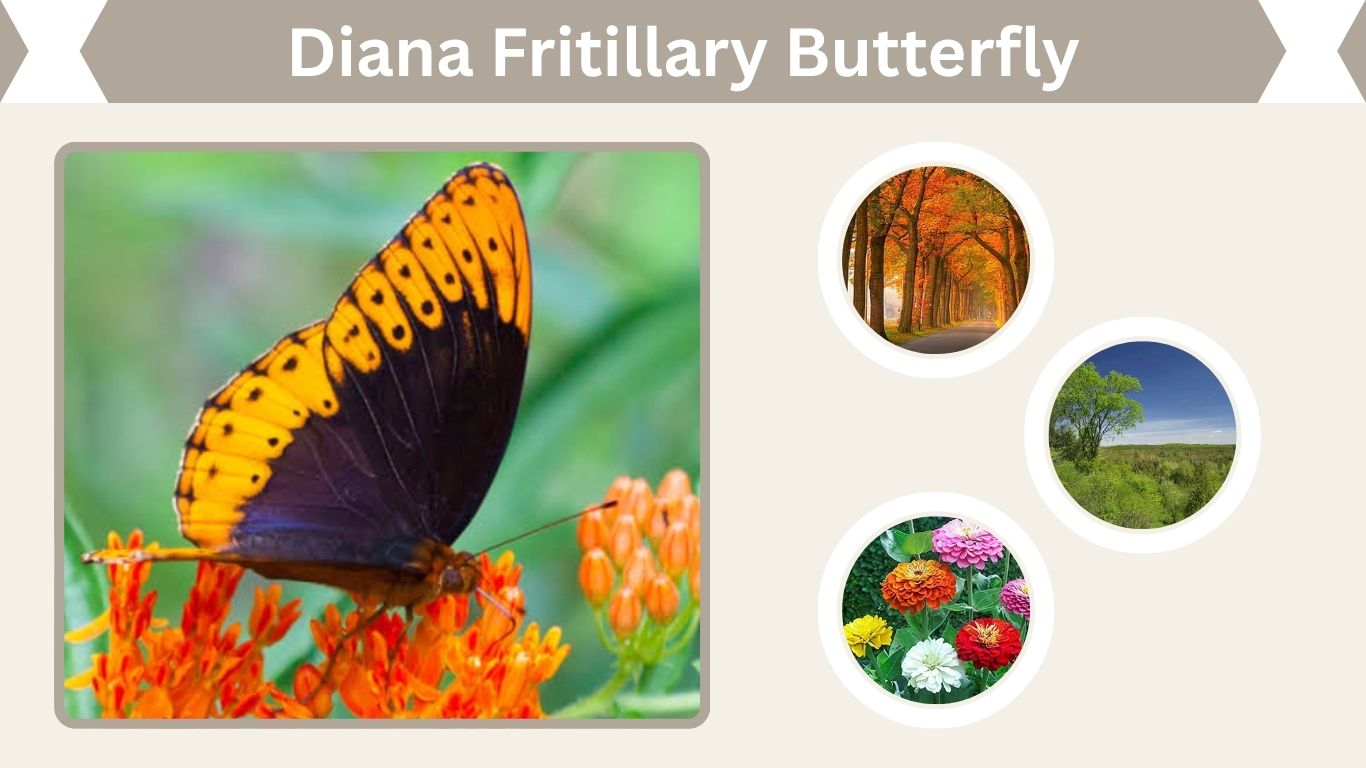
The Diana fritillary butterfly (Speyeria diana) is a large, striking North American butterfly famous for the dramatic difference between males and females. Males display rich orange and dark brown wings, while females are mostly black with brilliant blue markings. Found primarily in the southern Appalachian region and parts of the Ozarks, this forest-associated fritillary depends on violets during its caterpillar stage. It is also especially important in Arkansas, where it was officially designated the state butterfly in 2007.
Diana Fritillary Butterfly Identification
The Diana fritillary belongs to the brush-footed butterfly family Nymphalidae. It is among the largest fritillaries in eastern North America, with a wingspan of roughly 3.4 to 4.4 inches. One of its most unusual characteristics is extreme sexual dimorphism: adult males and females look so different that beginners may assume they are separate species.
Male Diana Fritillary
Male Diana fritillaries have a much more traditional fritillary appearance.
- Basal portions of the wings are dark brown to nearly black
- Outer portions are bright orange
- Wings are broad and rounded
- Males usually appear earlier in the flight season
- They often patrol woodland openings while searching for females
The strong orange-and-black pattern makes males relatively easy to recognize once their range and large size are considered.
Female Diana Fritillary
Females have an entirely different appearance and are typically larger.
- Wings are predominantly dark brown or black
- Forewings have pale blue or whitish spots
- Hindwings show striking iridescent blue markings
- Orange coloration is largely absent
- Females resemble several dark swallowtail butterflies
Arkansas educational materials specifically highlight the female’s bright blue markings and larger size compared with the male.
Diana Fritillary Range and Habitat
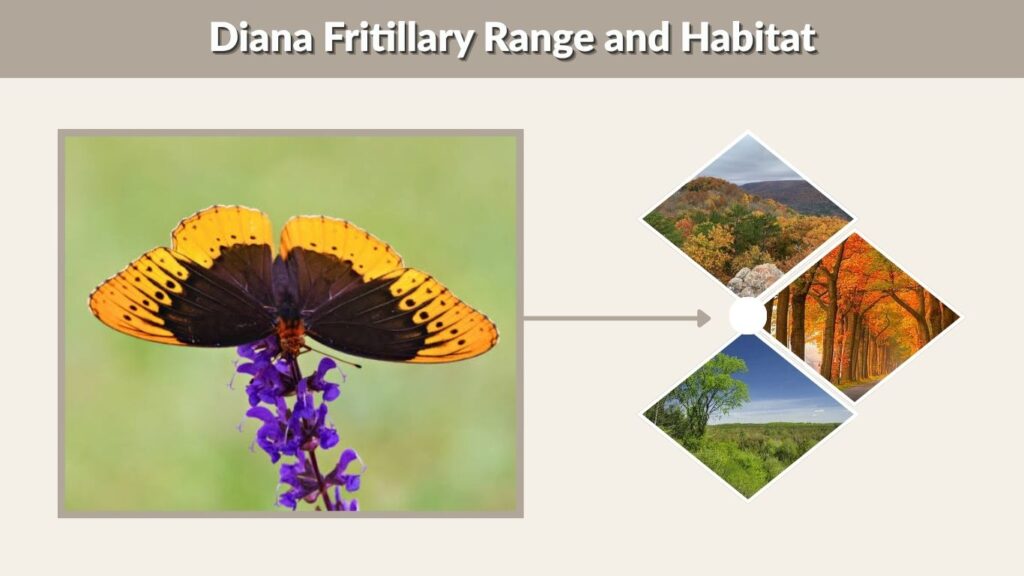
The Diana fritillary has a relatively restricted distribution compared with many widespread North American butterflies. Its main populations occur in forested portions of the southern Appalachian Mountains and the Ozark region. It favors moist, rich woodland landscapes rather than open grasslands, although adults frequently visit sunny openings and roadsides to obtain nectar.
Where Do Diana Fritillaries Live?
Its established range includes:
- Arkansas and the Ozark region
- Parts of eastern Oklahoma and southern Missouri
- West Virginia and Virginia
- Tennessee and Kentucky
- North Carolina
- Northern Georgia
- Northern Alabama
- Other localized areas within the southern Appalachian region
Suitable habitat includes moist mountain forests, wooded valleys, forest openings, roadsides, stream corridors, and edges where both violets and nectar-producing flowers are available.
Are Diana Fritillary Butterflies in Maryland?
Maryland is outside the species’ main established range described by major butterfly databases. Diana fritillaries are much more characteristic of the Appalachian region from Virginia and West Virginia southward.
An unusual butterfly seen in Maryland should therefore be identified carefully rather than assumed to be a Diana fritillary. Dark female butterflies can easily be confused with red-spotted purples and several swallowtails.
Why Is the Diana Fritillary Arkansas’s State Butterfly?
The Diana fritillary has a particularly strong connection with Arkansas, especially the state’s mountainous landscapes. Arkansas officially designated the species as its state butterfly through Act 156 of 2007. The butterfly occurs in suitable forest habitat within the state, including mountainous areas around Mount Magazine and elsewhere in the Interior Highlands.
Diana Fritillary in Arkansas
Several features make the species closely associated with Arkansas:
- It has established populations in the state
- The Ozarks provide suitable forest habitat
- Mount Magazine is known for Diana fritillary observations
- Wild violets provide essential caterpillar food
- Woodland wildflowers provide nectar for adults
Arkansas represents an important western portion of the butterfly’s distribution.
Diana Fritillary Camouflage and Mimicry
The female Diana fritillary’s dark blue-and-black coloration is more than an attractive pattern. It closely resembles the pipevine swallowtail, a butterfly that gains chemical protection from compounds acquired by its caterpillars while feeding on pipevine. Predators that learn to avoid pipevine swallowtails may therefore also hesitate to attack butterflies with a similar appearance.
Does the Female Diana Fritillary Mimic Another Butterfly?
Yes. Females are widely regarded as mimics of the pipevine swallowtail. Their black wings and bright blue hindwing coloration contribute to this resemblance.
This defensive appearance places female Diana fritillaries among a broader group of eastern butterflies with similar dark coloration, including female black swallowtails, female dark-form eastern tiger swallowtails, spicebush swallowtails, and red-spotted purples.
Interestingly, males do not share this blue-black appearance. Their orange coloration illustrates how differently natural selection can shape males and females of the same species.
Diana Fritillary vs. Red-Spotted Purple
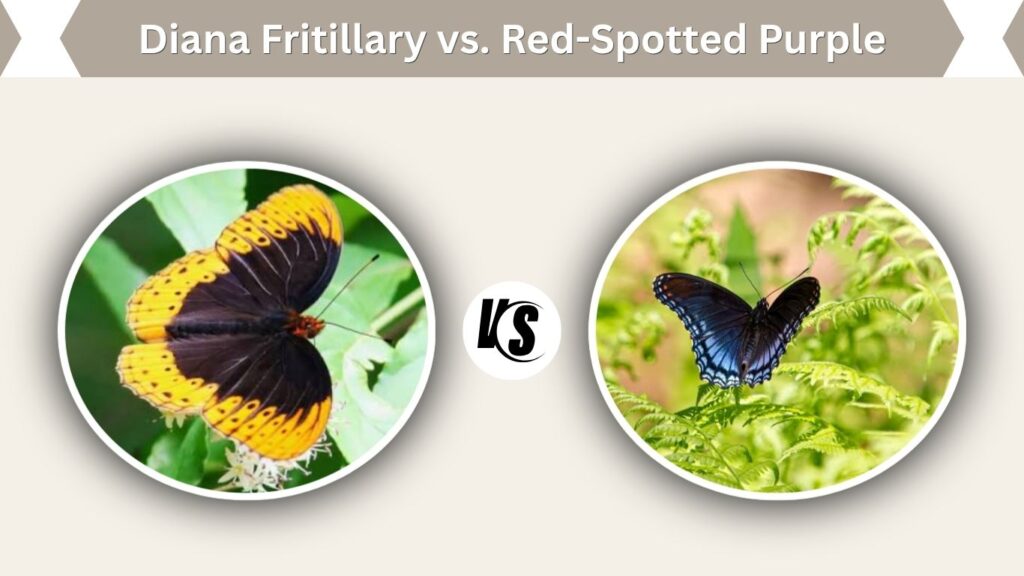
Female Diana fritillaries and red-spotted purples can appear similar because both have dark wings with blue coloration. However, careful observation usually separates them. Their overall shapes, markings, sizes, and underside patterns differ, and they belong to different butterfly groups.
Key Differences
- Diana fritillary: Large butterfly, often approaching 4 inches or more across
- Red-spotted purple: Generally smaller and more streamlined
- Female Diana: Broad black wings with pale and vivid blue markings
- Red-spotted purple: Strong blue iridescence with distinctive reddish-orange markings underneath
- Diana: Associated strongly with violets and forested mountain habitats
- Red-spotted purple: Uses several woody host plants and occurs across a much broader eastern range
Both can participate visually in the dark pipevine-swallowtail mimicry complex, so looking at several identification features is better than relying on blue coloration alone.
What Do Diana Fritillary Butterflies Eat?
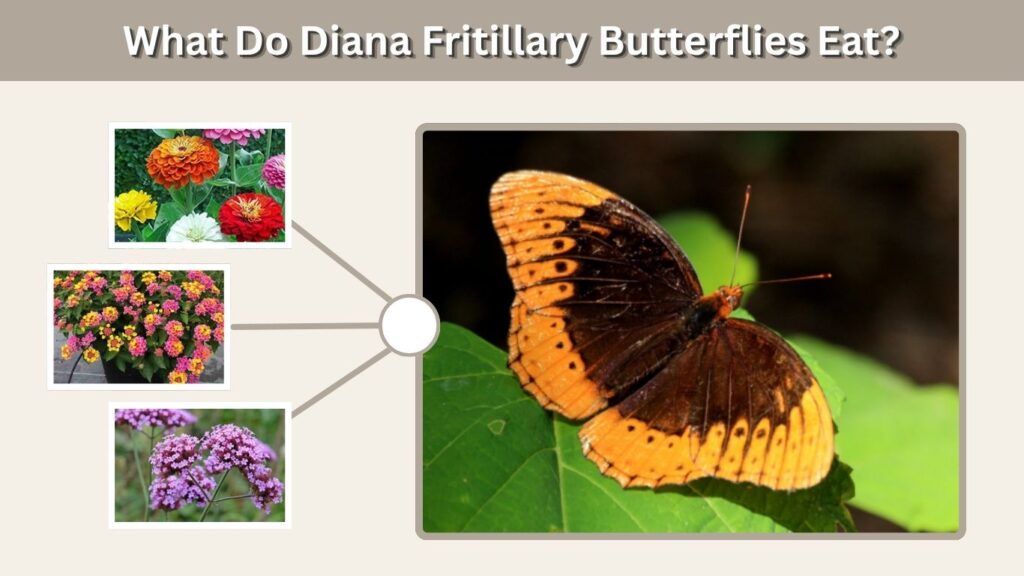
Food requirements change dramatically between the caterpillar and adult stages. Diana fritillary caterpillars specialize on violets, while adults visit many flowering plants. Suitable forests therefore need both violet host plants near the ground and abundant nectar sources in openings, roadsides, and woodland edges.
Caterpillar and Adult Food
Diana fritillaries use:
- Violets (Viola species): Primary caterpillar host plants
- Milkweed flowers: Nectar for adults
- Ironweed: Important nectar source
- Red clover: Visited by adults
- Butterfly bush: Used where available
- Other nectar-rich summer wildflowers
Adults have also been reported taking nutrients from dung, a behavior found in various butterflies.
Diana Fritillary Life Cycle
The Diana fritillary has an unusual annual life cycle closely synchronized with violets. Unlike butterflies that produce several generations each summer, it generally has one flight period each year. Eggs are placed near violets rather than directly depending on fresh leaves being available immediately.
From Caterpillar to Butterfly
Females descend close to the ground and deposit individual eggs on dead leaves, twigs, or other material near violet plants. After hatching, the tiny caterpillars do something unusual: they overwinter without initially feeding.
When spring arrives and violets begin producing fresh growth, the caterpillars become active and feed on violet leaves and flowers. They continue growing through several larval stages before forming a chrysalis.
Adults emerge during the warmer months. Males patrol through deep woods and woodland openings searching for females. Depending on location, adults may be encountered from early summer into late summer or early fall. Butterflies and Moths of North America describes a single flight extending approximately from mid-June into early September across the species’ range.
FAQs
What is the scientific name of the Diana fritillary?
The scientific name is Speyeria diana. It belongs to the butterfly family Nymphalidae and the fritillary group.
Is the Diana fritillary rare?
It can be uncommon or highly localized across much of its range. Some former populations have disappeared, and suitable forest habitat with violets and nectar plants remains important for maintaining populations.
Why do male and female Diana fritillaries look different?
The species shows extreme sexual dimorphism. Males are orange and dark brown, whereas females are black and blue. The female’s coloration is associated with mimicry of the chemically protected pipevine swallowtail.
What do Diana fritillary caterpillars eat?
The caterpillars feed on violets (Viola species). Newly hatched larvae overwinter without feeding and begin eating violets when they become active the following spring.
Is the Diana fritillary Arkansas’s state butterfly?
Yes. Arkansas officially designated the Diana fritillary as its state butterfly in 2007 through Act 156.