
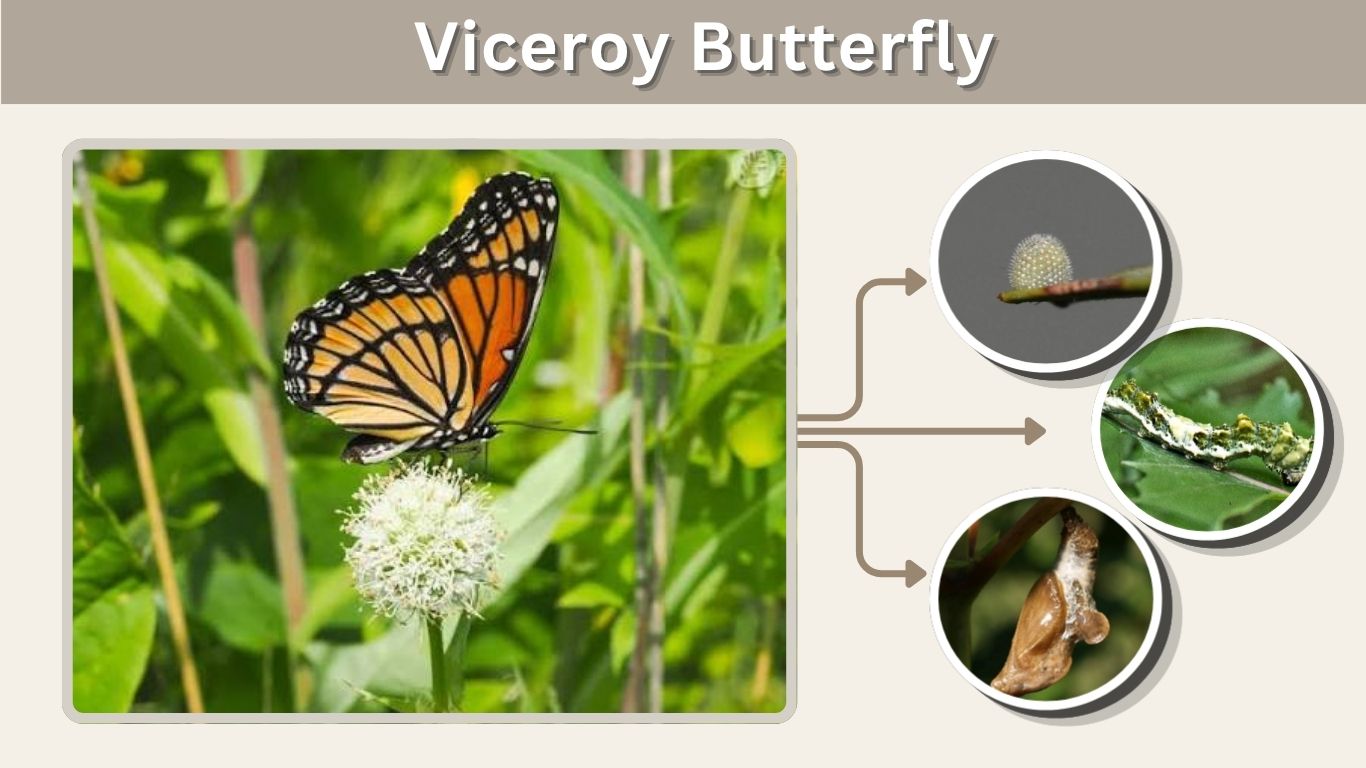
The viceroy butterfly (Limenitis archippus) is a striking orange-and-black butterfly found across much of North America. It is famous for looking remarkably similar to the monarch butterfly, although several physical features make the two easy to distinguish with practice. Viceroys also have an interesting life cycle, unusual caterpillars, distinctive host plants, and their own chemical defenses against predators. This guide covers viceroy butterfly identification, monarch comparisons, caterpillars, diet, habitat, mimicry, life cycle, size, and other fascinating facts.
What Is a Viceroy Butterfly?
The viceroy butterfly belongs to the family Nymphalidae, which includes many familiar brush-footed butterflies. Adults have orange wings with black veins and white spots, giving them a strong resemblance to monarch butterflies. Viceroys usually live near wetlands, streams, lakes, and other habitats where willow and related host plants are common.
Viceroy Butterfly Identification
A viceroy butterfly can be recognized by several important characteristics:
- Scientific name: Limenitis archippus
- Family: Nymphalidae
- Orange wings with black veins
- Black borders containing white spots
- Distinct black line across each hindwing
- Medium-sized body
- Rapid, gliding flight
- Strong resemblance to monarch butterflies
The dark horizontal line crossing the hindwing is usually the easiest feature for distinguishing a viceroy from a monarch.
Viceroy Butterfly Size
Viceroys are medium-sized butterflies, generally smaller than monarchs.
Their wingspan is usually around 2.5 to 3.3 inches, although size can vary depending on the individual and environmental conditions during development.
Their relatively compact size can sometimes help with identification, but wing markings are more reliable because exceptionally small monarchs or large viceroys may overlap in appearance.
What Color Is a Viceroy Butterfly?
Most viceroys are bright orange with black veins and white-spotted borders.
However, coloration can vary geographically. In some parts of the southern United States, viceroys may appear darker or more reddish-brown.
Yellowish forms can also occur in certain populations, demonstrating that the species does not always display the classic monarch-like orange appearance.
Viceroy Butterfly vs Monarch Butterfly
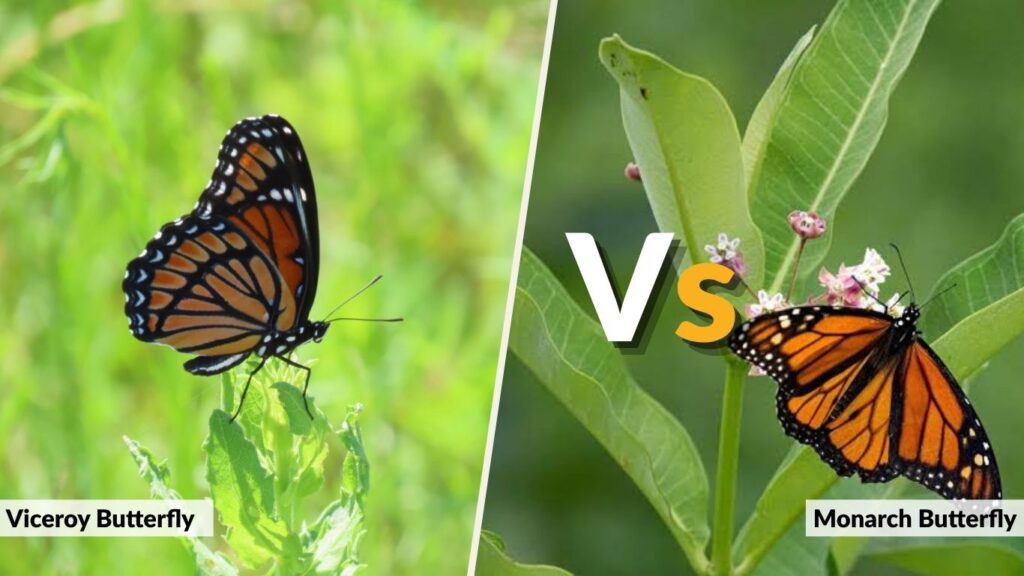
The resemblance between the viceroy butterfly and monarch butterfly is one of the most famous examples of mimicry discussed in biology. At first glance, their orange wings, black veins, and white-spotted borders appear almost identical. A closer look reveals several dependable differences in markings, size, behavior, and life history.
Viceroy vs Monarch Identification
Key differences include:
- Viceroys have a black horizontal line across the hindwing.
- Monarchs lack this dark hindwing line.
- Viceroys are usually smaller.
- Monarchs generally have longer, narrower wings.
- Viceroys often have a quicker, more irregular flight.
- Monarchs commonly glide with slower wingbeats.
- Their caterpillars look completely different.
- They use different host plants.
The hindwing line is usually the fastest and easiest way to identify a viceroy.
Monarch and Viceroy Caterpillar Differences
Monarch caterpillars are brightly striped with black, white, and yellow bands and have long flexible filaments at the front and rear of the body.
Viceroy caterpillars look dramatically different. They are brown, cream, greenish, and mottled, with an irregular shape that helps them resemble bird droppings.
Their camouflage strategy makes the two caterpillar species easy to distinguish even though the adults look similar.
Viceroy Butterfly Mimicry
For many years, the viceroy was commonly described as a harmless species that copied the poisonous or distasteful monarch.
Research has shown the relationship is more complicated. Viceroys themselves can be unpalatable to predators, partly because of compounds obtained from their host plants.
As a result, the resemblance between monarchs and viceroys is often considered a form of Müllerian mimicry, where multiple defended species share similar warning coloration.
Why Does the Viceroy Resemble a Monarch?
Predators such as birds can learn that orange-and-black butterflies are unpleasant to eat.
When two defended species share similar warning patterns, predators may learn to avoid both more quickly. This can provide protection for both monarchs and viceroys.
Their resemblance therefore serves as an important survival adaptation rather than simply being a coincidence.
Viceroy Butterfly Caterpillar
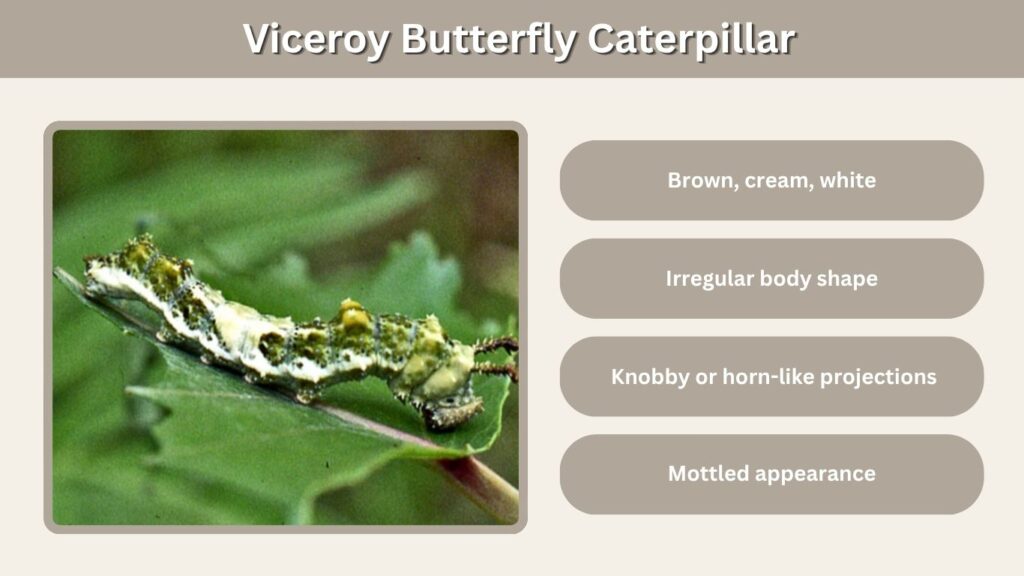
The viceroy butterfly caterpillar looks nothing like the beautiful orange adult. Instead, it uses camouflage to avoid predators. Its irregular brown, white, cream, and greenish pattern can resemble bird droppings or damaged plant material, helping it blend into leaves and branches.
What Does a Viceroy Caterpillar Look Like?
Common identification features include:
- Brown, cream, white, and greenish coloration
- Irregular body shape
- Knobby or horn-like projections
- Large head region
- Mottled appearance
- Strong resemblance to bird droppings
- Usually found on willow-family host plants
Its strange appearance is an effective defense against animals searching for caterpillars as food.
What Do Viceroy Caterpillars Eat?
Viceroy caterpillars mainly feed on plants in the willow family.
Common host plants include:
- Willow
- Poplar
- Cottonwood
- Aspen
Young caterpillars eat the leaves of these plants and may leave portions of the leaf midrib behind.
Host plants provide both nutrition and chemical compounds that contribute to the caterpillar’s defensive abilities.
Viceroy Caterpillar Adaptations
Young larvae often construct unusual structures called frass chains from leaf material and droppings.
These extensions may help reduce the chance of predators finding the caterpillar.
Later-stage caterpillars rely heavily on their bird-dropping-like camouflage. During colder periods, young caterpillars may also create protective shelters from leaves in which they overwinter.
Viceroy Butterfly Life Cycle
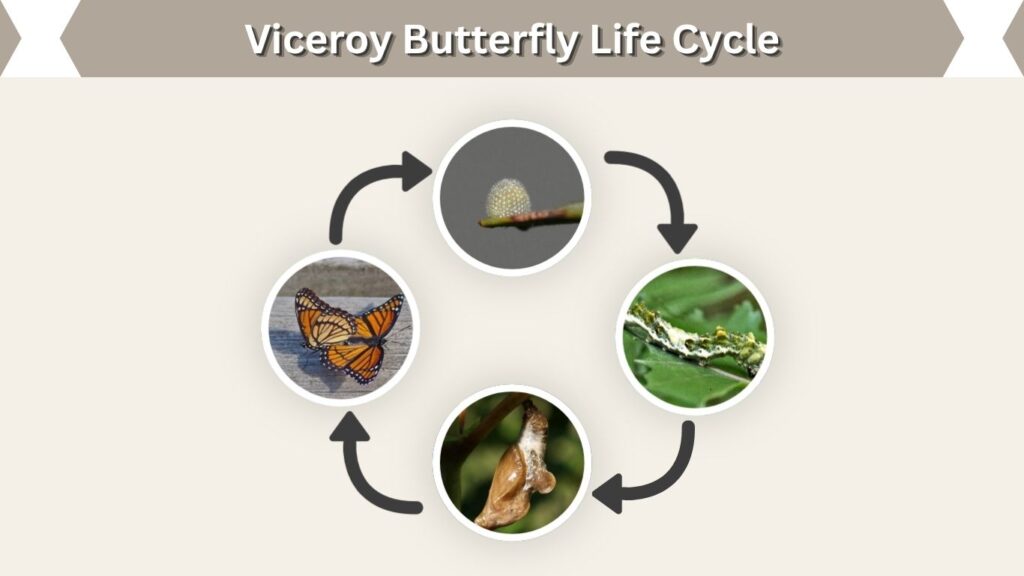
Like all butterflies, viceroys undergo complete metamorphosis through four major stages: egg, caterpillar, chrysalis, and adult. Their development is closely tied to willow-family host plants. Depending on climate and season, there may be multiple generations in warmer regions, while northern populations have shorter reproductive seasons.
Viceroy Butterfly Eggs
Female viceroys lay their eggs individually on the tips or edges of suitable host plant leaves.
After hatching, the tiny caterpillar begins eating the leaf.
Egg laying near fresh plant growth helps provide young larvae with tender foliage that is easier to consume.
Larval Stage
The caterpillar passes through several growth stages called instars.
During this period it:
- Eats host plant leaves
- Molts several times
- Develops stronger camouflage
- Stores energy for metamorphosis
- May overwinter when young
- Eventually prepares to form a chrysalis
This stage accounts for most of the butterfly’s physical growth.
Viceroy Butterfly Chrysalis
When fully developed, the caterpillar attaches itself to vegetation and forms a chrysalis.
The viceroy chrysalis has an unusual shape and coloration that helps it blend into its surroundings. It may resemble a dried leaf, damaged plant material, or even bird droppings.
Inside, the caterpillar transforms into the winged adult butterfly.
Adult Viceroy Butterfly
After emerging, the adult expands and dries its wings before flying.
Adult viceroys spend their time feeding, mating, searching for host plants, and establishing territories.
Unlike many adult moths, viceroy butterflies have functional mouthparts and regularly feed on nectar and other liquid food sources.
Viceroy Butterfly Diet and Host Plants
Adult and larval viceroys have very different diets. Caterpillars depend on specific host plants, while adults visit flowers and other food sources. Maintaining both nectar-rich plants and willow-family trees can make suitable habitat more attractive to viceroys.
Adult Viceroy Butterfly Food
Adult viceroys may feed on:
- Flower nectar
- Sap
- Overripe fruit
- Moist organic material
- Occasionally animal droppings or carrion for minerals
Nectar provides carbohydrates needed for flight and reproduction.
Best Host Plants for Viceroys
Important host plants include:
- Willows
- Cottonwoods
- Poplars
- Aspens
These plants are especially important because females must find suitable leaves for egg laying.
A butterfly garden containing only nectar flowers may attract adults but cannot support the complete viceroy life cycle without appropriate caterpillar host plants.
Viceroy Butterfly Habitat and Range
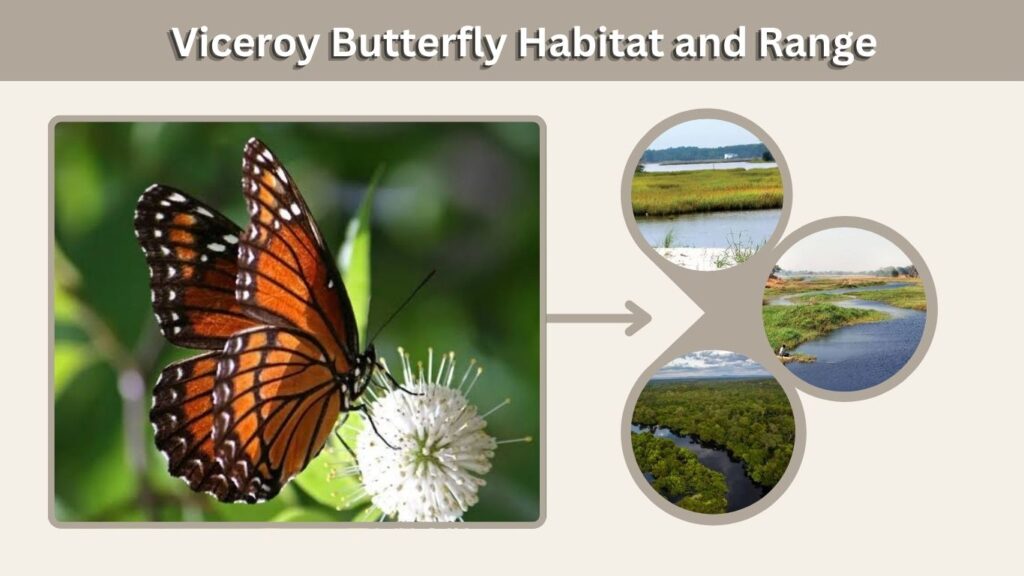
Viceroys are widely distributed across North America and are especially associated with moist environments. Their reliance on willow-family plants means they frequently occur around wetlands, rivers, streams, ponds, lakeshores, and woodland edges where these trees grow naturally.
Where Do Viceroy Butterflies Live?
Typical habitats include:
- Wetlands
- Marsh edges
- Riverbanks
- Stream corridors
- Pond edges
- Lakeshores
- Open woodland
- Gardens near suitable host plants
They occur across much of the United States and southern Canada.
Do Viceroy Butterflies Migrate?
Viceroys do not undertake the massive long-distance migration associated with monarch butterflies.
Their movement is generally more localized, although individuals may disperse between suitable habitats.
In colder regions, the species survives winter primarily during the caterpillar stage rather than migrating thousands of miles to warmer climates.
Viceroy Butterfly Meaning and Symbolism
Butterflies are widely associated with transformation because of their dramatic metamorphosis from caterpillar to adult. The viceroy may additionally symbolize adaptation, protection, resilience, and the ability to survive by changing one’s appearance or behavior.
These interpretations are cultural or personal rather than scientific facts. Biologically, the viceroy’s coloration and mimicry are survival adaptations shaped by interactions with predators.
FAQs
1. What is the difference between a monarch and a viceroy butterfly?
The easiest difference is the black horizontal line across each viceroy’s hindwing. Monarch butterflies do not have this line. Viceroys are also usually smaller.
2. Is the viceroy butterfly poisonous?
Viceroys are considered unpalatable to many predators because they can obtain defensive compounds from their caterpillar host plants. They are harmless to humans.
3. What do viceroy butterfly caterpillars eat?
The caterpillars mainly eat willow-family plants, including willow, poplar, cottonwood, and aspen.
4. What does a viceroy butterfly caterpillar look like?
It is mottled brown, cream, white, and greenish with an irregular shape that often resembles bird droppings.
5. Do viceroy butterflies migrate like monarchs?
No. Viceroys do not perform the famous long-distance migration of monarch butterflies. Northern populations generally survive winter as young caterpillars in protective leaf shelters.