
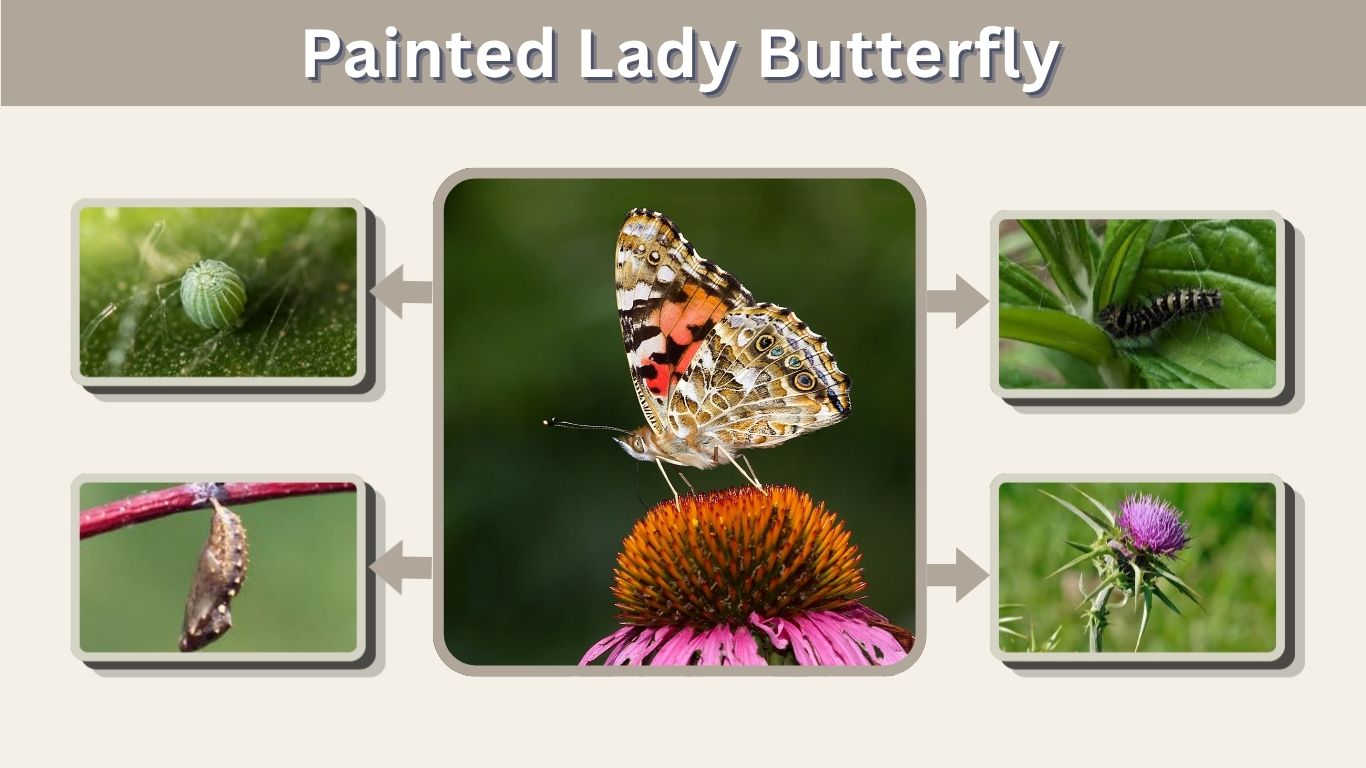
The painted lady butterfly (Vanessa cardui) is one of the most widespread and recognizable butterflies in the world. Its orange, black, brown, and white patterned wings make it easy to spot in gardens, fields, and open countryside. Painted ladies are also remarkable travelers, with some populations completing impressive seasonal migrations. Their life cycle includes an unusual spiny caterpillar and a beautifully camouflaged chrysalis. This guide covers painted lady identification, caterpillars, host plants, diet, migration, lifespan, life cycle, and differences from monarch butterflies.
What Is a Painted Lady Butterfly?
The painted lady belongs to the brush-footed butterfly family Nymphalidae. It occurs across much of the world and can live in a wide variety of environments. Adults frequently visit gardens because they feed on nectar from many flowering plants. Their ability to use numerous caterpillar host plants also helps them survive across a remarkably broad geographic range.
Painted Lady Butterfly Identification
Common characteristics include:
- Scientific name: Vanessa cardui
- Family: Nymphalidae
- Orange and brown upper wings
- Black wing markings
- White spots near the forewing tips
- Mottled brown undersides
- Several small eyespots underneath the hindwings
- Medium-sized body
- Fast, active flight
The underside of the wings provides excellent camouflage when the butterfly rests with its wings closed.
Painted Lady Butterfly Size
Painted ladies are medium-sized butterflies with a wingspan generally measuring around 2 to 3 inches.
Their wings appear broad compared with their relatively slim bodies. Although smaller than many monarch butterflies, painted ladies are strong fliers capable of traveling remarkable distances.
Size can vary depending on food availability, environmental conditions, and geographic population.
American Painted Lady vs Painted Lady
The painted lady can sometimes be confused with the American painted lady (Vanessa virginiensis).
Both have orange, black, and white coloration, but the American painted lady generally displays two large eyespots on the underside of each hindwing. The painted lady typically shows several smaller eyespots.
Careful examination of the underside of the wings is one of the easiest ways to separate these similar species.
Painted Lady Caterpillar
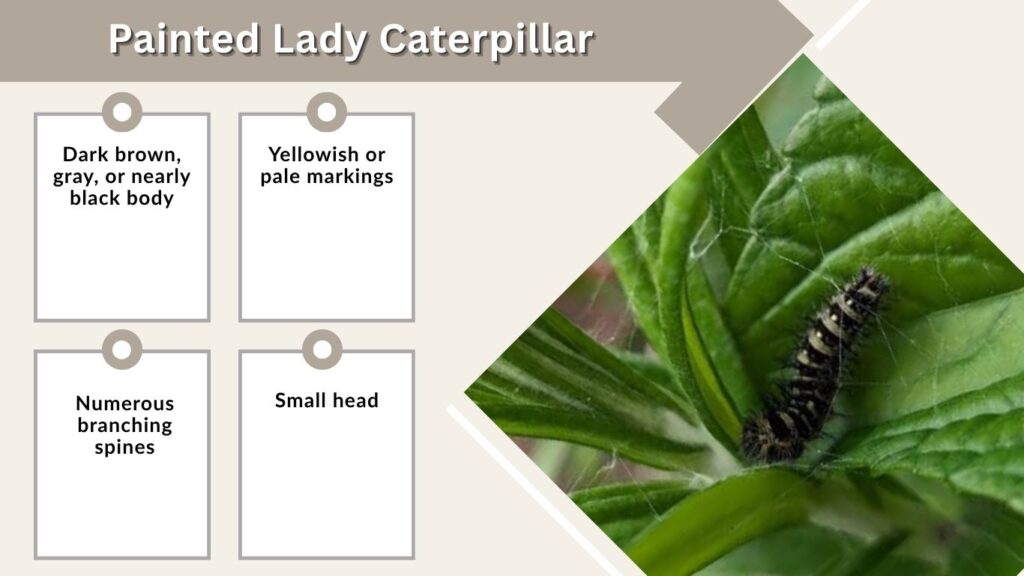
The painted lady caterpillar is quite different from the colorful adult butterfly. Caterpillars are usually dark-colored and covered with branching spines. They often hide within shelters made by joining leaves together with silk, which provides protection while they feed.
What Does a Painted Lady Caterpillar Look Like?
Typical characteristics include:
- Dark brown, gray, or nearly black body
- Yellowish or pale markings
- Numerous branching spines
- Segmented appearance
- Small head
- Length increasing significantly through development
- Often found inside folded or webbed leaves
Despite their spiny appearance, painted lady caterpillars are not dangerous to people.
Are Painted Lady Caterpillars Poisonous?
Painted lady caterpillars are not considered poisonous or venomous.
Their spines primarily discourage predators rather than injecting venom. They do not deliver the painful sting associated with species such as Io moth caterpillars.
Handling wild caterpillars is still best kept to a minimum because they are delicate and can easily be injured.
What Do Painted Lady Caterpillars Eat?
Painted lady caterpillars consume leaves from numerous host plants.
Common examples include:
- Thistles
- Hollyhock
- Mallow
- Sunflower
- Burdock
- Various plants in the daisy family
- Other suitable broadleaf plants
Thistles are among their best-known host plants, which is one reason painted ladies frequently occur in open fields and disturbed habitats.
Painted Lady Butterfly Life Cycle
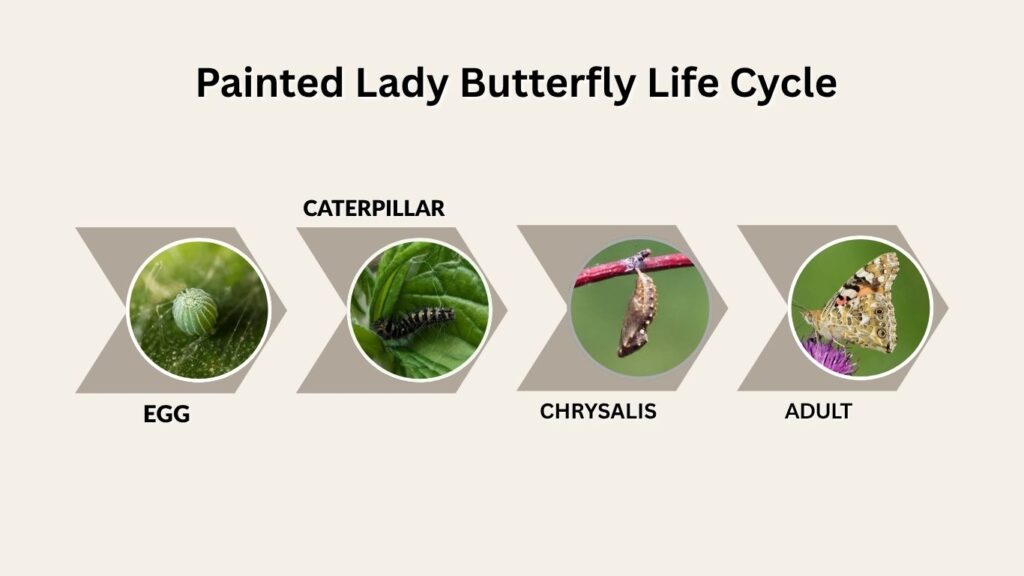
The painted lady undergoes complete metamorphosis through four stages: egg, caterpillar, chrysalis, and adult. Development can happen relatively quickly during warm weather, allowing several generations to occur in favorable climates. Temperature and food availability strongly influence how long each stage lasts.
Painted Lady Butterfly Eggs
Female butterflies lay tiny eggs individually on suitable host plants.
The eggs are usually pale green and have a barrel-like shape with vertical ridges. Females carefully select plants that will provide food for newly hatched caterpillars.
Once the larva emerges, it begins feeding almost immediately.
Caterpillar Stages
Painted lady caterpillars pass through several instars, growing larger each time they shed their skin.
During this period they:
- Feed heavily on host plant leaves
- Build protective silk shelters
- Molt several times
- Increase greatly in size
- Store energy for metamorphosis
- Eventually leave their feeding area to pupate
The larval stage is the main period of physical growth.
Painted Lady Chrysalis
Once fully developed, the caterpillar hangs upside down from a suitable surface before transforming into a chrysalis.
The painted lady chrysalis is commonly grayish, brown, or tan and may have metallic-looking gold areas.
Its irregular shape and muted coloration help it resemble dried vegetation or plant debris, providing camouflage from predators.
Adult Emergence
Inside the chrysalis, the caterpillar undergoes a dramatic transformation.
When development is complete, the adult butterfly breaks out. Its wings initially appear soft and wrinkled.
The butterfly pumps fluid through the wing veins until they expand. After the wings harden and dry, the new adult can fly away to feed and eventually reproduce.
Painted Lady Butterfly Diet
Adult painted ladies need liquid food rather than leaves. They use their long coiled proboscis to drink nectar and other liquids. Gardens containing a continuous supply of flowering plants can provide valuable food throughout the butterfly’s active season.
What Do Painted Lady Butterflies Eat?
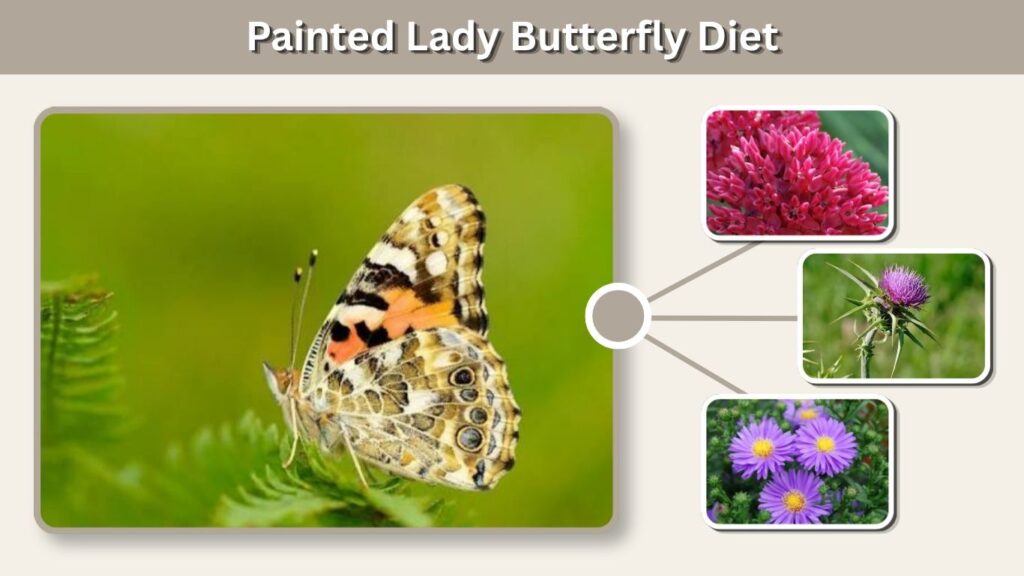
Adults commonly drink nectar from:
- Thistles
- Asters
- Coneflowers
- Zinnias
- Sunflowers
- Lantana
- Milkweed flowers
- Other nectar-rich plants
They may occasionally obtain nutrients from other liquid sources, but flower nectar provides their primary energy.
Painted Lady Host Plants
Host plants are different from nectar plants because they provide food specifically for caterpillars.
Thistles are particularly important, but females can use many other plants.
A butterfly garden that includes both caterpillar host plants and nectar flowers provides much better habitat than one containing only flowering plants.
Painted Lady Butterfly Migration
Painted ladies are famous for their ability to travel long distances. Unlike monarchs, which follow a well-known migration between specific seasonal areas in North America, painted lady movements can involve multiple generations and vary greatly according to rainfall, temperature, vegetation, and regional weather patterns.
Why Do Painted Ladies Migrate?
Migration allows painted ladies to take advantage of:
- Seasonal flowering plants
- Fresh host plant growth
- Favorable temperatures
- Rainfall-driven vegetation
- Better breeding conditions
Large numbers may suddenly appear in regions where relatively few had been observed previously.
How Far Can Painted Ladies Travel?
Individual butterflies can travel substantial distances, while successive generations may collectively cover thousands of miles.
Their migration patterns are especially impressive because different generations can continue the overall movement rather than a single butterfly necessarily completing the entire journey.
Wind conditions can also help butterflies cover large areas.
Painted Lady vs Monarch Butterfly
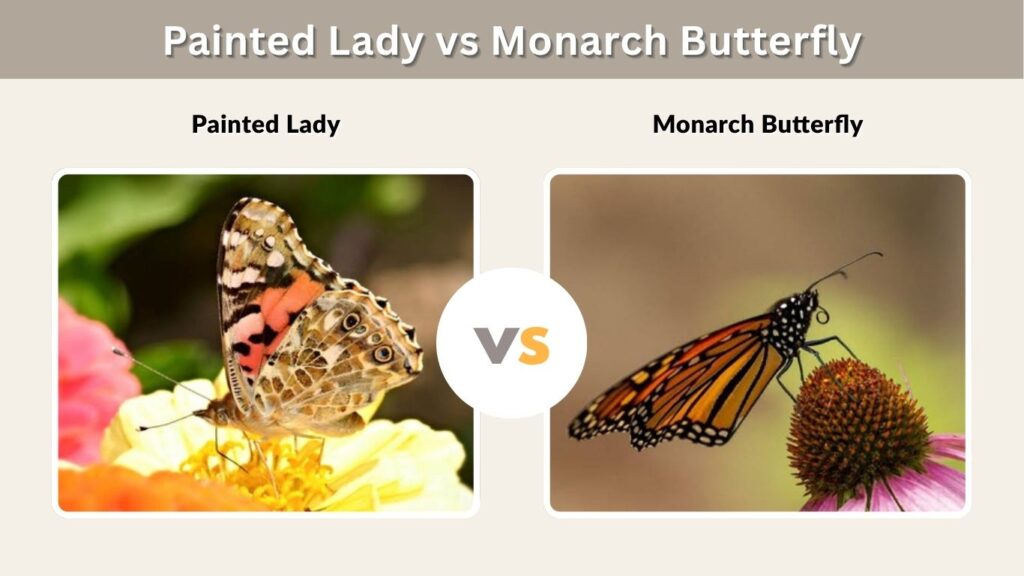
Painted ladies and monarchs share orange-and-black coloration, so people occasionally confuse them. However, their wing patterns, size, caterpillars, host plants, and migration behavior are quite different.
Painted Lady vs Monarch Differences
Key differences include:
- Monarchs are generally larger.
- Painted ladies have more complex brown and orange patterns.
- Monarchs have strong black veins across orange wings.
- Painted ladies have white spots near the tips of their forewings.
- Monarch caterpillars are striped black, white, and yellow.
- Painted lady caterpillars are dark and spiny.
- Monarch caterpillars mainly depend on milkweed.
- Painted lady caterpillars use many host plants, especially thistles.
Once the wing markings are examined closely, separating the two species is usually straightforward.
Migration Differences
Monarch migration is famous for its seasonal movement between North America and overwintering areas.
Painted lady migrations are generally less predictable. Their movements are strongly influenced by rainfall, vegetation, temperature, and changing food resources.
Both species demonstrate impressive long-distance flight abilities, but their migration strategies are not identical.
Painted Lady Habitat, Range, and Lifespan
Painted ladies are exceptionally adaptable butterflies. They can occupy gardens, meadows, roadsides, fields, deserts, grasslands, and many other open habitats. Their broad range of caterpillar host plants and strong flying ability contribute to their enormous geographic distribution.
Where Do Painted Lady Butterflies Live?
Typical habitats include:
- Flower gardens
- Meadows
- Grasslands
- Open woodland
- Roadsides
- Agricultural areas
- Desert regions after rainfall
- Disturbed habitats
Painted ladies occur on several continents and are considered among the world’s most widely distributed butterfly species.
How Long Do Painted Lady Butterflies Live?
Adult painted lady butterflies commonly live for only a few weeks, although lifespan varies according to temperature, food availability, activity, and environmental conditions.
Their complete life cycle is longer because it includes the egg, caterpillar, and chrysalis stages.
Warm temperatures generally speed development, while cooler conditions can slow it considerably.
Interesting Painted Lady Butterfly Facts
Painted ladies combine colorful appearance with extraordinary adaptability. Their ability to travel great distances and reproduce across changing environments has helped them become one of the world’s most successful butterflies.
Quick Facts
- Their scientific name is Vanessa cardui.
- They occur across much of the world.
- Caterpillars are dark and spiny.
- Thistles are important host plants.
- Adults feed mainly on flower nectar.
- They undergo complete metamorphosis.
- Their chrysalis may appear metallic gold.
- They are powerful long-distance fliers.
- They are smaller than monarch butterflies.
- Their migrations may involve several generations.
FAQs
1. What do painted lady butterflies eat?
Adult painted ladies mainly drink nectar from flowers such as thistles, asters, coneflowers, zinnias, and other nectar-producing plants.
2. What do painted lady caterpillars eat?
Caterpillars feed on numerous host plants, especially thistles, along with mallow, hollyhock, sunflower, and related plants.
3. How long do painted lady butterflies live?
Adults generally live for a few weeks, although temperature, food availability, weather, and other environmental conditions influence their lifespan.
4. What is the difference between a painted lady and a monarch?
Painted ladies are generally smaller and have complex brown, orange, black, and white wing patterns. Monarchs have prominent black veins running across bright orange wings.
5. Do painted lady butterflies migrate?
Yes. Painted ladies can undertake extensive seasonal movements. Their migration often involves multiple generations and is strongly influenced by rainfall, temperature, flowering plants, and available host vegetation.