
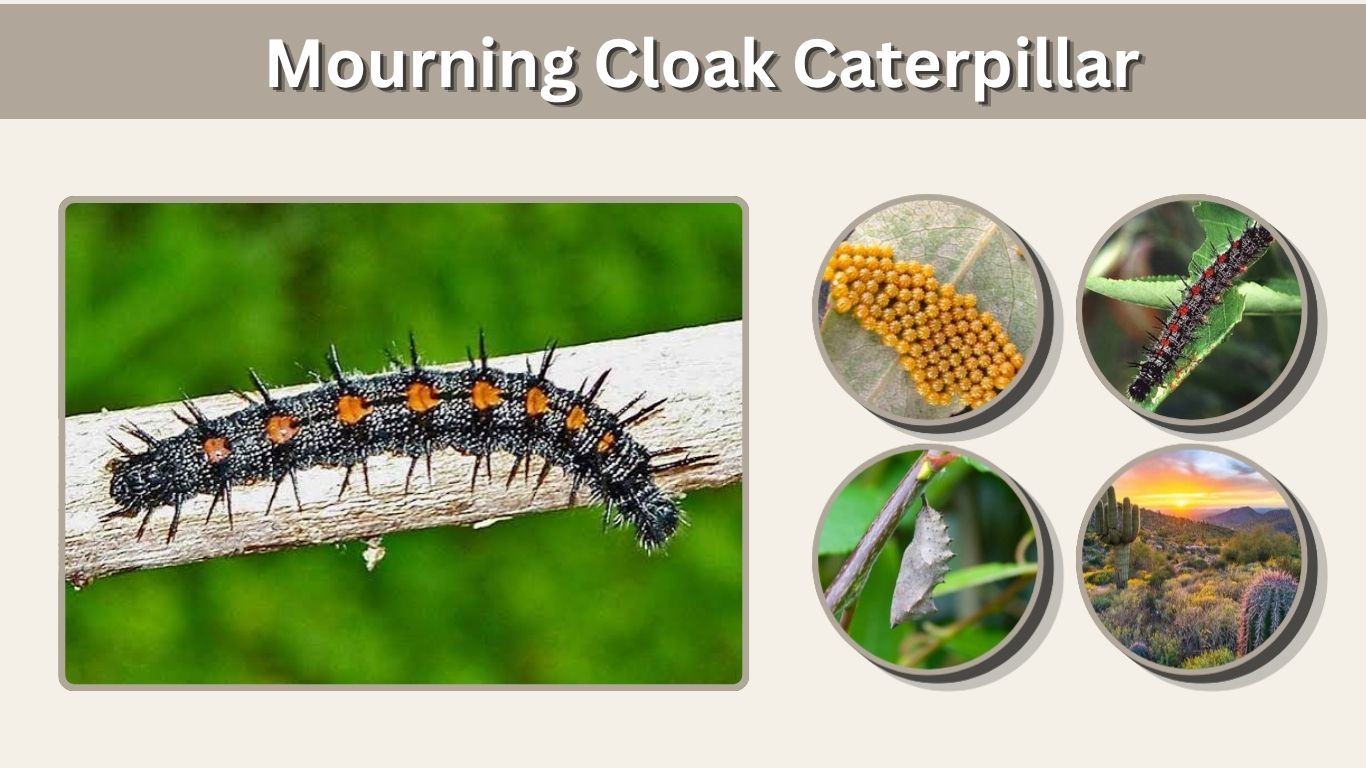
The mourning cloak caterpillar is the larval stage of the mourning cloak butterfly (Nymphalis antiopa). This distinctive black caterpillar has white speckles, red spots, and rows of sharp-looking branched spines. It commonly feeds in groups on willow, elm, cottonwood, and other deciduous trees. Although its appearance may seem threatening, it is neither poisonous nor venomous. Learning about its identification, diet, behavior, life cycle, and host plants can help gardeners protect this beneficial native butterfly without unnecessarily removing its caterpillars.
Mourning Cloak Caterpillar Identification
Mourning cloak caterpillars are sometimes called spiny elm caterpillars because of their appearance and preference for elm leaves. Young larvae may be difficult to recognize, but their markings become clearer with each molt. Mature caterpillars have black bodies covered with tiny white dots, a line of reddish-orange spots, and prominent black spines extending from each body segment.
Color, Size, and Physical Features
- Body color: Primarily black with numerous tiny white speckles
- Red markings: A row of reddish-orange or maroon spots along the back
- Spines: Several rows of long, black, branched spines
- Head: Shiny black and rounded
- Legs: Small, dark legs underneath the body
- Length: Mature caterpillars can reach approximately two inches
- Movement: Slow crawling combined with occasional defensive curling
- Group behavior: Young caterpillars frequently rest and feed together
Their black, red, and white pattern distinguishes them from many other spiny caterpillars. However, identification should include both appearance and the type of tree on which they are feeding.
Newly Hatched and Mature Caterpillars
Newly hatched mourning cloak caterpillars are tiny, dark, and relatively difficult to see. They remain close to their empty eggshells before beginning to eat nearby leaves. The young larvae usually feed communally, sometimes covering a branch with silk and droppings.
As they grow, the caterpillars molt repeatedly and pass through several developmental stages called instars. Their red dorsal spots, white speckles, and branched spines become increasingly noticeable. Older caterpillars may leave their original group and travel individually while searching for additional food or a protected place to form a chrysalis.
Are Mourning Cloak Caterpillars Poisonous?
The dramatic spines of a mourning cloak caterpillar naturally raise concerns about stings, venom, and skin reactions. Despite their intimidating appearance, these caterpillars do not possess venom glands or specialized stinging hairs. They are not medically significant to humans. However, their stiff spines may prick sensitive skin, so direct handling is unnecessary and should generally be avoided.
Can a Mourning Cloak Caterpillar Sting or Bite?
A mourning cloak caterpillar cannot deliver a true venomous sting. Its spines are primarily defensive structures that make the caterpillar difficult or uncomfortable for predators to swallow. They may produce a minor prick or temporary irritation when pressed firmly against bare skin.
The caterpillar also does not normally bite people. Its mouthparts are designed for cutting and chewing leaves rather than attacking humans. A person handling one roughly might experience a slight pinch, but this is unusual.
If skin irritation occurs after contact, wash the area gently with soap and water. Avoid scratching, and apply a cool compress if needed. Seek medical advice if significant swelling, breathing difficulty, or a spreading reaction develops, as another insect or an individual allergy may be responsible.
Are They Dangerous to Pets or Children?
Mourning cloak caterpillars are not considered dangerous to children, dogs, cats, or other household pets. Nevertheless, children should be taught to observe unfamiliar caterpillars without touching them. Pets should also be discouraged from chewing or swallowing spiny insects because the spines could cause mechanical irritation inside the mouth.
The caterpillar is not known for releasing dangerous toxins. Its protective strategy relies mainly on camouflage, group behavior, spines, and defensive body movements rather than chemical venom.
Mourning Cloak Caterpillar Diet and Host Plants
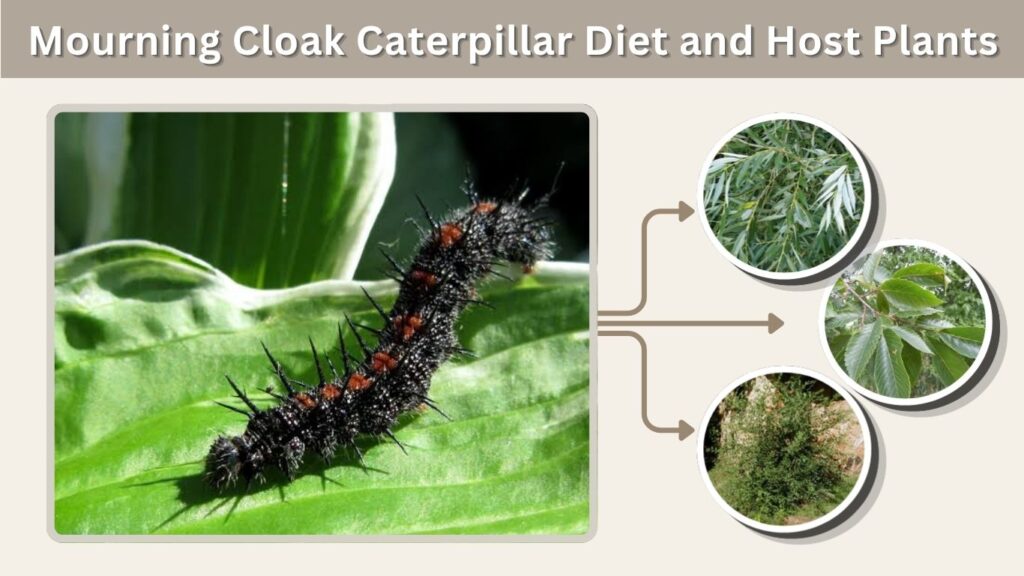
Mourning cloak caterpillars are leaf eaters with a preference for several deciduous trees. The female butterfly selects an appropriate host plant and deposits a cluster of eggs around a twig. Once hatched, the larvae begin eating the surrounding leaves. They cannot thrive on random garden vegetables or most flowering plants because they require compatible tree foliage.
What Do Mourning Cloak Caterpillars Eat?
- Willow leaves
- American elm leaves
- Siberian elm leaves
- Cottonwood leaves
- Aspen leaves
- Poplar leaves
- Birch leaves
- Hackberry leaves
- Hawthorn leaves
- Wild rose leaves
Willow, elm, cottonwood, and aspen are especially important host plants. When caring for a caterpillar temporarily, provide fresh, pesticide-free leaves from the same tree on which it was discovered. A sudden switch to an unfamiliar plant may cause it to stop eating.
Can They Kill a Willow or Elm Tree?
A large group of mourning cloak caterpillars can remove numerous leaves from a branch, making the damage look serious. However, established, healthy trees usually recover from limited feeding. The caterpillars remain active for only part of the growing season and eventually leave the tree to pupate.
Young, stressed, or recently planted trees may need closer observation. Instead of using insecticide, move some caterpillars to another suitable host tree if severe defoliation is occurring. Broad-spectrum pesticides may harm mourning cloaks, beneficial insects, and natural predators.
Mourning Cloak Caterpillar Behavior, Predators, and Range
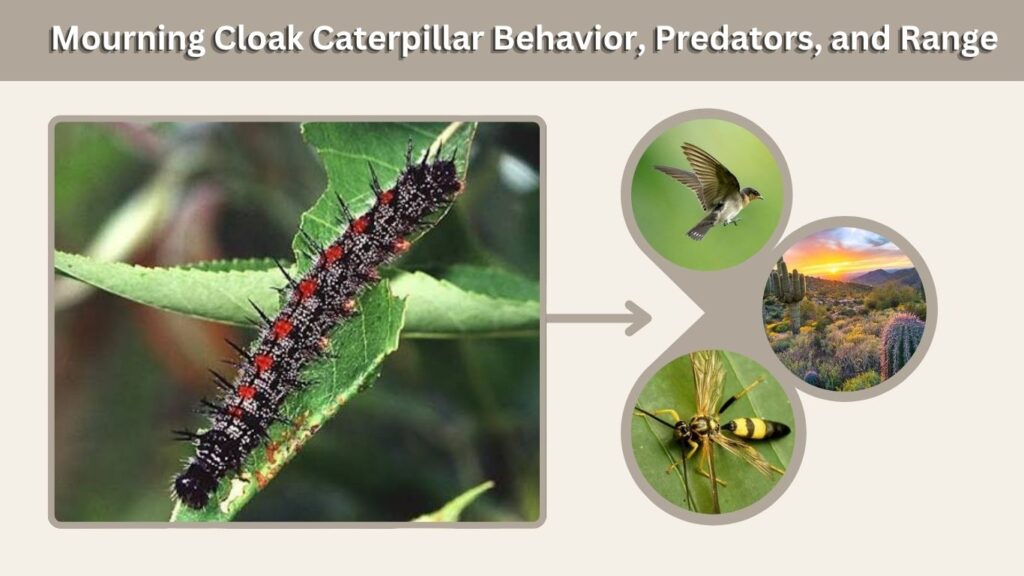
Mourning cloak caterpillars are social during their early development. Groups feed openly on host trees and may move together from one branch to another. Their conspicuous colors can warn predators that they are difficult to handle, even though they are not venomous. As the caterpillars mature, they become more independent and eventually wander away to find pupation sites.
Feeding, Resting, and Defensive Behavior
Young caterpillars often remain clustered on the underside of leaves, along branches, or inside thin layers of silk. They may rest motionlessly between feeding periods, which can sometimes be mistaken for sleeping or illness.
When disturbed, the caterpillars may curl their bodies, twitch, drop from a branch, or remain firmly attached to the plant. Older larvae often travel considerable distances before pupation. Finding one crawling on a wall, fence, patio, or ground does not necessarily mean it is lost; it may be searching for a secure place to transform.
Predators and Natural Threats
Birds, predatory insects, spiders, parasitic wasps, and tachinid flies may attack mourning cloak caterpillars. Their spines provide protection from some predators but do not make them invulnerable.
Disease, pesticide exposure, extreme weather, and lack of fresh foliage can also reduce survival. Caterpillars raised in crowded containers are especially vulnerable to bacterial or viral infections, which is one reason outdoor development is generally safer.
Where Are Mourning Cloak Caterpillars Found?
The species has a broad range across North America, Europe, and Asia. In North America, mourning cloak caterpillars occur throughout Canada and most of the United States, including California, Arizona, Minnesota, and other northern or western regions.
They are most likely to be found in woodlands, river valleys, suburban parks, gardens, and neighborhoods with suitable host trees. Their exact appearance period varies with local climate. Populations in warm regions may develop earlier than those in Alberta, Minnesota, or other colder areas.
Life Cycle and Caterpillar Care
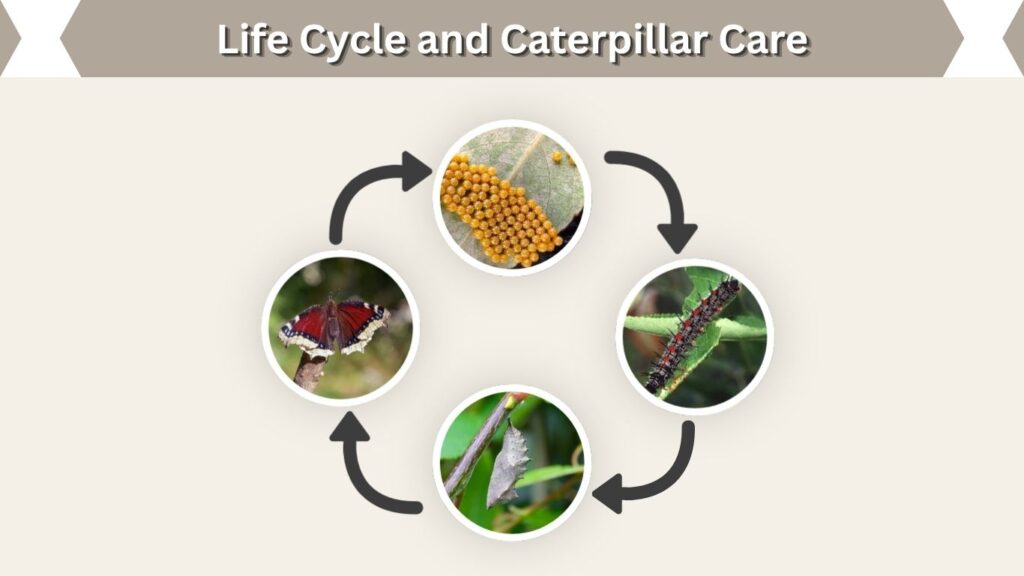
The mourning cloak develops through egg, larva, pupa, and adult stages. Caterpillars grow rapidly by eating leaves and shedding their skins several times. When fully developed, they stop feeding and search for a sheltered location. They then hang upside down, shed their final larval skin, and become a chrysalis before emerging as adult butterflies.
Mourning Cloak Caterpillar Stages
- Egg: A female lays a cluster or ring of eggs around a host-tree twig.
- New larva: Tiny caterpillars hatch and begin feeding together on nearby leaves.
- Growing instars: The larvae molt several times, increasing in size after every molt.
- Wandering stage: Mature caterpillars stop feeding and search for protected pupation sites.
- Chrysalis: Each caterpillar hangs upside down and transforms inside an angular brown or gray chrysalis.
- Adult butterfly: The mourning cloak emerges, expands its wings, and begins its unusually long adult life.
The mourning cloak forms a chrysalis rather than a cocoon. A cocoon is a silk covering made by many moth caterpillars, while a butterfly pupa is usually exposed.
How to Care for a Mourning Cloak Caterpillar
- Keep it in a spacious, ventilated enclosure protected from direct sunlight.
- Supply fresh leaves from the exact host tree where it was found.
- Place leaf stems in water, but cover the opening to prevent drowning.
- Replace wilted foliage and remove droppings every day.
- Avoid leaves treated with pesticides or collected beside busy roads.
- Provide twigs or mesh from which the caterpillar can hang.
- Do not disturb it after it attaches itself upside down.
- Release the adult near the original location after its wings fully expand.
Outdoor rearing on the original host tree is usually best. If the caterpillar appears healthy and safe, leaving it undisturbed allows it to experience natural temperature, airflow, and humidity.
How Long Does It Stay in the Chrysalis?
The chrysalis stage commonly lasts approximately 10 to 15 days during warm weather. Cooler temperatures can slow development, while warmer conditions may shorten it. The pupa gradually darkens before the adult emerges.
A hanging caterpillar may remain still in a curved or J-shaped position for about a day before forming its chrysalis. This is normal preparation for pupation and should not be interrupted.
FAQs
Mourning cloak caterpillars often attract attention because they gather in groups and possess numerous sharp-looking spines. Gardeners may worry about tree damage, while parents and pet owners commonly wonder whether the caterpillars are dangerous. Understanding their host plants, defensive structures, transformation process, and basic care requirements makes it easier to observe them safely while protecting the future butterflies.
Are mourning cloak caterpillars venomous?
No. They do not inject venom and are not considered venomous. Their spines can sometimes cause minor mechanical irritation.
What should I feed a mourning cloak caterpillar?
Provide pesticide-free leaves from the host tree where you found it. Willow, elm, cottonwood, aspen, poplar, and birch are common foods.
Why is my mourning cloak caterpillar hanging upside down?
A mature caterpillar hangs upside down before shedding its skin and forming a chrysalis. Avoid moving or touching it during this vulnerable stage.
How long is the mourning cloak caterpillar stage?
The larval stage generally lasts several weeks, although temperature, food quality, climate, and individual development can affect its duration.
Should I remove mourning cloak caterpillars from my tree?
Removal is usually unnecessary. Healthy mature trees generally tolerate their feeding. If a young tree experiences heavy defoliation, carefully relocate some caterpillars to another suitable host tree.