
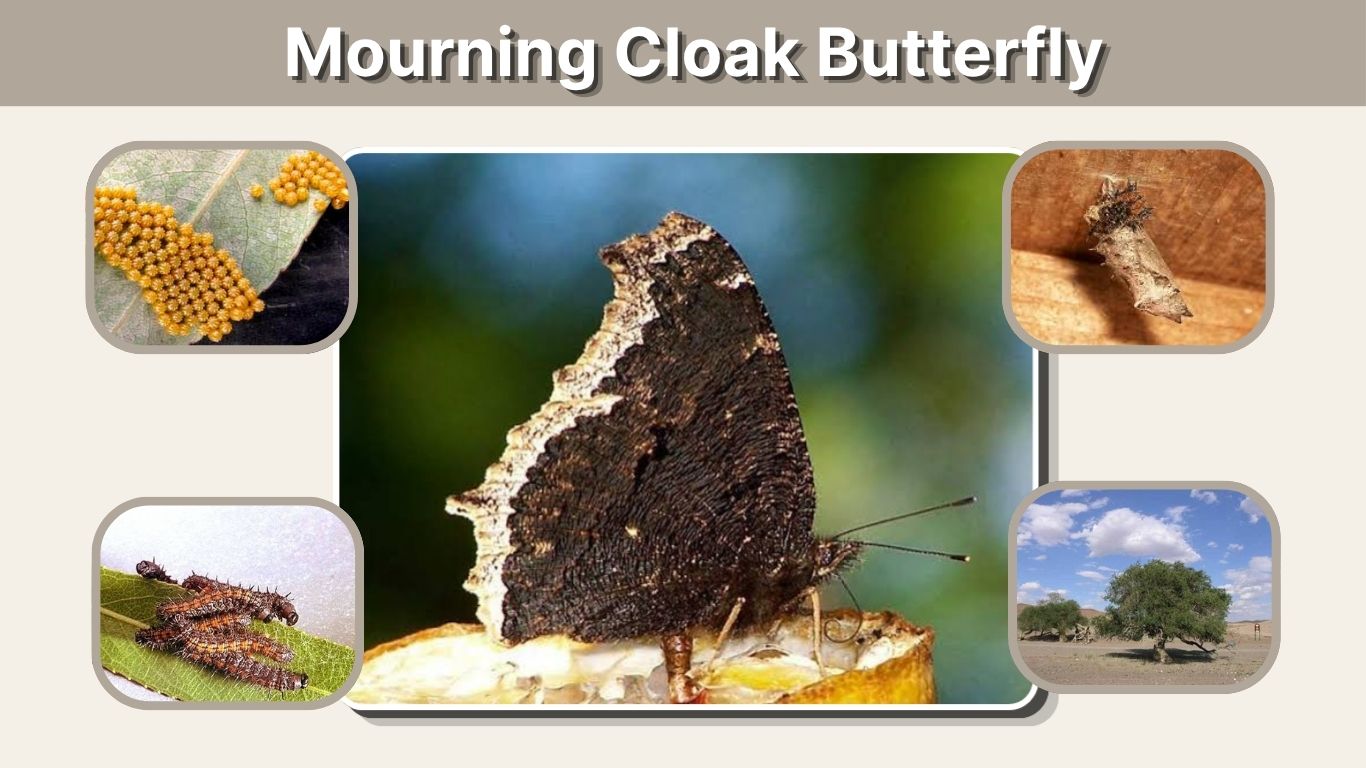
The mourning cloak butterfly (Nymphalis antiopa) is a large, distinctive butterfly recognized by its dark wings, pale yellow borders, and bright blue spots. It has one of the longest adult lifespans of any North American butterfly and can survive cold winters by hibernating. Found across North America, Europe, and Asia, this woodland species has a fascinating life cycle. Its spiny caterpillar may appear threatening, but it is generally harmless to people and plays an important role in forest ecosystems.
Mourning Cloak Butterfly Identification
The mourning cloak is sometimes described as a black butterfly with yellow or white edges. Its elegant colors resemble a traditional cloak worn during mourning, which inspired its common name. Although its wings may look black from a distance, they are usually deep brown or maroon. The butterfly’s size, irregular wing edges, and colorful border make identification relatively easy.
Color, Markings, and Size
- Wings: Dark brown or maroon with slightly ragged edges
- Wing border: Broad yellow or cream band along the outer edges
- Blue spots: A row of bright blue spots inside the pale border
- Underside: Mottled gray-brown, providing excellent camouflage
- Wingspan: Approximately 2.25 to 4 inches
- Body: Dark, hairy, and relatively thick compared with many butterflies
- Flight pattern: Strong, quick flight mixed with long gliding movements
Fresh adults have bright yellow wing margins. As the butterfly ages, these borders may fade and appear almost white. This explains reports of mourning cloak butterflies with either yellow or white edges.
Male vs. Female Mourning Cloak Butterfly
Male and female mourning cloaks look extremely similar. Both have the same dark wings, blue spots, and pale borders, so distinguishing them from appearance alone is difficult. Females are sometimes slightly larger and may have fuller abdomens, particularly when carrying eggs.
Behavior can provide additional clues. Males frequently defend sunny woodland territories and fly toward passing butterflies. Females spend more time searching for suitable host trees on which to deposit their eggs.
Mourning Cloak Butterfly Habitat, Range, and Behavior
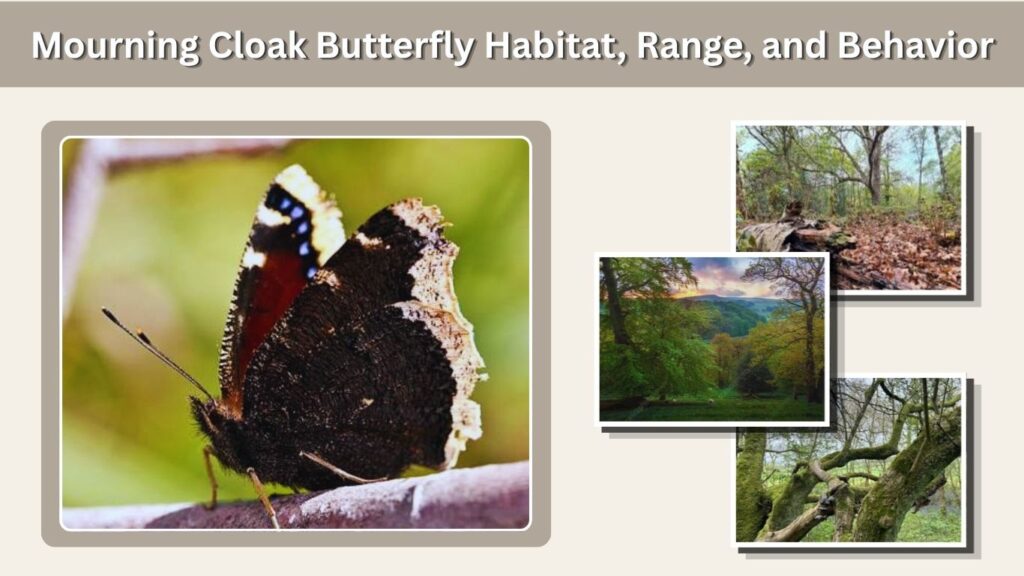
Mourning cloak butterflies occupy an exceptionally wide range. They occur across most of North America, including Canada, Alaska, the continental United States, and parts of Mexico. The species is also native to Europe and Asia, where it is commonly called the Camberwell beauty. It prefers environments containing trees, moisture, sunny openings, and sheltered places for winter survival.
Where Mourning Cloak Butterflies Live
- Deciduous and mixed woodlands
- Forest edges and sunny clearings
- Parks, gardens, and tree-lined neighborhoods
- Riverbanks and areas containing willow trees
- Mountain valleys and open countryside
- Farms, orchards, and wooded roadsides
- Cold regions where secure winter shelters are available
They are widespread in states such as California, Colorado, Michigan, Minnesota, Maine, and Wisconsin. They are also commonly recorded in southern Canada, including Ontario.
Behavior and Hibernation
Unlike most butterflies, adult mourning cloaks can survive winter. They enter a dormant state called diapause and shelter beneath loose tree bark, inside hollow logs, in woodpiles, or within unheated buildings. Natural antifreeze-like compounds in their bodies help them tolerate freezing conditions.
On warm days in late winter or early spring, they emerge and fly before many other butterflies appear. Adults often rest in sunny places to warm their wings. Males may defend territories by chasing butterflies, insects, birds, or even people who enter their chosen space.
Mourning Cloak Butterfly Life Cycle
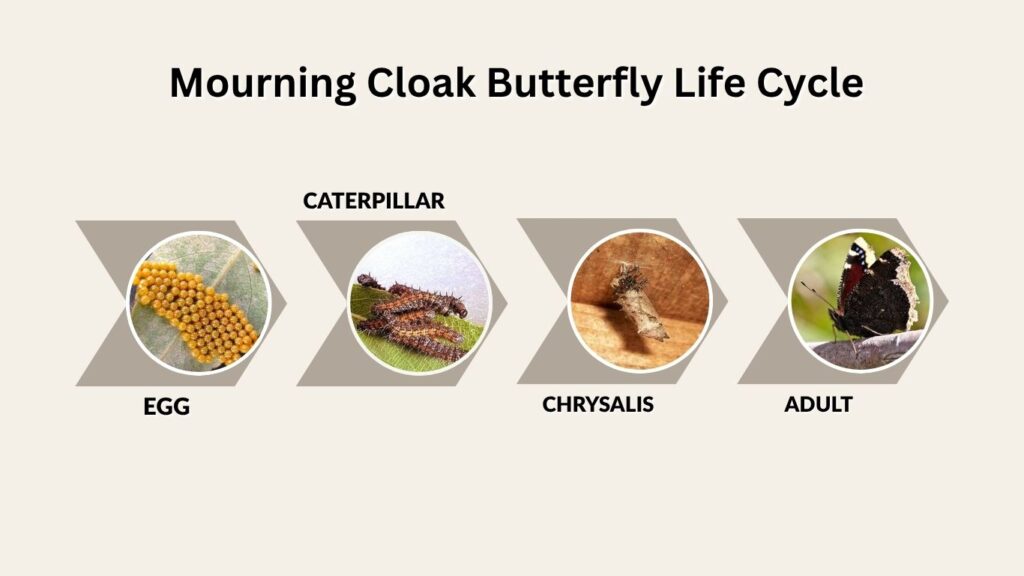
The mourning cloak undergoes complete metamorphosis, developing through egg, caterpillar, chrysalis, and adult stages. Overwintering adults mate during spring after emerging from their shelters. Females then lay clusters of eggs around twigs of suitable host trees. The caterpillars initially feed together but gradually become more independent as they grow and prepare to pupate.
Eggs, Caterpillar, Chrysalis, and Adult
- Eggs: Females lay rings or clusters of pale yellow eggs around small twigs. The eggs darken as the developing larvae mature.
- Caterpillars: Newly hatched larvae feed together on host-tree leaves. Mature mourning cloak caterpillars are black with tiny white speckles, red spots along the back, and rows of branched spines.
- Chrysalis: The full-grown caterpillar hangs upside down and forms an angular gray, brown, or tan chrysalis. Mourning cloaks do not make cocoons because cocoons are associated mainly with moths.
- Adults: A fully formed butterfly emerges, expands its wings, and begins feeding. Depending on the climate, one or more generations may develop annually.
Lifespan of a Mourning Cloak Butterfly
Adult mourning cloaks may live for ten to twelve months, making them unusually long-lived butterflies. Their extended lifespan is possible because adults pause their activity during both winter dormancy and periods of intense summer heat.
A butterfly emerging in summer may feed for several weeks, enter a resting period, become active again during autumn, overwinter, and reproduce the following spring. Weather, predators, food availability, and shelter quality influence how long an individual survives.
Mourning Cloak Butterfly Diet, Host Plants, and Safety
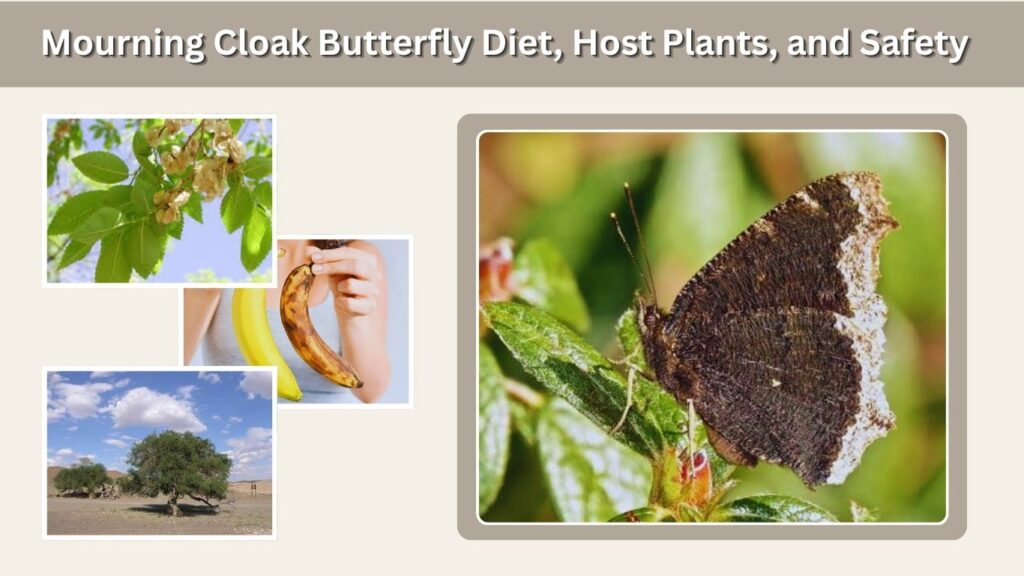
Mourning cloak caterpillars and adults have very different diets. Caterpillars eat the leaves of selected deciduous trees, while adults obtain energy primarily from tree sap and fermenting fruit. They visit flowers occasionally but are less dependent on nectar than many familiar garden butterflies. Planting native host trees can support their reproduction more effectively than planting flowers alone.
Caterpillar Food and Host Plants
- Willows
- American elm
- Siberian elm
- Cottonwood
- Aspen
- Poplar
- Birch
- Hackberry
- Hawthorn
- Wild rose
Willows, elms, aspens, and cottonwoods are among the most important mourning cloak host plants. Caterpillars can temporarily remove many leaves from a branch, but healthy mature trees normally recover without treatment.
What Do Adult Mourning Cloak Butterflies Eat?
Adult mourning cloaks frequently drink sap leaking from injured trees. They also feed on overripe fruit, moisture from wet soil, and minerals found in animal droppings. Flower nectar is a secondary food source, especially when sap or fruit is unavailable.
Their preference for sap explains why they are often observed resting head downward on tree trunks. They may gather near broken branches, woodpecker holes, or cracks where sap is accessible. Gardeners can attract them by preserving native trees and leaving a small amount of naturally fallen fruit in a safe area.
Are Mourning Cloaks Poisonous or Venomous?
Mourning cloak butterflies are not considered poisonous or venomous to humans. They cannot sting, and they do not have biting mouthparts capable of harming people.
The caterpillar has many sharp-looking, branched spines. These spines are not venomous, but direct handling may cause minor mechanical irritation in sensitive individuals. It is best to observe the caterpillar without touching it. If contact causes itching, wash the affected skin with soap and water and avoid rubbing it.
Meaning, Symbolism, and Interesting Facts
The butterfly’s dark coloring and name have encouraged symbolic associations with grief, remembrance, transformation, hope, and renewal. These interpretations come from cultural traditions and personal beliefs rather than scientific evidence. From a biological perspective, its reappearance after winter makes it a powerful natural symbol of survival, particularly because it may fly while snow still covers the ground.
Mourning Cloak Butterfly Symbolism
Seeing a mourning cloak is sometimes interpreted as a reminder that periods of sadness can be followed by renewal. Some people associate its dark wings with loss, while the yellow border and blue spots represent light, hope, or beauty surrounding difficult experiences.
Spiritual meanings vary among individuals and cultures. Encountering one does not predict a specific event, but its long life and ability to survive winter can provide meaningful inspiration.
Notable Mourning Cloak Facts
The mourning cloak belongs to the brush-footed butterfly family, Nymphalidae. Its front pair of legs is reduced, making the butterfly appear to walk on only four legs. When its wings are closed, the mottled underside blends remarkably well with bark.
Its scientific name is Nymphalis antiopa. It is called the Camberwell beauty in Britain because an early documented specimen was discovered near Camberwell, London. Despite occasional confusion, the mourning cloak is a butterfly—not a moth.
FAQs
Mourning cloak butterflies attract attention because of their unusual appearance, early spring activity, and spiny caterpillars. People also frequently mistake the chrysalis for a cocoon or worry that the larvae are dangerous. The following answers address common questions about identification, diet, host plants, lifespan, and safety without confusing the species with similarly colored butterflies or moths.
Are mourning cloak caterpillars poisonous?
No. Mourning cloak caterpillars are not considered poisonous or venomous. However, their stiff spines may cause mild skin irritation, so avoid handling them directly.
What do mourning cloak caterpillars eat?
They eat leaves from willow, elm, cottonwood, aspen, poplar, birch, hackberry, and several other deciduous trees. Young caterpillars commonly feed together in groups.
How long do mourning cloak butterflies live?
Adults may live for ten to twelve months. This exceptionally long lifespan includes periods of summer dormancy and winter hibernation.
Where do mourning cloak butterflies go in winter?
They shelter under loose bark, inside tree cavities, beneath logs, in woodpiles, or within unheated structures. They emerge when temperatures become warm enough for flight.
What does seeing a mourning cloak butterfly mean?
Scientifically, it means suitable habitat and food are nearby. Symbolically, some people associate the butterfly with remembrance, endurance, transformation, and hope after a difficult period.