
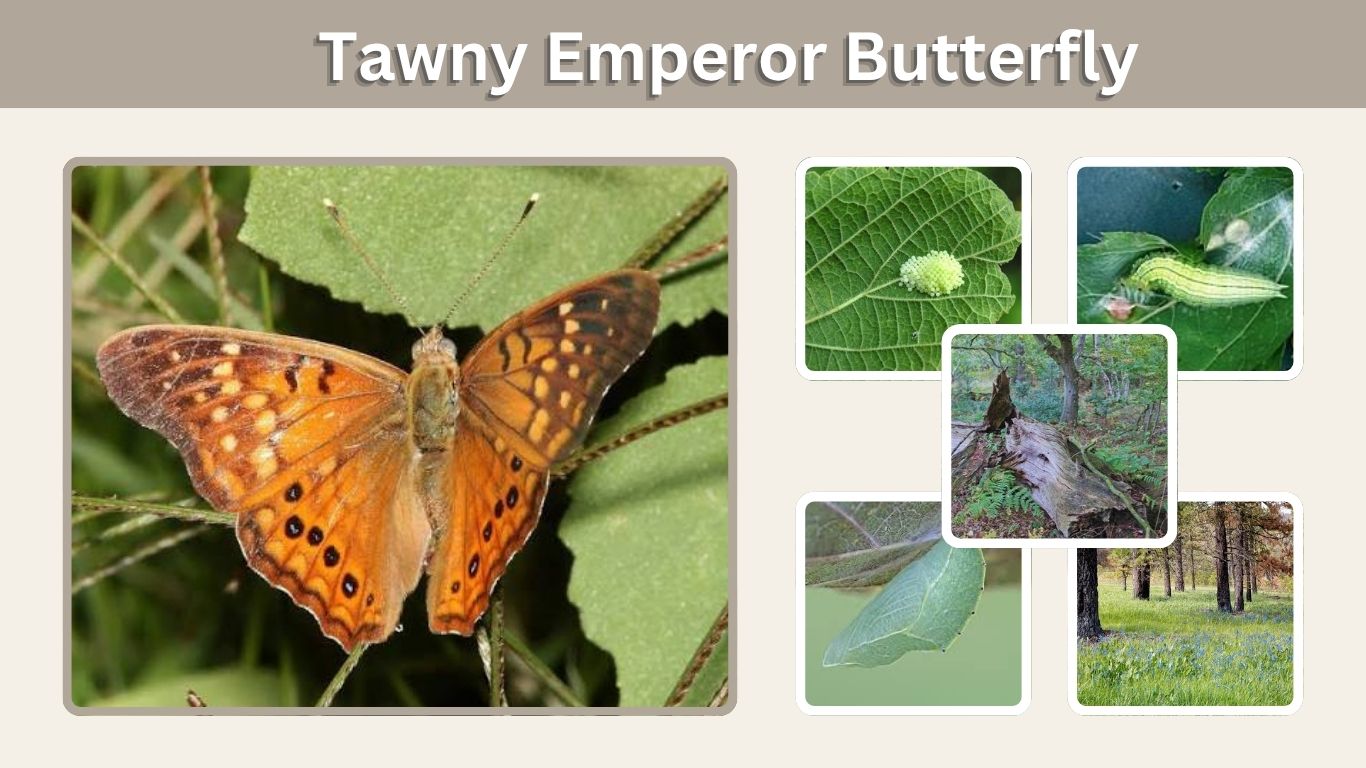
The Tawny Emperor is a medium-sized North American butterfly known for its warm orange-brown wings and close relationship with hackberry trees. Scientifically called Asterocampa clyton, it is often seen in wooded areas, parks, river corridors, and other places where its host plants grow. Unlike many familiar butterflies, adults rarely depend on flower nectar and instead visit tree sap, overripe fruit, carrion, and other nutrient-rich sources. This guide explains Tawny Emperor identification, caterpillars, host plants, life cycle, habitat, lifespan, and differences from the similar Hackberry Emperor.
What Is a Tawny Emperor Butterfly?
The Tawny Emperor belongs to the brush-footed butterfly family Nymphalidae. It is native to North America and occurs across much of the eastern and central United States. Its rusty-brown coloration provides excellent camouflage against tree bark, fallen leaves, and woodland soil, where adults frequently rest or feed.
Tawny Emperor Identification
Important identification features include:
- Scientific name: Asterocampa clyton
- Family: Nymphalidae
- Wingspan: About 1.6–2.8 inches
- Primary color: Tawny orange to chestnut brown
- Forewings: Dark bars and pale spots near the tips
- Hindwings: Orange-brown with dark marginal markings
- Underside: Grayish to brown with subtle patterns
- Body: Brown and relatively robust
- Flight: Quick and energetic
One useful feature is the absence of the prominent forewing eyespot pattern found on the similar Hackberry Emperor.
Why Is It Called the Tawny Emperor?
“Tawny” refers to the butterfly’s warm yellow-brown or orange-brown coloration. “Emperor” is part of the common naming used for several butterflies in the genus Asterocampa.
When resting with its wings open, the Tawny Emperor’s rusty coloration and darker wing edges are particularly noticeable.
Tawny Emperor Caterpillar
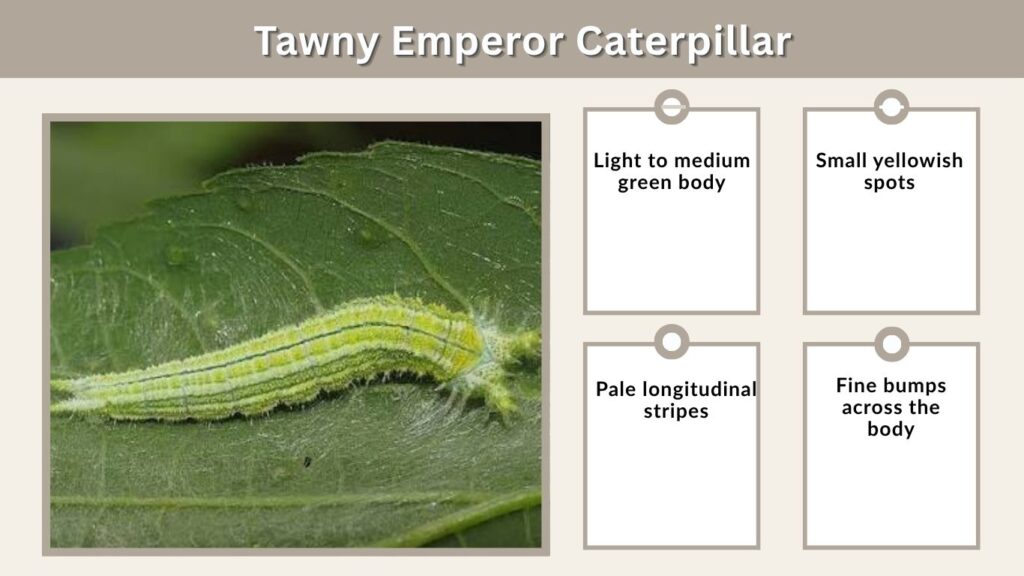
The Tawny Emperor caterpillar is green and highly adapted to life on hackberry leaves. Its unusual horned head may make it look intimidating, but these structures are not dangerous. Young caterpillars often remain together, while older larvae become more independent as they continue feeding and preparing for pupation.
Caterpillar Identification
A Tawny Emperor caterpillar typically has:
- Light to medium green body
- Small yellowish spots
- Pale longitudinal stripes
- Two horn-like projections on its head
- Two short tail-like projections
- Fine bumps across the body
- Strong camouflage on green leaves
- No dangerous stinging spines
Young larvae may look slightly different from mature caterpillars as their markings develop through successive molts.
Is the Tawny Emperor Caterpillar Poisonous?
No. Tawny Emperor caterpillars are not considered poisonous or venomous.
The horn-like projections on the head are defensive in appearance but cannot sting. The caterpillar does not have the venomous spines found on certain stinging caterpillar species.
Although it is generally harmless, unnecessary handling of wild caterpillars is best avoided.
Tawny Emperor Caterpillar Defense
Camouflage provides an important defense. The green body blends with hackberry leaves, making larvae difficult for predators to notice.
Young caterpillars may also feed together, while older larvae become more solitary. When winter approaches in colder parts of their range, partially grown caterpillars enter a resting period and shelter in curled leaves.
Tawny Emperor Host Plants and Diet
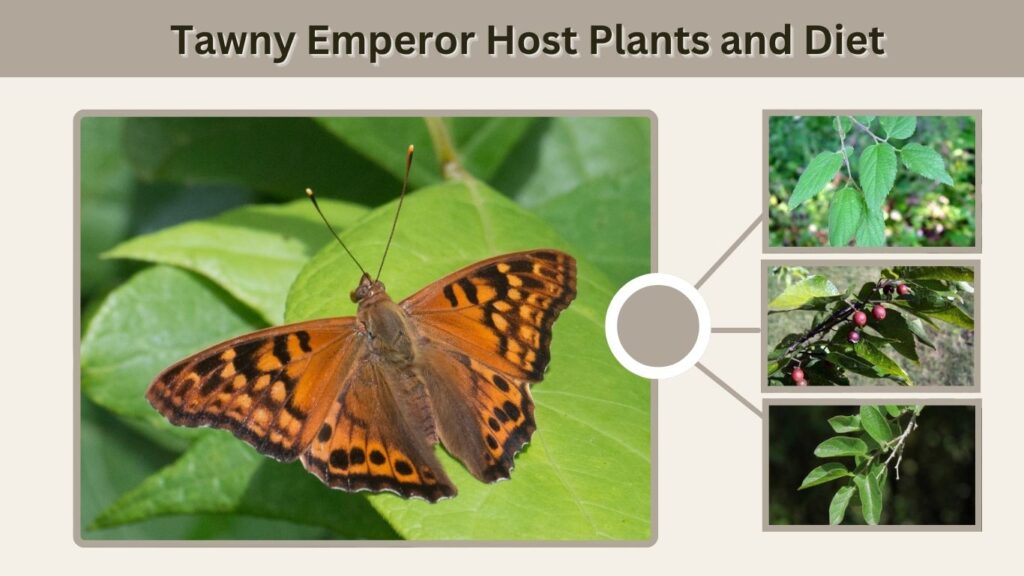
Hackberry trees are essential to the Tawny Emperor’s survival. Females carefully select these trees when laying eggs because newly hatched caterpillars need immediate access to suitable foliage. Adults, however, have very different feeding habits and are much less dependent on flowers than many other butterflies.
Tawny Emperor Larval Host Plants
Caterpillars feed primarily on hackberry species, including:
- Common hackberry
- Sugarberry
- Netleaf hackberry
- Dwarf hackberry
- Other suitable Celtis species
Hackberry trees support the butterfly during its entire larval development.
The presence of healthy hackberries can therefore greatly increase the likelihood of Tawny Emperors occurring in a particular area.
What Do Adult Tawny Emperors Eat?
Adult Tawny Emperors rarely rely heavily on flower nectar. Instead, they may feed on:
- Tree sap
- Rotting fruit
- Fermented fruit juices
- Animal droppings
- Carrion
- Mud
- Damp soil
- Mineral-rich moisture
They may occasionally land on people to obtain salts from perspiration.
This behavior is harmless and should not be confused with biting.
Tawny Emperor Habitat and Range
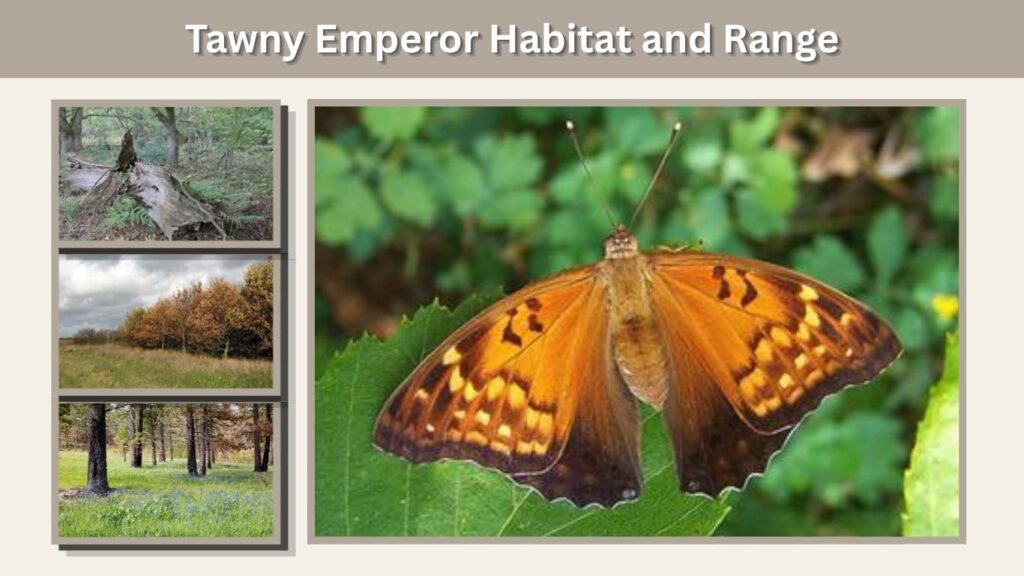
Tawny Emperors occur wherever suitable hackberry trees and woodland habitat overlap. They are particularly associated with wooded river systems but can also adapt to relatively dry forests, parks, cities, and suburban areas. Their distribution covers a broad portion of North America.
Habitat
Common Tawny Emperor habitats include:
- Riverbank forests
- Deciduous woodland
- Woodland edges
- Open forests
- Parks
- Fencerows
- Roadsides
- Suburban neighborhoods
- Areas with mature hackberry trees
Adults frequently rest on tree trunks or bare ground rather than continuously visiting flowers.
Tawny Emperor Range
The Tawny Emperor occurs across much of the eastern and central United States, with its range extending into portions of the Southwest and neighboring parts of North America.
It can be found in states such as Texas, Illinois, Michigan, New Jersey, and many areas throughout the Southeast.
Local populations are closely connected with hackberry availability, so butterflies may be common in one woodland and scarce only a short distance away.
Tawny Emperor in Texas
Texas provides extensive habitat for Tawny Emperors because several native hackberry species grow throughout the state.
Adults can occur in wooded river corridors, urban parks, forests, and suburban areas where suitable host trees are present. More than one generation may develop during long warm seasons in southern regions.
Tawny Emperor Life Cycle
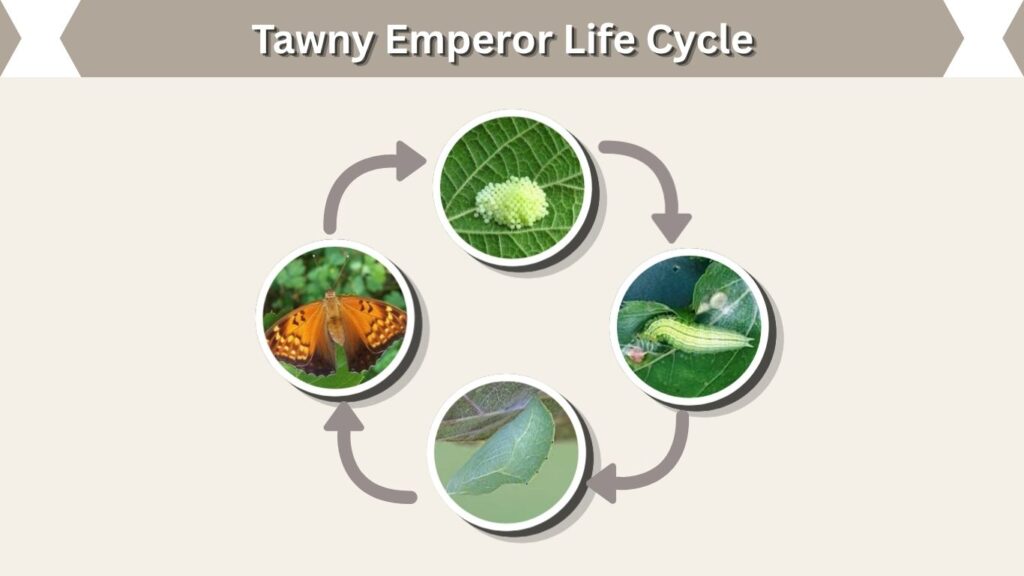
The Tawny Emperor undergoes complete metamorphosis, passing through four distinct stages: egg, caterpillar, chrysalis, and adult. Seasonal timing varies geographically. Populations in warmer southern regions can produce more generations each year than those living farther north.
Eggs
Females lay pale green eggs on hackberry trees, sometimes placing many eggs together.
After hatching, the young caterpillars remain close to their food source and begin feeding on hackberry leaves.
Early larvae are social and may remain together on the undersides of leaves before spreading out later in development.
Caterpillar Stage
Caterpillars grow through several instars, shedding their outer skin each time they become larger.
During summer, development can progress relatively quickly. In colder regions, partially grown caterpillars may overwinter rather than completing their development immediately.
They shelter within curled dead hackberry leaves and become active again when favorable spring conditions return.
Tawny Emperor Chrysalis
When fully grown, a caterpillar finds an appropriate surface and attaches itself before becoming a chrysalis.
The chrysalis is usually greenish and resembles surrounding vegetation, providing useful camouflage from birds and other predators.
Inside, the caterpillar undergoes dramatic biological changes before emerging as a winged adult.
Adult Butterfly
A newly emerged butterfly hangs while its wings expand and harden.
Adults soon begin searching for food and mates. Males often perch in sunny areas on trees and watch for passing females, occasionally chasing other butterflies from their preferred locations.
Tawny Emperor Lifespan
There is no single exact lifespan for every Tawny Emperor. Temperature, predators, weather, food availability, and geographic location all influence survival.
The adult butterfly represents only one part of its complete life cycle.
How Long Does a Tawny Emperor Live?
Individual adults generally live for a relatively short period measured in weeks rather than years.
However, the complete life cycle can extend much longer when overwintering caterpillars are considered. Northern populations may spend months in a dormant larval state before continuing development the following spring.
Multiple generations can occur in warmer climates.
Tawny Emperor vs Hackberry Emperor
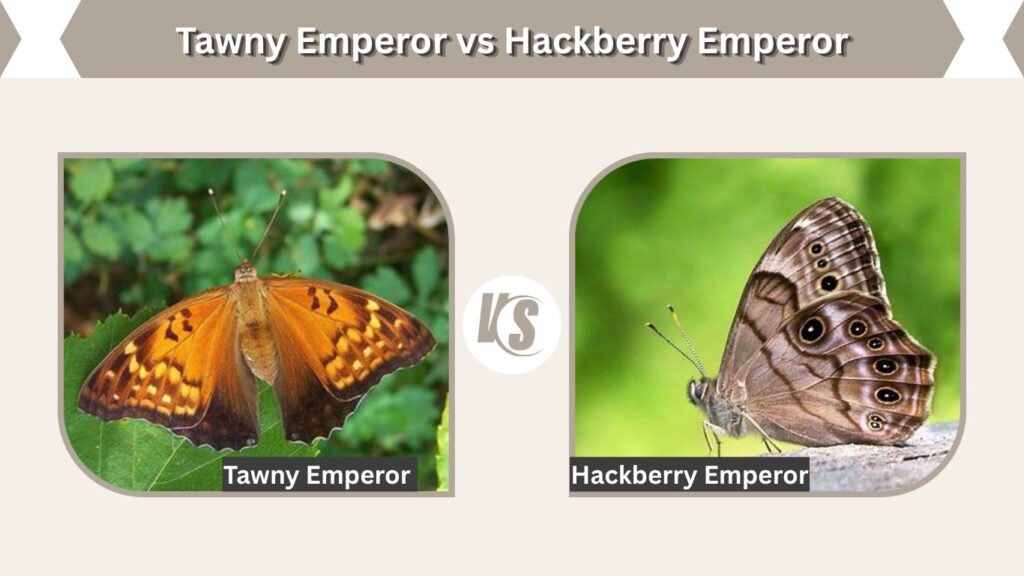
The Hackberry Emperor (Asterocampa celtis) is the butterfly most often confused with the Tawny Emperor. Both belong to the same genus, use hackberry trees as caterpillar host plants, and occupy many of the same habitats.
Key Differences
The Tawny Emperor generally has:
- Richer rusty or chestnut coloration
- Two strong dark bars in the forewing cell
- Fewer obvious white forewing spots
- No prominent forewing eyespot
- A more uniformly tawny appearance
The Hackberry Emperor generally has:
- More noticeable pale or white forewing spots
- A more patterned appearance
- Distinctive dark eyespot markings
- A somewhat grayer or tan overall appearance
Wing patterns are usually more reliable than size alone for distinguishing the two.
Tawny vs Hackberry Emperor Caterpillars
Their caterpillars can also look remarkably similar. Both are green, have horn-like head projections, and depend heavily on hackberry foliage.
Tawny Emperor caterpillars tend to use more mature leaves, while Hackberry Emperor larvae may favor newer foliage. This difference can reduce competition when both species inhabit the same trees.
Tawny Emperor Male vs Female
Male and female Tawny Emperors share similar wing patterns, but there are subtle differences in size and behavior.
Female Tawny Emperor
Females are generally larger and have fuller abdomens, especially when carrying eggs.
They spend considerable time searching for appropriate hackberry trees where they can deposit their eggs. Selecting a suitable host plant is critical because young caterpillars cannot simply move long distances to find another tree.
Male Tawny Emperor
Males are generally smaller and are more likely to be seen perching in sunny woodland openings or on tree trunks.
They watch for females and may rapidly chase passing butterflies. Males also seek mineral-rich food sources such as damp ground, sap, carrion, or animal droppings.
Tawny Emperor Spiritual Meaning and Symbolism
There is no scientifically established spiritual meaning for the Tawny Emperor butterfly. Butterfly symbolism comes primarily from cultural beliefs and personal interpretation. Because Tawny Emperors undergo complete metamorphosis, they can naturally inspire associations with transformation and change.
Common Symbolic Meanings
People may associate a Tawny Emperor with:
- Transformation
- Personal growth
- Adaptability
- Resilience
- Renewal
- Change
- Connection with nature
- Moving through a new life stage
These meanings are symbolic rather than biological facts.
Seeing a Tawny Emperor usually has a simple ecological explanation: suitable habitat and hackberry trees are probably nearby.
FAQs
Is the Tawny Emperor butterfly rare?
The Tawny Emperor is not generally considered rare across its overall range, but local abundance varies. It can be common where mature hackberry trees occur and much harder to find where host plants are absent.
Is a Tawny Emperor caterpillar poisonous?
No. Tawny Emperor caterpillars are not poisonous or venomous and do not have dangerous stinging spines.
What is the Tawny Emperor host plant?
Hackberry trees in the genus Celtis are the primary host plants. Caterpillars feed on their leaves throughout larval development.
Do Tawny Emperor butterflies drink flower nectar?
They rarely visit flowers compared with many butterflies. Adults more commonly feed on tree sap, rotting fruit, carrion, animal droppings, and other sources containing sugars or minerals.
What is the scientific name of the Tawny Emperor?
The scientific name is Asterocampa clyton. It belongs to the family Nymphalidae, commonly known as the brush-footed butterflies.