
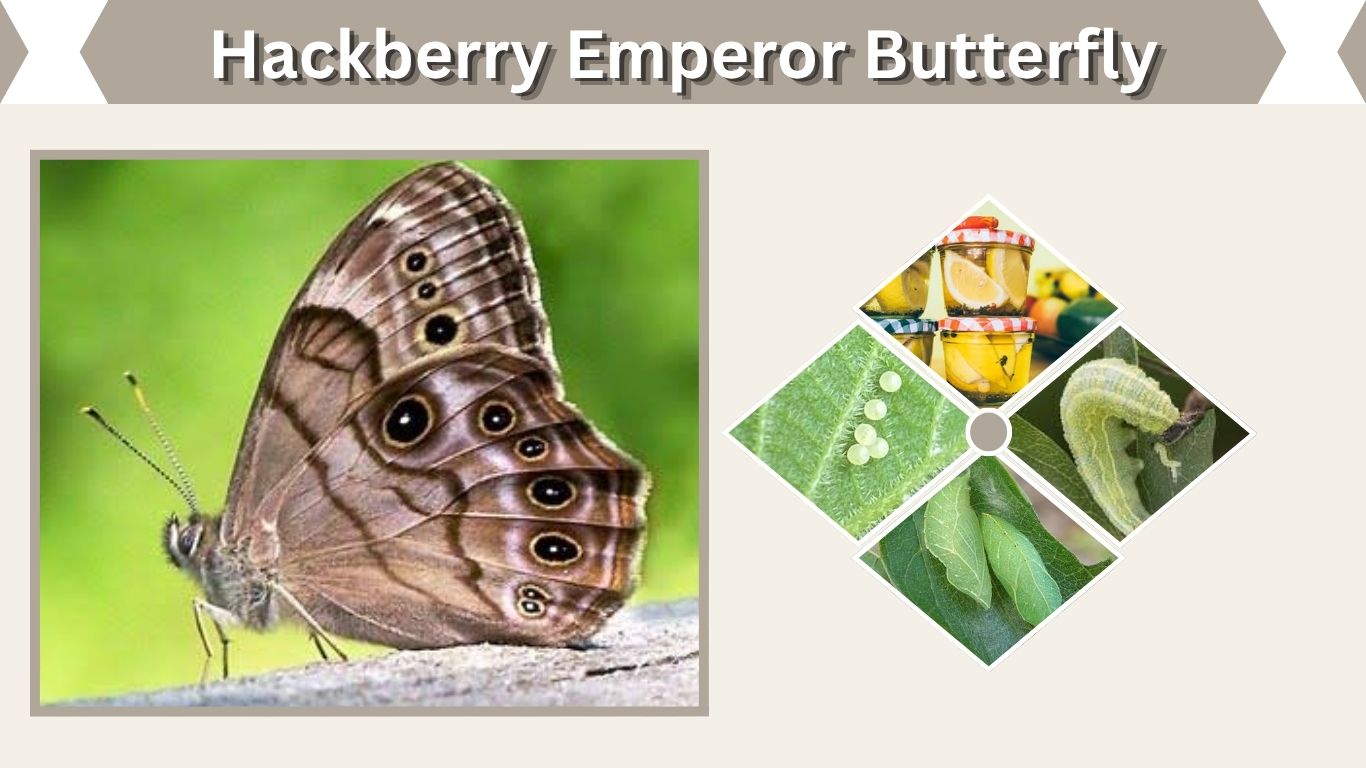
The Hackberry Emperor is a fast-flying brown butterfly commonly associated with hackberry trees across much of North America. Scientifically known as Asterocampa celtis, it is especially recognizable for its orange-brown wings, dark markings, and prominent eyespots. Unlike many butterflies, adults do not depend heavily on flower nectar and may instead visit tree sap, rotting fruit, animal droppings, or even people for salts from sweat. This guide covers Hackberry Emperor identification, caterpillars, habitat, life cycle, host plants, male and female differences, and comparisons with the similar Tawny Emperor.
What Is a Hackberry Emperor?
The Hackberry Emperor is a member of the brush-footed butterfly family, Nymphalidae. Its close association with hackberry trees gives the species its common name. Adults are energetic fliers and are frequently found around woodland edges, river corridors, parks, roadsides, and yards containing mature hackberry trees.
Hackberry Emperor Identification
Common identification features include:
- Scientific name: Asterocampa celtis
- Family: Nymphalidae
- Color: Orange-brown to grayish brown
- Wings: Dark bars, pale spots, and eyespots
- Wingspan: Roughly 1.5–2.5 inches
- Body: Brown with relatively long antennae
- Flight: Fast and active
- Primary host: Hackberry trees
- Type: Butterfly, not a moth
The upper wings generally have a warm brown or tawny appearance with darker markings. Several dark eyespots appear toward the outer portions of the hindwings.
Is the Hackberry Emperor a Moth?
No. Although searches sometimes refer to a “Hackberry Emperor moth,” Asterocampa celtis is a butterfly.
It belongs to the same family as monarchs, fritillaries, admirals, and many other familiar butterflies. Like other brush-footed butterflies, the first pair of legs is reduced, making adults appear to stand on only four legs.
Hackberry Emperor Caterpillar
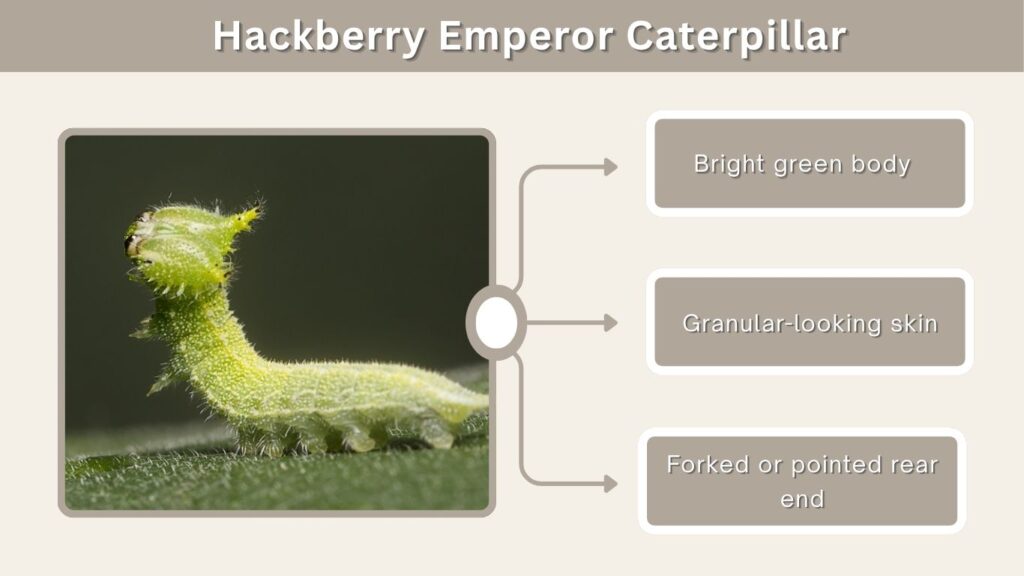
The Hackberry Emperor caterpillar looks very different from the adult butterfly. Larvae are usually green and well camouflaged against hackberry leaves. Their horned heads can make them appear unusual, but the caterpillars are harmless to people and do not have venomous spines.
Caterpillar Identification
A Hackberry Emperor caterpillar typically has:
- Bright green body
- Yellowish or pale longitudinal stripes
- Granular-looking skin
- Two prominent horn-like projections on the head
- Forked or pointed rear end
- Strong camouflage against foliage
- Relatively smooth body without stinging spines
These characteristics become easier to recognize as the caterpillar matures.
Is the Hackberry Emperor Caterpillar Poisonous?
No. Hackberry Emperor caterpillars are not considered poisonous or venomous.
Their head horns may look threatening, but they are not stingers. The caterpillar relies primarily on camouflage and its unusual body shape for protection.
As with any wild caterpillar, unnecessary handling is best avoided, but this species is not known as a medically significant stinging caterpillar.
What Do Hackberry Emperor Caterpillars Eat?
Hackberry trees are the essential larval host plants.
Caterpillars feed on foliage from species in the genus Celtis, including:
- Common hackberry
- Sugarberry
- Other native hackberry species
Females normally lay eggs directly on suitable host plants so newly hatched larvae have immediate access to food.
Hackberry Emperor Eggs and Chrysalis
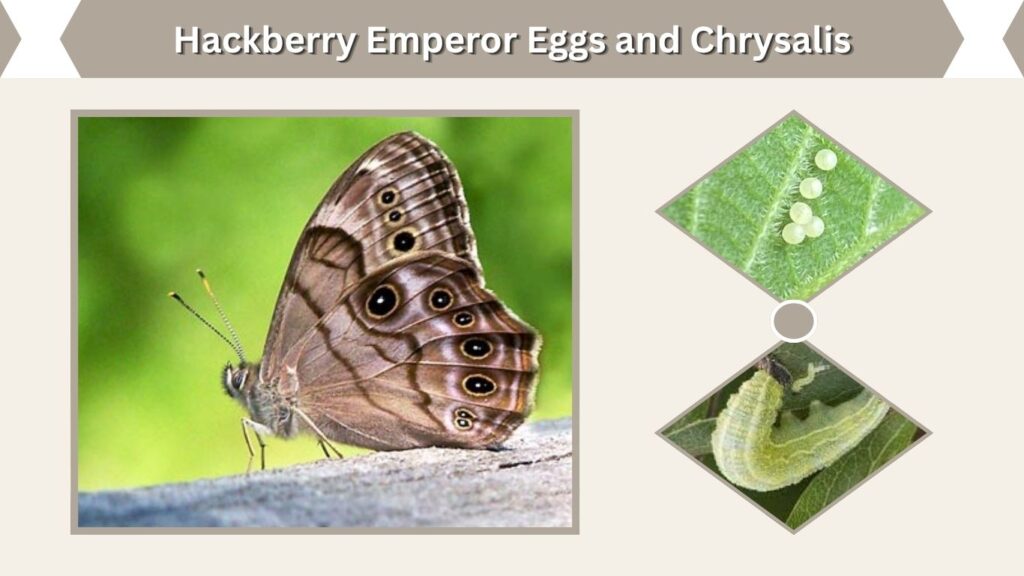
The life of a Hackberry Emperor begins on a hackberry tree. Females lay small eggs on the foliage, and the emerging caterpillars begin feeding soon afterward. After growing through several larval stages, the caterpillar forms a chrysalis where its body transforms into the adult butterfly.
Hackberry Emperor Eggs
Eggs are deposited on or near hackberry leaves.
Females can lay eggs in groups, making a suitable host tree particularly important for successful reproduction. Newly hatched larvae may initially stay relatively close together before spreading out as they develop.
Egg development depends on temperature and environmental conditions.
Hackberry Emperor Chrysalis
The chrysalis is generally greenish and blends well with leaves and vegetation.
Before pupation, the mature caterpillar attaches itself securely to a protected surface. Inside the chrysalis, the larval body undergoes complete metamorphosis.
After development is complete, the adult butterfly emerges, expands its wings, and begins flying once the wings have hardened.
Hackberry Emperor Life Cycle
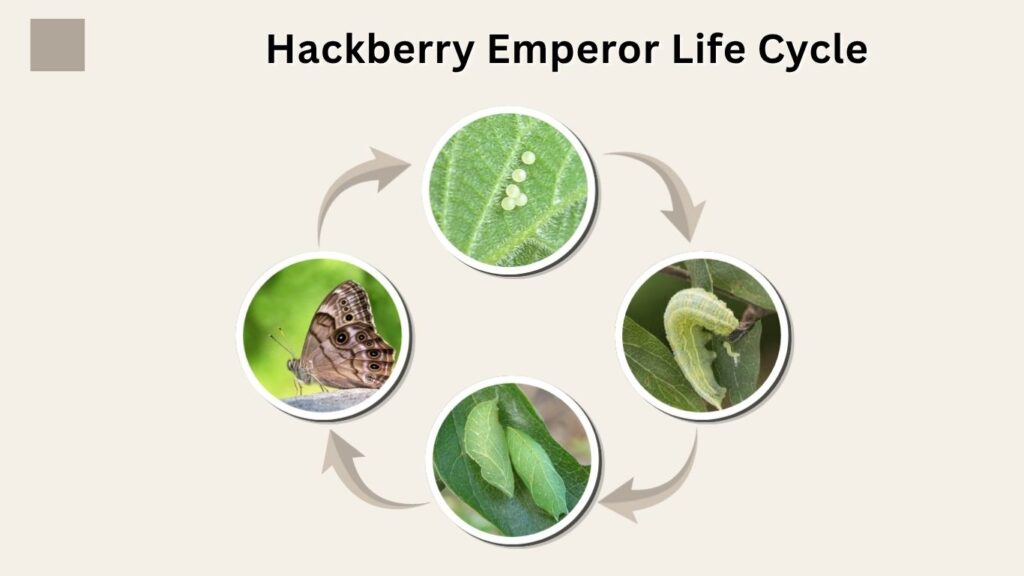
The Hackberry Emperor undergoes complete metamorphosis with four stages: egg, caterpillar, chrysalis, and adult. Depending on climate, more than one generation can occur during warmer months. In colder parts of the range, the species must survive winter before completing development the following season.
Egg to Adult
The basic life cycle includes:
- Egg: Females lay eggs on hackberry foliage.
- Larva: Caterpillars hatch and feed on leaves.
- Growing caterpillar: Larvae molt several times.
- Chrysalis: A mature caterpillar pupate.
- Adult: The butterfly emerges and begins reproducing.
Warm temperatures accelerate insect development, while cooler conditions slow it.
How Do Hackberry Emperors Survive Winter?
In colder regions, young caterpillars can overwinter in protected places associated with their host trees.
Development resumes when temperatures rise and fresh hackberry leaves become available. This seasonal strategy allows the butterfly to survive areas with freezing winters.
Hackberry Emperor Lifespan
The adult portion of the life cycle is relatively short compared with the entire development from egg to butterfly.
Exact lifespan varies with weather, predators, food availability, and generation. Adults devote their time primarily to feeding, mating, dispersal, and laying eggs for the next generation.
Hackberry Emperor Habitat and Range
Hackberry Emperors closely follow the distribution of their host trees. They are particularly common around wooded landscapes where hackberries grow naturally. Because hackberry trees tolerate many environments, the butterflies may also occur in cities, parks, gardens, and suburban neighborhoods.
Habitat
Typical habitats include:
- Deciduous woodland
- Woodland edges
- River valleys
- Stream corridors
- Parks
- Roadsides
- Forest openings
- Suburban yards
- Areas containing hackberry trees
Adults frequently perch on tree trunks, leaves, paths, or sunny open ground.
Hackberry Emperor Range
The species occurs across much of the central and eastern United States and extends into neighboring parts of North America.
It is especially common where native hackberry trees are abundant. Records occur across many southern and Midwestern states, including Texas, and farther north into parts of the Great Lakes region.
Local abundance can vary dramatically depending on host-tree availability.
What Do Adult Hackberry Emperors Eat?
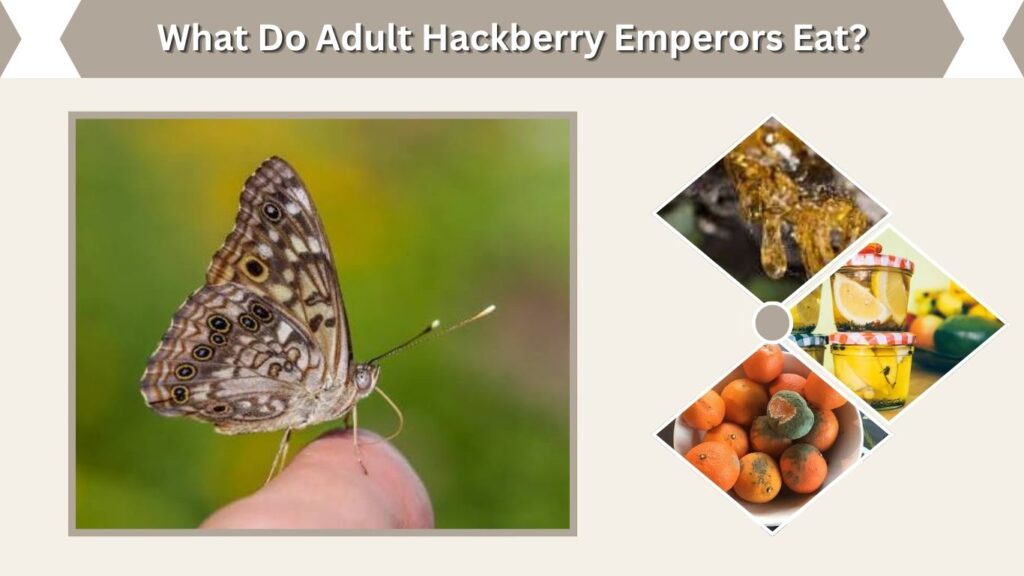
Hackberry Emperors have unusual feeding habits compared with butterflies that regularly visit colorful flowers. Adults obtain nutrients from several non-floral sources and can become surprisingly bold around people.
Adult Food Sources
Adults may feed on:
- Tree sap
- Rotting fruit
- Fermenting fruit juices
- Animal droppings
- Carrion
- Mud and damp soil
- Salts from human perspiration
People sometimes notice Hackberry Emperors repeatedly landing on their arms, clothing, or skin.
Why Do Hackberry Emperors Land on People?
The butterflies may be attracted to salts and minerals in sweat.
This behavior is harmless. The butterfly is not trying to bite or sting. Instead, it extends its proboscis to collect dissolved salts and moisture.
Their willingness to approach humans can make Hackberry Emperors unusually easy butterflies to observe at close range.
Hackberry Emperor Male vs Female
Males and females have similar overall coloration, making sex determination difficult for casual observers. However, differences in body proportions and behavior can offer clues.
Male Hackberry Emperor
Males tend to spend considerable time patrolling territories and watching for females.
They may perch on tree trunks, branches, or sunny openings before rapidly chasing other butterflies. Males are also frequently attracted to sources of salts and minerals.
Female Hackberry Emperor
Females are generally more closely associated with host trees when preparing to lay eggs.
Their abdomens may appear fuller, particularly when carrying developed eggs. They search for appropriate hackberry foliage before depositing eggs that will supply food for emerging larvae.
Color alone is usually not the easiest way to separate males and females.
Hackberry Emperor vs Tawny Emperor
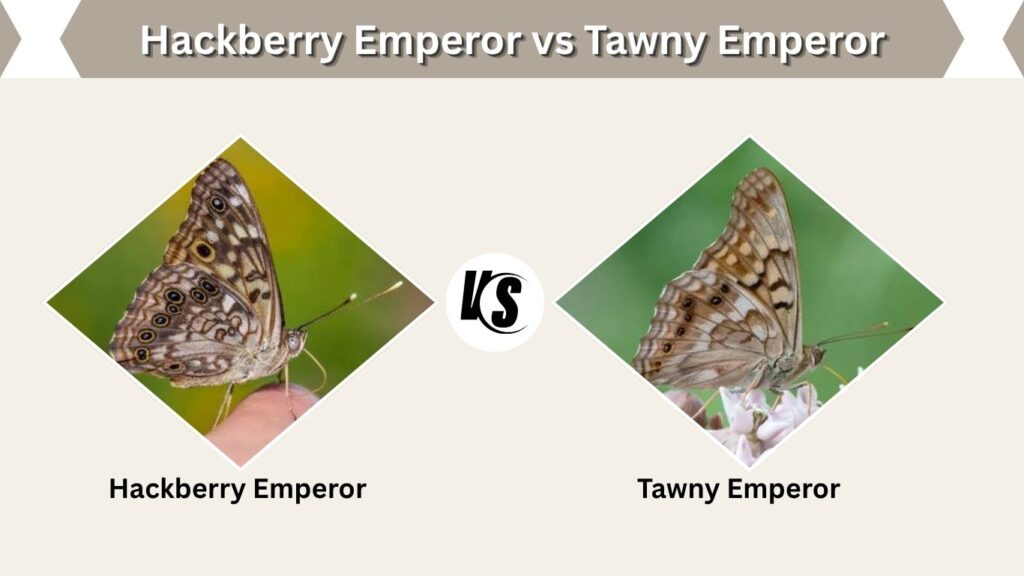
The Tawny Emperor (Asterocampa clyton) is the species most likely to be confused with the Hackberry Emperor. Both butterflies use hackberry trees as larval hosts, occupy similar habitats, and have brown or orange-brown wings.
Key Differences
Hackberry Emperors usually show:
- More obvious white spotting on the forewings
- More contrasting wing markings
- Stronger dark eyespots
- A somewhat patterned overall appearance
Tawny Emperors generally appear:
- More uniformly tawny or orange-brown
- Less strongly marked with white
- Slightly more subdued in pattern
- Similar in general size and shape
Careful examination of wing markings is often necessary when both species occur together.
Caterpillar Differences
Both species have green, horned caterpillars that feed on hackberry.
This makes larval identification challenging. Looking at detailed markings and head structures can help, but host plant alone cannot distinguish them because both species use similar trees.
Hackberry Emperor Meaning and Symbolism
There is no scientifically established spiritual meaning associated specifically with the Hackberry Emperor. Interpretations of butterflies as spiritual symbols come from cultural traditions and personal beliefs rather than entomology.
Hackberry Emperor Spiritual Meaning
People may symbolically associate the butterfly with:
- Transformation
- Adaptability
- Change
- Personal growth
- Resilience
- Renewal
- Connection with nature
- Moving into a new life stage
The transformation from caterpillar to butterfly makes butterflies natural symbols of change in many cultures.
What Does Seeing a Hackberry Emperor Mean?
Biologically, seeing one usually means suitable habitat or hackberry trees are nearby.
A butterfly repeatedly landing on a person may simply be seeking salts from perspiration rather than delivering a supernatural message. People can still assign personal meaning to an encounter, but such interpretations are symbolic rather than scientific.
FAQs
Is the Hackberry Emperor butterfly rare?
Not generally. It can be locally abundant wherever hackberry trees are common, although populations vary by region and season.
What is the scientific name of the Hackberry Emperor?
Its scientific name is Asterocampa celtis. It belongs to the butterfly family Nymphalidae.
Are Hackberry Emperor caterpillars poisonous?
No. The green horned caterpillars are not known to be poisonous or venomous and do not possess dangerous stinging spines.
What is the host plant for Hackberry Emperors?
Hackberry trees in the genus Celtis are the primary larval host plants. Caterpillars depend on their leaves for food.
What is the difference between a Tawny Emperor and Hackberry Emperor?
Hackberry Emperors generally have more contrasting white and dark markings on the wings. Tawny Emperors tend to look more uniformly orange-brown or tawny.