
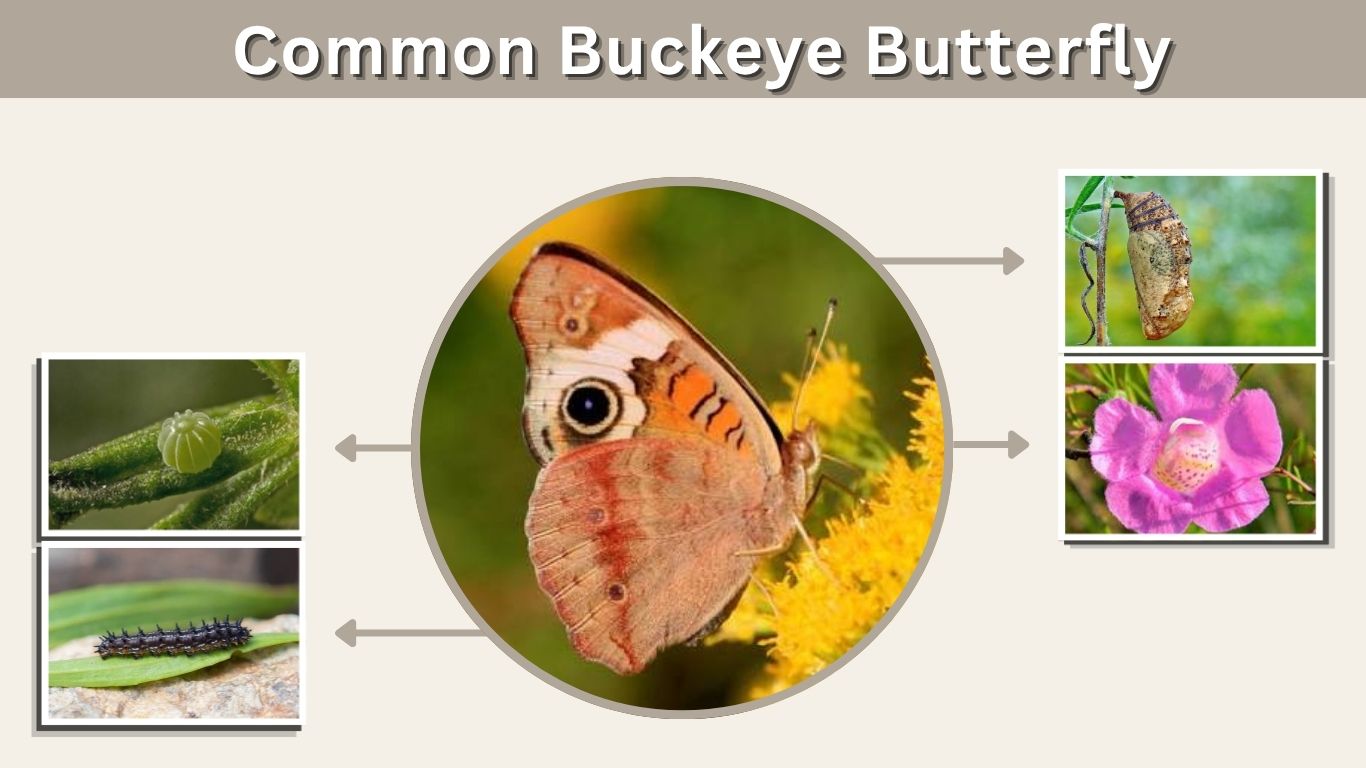
The Common Buckeye (Junonia coenia) is a striking North American butterfly recognized by its large, colorful eyespots and orange-and-white wing markings. It favors sunny, open habitats such as fields, roadsides, gardens, and disturbed areas. Common Buckeyes are active, low-flying butterflies that often rest on bare ground with their wings spread. Their caterpillars feed on plants such as plantain, toadflax, false foxglove, and twinflower. The species produces multiple generations each year and can migrate far north during the warmer months.
What Does a Common Buckeye Look Like?
The Common Buckeye belongs to the brush-footed butterfly family Nymphalidae. Its bold eyespots are its most obvious feature and may help startle or redirect predators. Adults usually fly close to the ground and frequently stop on bare soil or low vegetation. Their wing coloration changes somewhat with the season, particularly on the underside of the hindwings.
Common Buckeye Identification
- Scientific name: Junonia coenia
- Family: Nymphalidae
- Wingspan: about 1 5/8–2 3/4 inches
- Upper wings mainly brown
- Two orange bars on each forewing
- Large colorful eyespots on forewings and hindwings
- Largest hindwing eyespot contains a magenta crescent
- Summer underside generally brown or tan
- Fall form may have rosy or reddish hindwings
The distinctive combination of orange bars and large eyespots makes adults relatively easy to recognize.
Is the Common Buckeye a Moth?
No. Despite searches for “Common Buckeye moth,” Junonia coenia is a butterfly.
It belongs to the butterfly family Nymphalidae. Like other butterflies and moths, however, it belongs to the order Lepidoptera and develops through egg, caterpillar, chrysalis, and adult stages.
Its daytime activity and characteristic butterfly body form are additional clues that distinguish it from most moths.
Common Buckeye Caterpillar
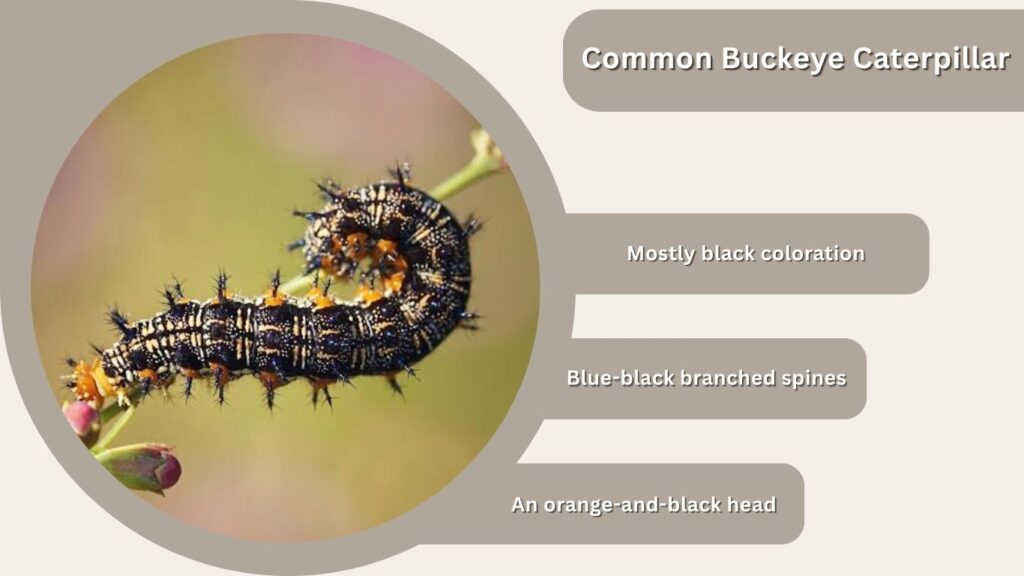
Common Buckeye caterpillars look very different from the colorful adults. Mature larvae are predominantly dark and covered with numerous branched spines. White or pale stripes and orange markings occur along the body. Although the caterpillar looks intimidating, the spines are not among the specialized venom-delivering structures associated with medically significant stinging caterpillars.
Caterpillar Identification
A mature Common Buckeye caterpillar typically has:
- Mostly black coloration
- Blue-black branched spines
- White or pale stripes along the sides
- Orange patches or markings
- Orange bases around some spines
- An orange-and-black head
- A mature length approaching about 45 mm
The caterpillars are generally solitary rather than feeding together in large groups.
Are Common Buckeye Caterpillars Poisonous?
Common Buckeye caterpillars are not generally listed among dangerous stinging caterpillars.
Their branched spines can make them look threatening, but appearance alone should never be used to decide whether an unfamiliar caterpillar is safe to handle.
It is best to observe caterpillars without touching them, especially when identification is uncertain.
Common Buckeye Host Plants
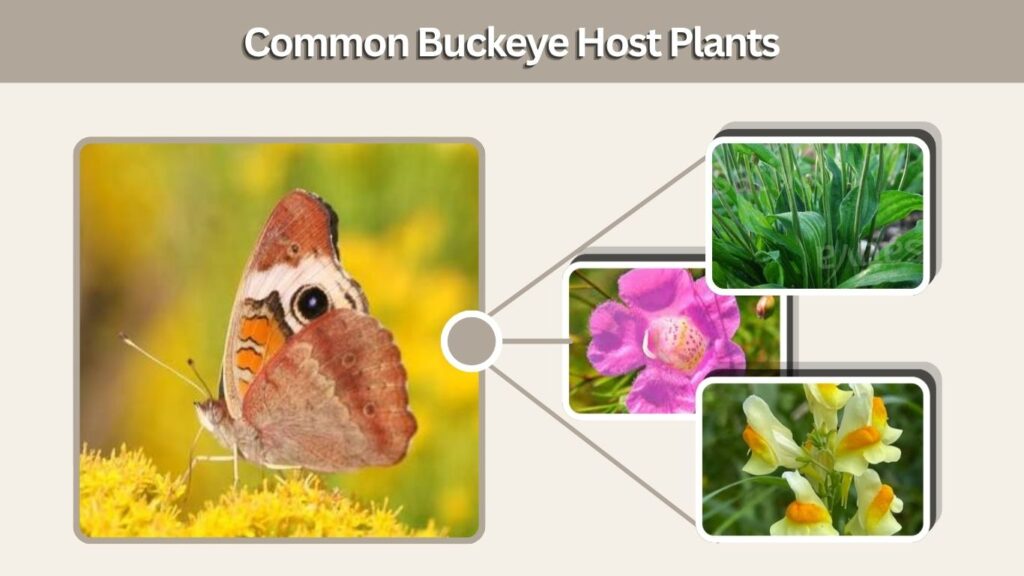
Female Common Buckeyes lay individual eggs directly on suitable host plants. Once the caterpillar hatches, it eats the plant’s foliage as it develops. The species uses several groups of herbaceous plants, which helps it occupy gardens, fields, roadsides, and other disturbed habitats where these plants grow naturally.
Common Host Plants
Important caterpillar foods include:
- Plantain (Plantago species)
- Toadflax (Linaria species)
- False foxglove (Agalinis species)
- Twinflower (Dyschoriste species)
- Turkey tangle fogfruit (Phyla nodiflora)
- American bluehearts
- Snapdragon and related plants
Canada toadflax is also documented as a Common Buckeye host plant.
Best Host Plants for a Butterfly Garden
Plantain, native false foxgloves, twinflowers, and frogfruit can help support Common Buckeye caterpillars.
A butterfly garden needs more than nectar flowers because adults and larvae require different resources. Nectar plants feed the butterflies, while host plants provide the leaves necessary for caterpillar development.
Allowing some natural host vegetation to remain can greatly improve breeding opportunities.
What Do Common Buckeye Butterflies Eat?
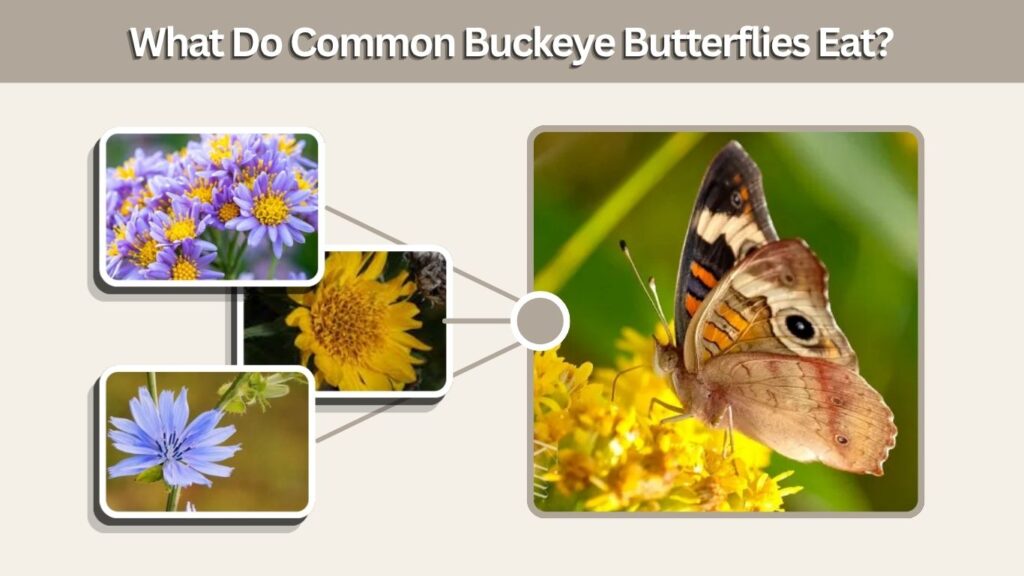
The caterpillar and adult have completely different diets. Caterpillars chew host-plant leaves, whereas adults obtain energy mainly by drinking liquids with their proboscis. Flowers in sunny open habitats are particularly important because Common Buckeyes spend much of their adult lives flying between low vegetation, feeding sites, and territories.
Adult Diet
Common Buckeye adults visit flowers such as:
- Asters
- Chicory
- Gumweed
- Knapweed
- Tickseed sunflower
- Dogbane
- Peppermint
- Various other nectar-producing flowers
Some regional sources also record adults feeding on rotting fruit.
Caterpillar Diet
Caterpillars eat leaves rather than flower nectar.
They remain on or near their host plants while developing and may consume noticeable portions of foliage. In most natural settings, this feeding is simply part of the plant-insect relationship rather than a serious pest problem.
Common Buckeye Life Cycle
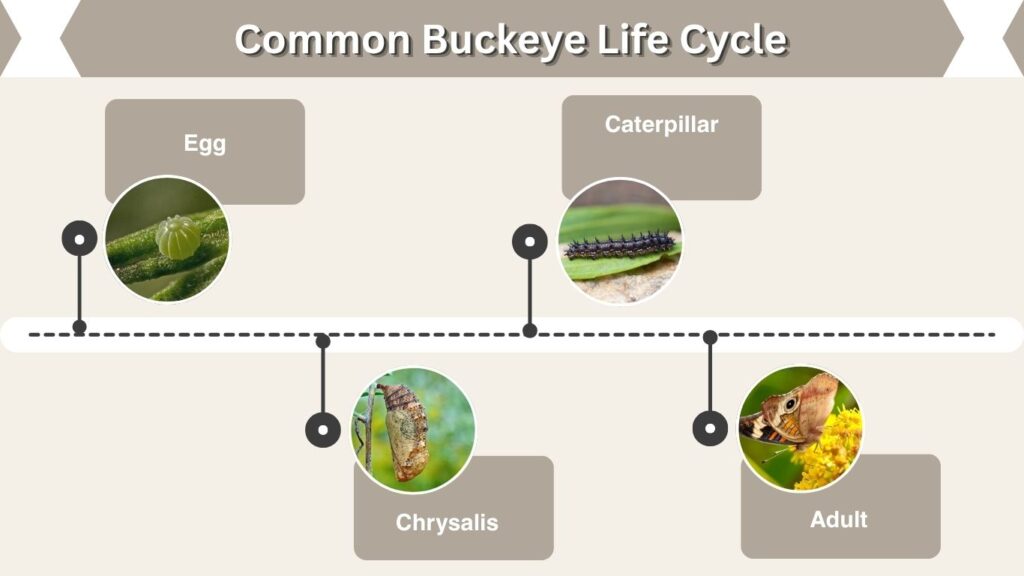
Like all butterflies, the Common Buckeye undergoes complete metamorphosis. Females select appropriate larval host plants before laying their eggs. Several generations may develop during a single warm season, allowing populations to increase quickly. In southern areas, the species can remain active for much more of the year than it can in northern parts of its temporary range.
Four Life Stages
- Egg: Small green eggs are laid singly on host plants.
- Caterpillar: The dark, spiny larva feeds on leaves and grows through several molts.
- Chrysalis: The mature caterpillar becomes a mottled brown or gray-brown pupa.
- Adult: The eyespotted butterfly emerges, feeds, mates, and produces another generation.
The chrysalis often has mottled coloration and short projections that help it blend into vegetation.
Common Buckeye Chrysalis
The Common Buckeye does not make a furry silk cocoon like some moths.
Instead, the caterpillar forms a chrysalis. It is typically brown, gray-brown, or cream and hangs from vegetation while metamorphosis occurs inside.
Its mottled appearance provides camouflage against stems, dried vegetation, and surrounding plant material.
Common Buckeye Habitat and Range
Common Buckeyes favor open landscapes rather than dense forests. Bare patches of soil are especially useful because males frequently perch on the ground while watching for females and defending small territories. Their ability to use disturbed environments explains why they are commonly encountered along roads, in gardens, fields, and other sunny landscapes.
Habitat
Common habitats include:
- Open fields
- Gardens
- Roadsides
- Forest edges
- Meadows
- Disturbed areas
- Sunny areas with low vegetation
- Places containing patches of bare soil
Adults typically fly quickly and somewhat erratically close to the ground.
Range and Migration
The species is resident across much of the southern United States, extending south into Mexico, Cuba, Bermuda, and nearby areas.
In late spring and summer, butterflies from southern populations move northward and can temporarily colonize much of the United States and parts of southern Canada.
This seasonal movement explains sightings in places such as New York, Minnesota, and southern Canada even though populations may not survive harsh northern winters.
Male vs Female Common Buckeye
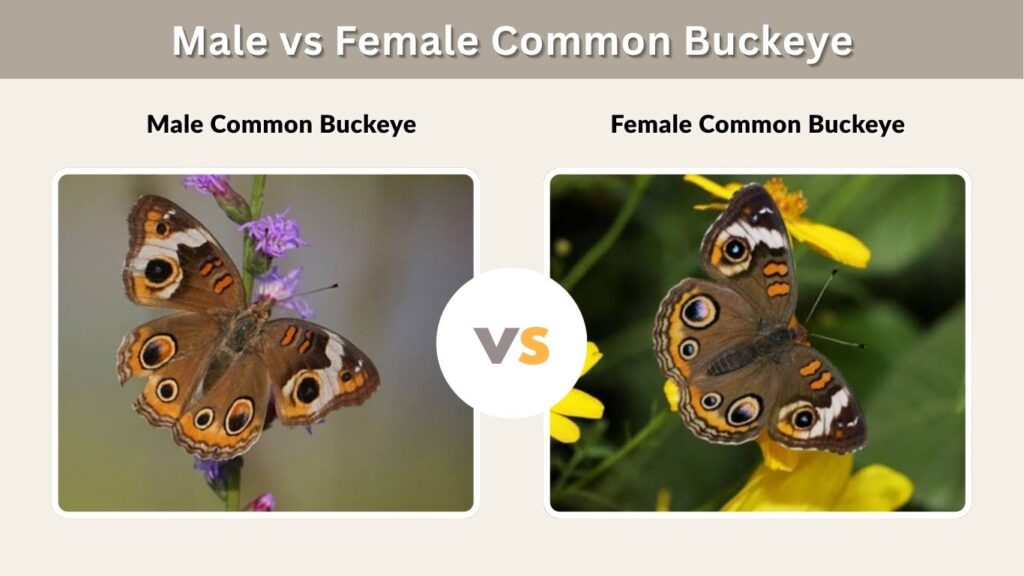
Male and female Common Buckeyes look very similar, so determining sex from a photograph can sometimes be difficult. Behavior may provide additional clues. Males frequently establish territories on bare ground or low vegetation and chase passing butterflies, while females spend more time locating host plants suitable for egg laying.
Male and Female Differences
- Females tend to be slightly larger.
- Female wings are often somewhat more rounded.
- Females may have more strongly developed light markings.
- Female eyespots sometimes appear larger.
- Male forewings tend to be slightly more fallacious.
- Males frequently perch and patrol territories.
These characteristics can overlap, so sex is not always obvious from wing markings alone.
Common Buckeye vs Tropical Buckeye
Common and Tropical Buckeyes belong to the same genus and share conspicuous eyespots. Their ranges also overlap in some southern locations, which can make identification challenging. Careful examination of wing bands and eyespot proportions is more reliable than relying simply on overall brown coloration.
Key Difference
The Common Buckeye (Junonia coenia) generally has orange forewing bars and its characteristic arrangement of eyespots.
The Tropical Buckeye (Junonia evarete) has a broad forewing band that can appear white with brown or orange diffusion, and its eyespot proportions differ. The Tropical Buckeye is associated mainly with warmer tropical and subtropical regions.
Common Buckeye Meaning and Symbolism
Butterflies frequently carry symbolic meanings in art and popular culture, and the Common Buckeye’s dramatic eyespots can inspire personal interpretations involving awareness, transformation, protection, or change.
Spiritual Meaning
There is no scientifically established spiritual meaning for the Common Buckeye.
Ideas about transformation, resilience, watchfulness, or renewal are cultural or personal interpretations rather than biological characteristics of the species.
Its scientifically documented significance lies in its role as a pollinator, herbivore, prey species, and member of open-habitat ecosystems.
FAQs
Common Buckeyes are easily recognized once their eyespot pattern becomes familiar, but their spiny caterpillars, seasonal color changes, and migratory behavior often lead to additional identification questions.
1. Is the Common Buckeye a butterfly or moth?
It is a butterfly in the family Nymphalidae, not a moth.
2. What is the scientific name of the Common Buckeye?
Its scientific name is Junonia coenia.
3. What plants do Common Buckeye caterpillars eat?
Important hosts include plantain, toadflax, false foxglove, twinflower, and turkey tangle fogfruit.
4. Are Common Buckeye caterpillars poisonous?
They are not generally regarded as dangerous stinging caterpillars, although unfamiliar caterpillars should still be handled cautiously.
5. Do Common Buckeye butterflies migrate?
Yes. Southern populations expand northward during late spring and summer, temporarily reaching much of the United States and parts of southern Canada.