
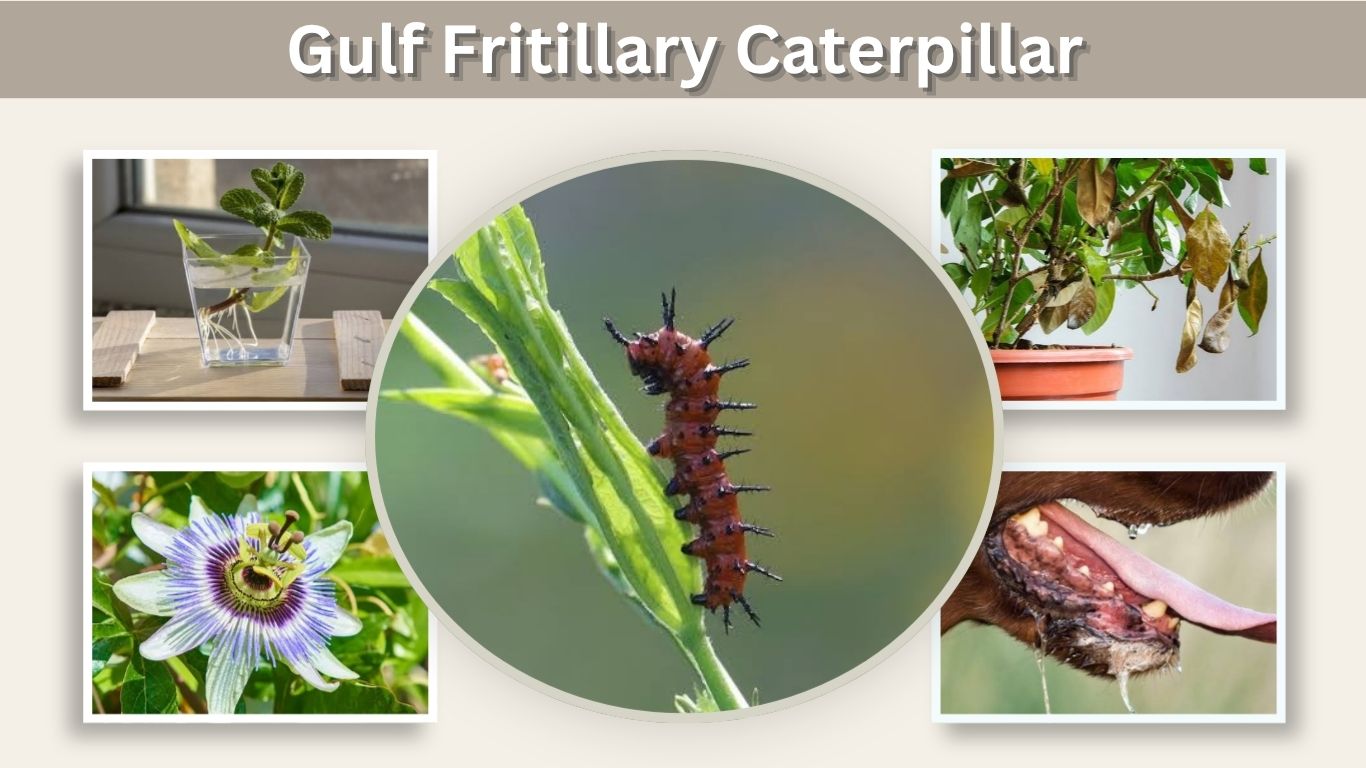
The Gulf fritillary caterpillar is a bright orange larva covered with rows of black, branched spines. Although its appearance can seem threatening, it does not sting and is not considered dangerous to humans. This caterpillar feeds mainly on passionflower vines before forming a brown chrysalis and emerging as a vivid orange butterfly. Understanding its appearance, diet, growth stages, and behavior can help gardeners protect both their plants and these beneficial pollinators. Proper care is especially important when numerous caterpillars occupy a young passion vine.
How to Identify a Gulf Fritillary Caterpillar
Gulf fritillary caterpillars are among the easiest butterfly larvae to recognize. Their orange coloration and black spines create a strong warning pattern that discourages many predators. The species’ current scientific name is Dione vanillae, although it is also widely listed under its former name, Agraulis vanillae.
Identification Features
- Body color: Bright orange to reddish-orange
- Markings: Dark spots or bands along the body
- Spines: Several rows of black, branched spines
- Head: Orange-brown to dark brown
- Mature size: Approximately 1.5 to 1.75 inches long
- Host plant: Almost always found on passion vines
- Adult form: Orange Gulf fritillary butterfly
- Common name variation: Gulf Coast fritillary caterpillar
The caterpillar’s spines may look hard and sharp, but they are relatively soft defensive structures. They are not connected to venom glands.
Gulf Fritillary vs Oleander Caterpillar
Both species are orange and may be found in warm areas, but they have different markings and diets. The Gulf fritillary caterpillar has long, black, branched spines and normally feeds on passionflower vines.
The oleander caterpillar is orange with clumps of long black hairs growing from dark bumps. It feeds mainly on oleander and occasionally desert rose. Therefore, an orange caterpillar eating desert rose or oleander is more likely to be an oleander caterpillar than a Gulf fritillary.
Gulf Fritillary vs Variegated Fritillary Caterpillar
The variegated fritillary is a separate butterfly species. Its caterpillar is mostly red or reddish-orange with pale spots, black markings, and dark spines. It can eat violets, flax, plantain, and passionflower.
Location alone is not enough for identification because both species can use passion vines. Close examination of the body pattern and the resulting adult butterfly provides a more reliable answer.
Are Gulf Fritillary Caterpillars Dangerous?
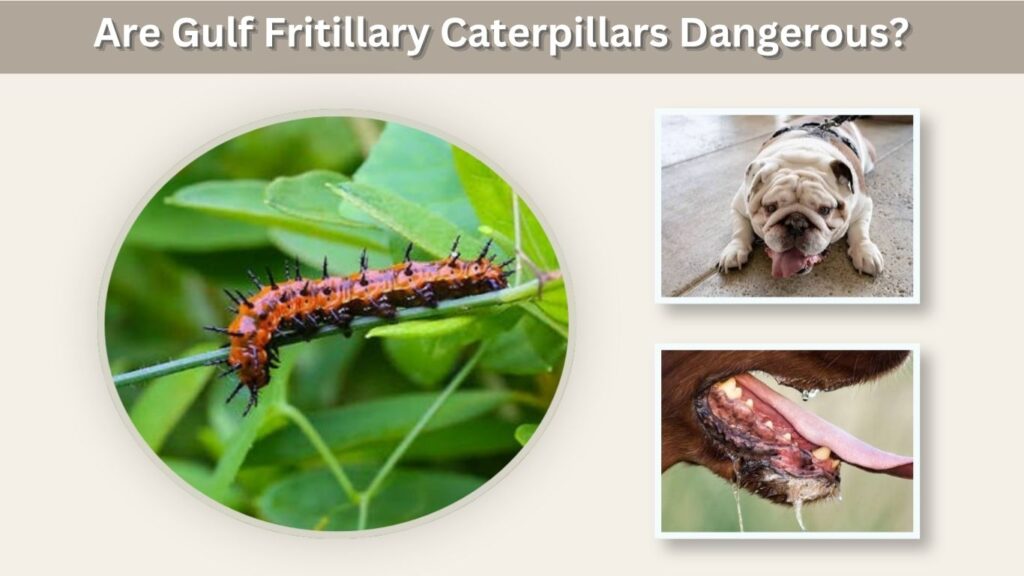
The caterpillar’s bright warning colors help advertise that it may taste unpleasant to predators. However, it poses little risk when observed or handled carefully. It cannot bite people effectively, inject venom, or deliver a painful sting through its spines.
Do Gulf Fritillary Caterpillars Sting?
Gulf fritillary caterpillars do not sting. Their black spines are not comparable to the venomous spines of puss, saddleback, or buck moth caterpillars. Touching one normally does not cause a painful reaction.
Nevertheless, it is better to avoid unnecessary handling. People with sensitive skin may experience minor irritation from contact with almost any hairy or spiny insect. If contact causes discomfort, wash the affected area with soap and water.
Are They Poisonous to Humans?
They are not considered dangerously poisonous to humans through ordinary contact. Caterpillars obtain defensive chemicals from passionflower leaves, potentially making them distasteful or harmful when eaten by certain predators.
This chemical defense does not mean that the caterpillar poisons people who touch it. However, caterpillars should never be eaten, used as human food, or handled immediately before touching the eyes or mouth.
Are They Poisonous to Dogs?
A dog that touches or sniffs a Gulf fritillary caterpillar is unlikely to be injured. Swallowing one may cause drooling, vomiting, stomach discomfort, or no obvious reaction at all. The response can depend on the amount consumed and the animal’s sensitivity.
Passionflower plants may also contain compounds that are harmful when eaten in significant quantities. Contact a veterinarian if a pet develops vomiting, weakness, breathing difficulty, excessive drooling, or unusual behavior after consuming a caterpillar or plant material.
Gulf Fritillary Caterpillar Diet and Host Plants
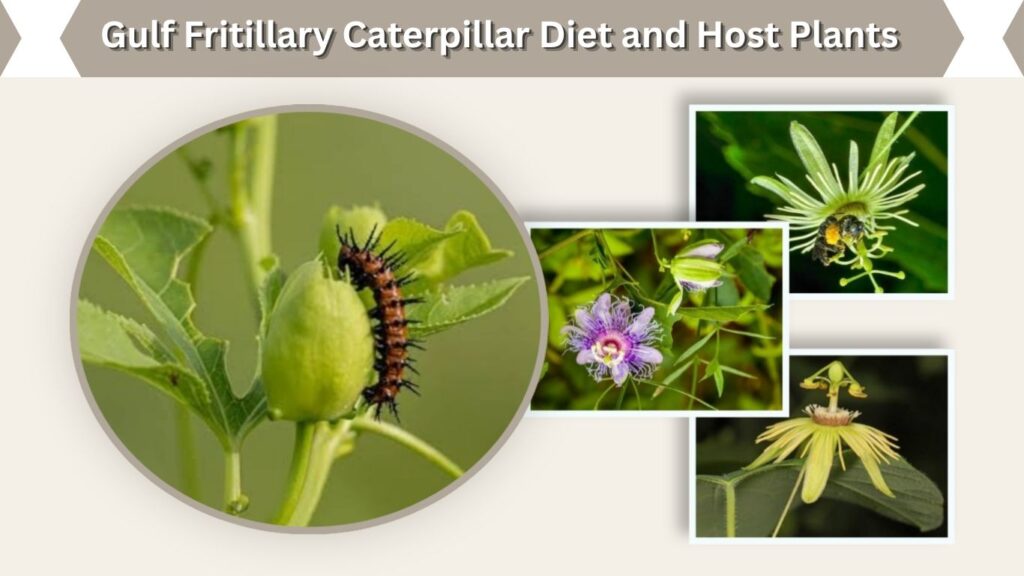
Gulf fritillary larvae are specialized feeders. Females search for members of the passionflower family and lay small yellow eggs on their leaves, stems, or tendrils. After hatching, the caterpillars consume the plant while storing some of its defensive chemicals in their bodies.
What Do Gulf Fritillary Caterpillars Eat?
Their common host plants include:
- Purple passionflower
- Yellow passionflower
- Corkystem passionflower
- Maypop
- Blue passionflower
- Passion fruit vine
- Other ornamental Passiflora species
A newly hatched caterpillar may first eat part of its eggshell. It then begins feeding on tender passionflower tissue. Older larvae consume larger sections of leaves and may chew young stems or developing flower parts when food is limited.
Do They Eat Desert Rose or Oleander?
Gulf fritillary caterpillars do not normally use desert rose or oleander as host plants. These plants are more closely associated with oleander caterpillars.
If an orange caterpillar is eating a desert rose, examine its body carefully. Long tufts of black hair indicate an oleander caterpillar, while rows of branched black spines suggest a Gulf fritillary larva that may have wandered away from its actual host plant.
Can Caterpillars Kill a Passion Vine?
A large, established passion vine generally recovers from occasional defoliation. Young, potted, newly transplanted, or unhealthy vines are more vulnerable. Numerous caterpillars can strip nearly every leaf and weaken the plant.
Gardeners can grow several vines, protect one plant as a reserve, or move some larvae to another pesticide-free passion vine. Caterpillars should never be transferred to an unrelated plant because they may refuse to eat it.
Gulf Fritillary Caterpillar Stages
A Gulf fritillary undergoes complete metamorphosis through egg, larva, pupa, and adult stages. Its development is fastest during warm weather. Temperature, food quality, daylight, and humidity can cause considerable variation in the timing.
Egg Stage
Female butterflies usually deposit yellow eggs individually on passionflower leaves, stems, or curling tendrils. They may also lay eggs on nearby structures when many butterflies visit the same vine.
The egg commonly hatches within three to five days in warm conditions. The emerging larva is tiny and dark but soon develops the species’ familiar orange coloration.
Caterpillar Instars and Molting
The caterpillar normally progresses through five larval stages called instars. Each stage ends with a molt:
- A tiny larva emerges and begins eating tender leaf tissue.
- The body becomes increasingly orange as the caterpillar grows.
- Black spots, bands, and branched spines become more visible.
- Feeding increases, and larger portions of leaves disappear.
- The mature caterpillar stops feeding and searches for a pupation site.
Molting may occur every few days during active growth. Before a molt, the caterpillar can become motionless and stop eating. It should not be handled or moved during this vulnerable period.
From Caterpillar to Chrysalis
After roughly two to three weeks of larval growth, the caterpillar enters a wandering stage. It may leave the passion vine and attach itself beneath a branch, fence, pot, wall, or enclosure lid.
It creates a silk pad and hangs in a curved, head-down position. The larval skin eventually splits, revealing a mottled brown or gray chrysalis that resembles a dry leaf. Gulf fritillaries form a chrysalis, not a silk cocoon.
Chrysalis to Adult Butterfly
The pupal stage often lasts approximately 8 to 14 days in warm weather but may take longer in cooler conditions. Shortly before emergence, the chrysalis darkens and the orange wing pattern may become visible.
The adult butterfly emerges with folded wings. It must hang vertically while its wings expand and harden. The resulting Gulf fritillary has vivid orange upper wings and reflective silver spots underneath.
Raising Gulf Fritillary Caterpillars
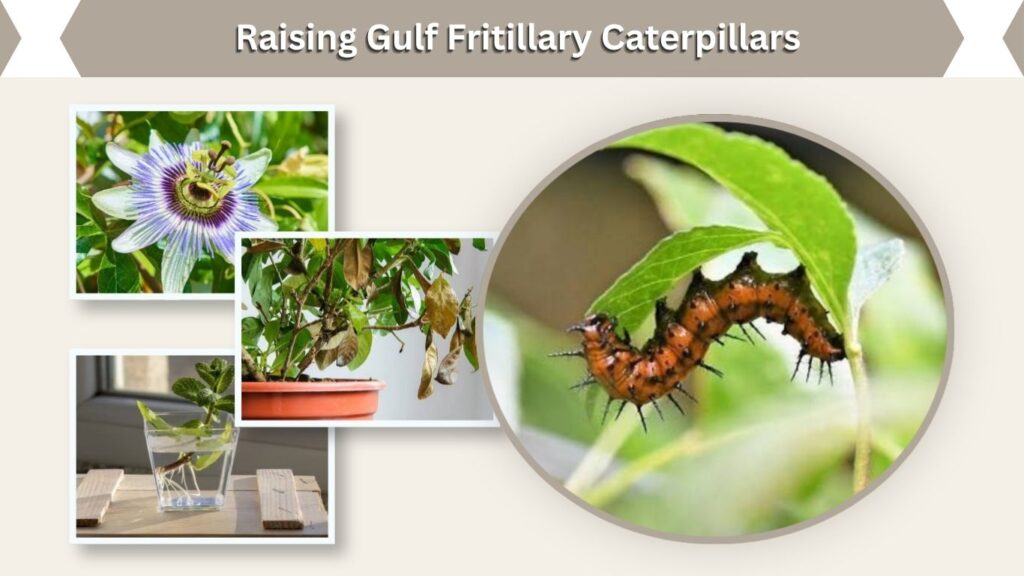
Gulf fritillary caterpillars can be observed in a protected outdoor habitat or a well-ventilated enclosure. Successful raising requires fresh food, cleanliness, airflow, and enough space for molting and butterfly emergence.
Basic Care Requirements
- Supply fresh, pesticide-free passionflower leaves.
- Keep leafy stems in water, but cover the opening to prevent drowning.
- Provide good ventilation without exposing larvae to extreme heat.
- Remove droppings and wilted leaves every day.
- Avoid overcrowding caterpillars in one container.
- Do not disturb a caterpillar that has stopped moving to molt.
- Provide branches or mesh surfaces for pupation.
- Give emerging adults enough vertical space to expand their wings.
- Release healthy native butterflies near nectar and host plants.
Wild caterpillars should not be transported beyond their natural range. They should also not be used as feeder insects because their plant-derived defensive chemicals may be unsuitable for captive predators.
Signs of Illness or Parasites
A caterpillar that stops eating briefly may simply be molting or preparing to pupate. More concerning symptoms include leaking fluid, persistent shriveling, foul odors, unusual softness, or widespread black discoloration.
Disease, pesticide exposure, injury, poor ventilation, and parasitoid flies or wasps can cause death. Isolate unhealthy caterpillars, remove dead individuals, discard contaminated leaves, and thoroughly clean the enclosure before introducing new larvae.
Gulf Fritillary Caterpillar Control
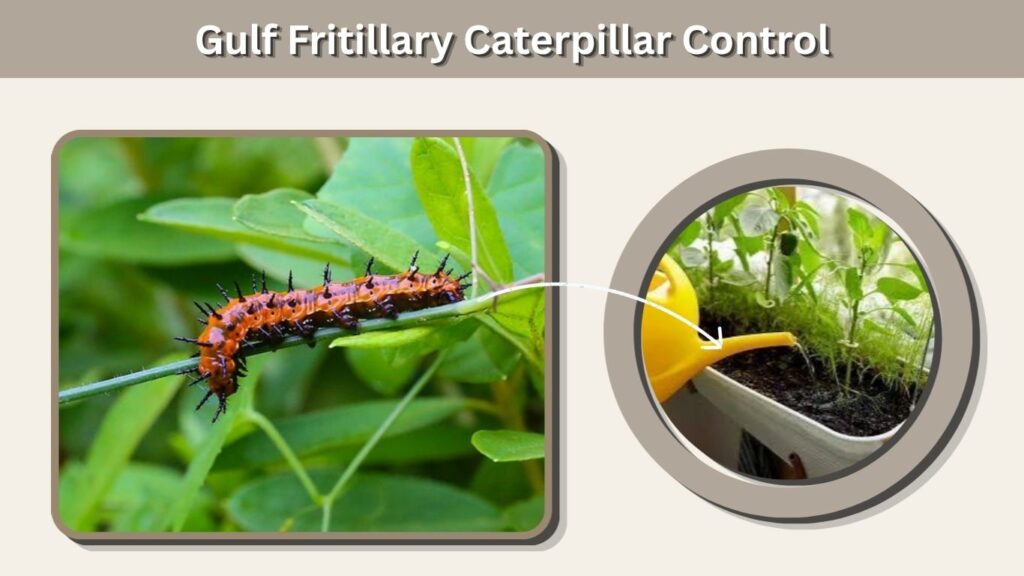
Control is rarely necessary on mature passion vines because caterpillar feeding is temporary and produces attractive pollinating butterflies. Management may be reasonable when a young or valuable plant faces complete defoliation.
Safe Ways to Protect Passion Vines
- Move excess caterpillars to another healthy passion vine.
- Protect one young vine with fine insect mesh before eggs are laid.
- Grow additional host plants to distribute feeding.
- Remove eggs by hand when caterpillar numbers become excessive.
- Allow damaged established vines time to regrow.
- Avoid applying insecticides to flowering plants.
Broad-spectrum pesticides can kill caterpillars, adult butterflies, bees, and other beneficial insects. Bt products also kill butterfly and moth larvae and should not be used where caterpillar conservation is desired.
FAQs
What does a Gulf fritillary caterpillar turn into?
It forms a brown, leaflike chrysalis and later emerges as an orange Gulf fritillary butterfly with silver spots beneath its wings.
Can Gulf fritillary caterpillars bite?
They are not aggressive and do not have a medically significant bite. Their small mouthparts are designed for chewing passionflower leaves.
Why is my Gulf fritillary caterpillar turning black?
Darkening can occur before molting or pupation. However, extensive blackening accompanied by leaking, softness, or a foul smell may indicate disease, injury, or pesticide exposure.
Where are Gulf fritillary caterpillars found?
They occur mainly in warm regions of the southern United States, Mexico, Central America, South America, and introduced locations such as Hawaii. Seasonal populations can appear farther north.
Should I remove Gulf fritillary caterpillars?
Removal is usually unnecessary on an established passion vine. If a young plant is being stripped, carefully transfer some caterpillars to another pesticide-free passionflower plant.