
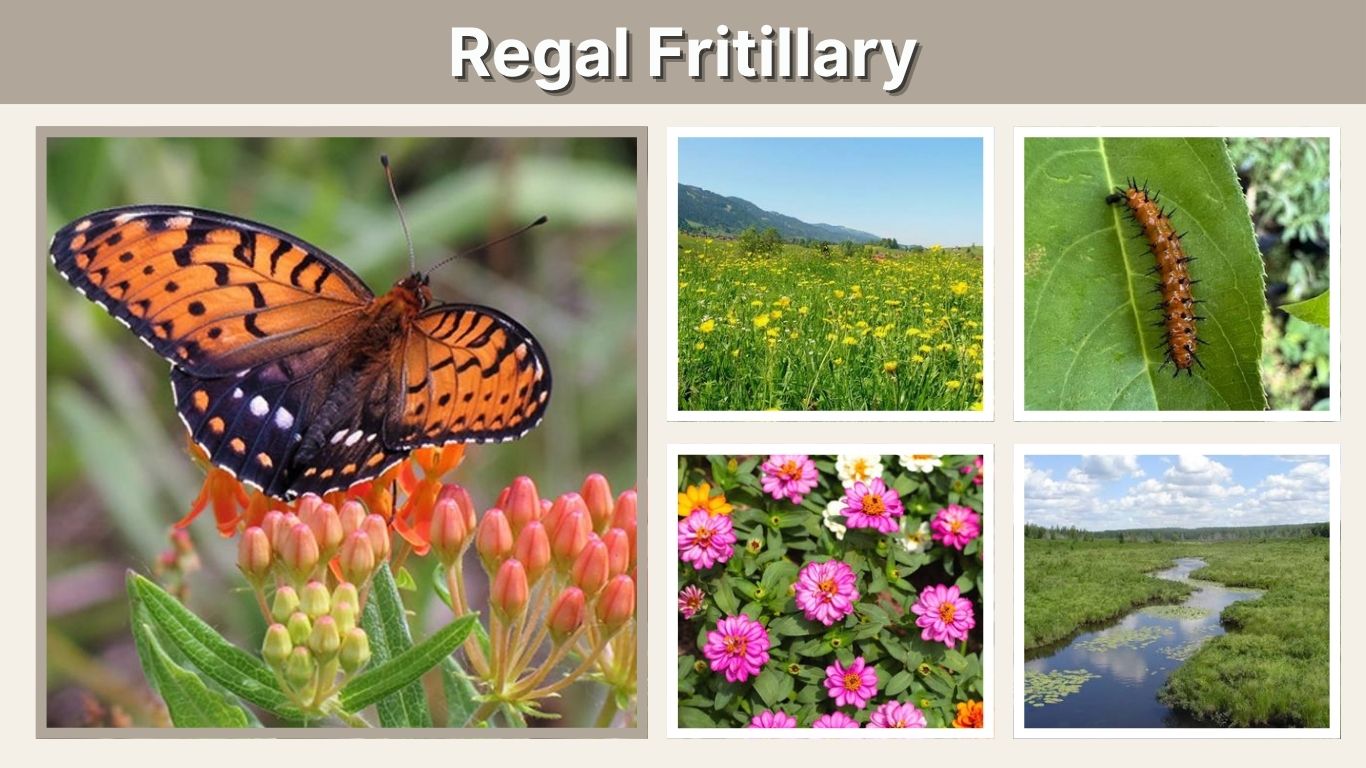
The regal fritillary is one of North America’s most striking prairie butterflies, recognized by its brilliant orange forewings, dark hindwings, and bold rows of contrasting spots. Scientifically known as Speyeria idalia, this large butterfly depends heavily on native grasslands, violets, and abundant nectar flowers. Once distributed across a much broader portion of the United States, regal fritillary populations have declined substantially as prairie habitats have disappeared or become fragmented. Understanding its habitat, caterpillar host plants, life cycle, range, and conservation needs helps explain why protecting remaining grasslands is so important for this remarkable butterfly.
What Is a Regal Fritillary?
The regal fritillary is a large brush-footed butterfly belonging to the family Nymphalidae. It is closely associated with native prairie ecosystems and is especially noticeable during summer when adults visit flowering plants for nectar.
Its wingspan is approximately 2.7 to 4.1 inches (6.8–10.5 cm), making it similar in size to a monarch butterfly. Its combination of orange forewings and almost black hindwings makes it much easier to distinguish from many other fritillaries.
Regal Fritillary Identification
A regal fritillary can be identified by several distinctive features:
- Large wingspan of roughly 2.7–4.1 inches
- Deep orange upper forewings
- Numerous black markings on the forewings
- Dark brown to black upper hindwings
- Rows of prominent white or orange spots
- Silvery-white spots underneath the hindwings
- Strong, fast flight
- Close association with open prairie habitat
The dark hindwings provide one of the best field marks because most other large orange fritillaries lack this dramatic contrast.
Regal Fritillary Male vs. Female
Male and female regal fritillaries look similar at first glance, but the hindwing markings can help separate them.
Male Regal Fritillary
Male regal fritillaries have dark upper hindwings containing a row of white spots and another row in which the outer spots appear orange. Males usually emerge earlier in the season and actively patrol prairie habitat searching for females.
Female Regal Fritillary
Females are generally slightly larger and may have a somewhat more reddish-orange appearance. On the upper hindwings, the outer row of spots is white rather than orange, providing a useful way to distinguish females from males.
Regal Fritillary Habitat
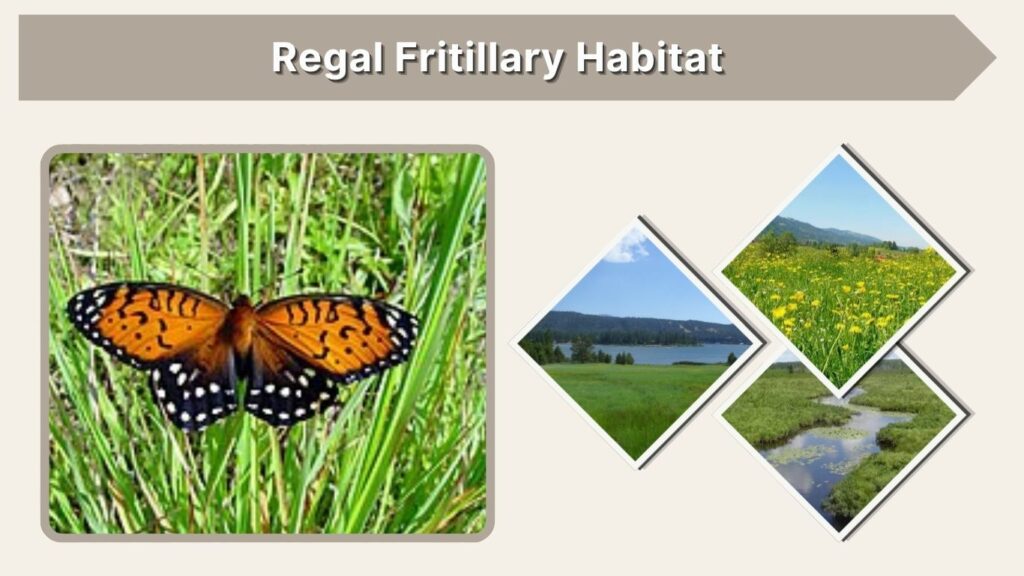
The regal fritillary habitat is strongly associated with open grasslands. Large populations are most often connected to high-quality native tallgrass or mixed-grass prairie containing both larval host plants and adult nectar flowers.
They can also occur in damp meadows, wet fields, marsh edges, lightly grazed grasslands, and mountain pastures.
Successful habitat requires three particularly important components: abundant violets for caterpillars, flowering nectar plants for adults, and warm-season grasses that provide shelter throughout different life stages.
Why Large Prairies Matter
Although adults are powerful flyers, they often remain relatively close to their natal grassland. Roads, cropland, trees, development, and other unsuitable areas can separate remaining populations.
This makes connected prairie landscapes particularly valuable. Small isolated patches may temporarily contain butterflies without necessarily supporting a stable population over many generations.
Where Do Regal Fritillaries Live?
Historically, the regal fritillary occupied a huge area extending from portions of the northeastern United States west to Montana and south toward Oklahoma and North Carolina.
Today, its distribution is much more fragmented. Western populations remain primarily across portions of the Great Plains and Midwest, while the eastern form has disappeared from nearly all of its former range.
Eastern Regal Fritillary
The eastern regal fritillary represents the extremely restricted eastern subspecies. Its best-known surviving population occurs at Fort Indiantown Gap in Pennsylvania, where large areas of grassland maintained through military land management provide suitable habitat.
Western Regal Fritillary
The western regal fritillary retains a much broader distribution than its eastern counterpart. Populations occur across portions of the Great Plains and Midwest, including areas from North Dakota south toward Oklahoma and westward toward Colorado.
Even within this broader range, populations can be separated by agricultural development, habitat loss, woody vegetation, roads, and degraded grasslands.
Regal Fritillary Host Plants
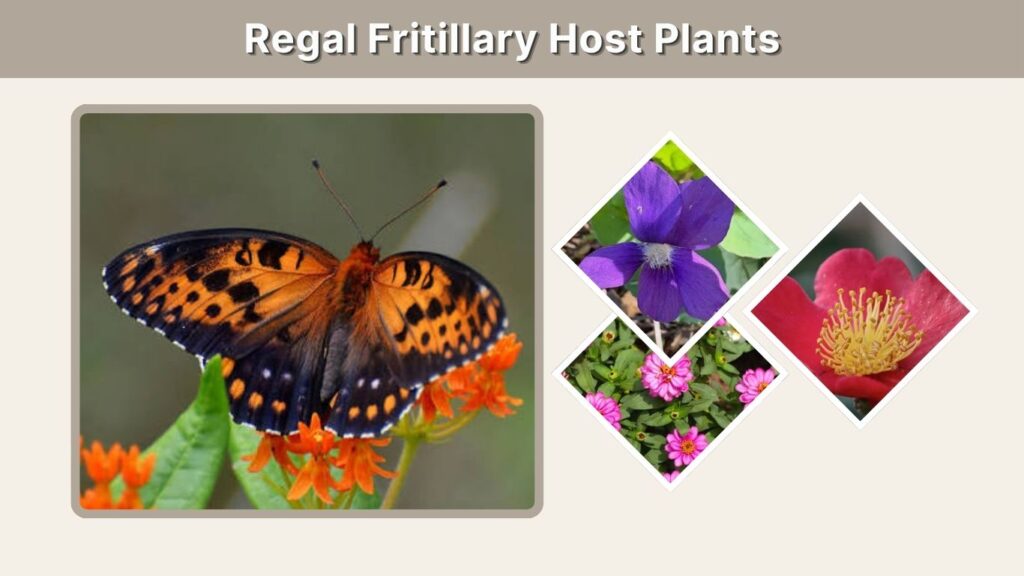
The most important regal fritillary host plants are violets (Viola species).
Regal fritillary caterpillars feed exclusively on violet leaves. Several violet species may be used depending on location, including bird’s-foot violet and other native prairie violets.
A prairie may contain abundant adult nectar flowers, but it cannot successfully support reproduction if enough appropriate violets are unavailable.
What Do Adult Regal Fritillaries Eat?
Adult butterflies drink nectar from many prairie flowers rather than violets alone. Important nectar sources can include milkweeds, thistles, blazing stars, coneflowers, mountain mint, joe-pye weed, and ironweed.
Having flowers available throughout the adult flight season is especially important for females because they live longer and must obtain enough energy before laying eggs.
Regal Fritillary Caterpillar
The regal fritillary caterpillar begins life in an unusual way. Females lay eggs during late summer and early fall, often scattering individual eggs throughout vegetation rather than placing every egg directly on a violet.
The eggs hatch after roughly two to three weeks. Newly hatched larvae consume part of their eggshell but do not immediately begin feeding on plants. Instead, tiny first-instar caterpillars enter dormancy and spend the winter sheltered in grassland vegetation.
What Does the Caterpillar Eat?
When temperatures rise during spring, surviving caterpillars become active and search for young violets.
Violet leaves are their only plant food. The larvae grow through six instars before eventually pupating among vegetation or grassland litter. This specialized diet makes violet abundance one of the major factors determining whether a habitat can support the butterfly.
Regal Fritillary Life Cycle
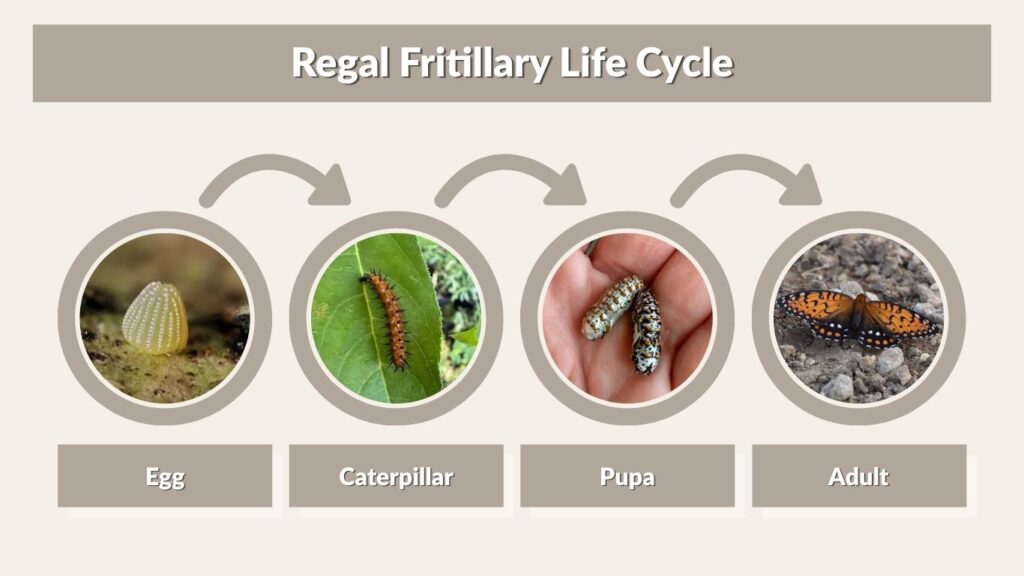
The regal fritillary produces one generation each year.
Its life cycle follows four main stages: egg, caterpillar, pupa, and adult.
Females lay eggs in late summer or early fall. The larvae hatch and overwinter while still extremely small. They begin feeding on violets during spring, pass through six larval stages, and pupate during late spring or early summer.
Adults generally begin appearing around June, although exact timing varies by location and weather. Males commonly emerge one or two weeks before females.
Regal Fritillary Lifespan
Adult males generally survive around four to six weeks, while females may live approximately eight to twelve weeks.
The longer female lifespan is connected with an unusual reproductive strategy. Females mate earlier in adulthood but delay egg development for several weeks before laying eggs later in summer or early fall.
Is the Regal Fritillary Endangered?
Regal fritillaries have experienced serious declines, particularly in the eastern United States.
In August 2024, the U.S. Fish and Wildlife Service proposed listing the eastern regal fritillary as endangered and the western regal fritillary as threatened under the Endangered Species Act. Current 2026 Fish and Wildlife Service material still refers to the western subspecies as proposed for threatened status, so the 2024 federal action should not be described as a completed final listing.
Why Are Regal Fritillaries Declining?
Major pressures include habitat loss, fragmentation, loss of violets and nectar plants, conversion of prairie to agriculture or development, invasive plants, woody vegetation encroachment, and inappropriate grassland management.
Prairies naturally benefit from disturbance such as grazing, mowing, or prescribed fire, but timing and intensity matter. Management affecting too much habitat at once can also kill eggs, caterpillars, pupae, or adults. Maintaining a mosaic of treated and untreated areas can therefore be important.
Regal Fritillary at Fort Indiantown Gap
Fort Indiantown Gap in Pennsylvania has become particularly important for the eastern regal fritillary.
The military installation contains thousands of acres of grassland maintained through a combination of military activity and active habitat management. Periodic disturbance prevents forests and shrubs from completely overtaking the open habitat that regal fritillaries require.
The site supports the last known population of the eastern subspecies highlighted by the U.S. Fish and Wildlife Service, making conservation work there especially significant.
Interesting Regal Fritillary Facts
- Its scientific name is commonly written as Speyeria idalia, although recent federal regulatory documents also use Argynnis idalia.
- It has only one generation per year.
- Caterpillars eat only violet leaves.
- Newly hatched caterpillars overwinter before feeding on plants.
- Females can lay very large numbers of eggs.
- Males emerge earlier than females.
- Females usually live much longer than males.
- Adults are powerful flyers despite their dependence on prairie habitats.
- Milkweeds and thistles are important adult nectar sources.
- The orange-and-black wings can resemble a monarch from a distance.
- Habitat quality depends on both flowers and appropriate grassland structure.
FAQs
Is the regal fritillary a pollinator?
Yes. Adult regal fritillaries visit numerous flowering plants for nectar and can transfer pollen while moving between flowers.
What is the scientific name of the regal fritillary?
The species is widely known scientifically as Speyeria idalia. Some newer taxonomic and federal regulatory treatments use the genus Argynnis, including Argynnis idalia.
What plants do regal fritillary caterpillars eat?
The caterpillars feed exclusively on violets (Viola species). Without sufficient violets, successful reproduction is unlikely.
What is the difference between eastern and western regal fritillaries?
They are geographically and genetically differentiated forms. The eastern population has become extremely restricted, while western regal fritillaries remain distributed across parts of the Great Plains and Midwest.
When can you see regal fritillary butterflies?
Adults generally appear from early summer into late summer. Males tend to emerge first, while females can survive into September or even later under favorable conditions.