
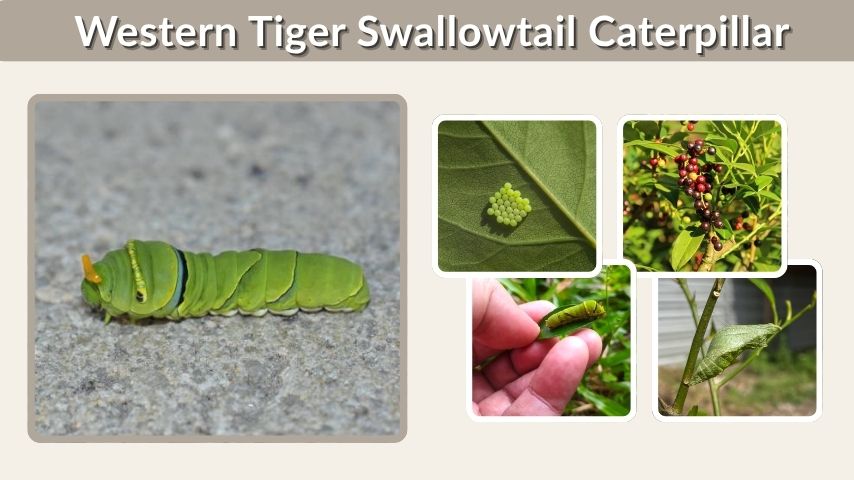
The western tiger swallowtail caterpillar is the young stage of the bright yellow-and-black western tiger swallowtail butterfly. Gardeners often notice it curled in leaves, resting on tree foliage, or changing color before pupation. This guide explains how to identify the caterpillar, what it eats, which host plants support it, and how its life cycle moves from egg to butterfly.
Western Tiger Swallowtail Caterpillar Overview
The western tiger swallowtail caterpillar belongs to the butterfly species Papilio rutulus. While the adult butterfly is large, yellow, and striped like a tiger, the caterpillar looks very different during its growth. It passes through several stages, changing from a small camouflaged larva into a larger green caterpillar with dramatic eyespots.
This caterpillar is most often associated with western North America, especially places where trees and moisture are available. It is commonly linked with riparian corridors, wooded parks, suburban shade trees, canyons, and gardens that include suitable host plants.
What It Looks Like
A young western tiger swallowtail butterfly caterpillar may look like a bird dropping. This disguise helps it avoid birds and other predators when it is small and vulnerable. As it grows, it usually becomes smoother, greener, and more leaf-like.
A mature caterpillar often has:
- A plump green body
- Large false eyespots near the front
- A slightly swollen “head-like” front section
- A smooth, soft appearance
- A habit of resting on leaves or inside curled leaf shelters
The eyespots are not real eyes. They are markings that make the caterpillar look larger and more threatening than it really is.
Western Tiger Swallowtail Caterpillar Stages
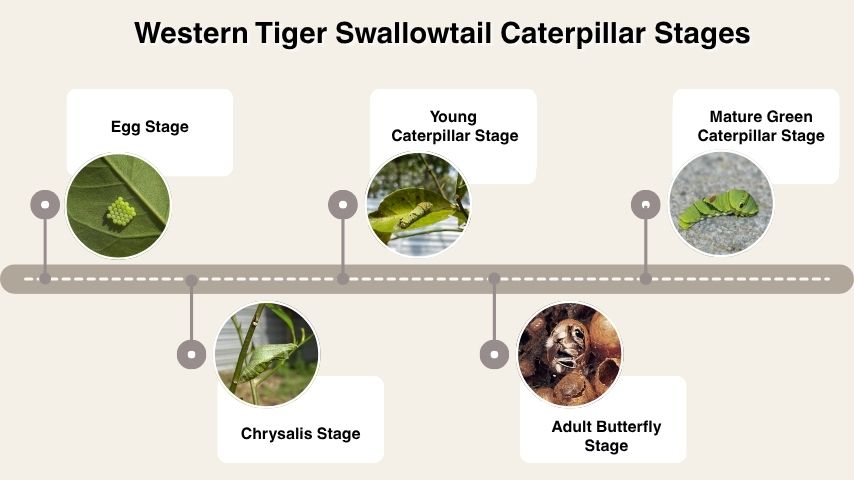
The western tiger swallowtail caterpillar stages are part of a complete butterfly life cycle. Like other butterflies, it develops through egg, larva, chrysalis, and adult stages. The caterpillar stage is the feeding and growing phase.
Egg Stage
A female western tiger swallowtail lays eggs singly on host plant leaves. This helps reduce crowding and gives each newly hatched caterpillar access to fresh foliage. The eggs are small and easy to miss unless you are carefully checking the leaves of host trees.
Egg placement matters because the caterpillar cannot simply switch to any garden plant. It must hatch on or near a plant it can eat.
Young Caterpillar Stage
After hatching, the tiny caterpillar begins feeding on its host plant. In early stages, its bird-dropping mimicry helps it blend into the leaf surface. This is one reason people may overlook it even when the butterfly is breeding nearby.
During this stage, the caterpillar eats, rests, and molts. Molting means it sheds its outer skin as its body grows.
Mature Green Caterpillar Stage
As the caterpillar becomes larger, it turns green and develops more noticeable eyespots. This is the stage most people recognize from western tiger swallowtail caterpillar images. The green color helps it blend with leaves, while the eyespots provide a second layer of defense.
Mature caterpillars may rest on a silken mat or inside curled leaves. They are usually not found in large groups, so they rarely cause serious damage to healthy trees.
Chrysalis Stage
When the caterpillar is ready to pupate, it forms a chrysalis. The chrysalis may be green or brown depending on the season and surroundings. A brown form is often confused with a “western tiger swallowtail caterpillar brown morph,” but it is usually related to late-stage development, prepupal change, or the chrysalis rather than a separate caterpillar type.
The chrysalis is the transformation stage. Inside it, the caterpillar reorganizes into an adult butterfly.
Adult Butterfly Stage
The adult western tiger swallowtail emerges from the chrysalis with soft wings. After the wings expand and harden, the butterfly can fly, feed on nectar, find mates, and continue the cycle.
Western Tiger Swallowtail Caterpillar Food
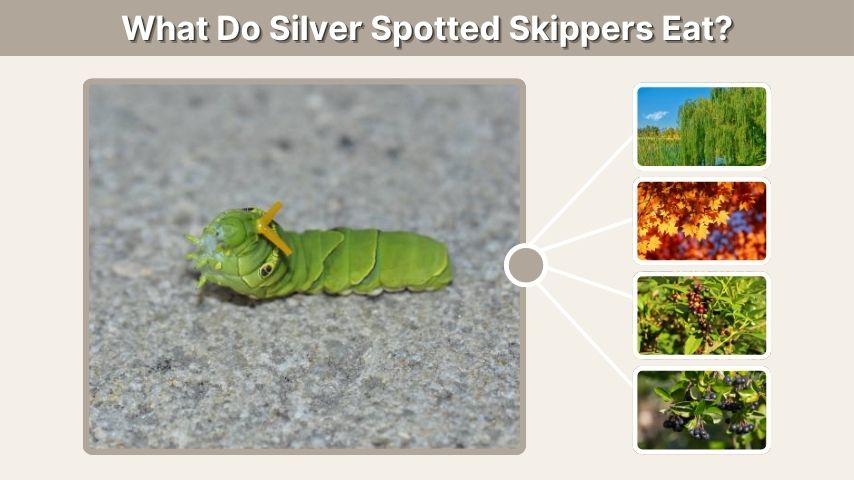
Western tiger swallowtail caterpillar food comes from specific host trees and shrubs. Unlike adult butterflies, which can drink nectar from many flowers, caterpillars are more limited. They need leaves from plants their bodies can digest.
Common Host Plants
The best western tiger swallowtail caterpillar host plants are usually deciduous trees and shrubs. Depending on the region, caterpillars may feed on:
- Willow
- Cottonwood
- Aspen
- Alder
- Birch
- Wild cherry
- Chokecherry
- Ash
- Maple
- Sycamore
- Some oaks in certain areas
These plants are especially common near streams, rivers, canyons, and older neighborhoods with mature shade trees.
Host Plant vs Nectar Plant
A host plant is not the same as a nectar plant. This is an important difference for butterfly gardening.
A host plant feeds the caterpillar. A nectar plant feeds the adult butterfly. A garden with only flowers may attract adult swallowtails, but it will not support their full life cycle unless caterpillar host plants are also nearby.
| Search Topic | Best Article Coverage | User Intent |
| western tiger swallowtail caterpillar food | Explain larval diet and host leaves | Learn what caterpillars eat |
| western tiger swallowtail caterpillar host plant | List trees such as willow, cottonwood, aspen, alder, cherry, ash, maple, and sycamore | Support caterpillars in a garden |
| western tiger swallowtail caterpillar stages | Cover egg, larva, chrysalis, adult | Understand life cycle |
| western tiger swallowtail caterpillar poisonous | Explain defense without exaggerating danger | Safety question |
| eastern vs western tiger swallowtail caterpillar | Compare range, host plants, and identification | Species identification |
How to Identify Western Tiger Swallowtail Caterpillar Images
Many people search for western tiger swallowtail caterpillar images because this larva can be confusing. It does not look like the adult butterfly, and it changes appearance as it grows.
Image Clues to Look For
When comparing photos, look for a combination of features rather than one single trait.
Useful identification clues include:
- Green body in later stages
- Large eyespots near the front
- Smooth, thick body shape
- Leaf shelter or curled leaf resting place
- Presence on a known host tree
- Location in western North America
Photos of very young caterpillars may look brown, blackish, or mottled. That does not always mean it is a different species. Early swallowtail caterpillars often use messy camouflage before becoming greener later.
Why Location Matters
The western tiger swallowtail overlaps visually with other swallowtail species. Location can help narrow the identification. In western regions, Papilio rutulus is a likely candidate when the caterpillar is found on suitable trees such as willow, cottonwood, alder, or cherry.
In eastern North America, a similar-looking caterpillar may belong to the eastern tiger swallowtail instead. That is why “eastern vs western tiger swallowtail caterpillar” is a useful comparison keyword.
Eastern vs Western Tiger Swallowtail Caterpillar
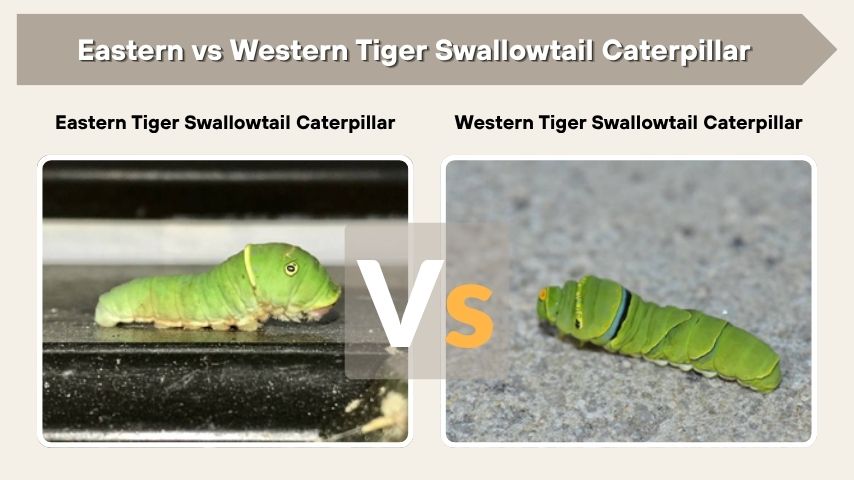
Eastern and western tiger swallowtail caterpillars can look similar because both belong to related tiger swallowtail groups. Both may show bird-dropping camouflage when young and green bodies with eyespots when mature.
The main differences are usually not obvious from the caterpillar alone. Range, host plant, and the adult butterfly nearby are often more useful.
Main Differences
The western tiger swallowtail is mainly associated with western North America. The eastern tiger swallowtail is mainly found in eastern North America. Host plants can overlap, but each species has regional preferences.
For a simple field approach:
- Use location first.
- Check the host plant.
- Compare several caterpillar images.
- Look for adult swallowtails in the same area.
- Avoid relying only on color, because stages can vary.
If you are in the western United States or nearby western regions and find a green swallowtail caterpillar on willow, cottonwood, alder, maple, cherry, or sycamore, western tiger swallowtail is a strong possibility.
Western Tiger Swallowtail Caterpillar Defense
The western tiger swallowtail caterpillar has several defenses that help it survive. These defenses explain why it looks so unusual.
Bird-Dropping Camouflage
Young caterpillars often resemble bird droppings. Predators that might eat a soft caterpillar are less likely to investigate something that looks like waste. This kind of mimicry is common in swallowtail larvae.
False Eyespots
The large eyespots on mature caterpillars may startle predators. A bird or wasp may hesitate if the caterpillar appears larger, snake-like, or more alert than it actually is.
The “Tongue” Is an Osmeterium
Some people search for “western tiger swallowtail caterpillar tongue” or misspell it as “toung.” The orange or reddish forked organ that may pop out when the caterpillar is disturbed is not a tongue. It is called an osmeterium.
The osmeterium is a defensive organ found in swallowtail caterpillars. When threatened, the caterpillar can extend it from behind the head area. It may release an unpleasant smell that discourages predators.
Is the Western Tiger Swallowtail Caterpillar Poisonous?
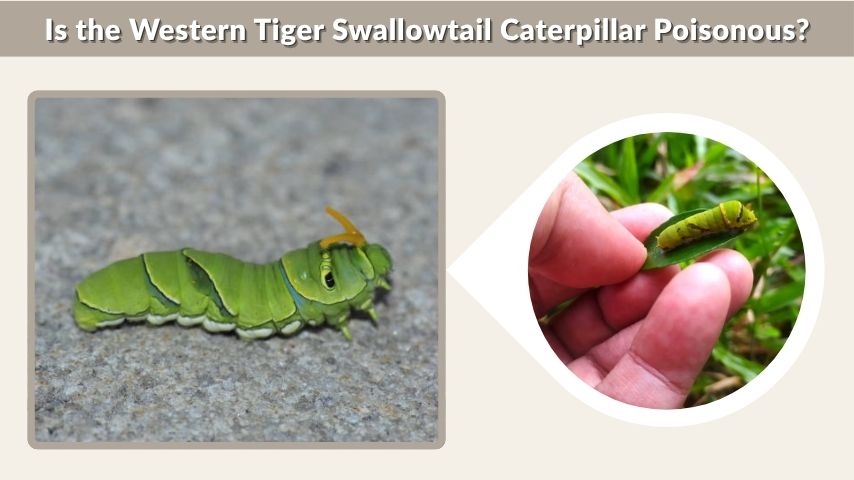
The western tiger swallowtail caterpillar is not known as a dangerous stinging caterpillar. It does not have the obvious irritating spines that some other caterpillars have. However, it is still best not to handle it unless necessary.
A cautious approach is best for both people and the caterpillar:
- Do not eat or crush caterpillars.
- Avoid touching your eyes after handling plants or insects.
- Let caterpillars remain on their host plant.
- Move them only if they are in immediate danger.
- Teach children to observe rather than squeeze or collect them.
The caterpillar’s defense is mainly camouflage, eyespots, and the osmeterium, not aggressive biting or stinging.
Western Tiger Swallowtail Caterpillar Care
People sometimes search for western tiger swallowtail caterpillar care after finding one in a yard. In most cases, the best care is to leave it on the correct host plant outdoors. Wild caterpillars usually do better when they remain in their natural environment.
If You Find One on a Host Plant
If the caterpillar is already on willow, cottonwood, cherry, alder, aspen, maple, sycamore, or another likely host plant, avoid moving it. It is probably exactly where it needs to be.
You can support it by avoiding pesticide sprays and leaving some natural leaf cover in place.
If It Falls or Is in Danger
If the caterpillar is on a sidewalk, driveway, or patio, gently move it to the nearest likely host plant. Use a leaf or small twig rather than your fingers if possible.
Do not place it on random flowers, grass, or vegetable crops. It may not be able to eat those plants.
Should You Buy One for Sale?
The keyword “western tiger swallowtail caterpillar for sale” suggests some people want to raise them. However, buying wild butterfly caterpillars is not always the best choice. Local rules, disease risk, and genetic mixing can be concerns.
A better option is to grow native host plants and let local butterflies find them naturally. This supports the right species in the right place and creates a healthier habitat.
How to Attract Western Tiger Swallowtails Naturally
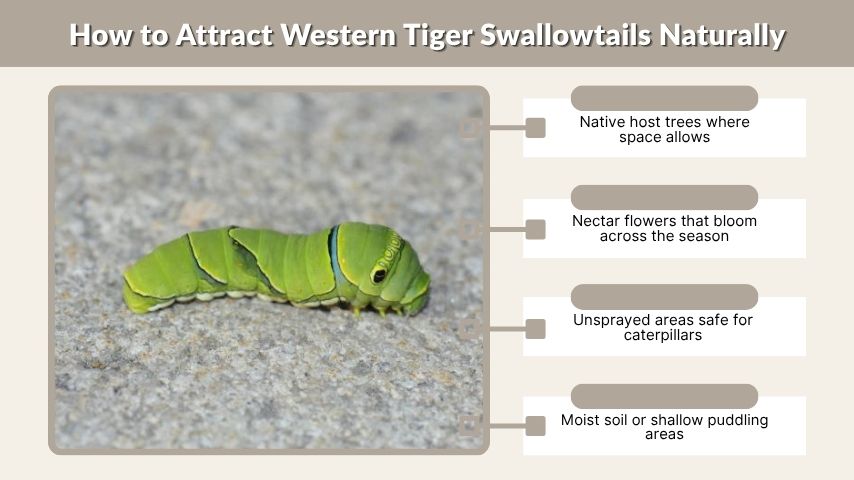
To attract western tiger swallowtails, think beyond flowers. Adult butterflies need nectar, but females need host plants for egg-laying.
Build a Better Habitat
A good swallowtail-friendly yard can include:
- Native host trees where space allows
- Nectar flowers that bloom across the season
- Unsprayed areas safe for caterpillars
- Moist soil or shallow puddling areas
- Leaf litter or sheltered spaces for wildlife
- A mix of sunny and lightly shaded spots
Because western tiger swallowtails often follow wooded corridors and streamside habitats, yards near mature trees may have a better chance of attracting them.
Avoid Pesticides
Even organic or natural insecticides can harm caterpillars. If your goal is to support butterflies, avoid spraying host plants where eggs or larvae may be present.
Caterpillar feeding may create small holes in leaves, but western tiger swallowtail caterpillars are not usually serious tree pests. A healthy tree can tolerate light feeding.
Western Tiger Swallowtail and Anise Swallowtail Caterpillar
The western tiger swallowtail and anise swallowtail caterpillar are sometimes confused because both are swallowtails found in western regions. However, their caterpillars usually use different host plants.
Anise swallowtail caterpillars commonly feed on plants in the carrot family, such as fennel, parsley, dill, and related species. Western tiger swallowtail caterpillars usually feed on trees and shrubs such as willow, cottonwood, alder, cherry, aspen, ash, maple, and sycamore.
So, if the caterpillar is on fennel, it is more likely an anise swallowtail. If it is on a tree leaf in a western riparian or suburban setting, western tiger swallowtail becomes more likely.
FAQs
What does a western tiger swallowtail caterpillar eat?
A western tiger swallowtail caterpillar eats leaves from specific host trees and shrubs. Common food plants include willow, cottonwood, aspen, alder, birch, cherry, chokecherry, ash, maple, and sycamore. It will not thrive on just any garden plant.
Is the western tiger swallowtail caterpillar poisonous?
It is not generally known as a dangerous stinging caterpillar. Its main defenses are camouflage, eyespots, and a forked defensive organ called an osmeterium. Still, it is best to observe it gently and avoid unnecessary handling.
What are the western tiger swallowtail caterpillar stages?
The main stages are egg, caterpillar, chrysalis, and adult butterfly. During the caterpillar stage, it grows through several molts. Young larvae may look like bird droppings, while older larvae are usually green with large false eyespots.
What is the orange tongue on a western tiger swallowtail caterpillar?
The orange “tongue” is not a tongue. It is an osmeterium, a forked defensive organ found in swallowtail caterpillars. When disturbed, the caterpillar may extend it to scare predators and release an unpleasant odor.
Can I raise a western tiger swallowtail caterpillar at home?
It is usually better to leave the caterpillar outdoors on its host plant. If you want to help, grow native host plants, avoid pesticides, and protect natural habitat. Raising wild caterpillars indoors can be difficult and may harm them if conditions are wrong.