
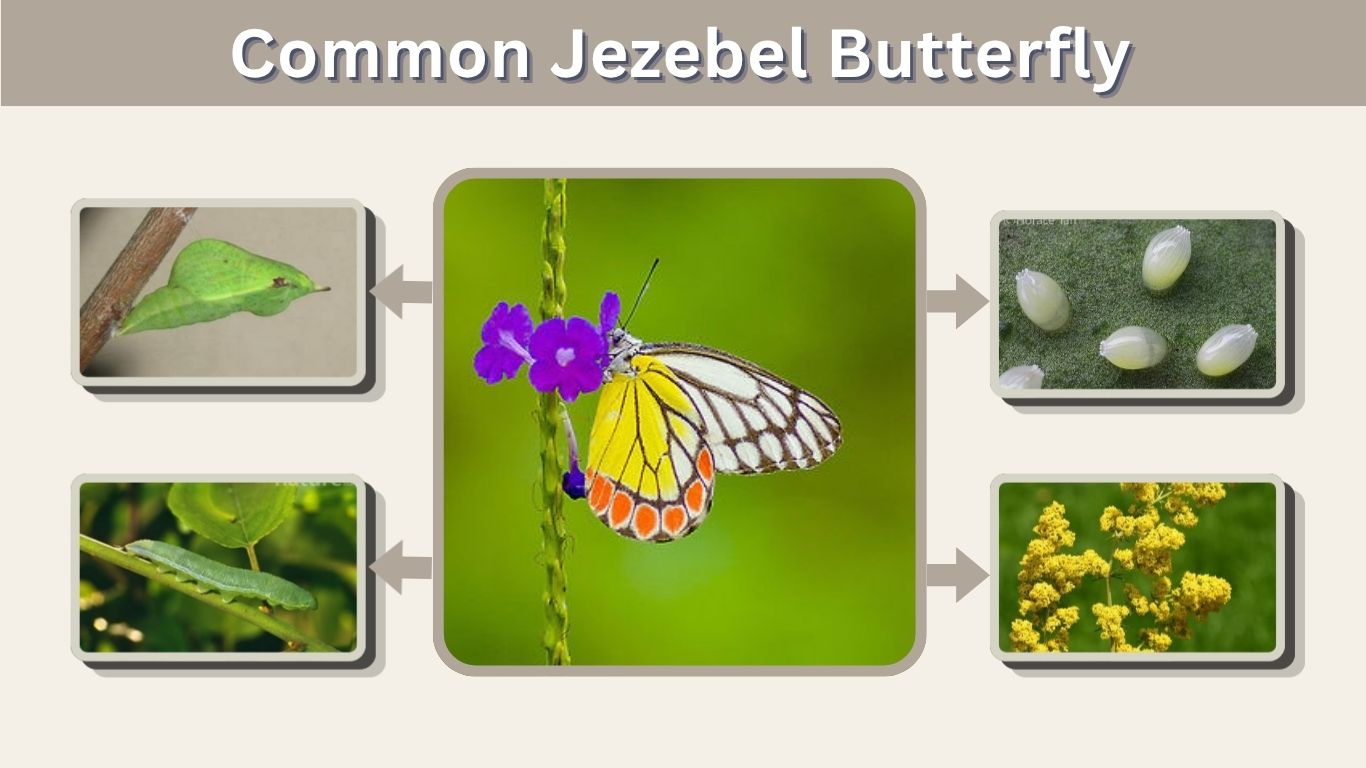
The Common Jezebel is a striking butterfly recognized by its combination of white, black, yellow, and red-orange wing markings. Scientifically known as Delias eucharis, it belongs to the Pieridae family and occurs widely across South and parts of Southeast Asia. It is especially familiar in India, where it can be seen in gardens, wooded areas, and other places with plenty of trees and flowers. Its colorful wings, unusual caterpillars, mistletoe host plants, and distinctive life cycle make the Common Jezebel easy to remember once you learn its main characteristics.
What Is a Common Jezebel?
The Common Jezebel is a medium-sized butterfly in the genus Delias. Its scientific name is Delias eucharis. Despite its colorful appearance, it belongs to the same butterfly family, Pieridae, that contains many familiar whites and yellows. The species is particularly well known throughout the Indian subcontinent and is frequently encountered around trees and flowering vegetation.
Common Name and Scientific Classification
The accepted English common name is Common Jezebel, while its scientific name is Delias eucharis.
Basic classification includes:
- Common name: Common Jezebel
- Scientific name: Delias eucharis
- Family: Pieridae
- Genus: Delias
- Order: Lepidoptera
- Type: Butterfly
The name “Common Jezebel” distinguishes this species from numerous other colorful butterflies belonging to the genus Delias.
Common Jezebel Characteristics and Identification
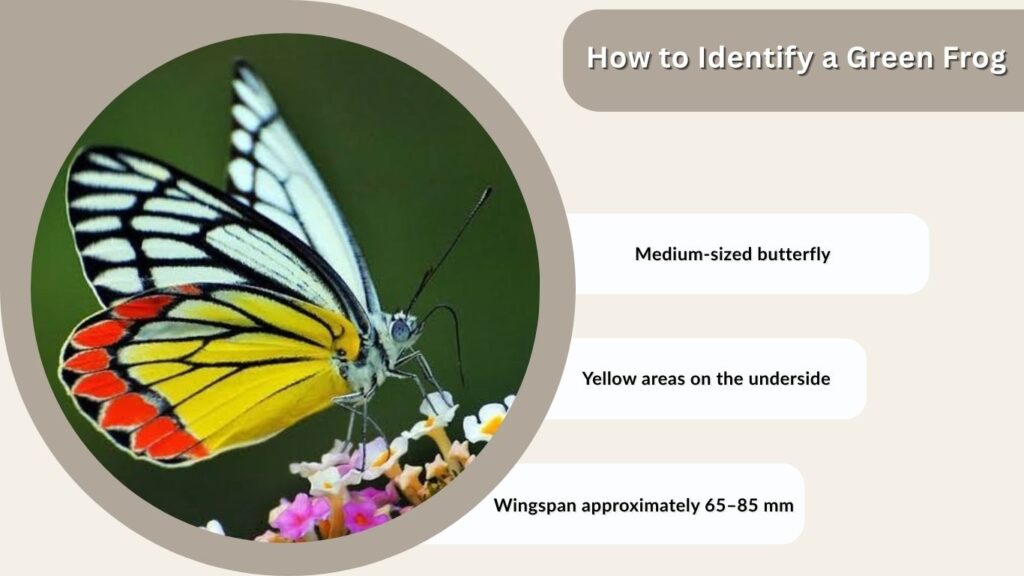
The Common Jezebel has a distinctive pattern that combines relatively pale upper wings with a much brighter underside. When flying high among trees, the butterfly may initially appear mostly white and black. Once it lands and closes its wings, however, the brilliant yellow and red-orange markings underneath become much easier to see.
What Does a Common Jezebel Look Like?
Important identification features include:
- Medium-sized butterfly
- Predominantly white upper wings
- Strong black veins and borders
- Yellow areas on the underside
- Red or orange-red markings on the hindwings
- Black outlining around colorful patches
- Long, relatively narrow wings
- Wingspan approximately 65–85 mm
The combination of yellow, red, black, and white makes the species one of the more visually striking butterflies in its range.
Why Is the Underside So Colorful?
When the butterfly rests, it normally keeps its wings closed. This exposes the colorful underside rather than the comparatively plain upper surface.
The bright coloration is believed to function as warning coloration. Common Jezebel caterpillars feed on certain mistletoe plants and can acquire defensive chemicals from their food. Their conspicuous adult coloration may therefore help advertise that they are unpleasant prey to potential predators.
Male vs. Female Common Jezebel
Male and female Common Jezebels look broadly similar, which can make sex identification more difficult than with butterfly species where males and females have completely different colors.
Common Jezebel Male
Males are frequently observed visiting flowers and flying actively around suitable habitat.
Their wings show the characteristic Common Jezebel combination of white and black on the upper surface with colorful yellow and red markings beneath.
Males may spend considerable time searching for females while also stopping at nectar-producing flowers for energy.
Common Jezebel Female
Females share the same recognizable overall pattern but may appear slightly different in wing markings and proportions when examined closely.
Females are often noticed moving around trees as they search for suitable host plants on which to deposit their eggs.
Because the differences are subtle, wing coloration alone may not always allow casual observers to distinguish males from females reliably.
Common Jezebel Habitat and Distribution

The Common Jezebel can live in a variety of tree-rich habitats. It is frequently associated with forests, woodland edges, gardens, parks, cultivated landscapes, and urban areas containing mature vegetation. Adults often fly relatively high among trees and descend to visit flowers for nectar.
Where Are Common Jezebel Butterflies Found?
The species occurs primarily across South Asia and parts of Southeast Asia.
Its range includes areas such as:
- India
- Bangladesh
- Sri Lanka
- Nepal
- Myanmar
- Thailand
- Other nearby parts of southern and southeastern Asia
In India, the Common Jezebel is widespread in many non-desert regions and can occur from lower elevations into hilly areas.
Common Jezebel Butterfly in India
India is one of the best-known parts of the Common Jezebel’s range.
The butterfly can occur in forests as well as human-modified environments. Gardens, villages, towns, parks, agricultural landscapes, and wooded roadsides may all provide suitable conditions if flowering plants and larval host plants are available.
Its ability to live close to people helps make it a familiar butterfly in many parts of the country.
What Do Common Jezebel Butterflies Eat?

Adult Common Jezebels obtain most of their energy from flower nectar. Their feeding behavior also brings them closer to the ground, making them easier to observe than when they are flying high in the tree canopy.
Adult Common Jezebel Food
Adults may visit a variety of nectar-rich flowers.
Common food sources include:
- Lantana flowers
- Wildflowers
- Garden flowers
- Flowering shrubs
- Small flowering trees
- Other nectar-producing plants
The exact flowers used vary depending on location and season. Adults move from flower to flower using their long proboscis to drink nectar.
Common Jezebel Host Plant
The host plant is especially important because female butterflies must locate appropriate vegetation for their caterpillars. Common Jezebel larvae are strongly associated with parasitic mistletoe plants, particularly members of the mistletoe group traditionally referred to as Loranthus and related genera.
Important Host Plants
Recorded larval host plants include:
- Dendrophthoe falcata
- Various mistletoe species
- Scurrula species
- Taxillus species
- Related plants in the mistletoe group
The availability of these plants can strongly influence where breeding Common Jezebels are found.
Females carefully investigate vegetation before laying eggs so newly hatched larvae have immediate access to suitable foliage.
Common Jezebel Caterpillar
The Common Jezebel caterpillar looks very different from the colorful adult. Young larvae often remain together and feed communally, making clusters of caterpillars relatively easy to notice on heavily used host plants.
Common Jezebel Caterpillar Identification
Typical features include:
- Brownish or yellow-brown body
- Dark head
- Numerous pale hairs or bristles
- Long cylindrical shape
- Small pale tubercles
- Group-feeding behavior when young
Several caterpillars may occupy the same plant and feed together, especially during the earlier stages of development.
Their social feeding behavior is one of the more recognizable features of the species’ larval stage.
Common Jezebel Life Cycle
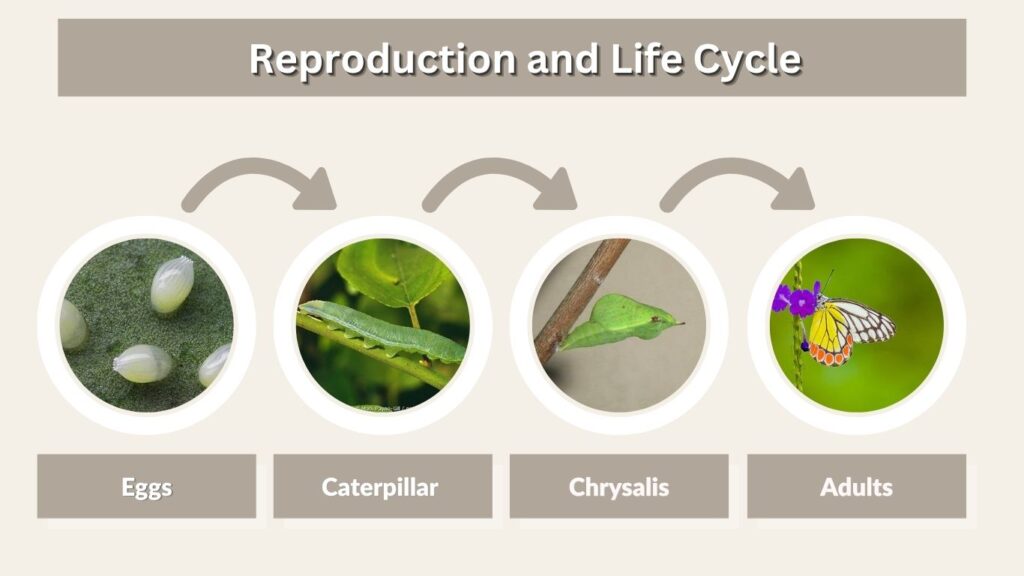
The Common Jezebel undergoes complete metamorphosis, meaning it develops through egg, larva, pupa, and adult stages. The entire process is closely connected with its host plants because eggs are deposited where newly hatched caterpillars can begin feeding immediately.
1. Egg Stage
Females may lay multiple eggs together on suitable host plant leaves.
The eggs are often arranged neatly rather than being scattered randomly. After development is complete, tiny caterpillars emerge.
2. Caterpillar Stage
The newly hatched larvae begin eating their host plant.
Young caterpillars remain fairly social and may feed together. As they grow, they molt several times and consume increasing quantities of foliage.
3. Chrysalis Stage
A fully grown caterpillar eventually stops feeding and prepares to pupate.
It attaches itself to a suitable surface and forms a chrysalis. Inside, its body undergoes extensive transformation before becoming an adult butterfly.
4. Adult Butterfly
The newly developed Common Jezebel emerges from the chrysalis, expands its wings, and eventually begins flying.
Adults feed on nectar, mate, and females search for appropriate host plants, restarting the life cycle. In suitable climates, the species may breed through much of the year.
Common Jezebel Behavior
One distinctive characteristic of the Common Jezebel is its tendency to spend substantial time around trees. It frequently flies relatively high above the ground and may travel between tree canopies before descending to flowering plants.
Flight and Feeding Behavior
The Common Jezebel is active during daylight and frequently visits flowers when feeding.
Its typical behavior includes:
- Flying around tree canopies
- Visiting flowers for nectar
- Resting with wings closed
- Females searching trees for host plants
- Males actively searching for females
- Moving between wooded and garden habitats
Its bright underside becomes particularly noticeable when the butterfly settles and folds its wings together.
Is the Common Jezebel Rare?
The Common Jezebel is not generally regarded as rare throughout much of its normal range. Its name itself reflects how frequently it can be encountered in suitable habitats.
Populations can still vary locally depending on vegetation, host plant availability, climate, and habitat conditions.
Where mistletoe host plants and nectar-producing flowers are plentiful, adults may be encountered regularly.
Interesting Common Jezebel Facts
The Common Jezebel has several features that make it stand out among Asian butterflies.
Quick Facts
- Its scientific name is Delias eucharis.
- It belongs to the Pieridae family.
- It has colorful yellow and red markings underneath its wings.
- Adults normally rest with their wings closed.
- Caterpillars often feed together.
- Mistletoes are important larval host plants.
- Adults frequently fly high around trees.
- Males commonly visit flowers for nectar.
- Females search vegetation for suitable host plants.
- Its bright colors may discourage predators.
- It is widespread across much of the Indian subcontinent.
FAQs
The Common Jezebel attracts attention because of its colorful wings, interesting caterpillars, and close relationship with mistletoe plants. Here are answers to several common questions about this butterfly.
1. What Is the Scientific Name of the Common Jezebel?
The scientific name of the Common Jezebel butterfly is Delias eucharis. It belongs to the genus Delias and the butterfly family Pieridae, which contains many white and yellow butterfly species.
2. What Is the Host Plant of the Common Jezebel?
Common Jezebel caterpillars mainly use mistletoe plants as hosts. Dendrophthoe falcata is one important recorded host, along with several related mistletoe species. Females search for suitable plants before depositing their eggs.
3. What Does a Common Jezebel Caterpillar Look Like?
The caterpillar is generally brownish or yellow-brown with a dark head and numerous pale hairs or bristles. Young caterpillars often remain together in groups while feeding on their host plants.
4. Where Is the Common Jezebel Found?
Common Jezebels occur across much of South Asia and portions of Southeast Asia. They are particularly widespread in India and are also recorded from countries including Bangladesh, Sri Lanka, Nepal, Myanmar, and Thailand.
5. What Does the Common Jezebel Butterfly Eat?
Adult Common Jezebels drink nectar from flowers, while their caterpillars eat leaves of suitable host plants, particularly mistletoes. This difference in diet allows adults to focus on finding nectar while larvae remain closely associated with their host vegetation.