
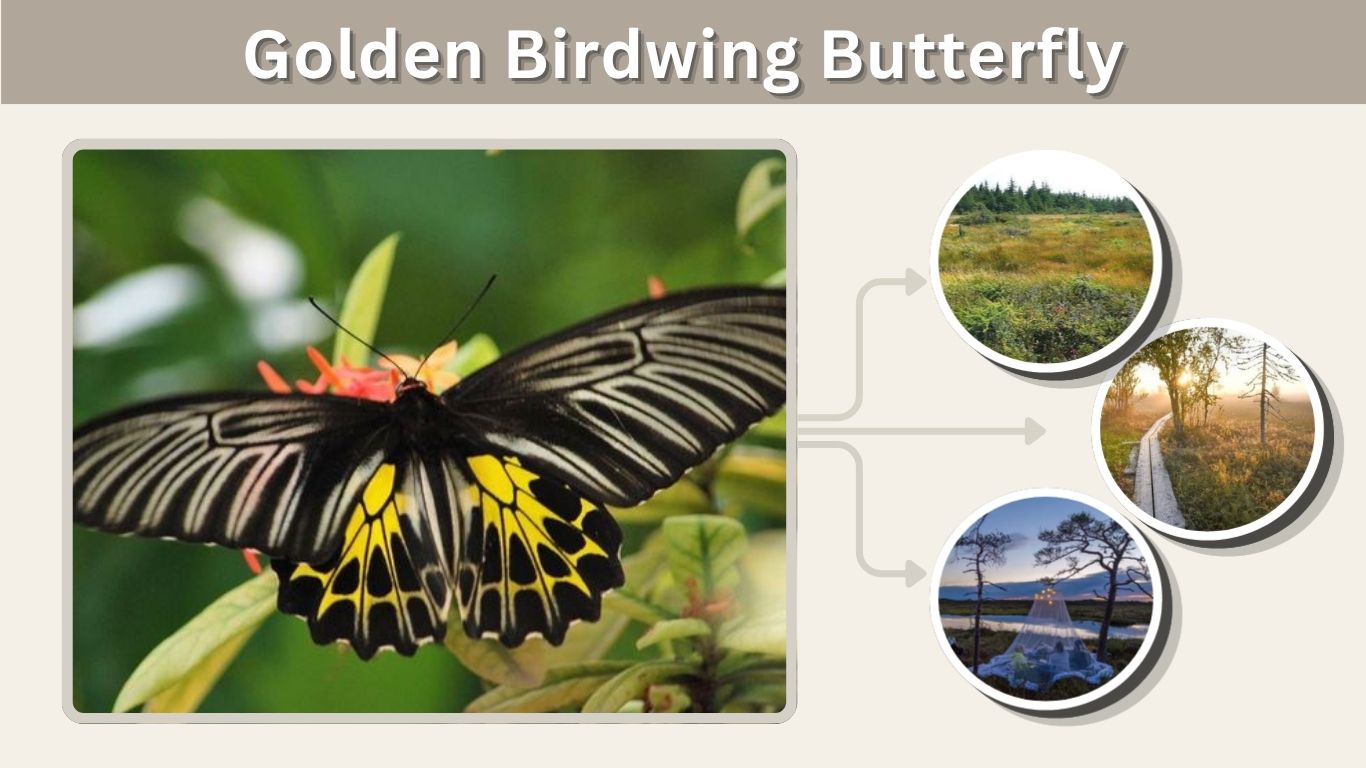
The golden birdwing butterfly (Troides aeacus) is a spectacular tropical butterfly recognized by its large wings, dark forewings, and brilliant golden-yellow hindwings. It belongs to the swallowtail family, Papilionidae, and occurs mainly across parts of South and Southeast Asia. Like other birdwing butterflies, it is a powerful flier and relies on specific host plants during its caterpillar stage. Its striking appearance sometimes causes confusion with Wallace’s golden birdwing, which is a different species. Here is everything to know about its identification, size, habitat, caterpillar, diet, and life cycle.
What Is a Golden Birdwing Butterfly?
The golden birdwing is a large butterfly scientifically known as Troides aeacus. It belongs to the birdwing group of swallowtail butterflies, famous for their impressive size and brightly colored wings.
Adults are usually seen flying around tropical forests, forest edges, gardens, and other areas containing flowering plants.
Golden Birdwing Identification
Important characteristics include:
- Large overall wingspan
- Dark brown to black forewings
- Brilliant golden-yellow hindwings in males
- Bold black markings along the hindwings
- Long, narrow forewings
- Robust black body
- Red or reddish markings around parts of the thorax
- Strong, graceful flight
Males generally display the brightest golden coloration, while females are usually larger and have more extensive dark markings.
Male vs. Female Golden Birdwing
Male and female golden birdwings can look noticeably different.
Males tend to have striking golden-yellow hindwings bordered with black. Their overall coloration is cleaner and more contrasting.
Females are normally larger. Their wings contain more brown or black coloration, and the yellow areas may be less extensive. This sexual dimorphism helps experienced observers distinguish the sexes relatively easily.
Why Is It Called a Birdwing?
Birdwing butterflies received their common name because of their unusually large size and powerful flight.
When flying high through tropical vegetation, they can appear almost bird-like from a distance. Their long wings allow them to travel efficiently between flowers and host plants.
Golden Birdwing Butterfly Size
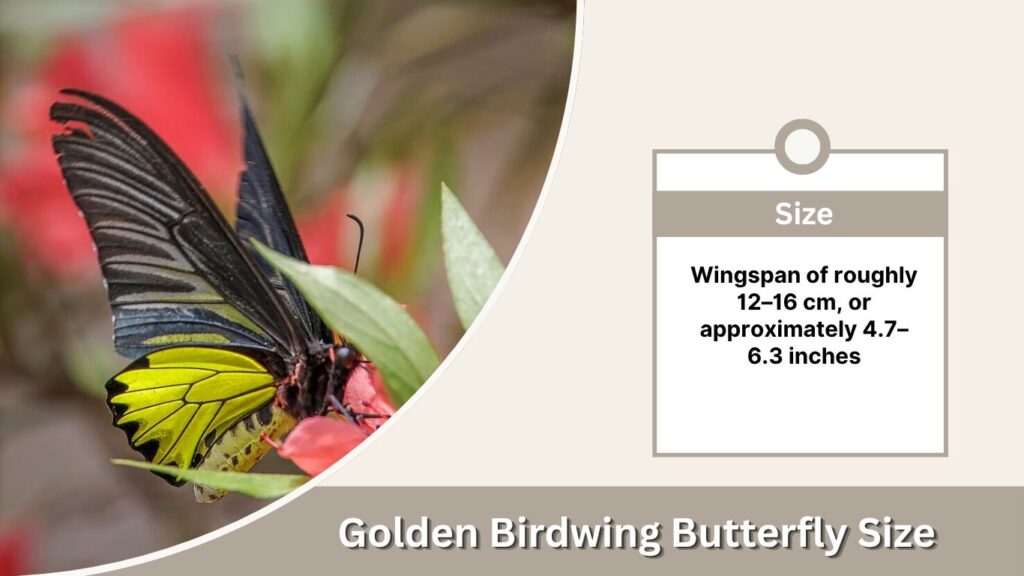
The golden birdwing is considerably larger than many familiar garden butterflies. Its impressive wingspan is one of the first characteristics people notice.
Females generally grow larger than males, a pattern common among many birdwing butterflies.
How Big Is a Golden Birdwing Butterfly?
Depending on sex and individual variation, adults can reach a wingspan of roughly 12–16 cm, or approximately 4.7–6.3 inches.
Typical characteristics include:
- Wingspan: Around 12–16 cm
- Female: Usually larger and heavier
- Male: Often smaller but more brightly colored
- Body: Thick compared with many smaller butterflies
Large females flying through forest openings can be especially impressive.
Is the Golden Birdwing One of the Largest Butterflies?
Golden birdwings are certainly large butterflies, although they are not the world’s largest.
Some relatives in the birdwing group grow considerably bigger. Queen Alexandra’s birdwing, for example, is famous for reaching an extraordinary wingspan compared with most butterfly species.
Still, Troides aeacus is large enough to stand out dramatically among ordinary butterflies.
Where Does the Golden Birdwing Live?
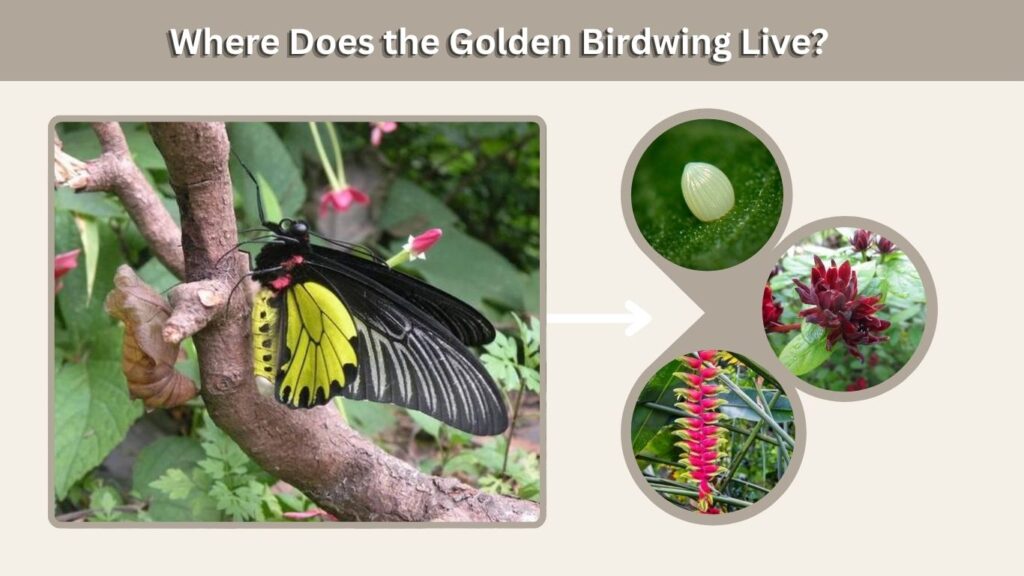
Golden birdwings occur primarily in tropical and subtropical regions of Asia. Their distribution includes areas of South Asia, mainland Southeast Asia, and nearby regions where suitable forest habitat and host plants are available.
They are strongly associated with warm environments.
Golden Birdwing Habitat
Typical habitats include:
- Tropical forests
- Subtropical forests
- Forest edges
- Open woodland
- Hillsides
- River valleys
- Flower-rich clearings
- Gardens close to natural habitat
Adults frequently move between sunny openings and wooded areas.
They may fly relatively high when traveling but descend toward flowering plants to feed.
Why Host Plants Matter
Golden birdwing populations depend heavily on suitable larval host plants.
Female butterflies must locate plants that their caterpillars can eat before laying eggs. Even areas with abundant flowers may therefore be unsuitable for breeding if the correct host plants are absent.
Golden Birdwing Caterpillar
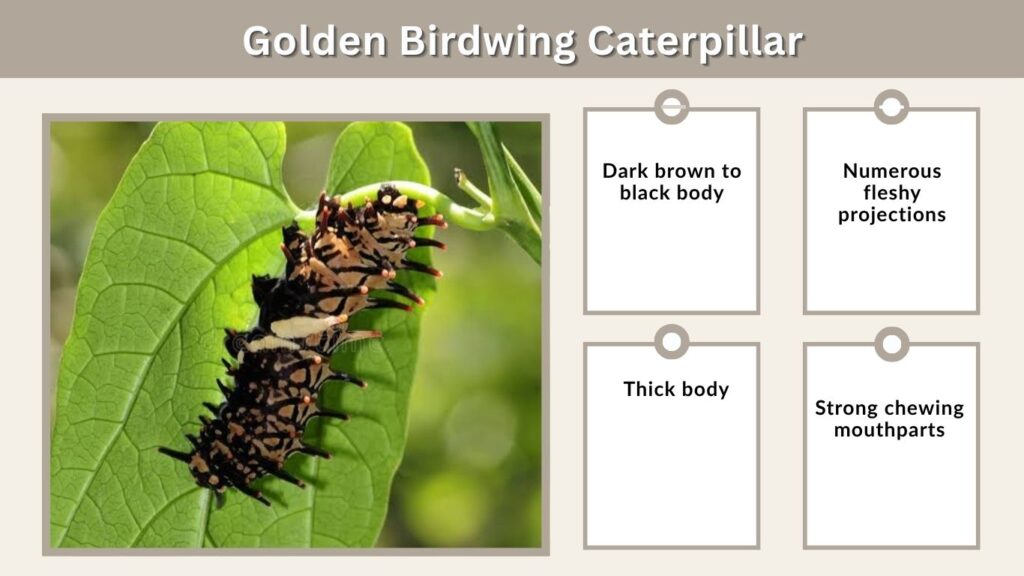
The golden birdwing caterpillar looks dramatically different from the beautiful adult.
Like many birdwing larvae, it has a dark, fleshy body covered with prominent projections. Its unusual appearance may seem intimidating, but these structures are not ordinary stingers.
Golden Birdwing Caterpillar Identification
A caterpillar may show:
- Dark brown to black body
- Numerous fleshy projections
- Contrasting reddish or orange markings
- Thick body
- Several developmental stages before pupation
- Strong chewing mouthparts
Young larvae are significantly smaller and may look different from mature caterpillars.
What Does the Golden Birdwing Caterpillar Eat?
Golden birdwing larvae feed primarily on Aristolochia plants, commonly called pipevines or birthworts.
These host plants contain chemical compounds that caterpillars can tolerate and use as part of their natural defenses.
A female butterfly therefore carefully searches for suitable host plants before depositing her eggs.
Are Golden Birdwing Caterpillars Poisonous?
The caterpillars are not aggressive and do not possess a venomous sting.
However, birdwing caterpillars can acquire defensive chemicals from their host plants. These compounds may make them unpleasant or unsuitable for certain predators.
Their bright contrasting coloration can serve as a warning that they are not an ideal meal.
What Do Golden Birdwing Butterflies Eat?
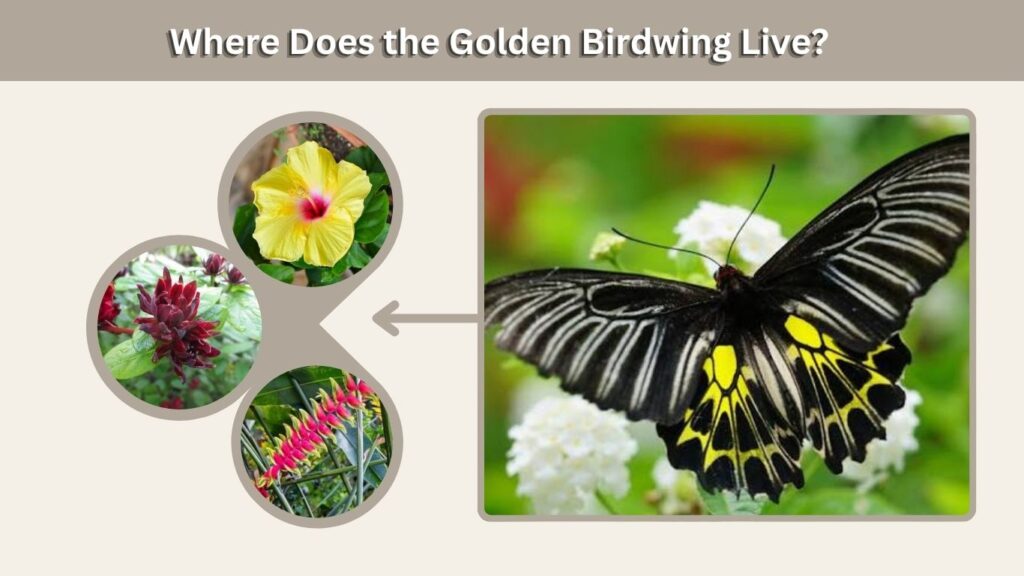
Adult golden birdwings drink nectar rather than chewing leaves.
Their feeding behavior differs completely from that of their caterpillars. Adults visit flowers and extend a long proboscis into the bloom to obtain liquid nectar.
Adult Golden Birdwing Diet
Adults commonly seek:
- Flower nectar
- Nectar from flowering shrubs
- Tropical flowering plants
- Other accessible sugar-rich floral resources
While feeding, butterflies can transfer pollen between flowers.
They therefore participate in pollination, although different plant species vary in how strongly they depend on butterfly visitors.
Caterpillar vs. Adult Diet
The two life stages have very different diets.
| Life Stage | Main Food |
| Caterpillar | Aristolochia host plant leaves |
| Pupa | Does not feed |
| Adult butterfly | Flower nectar |
This change occurs because the mouthparts and nutritional needs of the animal completely transform during metamorphosis.
Golden Birdwing Life Cycle
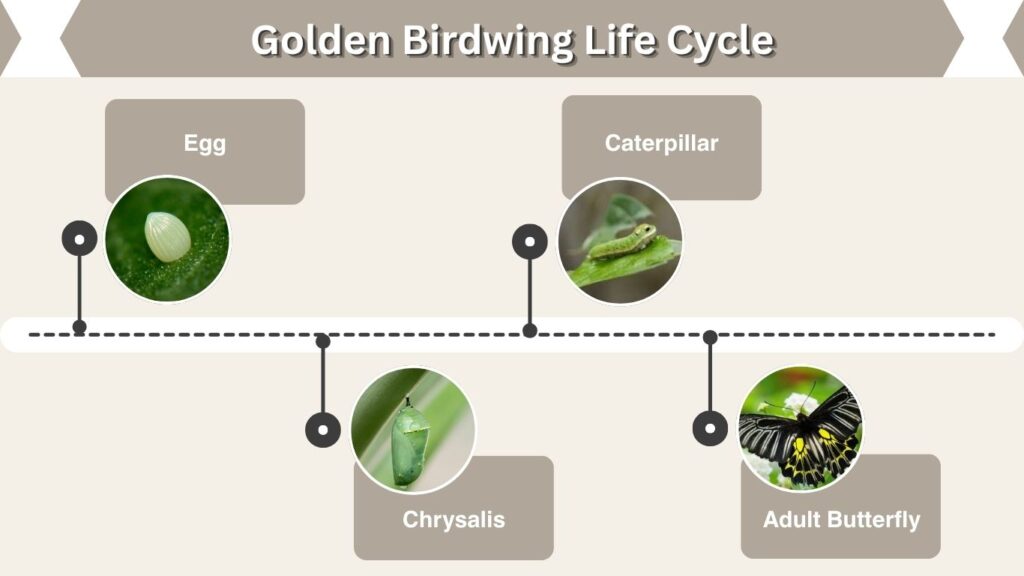
Golden birdwings undergo complete metamorphosis, progressing through egg, caterpillar, pupa, and adult stages.
Temperature, rainfall, food availability, and local climate can influence development.
1. Egg
A female searches for an appropriate host plant and deposits eggs on or near suitable leaves.
The developing caterpillar remains inside the egg until it is ready to hatch.
2. Caterpillar
After hatching, the larva begins eating host-plant foliage.
It grows rapidly and repeatedly sheds its outer skin. Each period between molts is known as an instar.
3. Pupa
Once fully developed, the caterpillar stops feeding and prepares for transformation.
It attaches itself to vegetation and becomes a chrysalis. Inside, extensive changes produce the adult butterfly.
4. Adult Butterfly
The adult eventually emerges from the chrysalis.
Its wings initially remain soft and folded. After expanding and drying them, the butterfly becomes capable of flight and begins searching for nectar and potential mates.
Golden Birdwing Behavior
Golden birdwings are strong fliers that can travel through and above forest vegetation with surprisingly powerful wingbeats.
Males and females may behave somewhat differently because females must search for host plants suitable for egg laying.
Typical Behavior
Golden birdwings may:
- Visit flowers for nectar
- Fly through forest openings
- Rest on vegetation
- Search for mates
- Patrol suitable habitat
- Seek Aristolochia plants for reproduction
Warm, sunny weather often encourages more visible butterfly activity.
During unfavorable weather, individuals are more likely to remain sheltered.
Golden Birdwing vs. Wallace’s Golden Birdwing
These names can be confusing, but the golden birdwing and Wallace’s golden birdwing are not the same species.
The golden birdwing is Troides aeacus, while Wallace’s golden birdwing is generally known scientifically as Ornithoptera croesus.
Main Differences
| Feature | Golden Birdwing | Wallace’s Golden Birdwing |
| Scientific name | Troides aeacus | Ornithoptera croesus |
| Main region | South and Southeast Asia | Indonesian islands |
| Group | Birdwing butterfly | Birdwing butterfly |
| Male coloration | Black with golden-yellow hindwings | Brilliant golden/orange coloration |
| Caterpillar food | Mainly Aristolochia | Mainly Aristolochia relatives |
Wallace’s golden birdwing is particularly famous because of its historical association with naturalist Alfred Russel Wallace.
Golden Birdwing Butterfly Facts
Several characteristics make this butterfly particularly interesting:
- Its scientific name is Troides aeacus.
- It belongs to the swallowtail family Papilionidae.
- Females are generally larger than males.
- Males have striking golden-yellow hindwings.
- Caterpillars feed primarily on Aristolochia plants.
- Adults mainly drink flower nectar.
- Caterpillars can retain defensive compounds obtained from host plants.
- The species undergoes complete metamorphosis.
- It is a strong and powerful flier.
- It should not be confused with Wallace’s golden birdwing.
FAQs
1. How big is a golden birdwing butterfly?
Golden birdwing butterflies commonly reach approximately 12–16 cm, or about 4.7–6.3 inches, across the wings. Females are generally larger and more heavily built than males, while males usually display brighter golden-yellow wing coloration.
2. What does a golden birdwing caterpillar eat?
Golden birdwing caterpillars mainly feed on plants belonging to the genus Aristolochia. These plants serve as essential larval hosts and provide both nutrition and chemical compounds that can contribute to the caterpillar’s defenses against predators.
3. Where are golden birdwing butterflies found?
Golden birdwings occur across parts of South and Southeast Asia. They favor tropical and subtropical forests, forest edges, open woodland, valleys, and other warm habitats containing suitable nectar sources and larval host plants.
4. Is the golden birdwing butterfly poisonous?
Adult golden birdwings are not dangerous to humans. Their caterpillars obtain defensive compounds from Aristolochia host plants, which can help discourage predators. Neither the adult nor caterpillar has a venomous sting designed to harm people.
5. Is Wallace’s golden birdwing the same butterfly?
No. Wallace’s golden birdwing and the golden birdwing are different species. Golden birdwing generally refers to Troides aeacus, while Wallace’s golden birdwing refers to Ornithoptera croesus, a birdwing butterfly native to parts of Indonesia.