
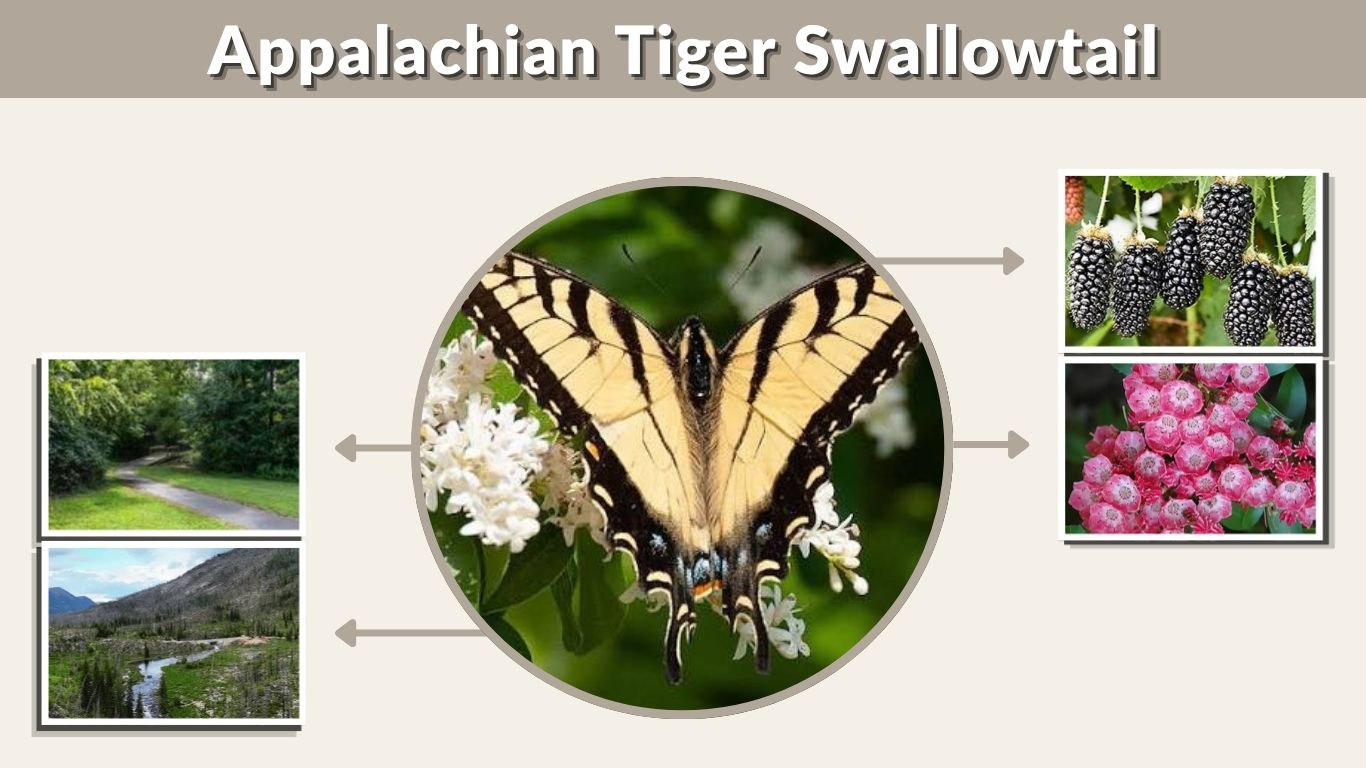
The Appalachian Tiger Swallowtail is a large yellow-and-black butterfly native to the Appalachian Mountains of the eastern United States. Scientifically known as Papilio appalachiensis, it closely resembles the Eastern Tiger Swallowtail but is usually larger and associated with higher-elevation forests. Adults are most visible in late spring, when males patrol ridges and forest openings while females remain closer to the tree canopy. Wild black cherry is the only currently documented caterpillar host plant.
What Is an Appalachian Tiger Swallowtail?
The Appalachian Tiger Swallowtail belongs to the swallowtail family Papilionidae. It was formally described as a separate species in 2002 after researchers examined its appearance, seasonal activity, habitat, range, and behavior. Some taxonomic sources place it in the genus Pterourus as Pterourus appalachiensis, although Papilio appalachiensis remains widely used.
Genetic research indicates that the species originated through historical hybridization between the Eastern Tiger Swallowtail and Canadian Tiger Swallowtail. It now maintains its own recognizable appearance, seasonal cycle, and mountain habitat.
| Feature | Description |
| Scientific name | Papilio appalachiensis |
| Alternative genus | Pterourus appalachiensis |
| Family | Papilionidae |
| Wingspan | 3⅜–4½ inches |
| Main colors | Yellow and black |
| Flight period | Mainly May through June |
| Caterpillar host | Wild black cherry |
| Habitat | Mid- to high-elevation deciduous forest |
| Range | Appalachian Mountains of the eastern US |
Appalachian Tiger Swallowtail Identification
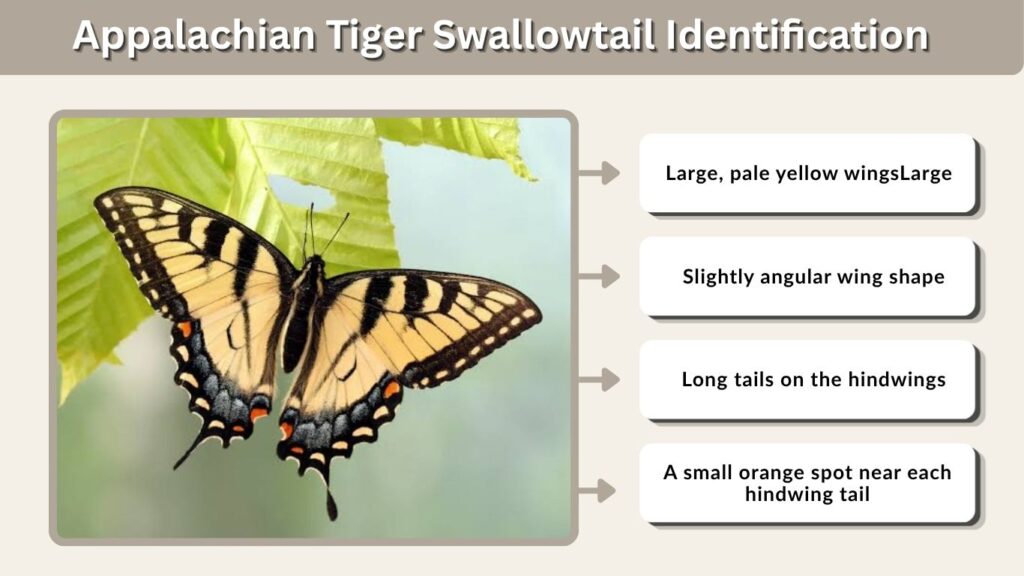
This butterfly has pale yellow wings crossed by bold black tiger stripes. Each hindwing ends in a narrow tail and carries blue, orange, and pale markings near its outer edge.
Its wingspan ranges from approximately 8.6 to 11.5 centimeters, or 3⅜ to 4½ inches. It is generally larger than the Eastern Tiger Swallowtail, although size alone cannot always confirm identification.
Key Identification Features
Look for:
- Large, pale yellow wings
- Four narrow black stripes on each forewing
- Slightly angular wing shape
- Black borders containing pale yellow spots
- Long tails on the hindwings
- Reduced blue coloring on the upper hindwings
- A small orange spot near each hindwing tail
- A nearly continuous yellow band beneath the forewing
- Rectangular pale markings beneath the hindwing
Male hindwings tend to look more triangular than those of related tiger swallowtails. Reliable identification may require a clear view of both the upper and lower wing surfaces because the species can occur alongside Eastern Tiger Swallowtails.
Male vs. Female Appalachian Tiger Swallowtail
Male and female Appalachian Tiger Swallowtails differ in coloration and behavior, although both sexes are large butterflies with black-striped wings.
Male Appalachian Tiger Swallowtail
Males are normally yellow with dark tiger stripes. They frequently patrol treetops, mountain ridges, and forest openings while searching for females.
Males may also gather on damp soil, muddy roads, or stream banks. This behavior, known as puddling, allows them to absorb moisture and dissolved minerals.
Female Appalachian Tiger Swallowtail
Females occur in both yellow and dark forms. Yellow females resemble males but usually have more blue coloring along the hindwing margins.
Dark-form females are predominantly black, with faint shadows of the tiger stripes and pale blue markings on the hindwings. Both female forms have less extensive iridescent blue coloring than Eastern Tiger Swallowtail females. Females are often difficult to observe because they spend considerable time in the forest canopy.
Appalachian Tiger Swallowtail Caterpillar
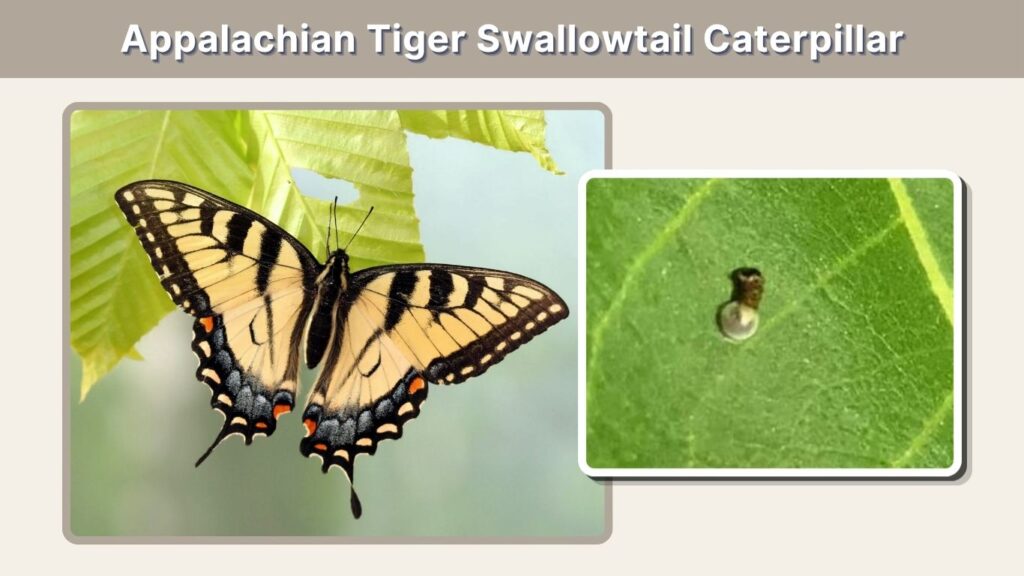
The Appalachian Tiger Swallowtail begins life as an egg placed individually on a host leaf. After hatching, the caterpillar feeds on the leaf and passes through several growth stages called instars.
Young tiger swallowtail caterpillars may resemble bird droppings, helping them avoid predators. A mature caterpillar becomes green and develops a pair of prominent false eyespots near the front of its body. These markings can make the caterpillar resemble a small snake, although its real head is much smaller and positioned below the eyespots.
Appalachian Tiger Swallowtail caterpillars may be difficult to find because females often lay eggs high in trees. The caterpillar eventually leaves the feeding area and forms a chrysalis attached to a stem, trunk, or another protected surface.
Appalachian Tiger Swallowtail Host Plants
Wild black cherry, Prunus serotina, is the only currently confirmed caterpillar food plant for this species. Females lay their eggs individually on its leaves, which the caterpillars eat after hatching.
This specialized relationship differs from that of the Eastern Tiger Swallowtail, whose caterpillars use many trees, including cherry, tulip tree, willow, birch, ash, cottonwood, sweetbay, and basswood.
Planting native wild black cherry within the butterfly’s natural range may provide breeding habitat. However, the tree should be allowed to grow without routine insecticide treatment because pesticide residue can kill eggs and caterpillars.
What Do Adult Appalachian Tiger Swallowtails Eat?
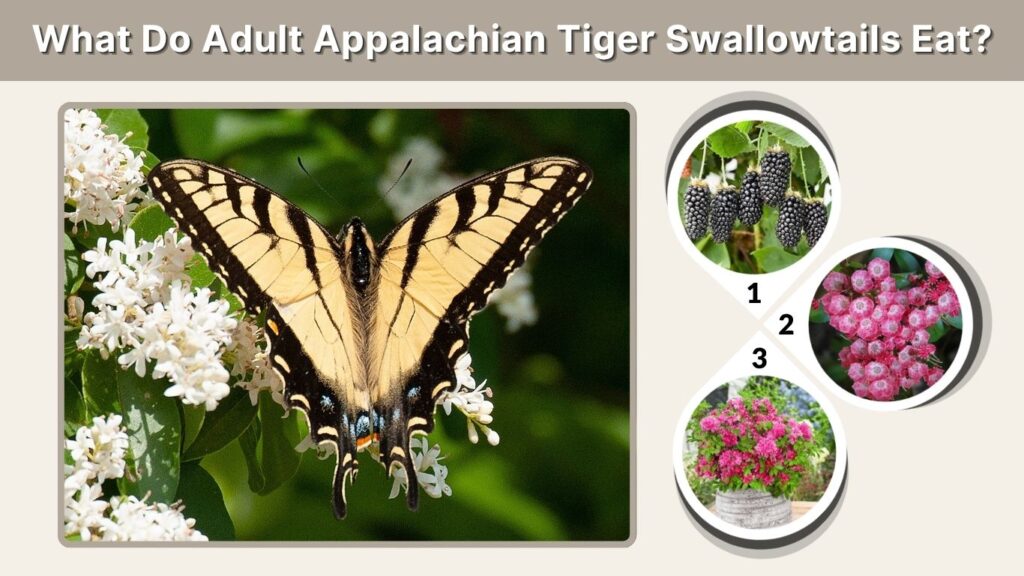
Adult butterflies do not eat leaves. They drink nectar through a long, coiled mouthpart called a proboscis.
Documented nectar plants include:
- Early azalea
- Pink azalea
- Mountain laurel
- Blackberry
- Cockspur hawthorn
- Bush honeysuckle
- Multiflora rose
Adults may visit other available flowers, especially those growing along forest openings, roadsides, stream banks, and mountain meadows.
Males also obtain minerals from moist soil and animal waste. These nutrients may later be transferred to females during mating.
Appalachian Tiger Swallowtail Habitat and Distribution
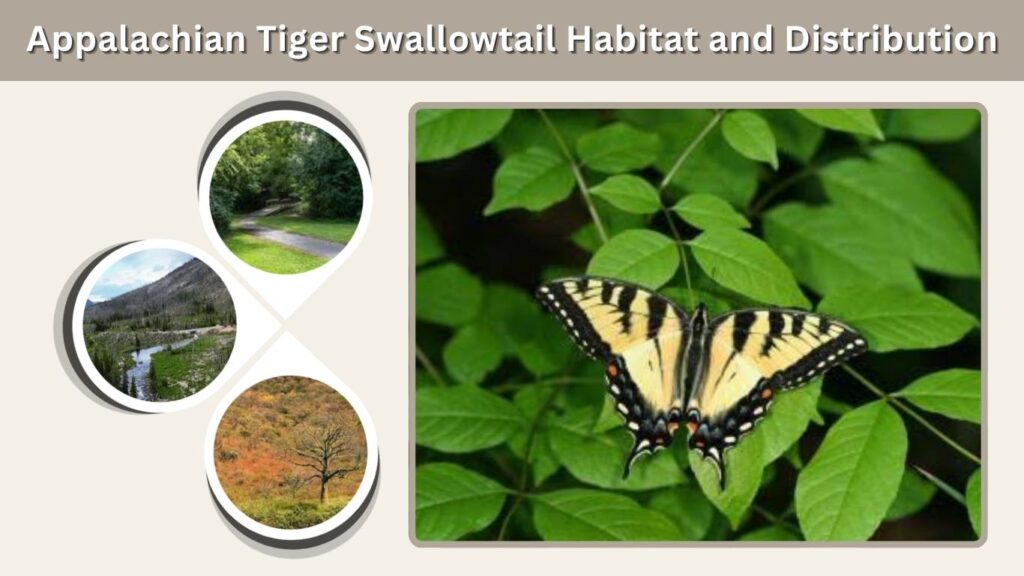
The Appalachian Tiger Swallowtail lives mainly in deciduous broadleaf forests at middle and higher elevations. It is closely connected to mountainous areas and seldom wanders far from woodland.
Its range follows the Appalachian Mountains from Pennsylvania south through Maryland, West Virginia, Virginia, Tennessee, North Carolina, and Georgia. Its western range reaches northeastern Alabama. Local distribution depends on elevation, forest cover, climate, and the availability of wild black cherry.
Adults may be found around:
- Mountain ridges
- Deciduous forests
- Woodland roads
- Stream valleys
- Forest clearings
- Moist roadside soil
- Summit openings
- Flowering shrubs near forests
Appalachian Tiger Swallowtail Life Cycle
The species undergoes complete metamorphosis through four stages: egg, caterpillar, chrysalis, and adult.
Egg and Caterpillar
A female deposits eggs singly on wild black cherry leaves. After hatching, the caterpillar feeds and molts several times as it increases in size.
Chrysalis
The mature caterpillar forms a chrysalis. The species generally passes the winter in this protected pupal stage.
Adult Butterfly
Adults emerge mainly during May and June. The Appalachian Tiger Swallowtail generally produces one generation each year, making its adult flight season shorter than that of the Eastern Tiger Swallowtail.
Appalachian vs. Eastern Tiger Swallowtail
These butterflies overlap geographically and can look nearly identical. A combination of size, wing markings, elevation, and season offers the best field clues.
| Feature | Appalachian Tiger | Eastern Tiger |
| Scientific name | P. appalachiensis | P. glaucus |
| Typical habitat | Mid- to high-elevation forest | Many wooded and suburban habitats |
| Relative size | Usually larger | Often smaller |
| Black wing stripes | Generally narrower | Usually broader |
| Female blue wash | Markedly reduced | Often extensive |
| Main flight period | May–June | Spring through summer |
| Annual generations | Usually one | Two in the north; three in the south |
| Known host range | Wild black cherry | Many tree species |
Spring Eastern Tiger Swallowtails can resemble Appalachian Tigers, so photographs may need expert review for reliable confirmation.
FAQs
Is the Appalachian Tiger Swallowtail rare?
It has a restricted mountain range but is considered secure overall. It may be uncommon at lower elevations and locally absent where suitable forest habitat or wild black cherry is limited. Its brief spring flight period can also make it seem rarer than it is.
Where can you see an Appalachian Tiger Swallowtail?
Look in mid- and high-elevation Appalachian forests from Pennsylvania to Georgia and northeastern Alabama. Males are often seen patrolling mountain ridges, forest roads, and treetops or gathering on moist ground during May and June.
What is the food plant of the Appalachian Tiger Swallowtail?
Wild black cherry is the only currently documented caterpillar host. Adult butterflies drink nectar from azaleas, mountain laurel, blackberry flowers, hawthorn, bush honeysuckle, and other flowering plants.
How can you attract Appalachian Tiger Swallowtails?
Within their natural range, protect mature deciduous forest, retain wild black cherry trees, grow nectar-rich native flowers, and avoid broad-spectrum insecticides. A shallow area of moist, mineral-rich soil may also attract puddling males.
Is the Appalachian Tiger Swallowtail poisonous?
It is not dangerous to humans and cannot sting. Caterpillars may display an orange defensive organ called an osmeterium when threatened, but the butterfly and caterpillar are best handled minimally to avoid injuring them.