

Monarch butterfly migration is one of the most remarkable journeys in the insect world. Every year, millions of monarchs travel between breeding grounds in the United States and Canada and overwintering areas farther south. Eastern monarchs primarily travel to central Mexico, while western populations often move toward coastal California and Mexico. Their migration can cover thousands of miles and involves several generations. Understanding when monarch butterflies migrate, where they travel, and how they navigate reveals an extraordinary survival strategy.
Why Do Monarch Butterflies Migrate?
Monarch butterflies migrate because they cannot survive prolonged freezing temperatures in much of their northern range. As autumn approaches, decreasing daylight and cooler temperatures trigger behavioral and physiological changes. Instead of reproducing immediately, the fall generation begins traveling toward locations where winter conditions are mild enough for survival.
Main Reasons Monarchs Migrate
Monarch migration helps the butterflies:
- Escape freezing winter temperatures
- Find suitable overwintering conditions
- Conserve energy during the cold season
- Return north when milkweed becomes available
- Reach breeding habitats during spring and summer
- Maintain populations across a large geographic range
Unlike many insects, monarchs do not simply remain dormant throughout harsh northern winters.
The Special Migratory Generation
Most monarch generations during spring and summer live for only a few weeks. The generation that emerges in late summer and early fall is different.
These butterflies enter a temporary reproductive pause known as diapause. Instead of mating immediately, they direct much of their energy toward migration and survival.
This migratory generation can live for several months, allowing it to travel south, overwinter, and begin the northward journey before reproducing.
Where Do Monarch Butterflies Migrate To?

The destination depends largely on which monarch population is being observed. Eastern North American monarchs make the most famous migration, traveling toward high-elevation forests in central Mexico. Western monarchs historically concentrate at numerous overwintering sites along the California coast, although some western butterflies may also travel toward Mexico.
Major Monarch Migration Destinations
Important destinations include:
- Central Mexico: Primary winter destination for eastern monarchs
- Michoacán: Home to several famous overwintering colonies
- State of Mexico: Contains additional mountain overwintering sites
- Coastal California: Supports numerous western overwintering sites
- Northern Mexico: Important migration corridor
- Texas: Major pathway for monarchs traveling between Mexico and northern breeding grounds
Monarchs often gather in enormous groups once they reach suitable winter habitat.
Monarch Butterfly Migration to Mexico
Eastern monarchs travel toward mountainous forests in central Mexico, especially areas dominated by oyamel fir trees.
The combination of elevation, forest cover, temperature, and humidity creates a cool but relatively protected environment. Conditions allow monarchs to reduce their activity and conserve stored energy.
Thousands or even millions of butterflies can gather on trees within the same forest areas. Dense clusters help them remain relatively inactive until temperatures begin rising toward spring.
Monarch Butterfly Migration Route

Monarch migration does not follow one narrow path. Butterflies spread across a broad geographic area and gradually concentrate along major routes as they travel south. Eastern monarchs moving from Canada and the northern United States commonly pass through the central United States and Texas before entering Mexico.
Typical Eastern Migration Path
A simplified route includes:
- Southern Canada
- Northern and central United States
- Great Plains and Midwest regions
- Oklahoma and surrounding areas
- Texas
- Northern Mexico
- Central Mexican mountains
Monarchs from the eastern United States may take somewhat different routes before joining the larger southbound movement.
Monarch Butterfly Migration Through Texas
Texas is particularly important because much of the eastern monarch population passes through the state.
During autumn, butterflies stop to feed on nectar-producing flowers before continuing toward Mexico. These nectar sources allow them to replenish energy required for the remaining journey.
In spring, Texas again becomes important because returning monarchs encounter newly growing milkweed where females can deposit eggs.
When Do Monarch Butterflies Migrate?
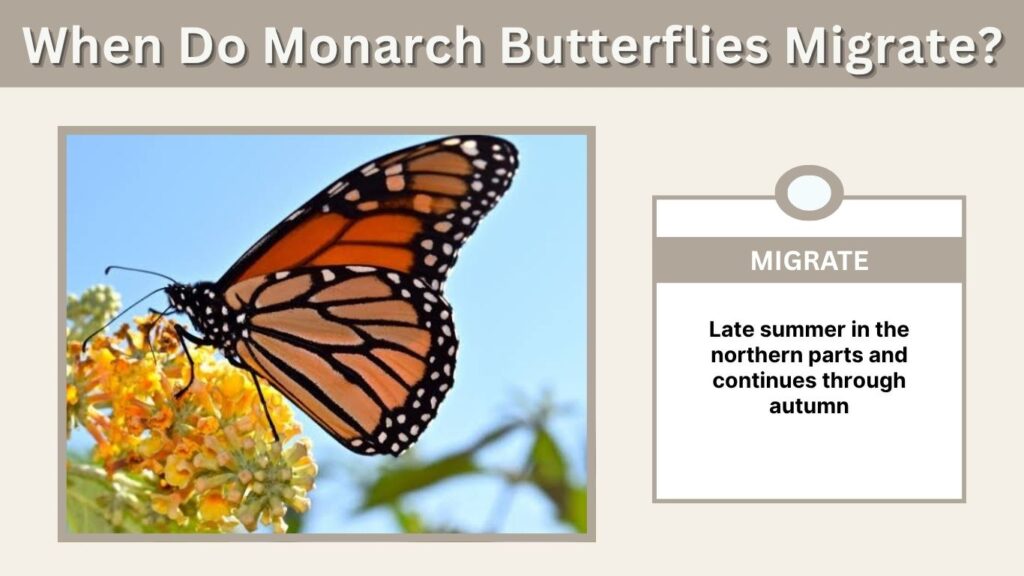
Migration timing varies with latitude, weather, and seasonal conditions. Southbound migration generally begins in late summer in the northern parts of the monarch’s range and continues through autumn. Butterflies farther south usually pass through later. Spring migration begins after overwintering monarchs become active and start moving north from Mexico.
General Monarch Migration Timeline
The annual pattern can be summarized as:
- August: Some northern monarchs begin moving south.
- September: Major southward migration develops.
- October: Large numbers move through central and southern regions.
- November: Many eastern monarchs reach Mexico.
- December–February: Butterflies remain at overwintering sites.
- March: Northward movement begins.
- Spring and summer: Successive generations continue expanding northward.
Exact dates vary each year because temperature, wind, and flowering conditions affect migration.
When Do Monarchs Migrate North?
Monarchs overwintering in Mexico usually begin becoming more active as temperatures rise toward the end of winter.
They leave Mexico and travel north into Texas and neighboring regions. Females begin laying eggs on newly emerging milkweed.
The butterflies that reach the northern United States and Canada later in the year are generally descendants of these returning monarchs rather than the same individuals that spent winter in Mexico.
How Far Do Monarch Butterflies Migrate?
Individual eastern monarchs can travel extraordinarily long distances. Some originating in southern Canada may travel around 2,000 to 3,000 miles before reaching central Mexico. The actual distance depends on where the butterfly begins and which route it follows.
Monarch Migration Distance Facts
During migration, monarchs may:
- Travel thousands of miles overall
- Cover dozens of miles on favorable days
- Use rising warm air to gain altitude
- Glide to conserve energy
- Stop regularly to drink nectar
- Rest during unfavorable weather
- Take several weeks to reach wintering grounds
Wind direction and weather can significantly affect daily progress.
How Long Does Monarch Migration Take?
The fall journey can take several weeks to around two months for butterflies beginning far north.
Monarchs do not fly continuously. They stop overnight and may remain inactive during cold, rainy, or extremely windy conditions.
On favorable days, they use a combination of powered flight and gliding. Feeding stops are essential because nectar provides carbohydrates that can be converted into stored fat needed during migration and overwintering.
How Do Monarch Butterflies Know Where to Migrate?
One of the most fascinating aspects of monarch migration is that the butterflies traveling to Mexico have never previously visited the overwintering forests. They must navigate without following parents that already know the route. Their ability combines inherited behavior with environmental information.
Navigation Tools Used by Monarchs
Monarchs can use:
- The position of the sun
- An internal biological clock
- Day length
- Temperature changes
- Wind conditions
- Earth’s magnetic field under some conditions
- Inherited directional behavior
Their sun-compass system allows them to maintain a generally southwesterly direction during fall migration.
How Can a New Generation Find Mexico?
The migratory behavior is genetically programmed rather than learned from an older generation.
Monarchs respond to seasonal environmental signals and use their internal navigation systems to maintain the appropriate direction.
This is especially remarkable because several generations may separate one year’s northward-moving butterflies from the generation that later returns south. Yet the autumn generation can still locate the same general mountain region used by previous generations.
Monarch Migration in Spring and Fall
Fall and spring migrations are very different. Fall migration is largely completed by one unusually long-lived generation, whereas the northward expansion happens across multiple generations. This distinction helps explain why monarch migration is often described as a multigenerational journey.
Fall Migration
Fall migrants:
- Live much longer than typical summer monarchs
- Delay reproduction
- Travel south toward overwintering areas
- Feed heavily on nectar
- Accumulate body fat
- Spend winter in large colonies
Their primary task is reaching and surviving at the overwintering grounds.
Spring Migration
In spring, overwintering butterflies leave Mexico and begin moving north.
They mate and lay eggs on milkweed as they travel. Their offspring mature and continue farther north, followed by additional generations.
As a result, the complete northward expansion into Canada may involve several generations. Later in the year, a new migratory generation makes the long southbound journey again.
Do All Monarch Butterflies Migrate?
Not every monarch population performs the famous long-distance journey between Canada and Mexico. Monarchs occur in several parts of the world, and migration behavior varies according to climate and geography. Even within North America, different populations may follow different seasonal movements.
Eastern vs Western Monarch Migration
Eastern monarchs are best known for traveling to central Mexico. Western monarchs often overwinter along coastal California, although migration patterns can overlap and some may travel into Mexico.
Monarch populations living in consistently warm environments may remain active throughout much of the year rather than undertaking the same long-distance seasonal migration.
Migration behavior is therefore strongly influenced by location and environmental conditions.
Threats During Monarch Butterfly Migration
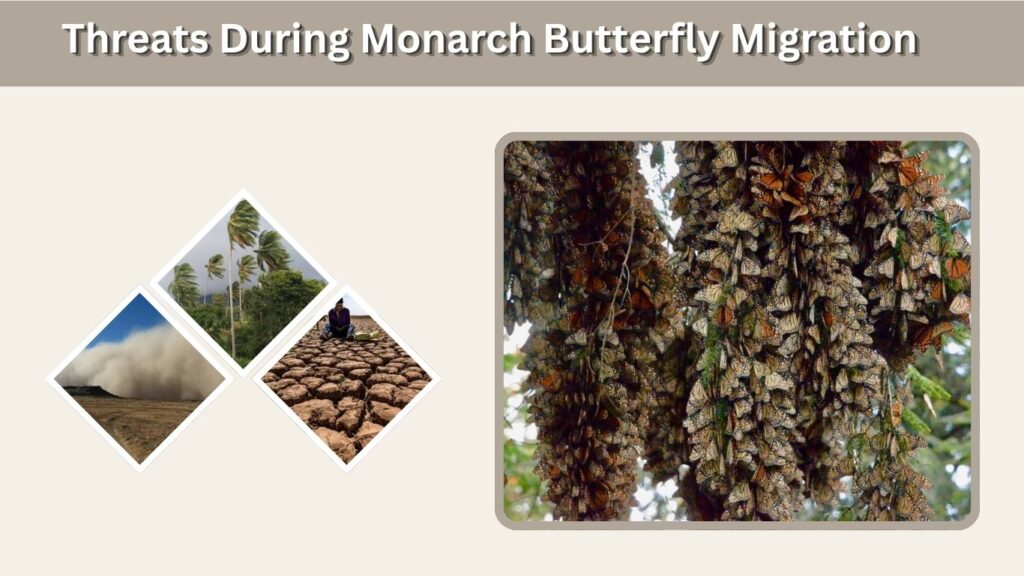
Migrating thousands of miles exposes monarchs to many challenges. Their survival depends on appropriate weather, flowering plants along migration corridors, suitable overwintering habitat, and milkweed for the next breeding generation. Changes anywhere along this chain can affect the number of butterflies completing the journey.
Major Migration Challenges
Monarchs may face:
- Severe storms
- Strong unfavorable winds
- Drought
- Loss of nectar plants
- Habitat destruction
- Loss of milkweed
- Pesticide exposure
- Extreme temperatures
- Predators and disease
Maintaining diverse flowering plants along migration routes can provide valuable nectar resources for traveling butterflies.
FAQs
Where Do Monarch Butterflies Migrate To?
Eastern North American monarchs primarily migrate to high-elevation forests in central Mexico, particularly in Michoacán and the State of Mexico. Western populations often overwinter at coastal California sites, although some western monarchs may also travel toward Mexico.
When Do Monarch Butterflies Migrate?
Southward migration generally begins in late summer and becomes strongest during September and October, depending on latitude. Many eastern monarchs reach Mexico by November. Their northward movement begins toward the end of winter and early spring.
How Far Do Monarch Butterflies Migrate?
Some monarch butterflies travel approximately 2,000 to 3,000 miles from southern Canada and the northern United States to central Mexico. Distance varies depending on starting location, weather, and migration route.
Why Do Monarch Butterflies Migrate to Mexico?
Monarchs migrate to central Mexico because its high-elevation forests provide relatively stable winter conditions. The cool temperatures reduce butterfly activity and conserve energy, while surrounding forests help protect colonies from severe weather until spring approaches.
How Do Monarch Butterflies Know Where to Migrate?
Monarchs rely on inherited navigation behavior combined with environmental information. They use the sun as a compass, adjust for time of day with an internal biological clock, and respond to seasonal cues. This allows butterflies that have never visited Mexico before to travel in the correct general direction.