
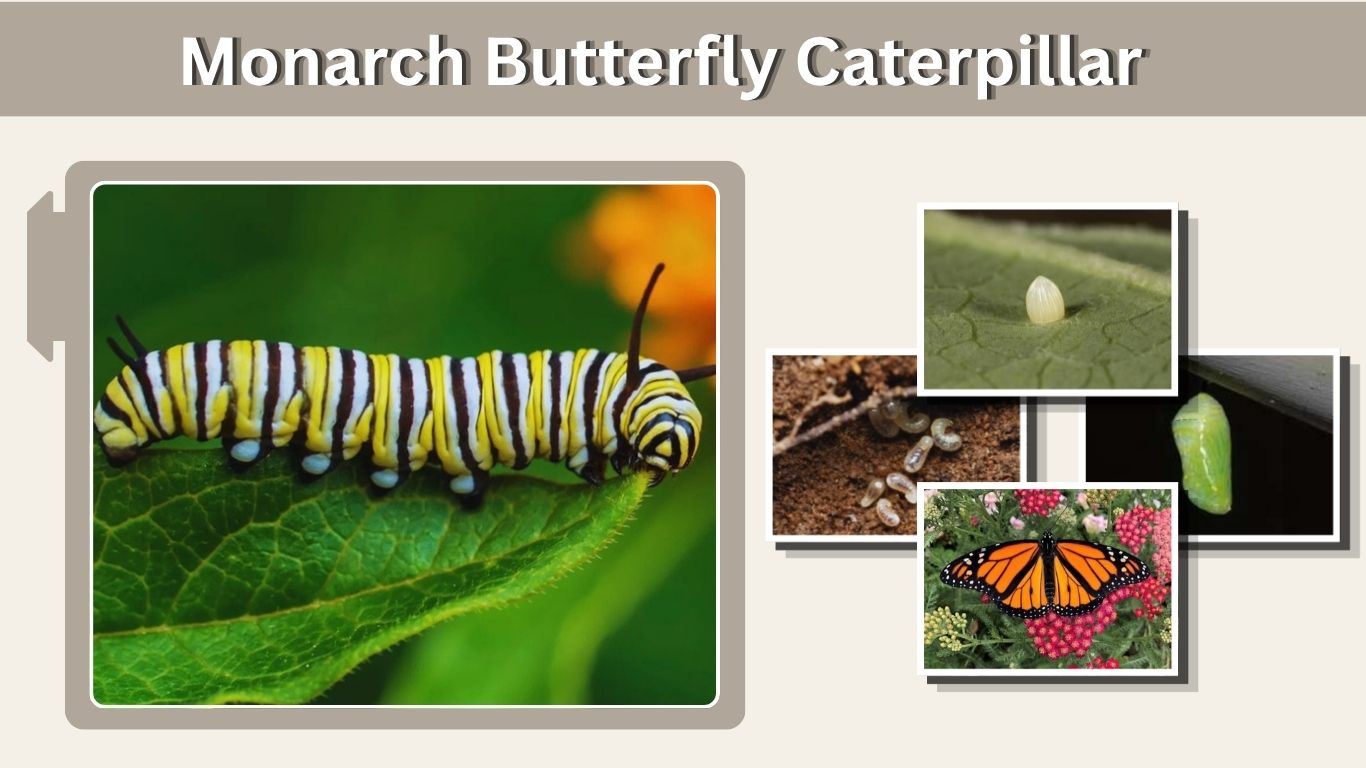
The monarch butterfly caterpillar is one of the easiest North American caterpillars to recognize because of its bold black, white, and yellow stripes and pairs of flexible black filaments. It is the larval stage of the monarch butterfly (Danaus plexippus) and depends almost entirely on milkweed for food. During only a couple of weeks, a tiny newly hatched larva grows dramatically, passes through five caterpillar stages, forms a green chrysalis, and eventually becomes an orange-and-black adult monarch butterfly.
What Does a Monarch Butterfly Caterpillar Look Like?
A mature monarch caterpillar has a striking striped appearance. Its body is covered with alternating black, white, and yellow bands, giving it a colorful pattern that becomes more noticeable as the larva grows.
It also has two pairs of long, flexible black projections called filaments—one pair near the head and another near the rear. These are not stingers or antennae.
Very young monarch caterpillars look different. Newly hatched larvae are extremely small, pale, and may initially have only faint markings. Their characteristic stripes develop as they grow.
Monarch Caterpillar Identification
Look for these features:
- Black, white, and yellow horizontal bands
- Smooth body without fuzzy hairs
- Two long black filaments near the head
- Two shorter filaments near the rear
- Six true legs near the front
- Fleshy prolegs farther down the body
- Commonly found feeding on milkweed
- Approximately 4–5 cm long when fully grown
A caterpillar with similar stripes but found on a plant other than milkweed should be identified carefully before assuming it is a monarch.
Monarch Butterfly Caterpillar Stages
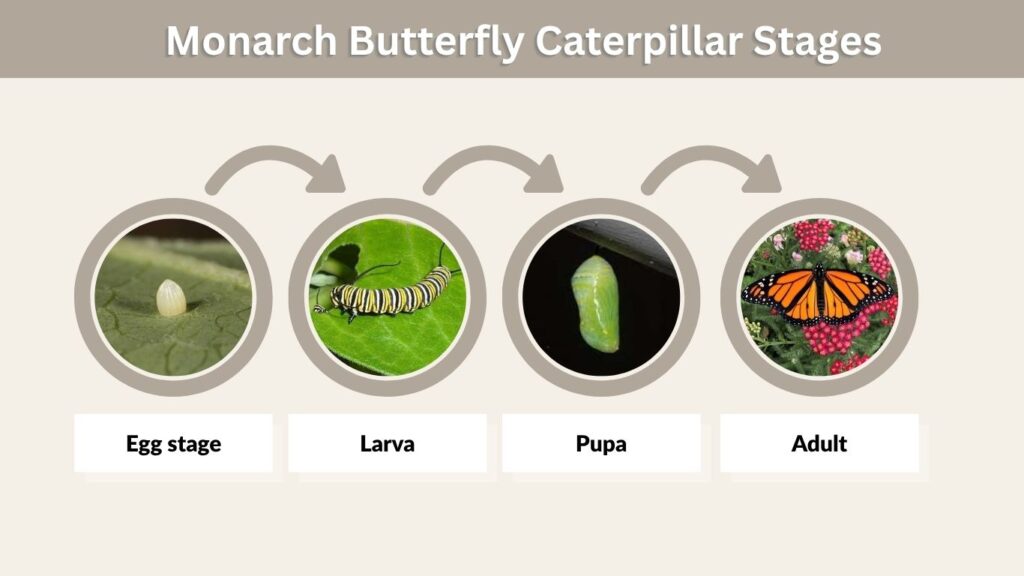
The monarch caterpillar passes through five larval stages called instars. Each instar ends when the caterpillar sheds its old skin and grows larger.
First Instar
A newly hatched monarch caterpillar is tiny, usually only a few millimeters long. It may first eat part of its eggshell before beginning to feed on milkweed.
The stripes and filaments are not yet as obvious as they will be later.
Second Instar
The caterpillar becomes noticeably larger, and the black, white, and yellow pattern develops more clearly.
Its front and rear filaments also become easier to see.
Third Instar
Feeding increases significantly. The caterpillar begins consuming larger portions of milkweed leaves and may move between leaves as it searches for fresh growth.
Fourth Instar
The body becomes thicker, and the stripes are now very distinctive. Caterpillars spend much of their time eating because rapid growth requires enormous amounts of food.
Fifth Instar
This is the final and largest caterpillar stage.
A fifth-instar monarch may reach roughly 4–5 cm in length. It eats heavily before eventually leaving its feeding area to search for a protected place to form a chrysalis.
What Do Monarch Butterfly Caterpillars Eat?
Monarch caterpillars eat milkweed.
Plants in the genus Asclepias are the primary host plants for monarch larvae. Female monarch butterflies deliberately search for milkweed when laying their eggs because newly hatched caterpillars need immediate access to suitable food.
Common milkweed species used by monarchs include:
- Common milkweed
- Swamp milkweed
- Butterfly weed
- Showy milkweed
- Whorled milkweed
- Tropical milkweed in cultivated areas
Although adult monarchs drink nectar from many flowers, the caterpillar stage is strongly dependent on milkweed.
Monarch Caterpillars on Butterfly Weed
Butterfly weed (Asclepias tuberosa) is itself a species of milkweed.
Therefore, finding a monarch caterpillar on butterfly weed is completely normal. The plant can serve as both a host plant for larvae and a nectar source for adult butterflies.
Do Monarch Caterpillars Eat Parsley?
No. Parsley is not a normal monarch host plant.
Striped caterpillars found eating parsley are more likely to be black swallowtail caterpillars. Black swallowtails commonly feed on parsley, dill, fennel, and related plants.
The host plant can therefore provide a useful identification clue.
Monarch Butterfly Egg to Caterpillar
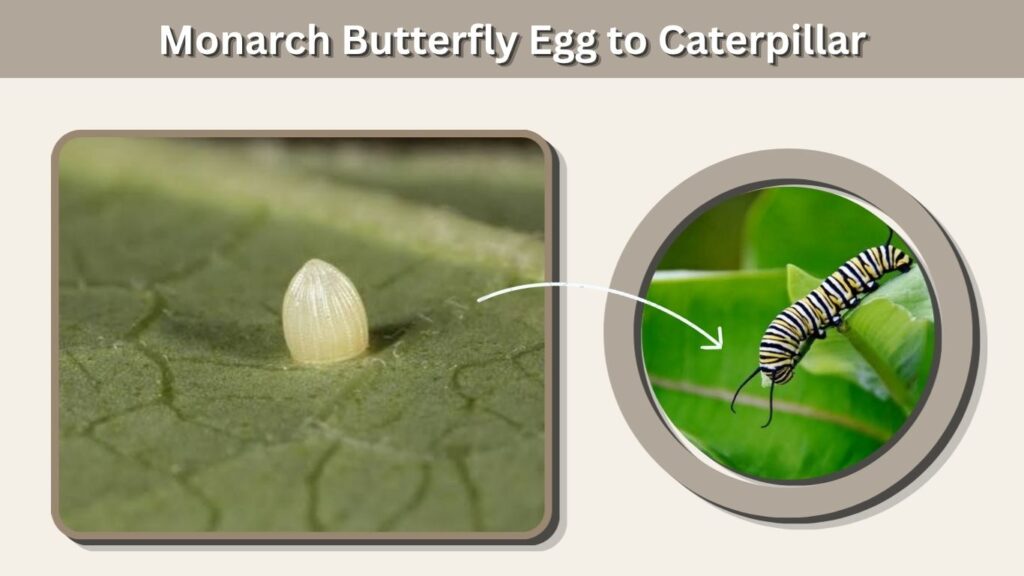
The monarch life cycle begins when a female lays a tiny egg, usually on the underside of a milkweed leaf.
The egg is pale cream to yellowish and has fine vertical ridges.
Under favorable warm conditions, the egg generally hatches after about 3–5 days.
The newly hatched caterpillar is tiny and immediately begins its period of rapid feeding and growth.
How Long Does a Monarch Stay a Caterpillar?
The monarch generally remains in the caterpillar stage for around 10–14 days, although temperature and food availability can influence development.
During that short time, it grows from a nearly microscopic hatchling into a large striped caterpillar.
Because its skin cannot continuously expand, it molts between each of its five instars.
After reaching full size, the caterpillar stops feeding and begins searching for a suitable place to pupate.
Monarch Caterpillar to Chrysalis
When ready to transform, the caterpillar attaches itself to a protected surface using a small pad of silk.
It then hangs upside down in a characteristic J shape.
After remaining in this position for a period, the caterpillar sheds its larval skin one final time. Beneath it is the bright green chrysalis.
Monarch Butterfly Chrysalis
The monarch chrysalis is:
- Bright jade green
- Smooth and rounded
- Decorated with metallic-looking gold spots
- Roughly 2–3 cm long
Although people sometimes call it a monarch caterpillar “cocoon,” monarchs technically form a chrysalis rather than a cocoon.
A cocoon generally includes a silk covering spun around the pupa, while a monarch pupa remains exposed inside its hardened chrysalis.
How Long From Caterpillar to Monarch Butterfly?
Once the caterpillar forms its chrysalis, the pupal stage typically lasts around 8–15 days, depending largely on temperature.
As emergence approaches, the chrysalis becomes darker and increasingly transparent. The orange-and-black wing pattern of the adult butterfly can eventually be seen through the outer covering.
The adult then emerges, expands its wings, and allows them to harden before flying.
From egg to adult butterfly, the entire process commonly takes approximately 3–5 weeks under favorable conditions.
Monarch Butterfly Caterpillar Size
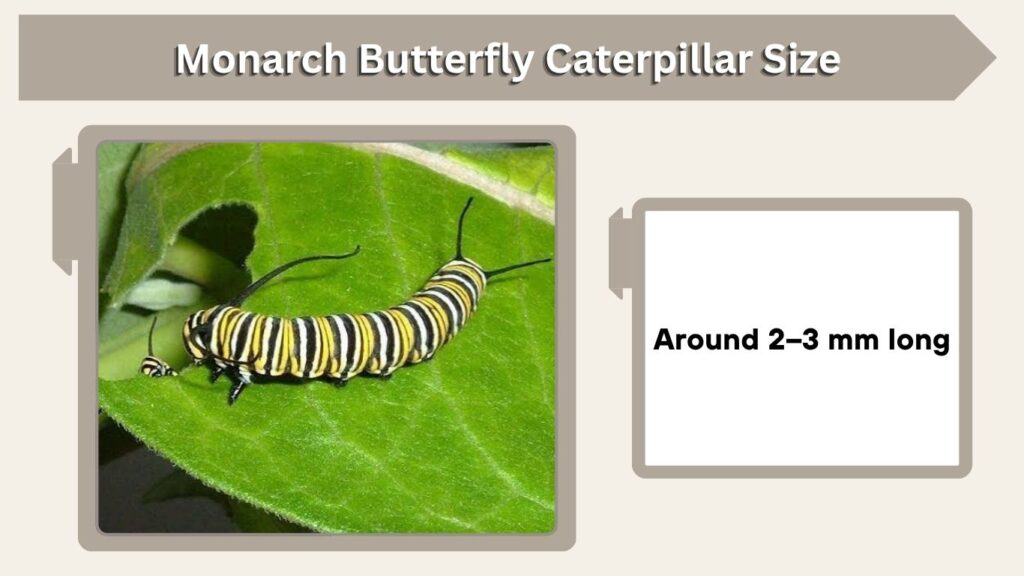
Monarch caterpillars grow remarkably quickly.
A newly hatched larva is only around 2–3 mm long, while a mature fifth-instar caterpillar may reach approximately 40–50 mm.
Much of this growth occurs because the caterpillar spends most of its larval period consuming milkweed.
Its increasing appetite also produces considerable amounts of caterpillar waste, commonly called frass. Finding dark pellets around milkweed can be a sign that caterpillars are feeding above.
Is a Monarch Butterfly Caterpillar Fuzzy?
No. A true monarch caterpillar is not fuzzy.
Its body appears relatively smooth, although it has long flexible filaments at the front and rear.
A heavily hairy or fuzzy caterpillar with monarch-like colors is likely another species and should not be identified based only on coloration.
Are Monarch Caterpillars Poisonous?
Monarch caterpillars are not venomous and do not sting people.
However, feeding on milkweed allows them to accumulate defensive chemicals called cardenolides. These compounds make monarch larvae and adults unpleasant or potentially toxic to many predators.
Their bright black, yellow, and white coloration functions partly as warning coloration.
For people, simply touching a monarch caterpillar is not comparable to touching a venomous stinging caterpillar. Nevertheless, unnecessary handling should be avoided because caterpillars are delicate.
Monarch Butterfly Caterpillar Predators
Despite their chemical defenses, monarch caterpillars still have many natural enemies.
Potential predators and parasites include:
- Spiders
- Ants
- Wasps
- Predatory bugs
- Birds capable of tolerating monarch toxins
- Tachinid flies
- Parasitoid wasps
Eggs and very young caterpillars are particularly vulnerable.
Only a fraction of monarch eggs laid in the wild survive through every stage to become adult butterflies.
Queen Butterfly Caterpillar vs Monarch Caterpillar
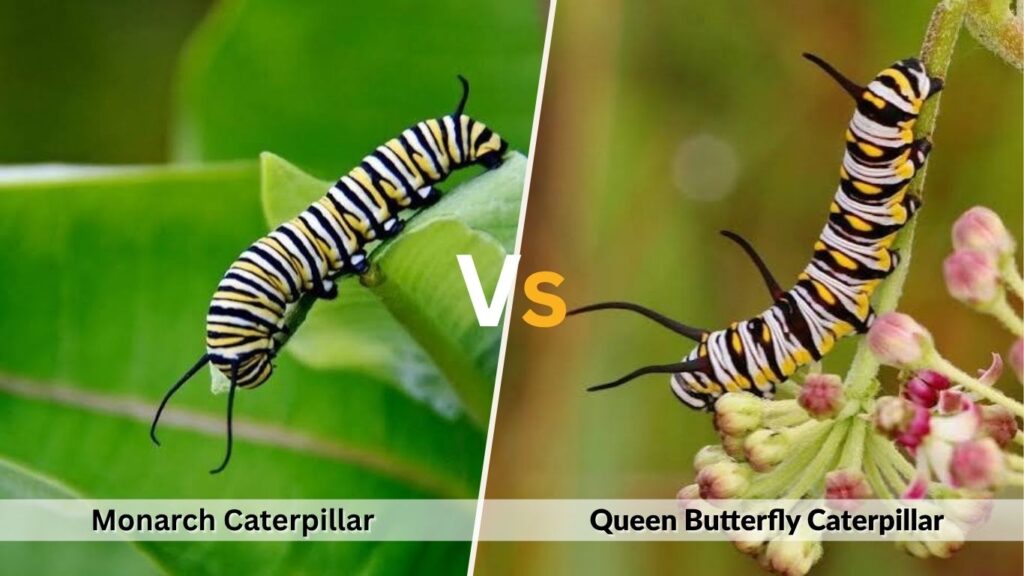
The queen butterfly caterpillar can look very similar to a monarch because both belong to the genus Danaus and feed on milkweed.
One of the easiest differences is the number of filament pairs.
| Feature | Monarch Caterpillar | Queen Caterpillar |
| Main colors | Black, white, yellow | Black, white, yellow |
| Filament pairs | 2 pairs | 3 pairs |
| Host plant | Milkweed | Milkweed |
| Adult | Orange with black veins | Dark reddish-brown/orange |
A monarch has one pair of filaments near the head and another near the rear, whereas queen caterpillars typically have an additional pair around the middle of the body.
How to Care for a Monarch Butterfly Caterpillar
If monarch caterpillars are being temporarily raised for observation or education, their basic requirements are simple but important.
Basic Monarch Caterpillar Care
- Provide fresh, pesticide-free milkweed.
- Replace wilted leaves regularly.
- Keep the enclosure well ventilated.
- Remove frass frequently.
- Avoid overcrowding caterpillars.
- Keep the enclosure away from extreme heat.
- Provide enough vertical space for chrysalis formation.
- Handle caterpillars as little as possible.
Milkweed should never be collected from plants recently treated with insecticides or other chemicals.
When the adult butterfly emerges, it needs sufficient room to hang vertically while its wings expand and harden.
Monarch Butterfly Caterpillar Habitat
Monarch caterpillar habitat is essentially wherever healthy milkweed plants grow within the monarch’s geographic range.
Typical habitats include:
- Meadows
- Prairies
- Roadsides
- Open fields
- Gardens
- Pastures
- Wetlands containing swamp milkweed
- Wildlife habitats planted with native milkweeds
Adult monarchs may visit many different flowering habitats, but successful reproduction requires milkweed because females need it for egg laying and caterpillars need it for food.
FAQs
What caterpillar turns into a monarch butterfly?
The black, white, and yellow striped caterpillar of Danaus plexippus develops into the monarch butterfly.
How long is the monarch butterfly a caterpillar?
The caterpillar stage generally lasts about 10–14 days, although development can vary with temperature and environmental conditions.
What does a monarch caterpillar eat?
Monarch caterpillars primarily eat milkweed plants in the genus Asclepias.
How many stages does a monarch caterpillar have?
A monarch caterpillar passes through five larval instars before forming its chrysalis.
How long does it take a monarch caterpillar to become a butterfly?
After the caterpillar forms its chrysalis, an adult usually emerges in roughly 8–15 days. From egg to adult, the complete transformation commonly takes around three to five weeks.