
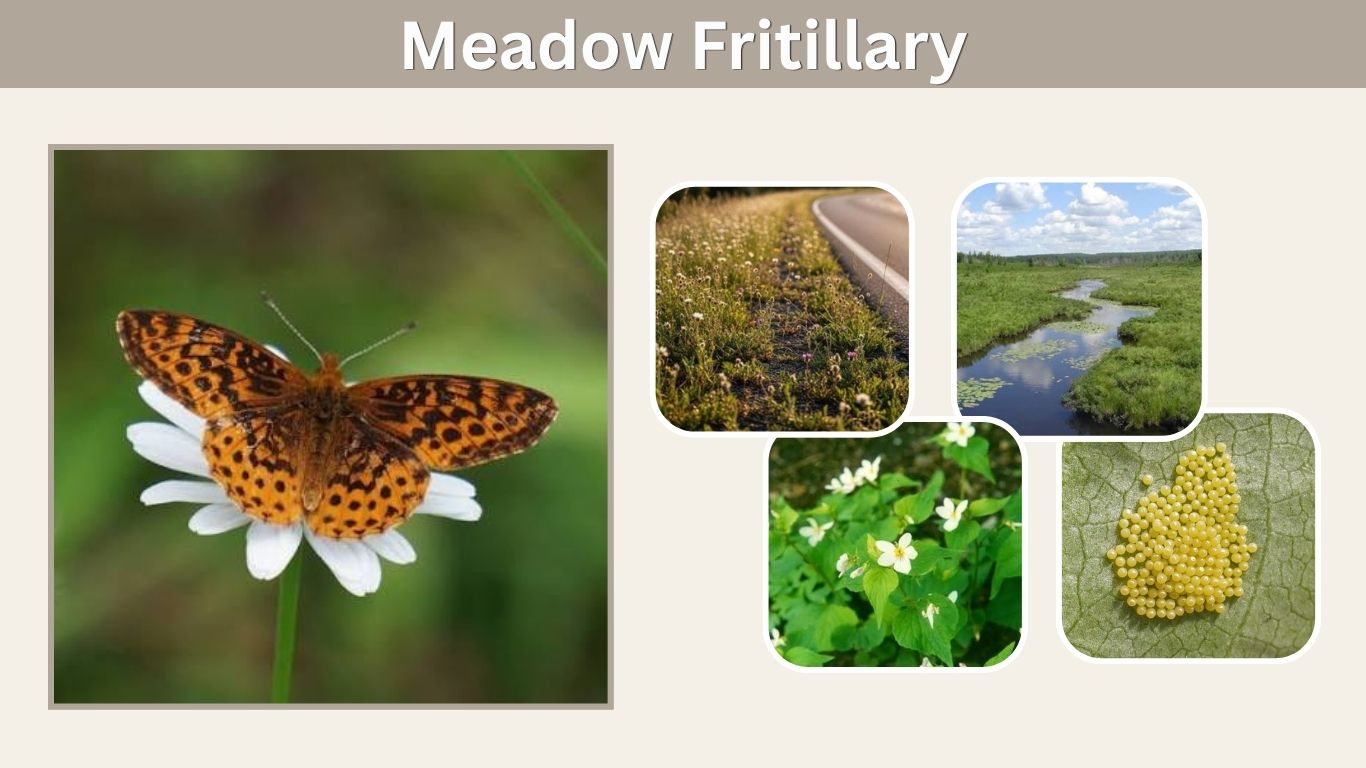
The meadow fritillary is a small but colorful North American butterfly known for its orange wings, bold black markings, and preference for sunny meadows and other open habitats. Scientifically called Boloria bellona, it belongs to the brush-footed butterfly family and is considerably smaller than large fritillaries such as the great spangled fritillary. Violets are essential to its survival because they provide food for developing caterpillars. From its unusual overwintering strategy to its multiple annual broods, the meadow fritillary has a fascinating life cycle worth discovering.
What Is a Meadow Fritillary?
The meadow fritillary (Boloria bellona) is a member of the family Nymphalidae and subfamily Heliconiinae. It is classified among the smaller fritillaries of the genus Boloria.
Adults are active during warm daytime conditions, when males can often be seen flying low over meadows in search of females. Unlike migratory butterflies such as monarchs, meadow fritillaries generally remain associated with suitable local habitats throughout their life cycle.
Meadow Fritillary Identification
Several characteristics can help identify this butterfly:
- Bright orange to reddish-orange upper wings
- Heavy black lines, spots, and other markings
- Forewing tips that appear slightly squared off
- Orange and purple-brown pattern underneath the hindwings
- No prominent metallic silver patches on the hindwing underside
- Dark, somewhat hairy-looking body
- Relatively small size compared with larger fritillaries
The squared appearance of the forewing is particularly useful when distinguishing it from similar Boloria species.
Meadow Fritillary Size and Wingspan
The meadow fritillary has a wingspan of approximately 1⅜ to 2 inches (3.5–5.1 cm). An average wingspan around 1.6 inches makes it significantly smaller than regal, great spangled, and other large fritillaries.
Its relatively small body can sometimes cause it to be mistaken for crescents or checkerspots when seen quickly in a meadow.
Careful inspection of the orange coloration, black pattern, and squared forewing tip usually makes identification easier.
Where Do Meadow Fritillary Butterflies Live?
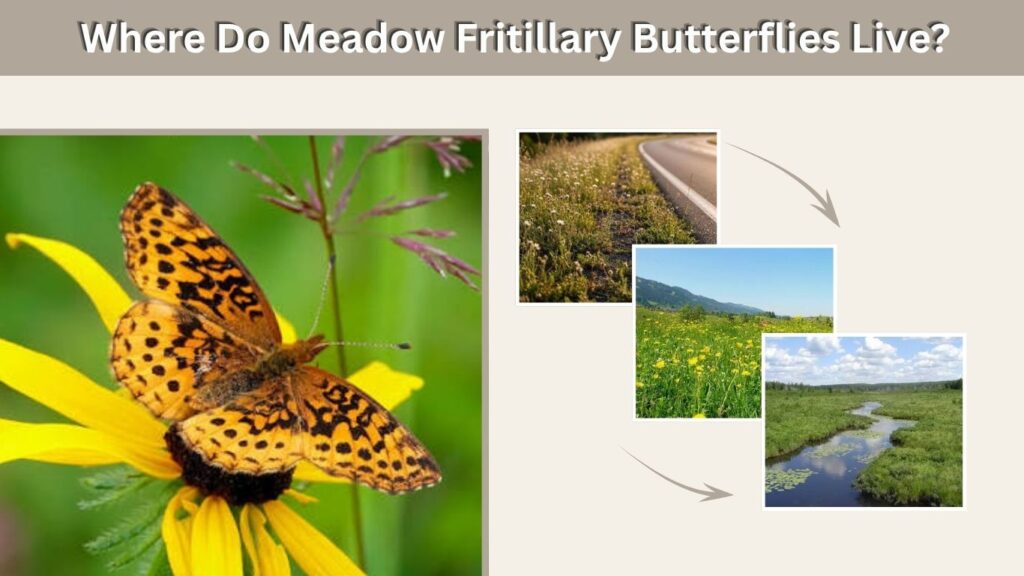
The meadow fritillary range covers a broad portion of North America. It occurs from parts of western Canada eastward across southern Canada to Newfoundland and throughout much of the northern United States.
Its distribution extends southward in some areas to Colorado, Tennessee, and North Carolina. Mountain populations can occur farther south where cooler conditions and appropriate habitat remain available.
Meadow Fritillary Habitat
Despite its name, the species is not restricted to classic meadows.
Suitable habitats include:
- Moist meadows
- Pastures
- Hayfields
- Grassy roadsides
- Marsh edges
- Wet fields
- Aspen openings
- Streamside areas
- Sunny woodland openings
Habitats containing both violets and nectar-producing flowers are particularly valuable because they support both caterpillars and adults.
Eastern vs. Western Meadow Fritillary
The names can be confusing because two different butterflies may appear when people search for eastern and western meadow fritillaries.
Eastern Meadow Fritillary
The butterfly usually meant by “eastern meadow fritillary” is simply the meadow fritillary, Boloria bellona. Major North American butterfly references use “Meadow Fritillary” as its standard common name rather than treating “Eastern Meadow Fritillary” as a separate species.
Its range extends broadly across Canada and much of the northern and eastern United States.
Western Meadow Fritillary
The western meadow fritillary (Boloria epithore) is a different species. It is also commonly called the Pacific fritillary.
It occurs from western Canada south along the Pacific region into California and favors moist forest openings, wet meadows, and streamside habitats. Its forewing is more rounded than the slightly squared forewing of B. bellona.
Both species use violets as important caterpillar host plants.
Meadow Fritillary Host Plants
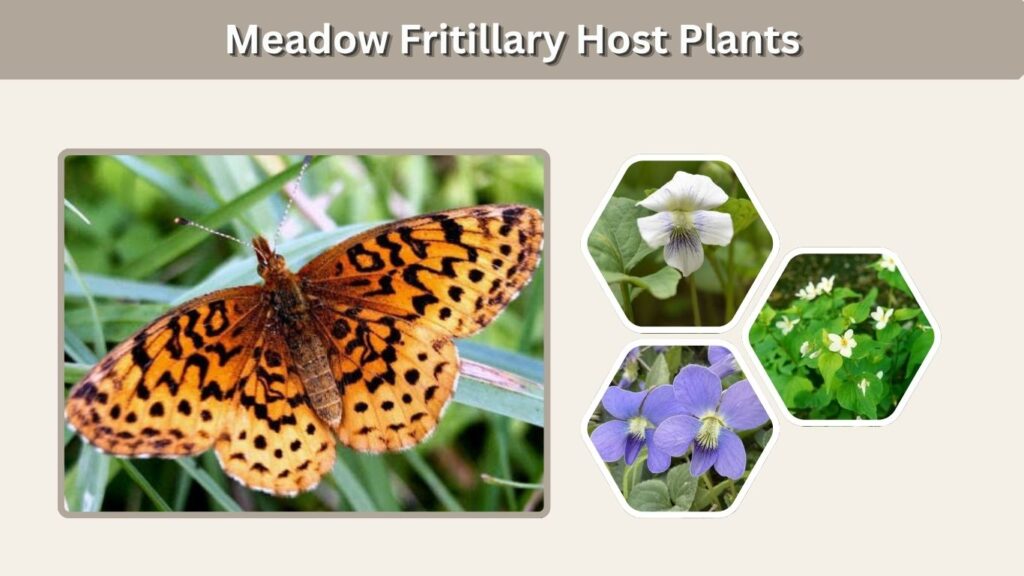
Violets in the genus Viola are the primary host plants for meadow fritillary caterpillars.
Documented hosts include:
- Northern white violet (Viola pallens)
- Common or woolly blue violet (Viola sororia)
- Canada violet (Viola canadensis) in some populations
The close relationship with violets means that removing native violets from fields and meadow edges can reduce breeding habitat even when plenty of nectar flowers remain.
What Do Adult Meadow Fritillaries Eat?
Adults feed mainly on flower nectar.
Frequently visited plants include black-eyed Susan, dandelion, oxeye daisy, asters, goldenrods, thistles, milkweeds, verbena, and dogbane. Exact nectar choices vary depending on which flowers are available locally.
Maintaining flowers from spring through fall can therefore provide feeding opportunities across multiple generations.
Meadow Fritillary Caterpillar
The meadow fritillary caterpillar looks very different from the bright orange adult.
Mature larvae are generally dark gray, brown, purplish, or nearly black. Rows of short spines cover the body, sometimes accompanied by lighter stripes or patches. These spines give the caterpillar a somewhat bristly appearance.
What Does the Caterpillar Eat?
Meadow fritillary larvae feed primarily on violet leaves and stems.
Interestingly, females do not always place their eggs directly on the host plant. Eggs may be deposited on nearby twigs or vegetation, requiring the young caterpillars to locate suitable violets after hatching.
Later-generation caterpillars typically enter winter dormancy while partly grown.
Meadow Fritillary Life Cycle
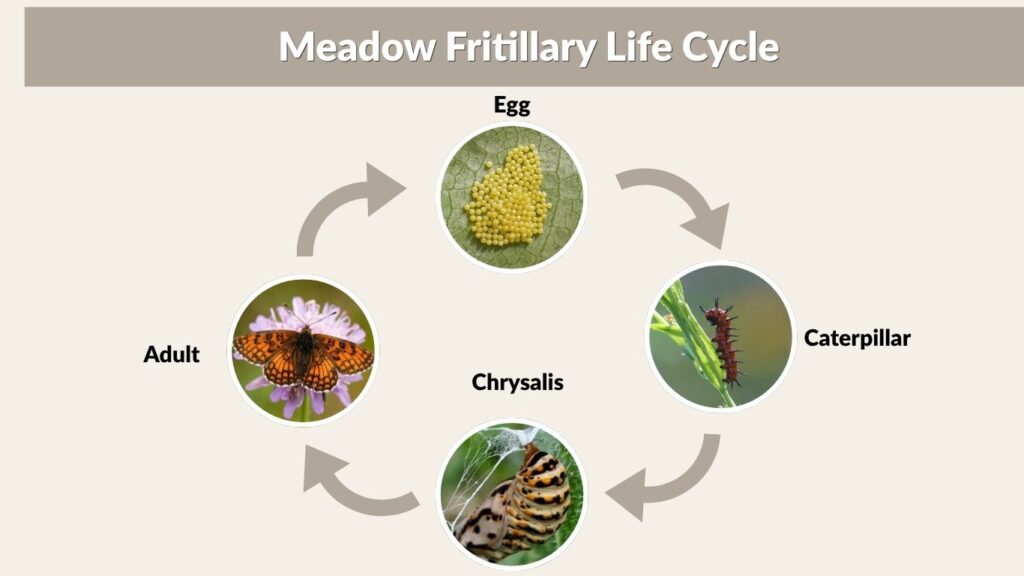
Like other butterflies, meadow fritillaries develop through four stages:
Egg → Caterpillar → Chrysalis → Adult
Females place eggs individually on vegetation near suitable violet host plants. After hatching, the larvae feed and grow through several stages.
In much of the range, third- or fourth-stage caterpillars overwinter. They resume development when favorable conditions return, eventually becoming pupae and emerging as adults.
How Many Generations Are Produced Each Year?
Meadow fritillaries may have two or three broods annually, depending on climate and location.
Across their broader range, adults may be observed from approximately late April through mid-October. Northern or high-elevation populations usually have a shorter season than populations in warmer regions.
Meadow Fritillary Chrysalis
When the caterpillar reaches full size, it enters the pupal stage and becomes a chrysalis.
The chrysalis is typically grayish to yellow-brown and has angular projections that help it blend into surrounding vegetation and dried plant material. It hangs from a silk attachment by its rear end rather than being supported by a silk girdle.
Inside the chrysalis, the caterpillar undergoes the transformation that produces the wings, antennae, proboscis, and other adult structures.
Meadow Fritillary vs. Silver-Bordered Fritillary
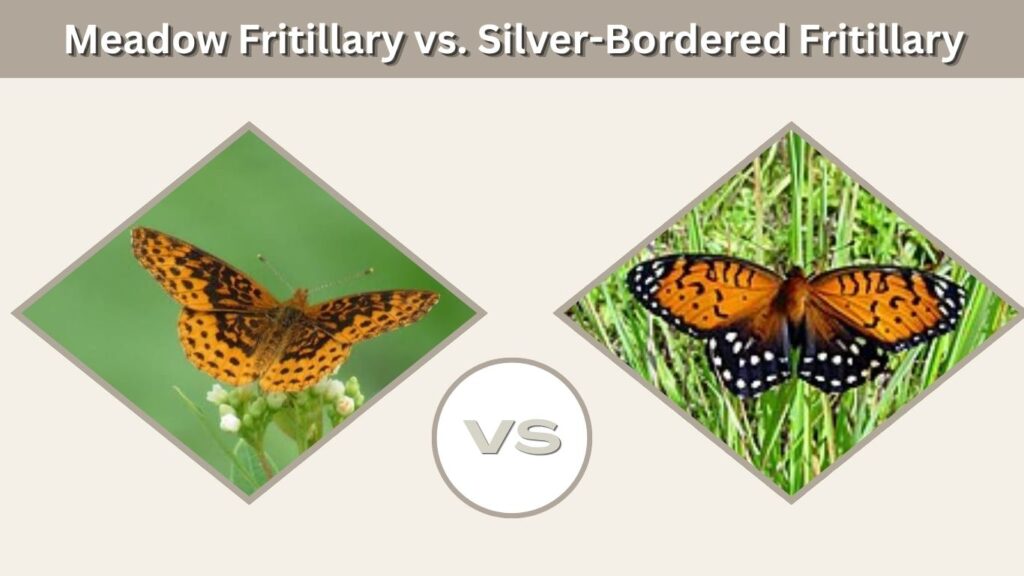
The meadow fritillary is sometimes confused with the silver-bordered fritillary (Boloria selene) because both are small orange butterflies associated with moist habitats and violets.
A useful difference appears on the underside of the hindwing.
Silver-bordered fritillaries have conspicuous metallic silver markings, whereas meadow fritillaries lack these prominent silver spots. Instead, their undersides show a mixture of orange and purple-brown markings.
Are Meadow Fritillaries Rare?
The meadow fritillary is not generally considered globally threatened. Butterflies and Moths of North America lists it as globally secure, although populations may be uncommon or locally vulnerable near the edges of its distribution.
Local populations can still decline when open fields and wetlands are converted to intensive agriculture, development, or other unsuitable land uses. Maintaining violets, nectar flowers, and open meadow habitat helps support the species.
Interesting Meadow Fritillary Facts
- Its scientific name is Boloria bellona.
- It belongs to the brush-footed butterfly family.
- Its wingspan can reach about 2 inches.
- Violets are the primary caterpillar host plants.
- Caterpillars overwinter rather than migrating.
- Adults may produce two or three generations per year.
- Males patrol low over meadows looking for females.
- Adults commonly nectar on members of the daisy family.
- The hindwings lack the strong silver markings found on silver-bordered fritillaries.
- Western meadow fritillary is a different species, Boloria epithore.
FAQs
What is the scientific name of the meadow fritillary?
The scientific name is Boloria bellona. It is a member of the Nymphalidae family.
What plants do meadow fritillary caterpillars eat?
Their primary host plants are violets, particularly species such as northern white violet and common blue violet.
How big is a meadow fritillary butterfly?
Adults typically have a wingspan between 1⅜ and 2 inches, or approximately 3.5–5.1 cm.
Where can meadow fritillaries be found?
They occur across southern Canada and much of the northern United States, with their range extending farther south in mountainous and suitable cool habitats.
Do meadow fritillaries migrate?
No. Meadow fritillaries are generally resident butterflies. They survive unfavorable seasons as developing caterpillars rather than undertaking long-distance seasonal migrations.