
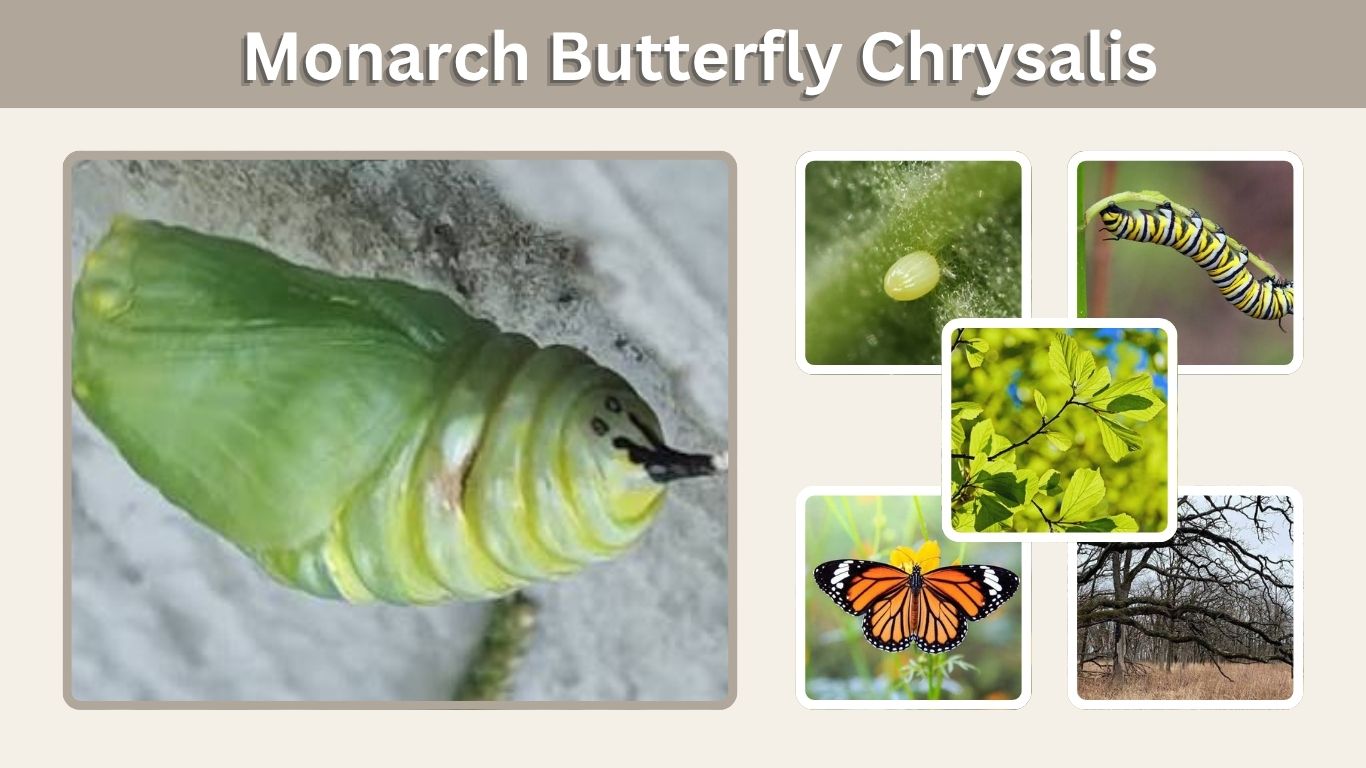
The monarch butterfly chrysalis is the remarkable pupal stage in which a striped monarch caterpillar transforms into an orange-and-black adult butterfly. A healthy monarch chrysalis is typically jade green with metallic-looking gold spots and hangs upside down from a small silk pad. Under warm conditions, the chrysalis stage usually lasts about 8–15 days, although temperature can speed up or slow down development. During the final day, the chrysalis darkens and becomes transparent enough for the monarch’s wing pattern to show through.
What Does a Monarch Butterfly Chrysalis Look Like?
A newly formed monarch chrysalis is usually bright green, smooth, and rounded, with a series of distinctive gold-colored dots and a gold-and-black band near the upper portion.
It measures roughly 1 inch (2.5 cm) long, although exact size varies between individuals.
A healthy chrysalis generally has:
- Jade-green coloration
- Smooth outer surface
- Metallic-looking gold spots
- A gold-and-black band
- Rounded lower end
- Dark attachment point at the top
- Firm, intact surface
Monarchs form a chrysalis rather than a cocoon. A cocoon is usually a protective silk covering spun around a pupa, whereas the monarch’s hardened pupal covering remains exposed.
Monarch Butterfly Chrysalis Stages
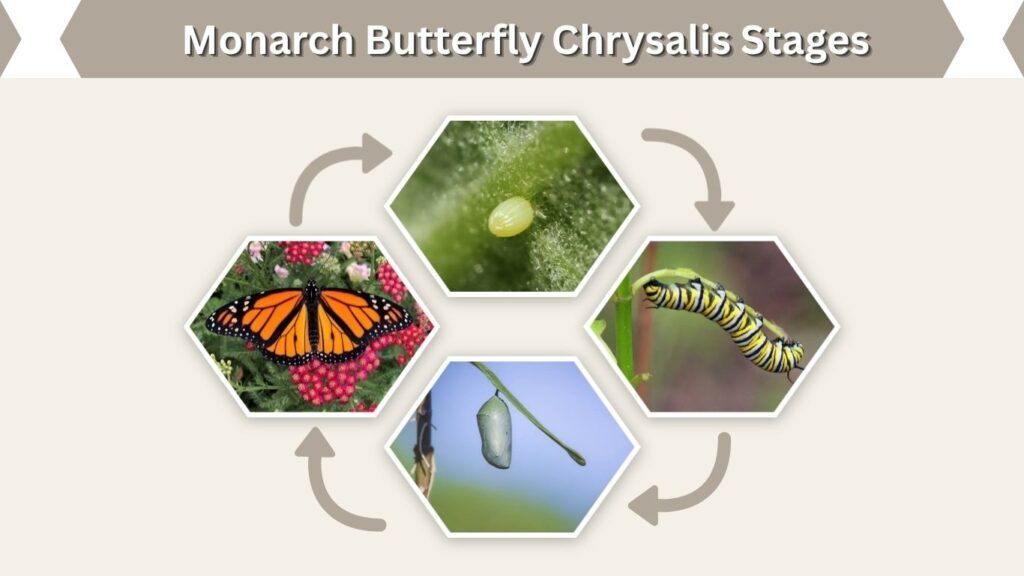
The monarch’s pupal stage looks relatively inactive from the outside, but enormous biological changes are occurring internally.
1. Caterpillar Forms a J Shape
Before becoming a chrysalis, a mature fifth-instar caterpillar stops eating and begins searching for a protected location.
It produces a small silk pad and attaches itself using a hook-covered structure called the cremaster.
The caterpillar then hangs upside down in a characteristic J shape, often for around 12–24 hours.
2. Caterpillar Turns Into a Chrysalis
The caterpillar’s skin splits behind the head and is gradually pushed upward.
Beneath it is the soft, newly formed pupa.
The new chrysalis moves and twists until the old caterpillar skin falls away. Its body then gradually becomes smooth and takes on the familiar green shape.
3. Green Chrysalis Stage
For most of the pupal period, the monarch chrysalis remains green.
Inside, the tissues are reorganizing as adult structures develop, including:
- Wings
- Antennae
- Compound eyes
- Legs
- Reproductive organs
- Adult feeding structures
Although the chrysalis may appear motionless, development is continuing throughout this period.
4. Chrysalis Darkens
Near the end of development, the chrysalis begins to look darker.
This does not automatically mean the monarch is dead.
A healthy chrysalis approaching emergence becomes increasingly transparent, allowing the developing butterfly’s black and orange wings to become visible through the pupal casing.
5. Adult Butterfly Emerges
The adult splits open the chrysalis and pulls itself free in a process called eclosion.
The newly emerged monarch hangs beneath the empty chrysalis while fluid is pumped into its folded wings.
The wings then expand and gradually harden before the butterfly is able to fly.
How Long Is a Monarch Butterfly in a Chrysalis?
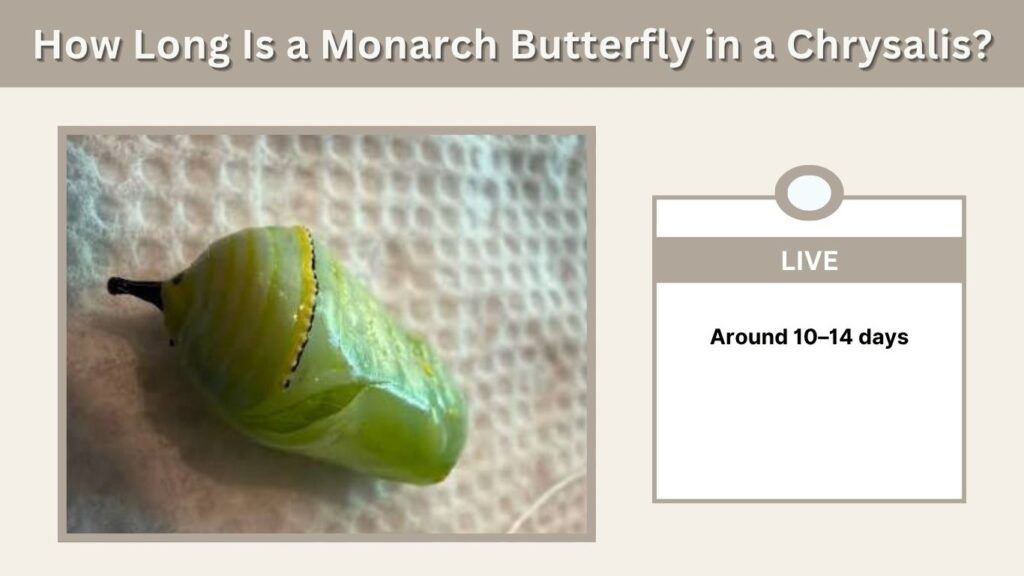
A monarch generally remains in its chrysalis for approximately 8–15 days.
Around 10–14 days is common under favorable summer conditions.
Temperature has a major influence. Warm conditions generally speed development, while cooler temperatures may extend the chrysalis period.
Therefore, not every monarch emerges on exactly the same day after pupation.
Monarch Chrysalis Timeline
A simplified timeline looks like this:
| Period | Typical Appearance |
| Day 1 | Soft green chrysalis forms |
| Days 2–7 | Firm jade-green chrysalis |
| Days 8–12+ | Adult continues developing |
| Final 1–2 days | Chrysalis becomes darker |
| Final hours | Wings become visible through casing |
| Emergence | Adult monarch exits chrysalis |
Exact timing varies with temperature and individual development.
Why Does a Monarch Chrysalis Have Gold Spots?
The gold markings on a monarch chrysalis are not actual gold.
They result from specialized structures in the outer covering that reflect light, producing a metallic appearance.
The pattern includes small gold spots along with a striking band near the upper portion of the chrysalis.
Scientists have proposed that these areas may have biological functions associated with the pupal covering, but their exact evolutionary role is more complicated than simply serving as decoration.
For identification purposes, however, the metallic-looking markings are one of the clearest characteristics of a monarch chrysalis.
Why Does a Monarch Butterfly Chrysalis Turn Black?
A black monarch chrysalis can be completely normal if the butterfly is about to emerge.
Shortly before eclosion, the formerly green casing becomes transparent. Because the adult monarch has predominantly black and orange wings, the chrysalis can appear nearly black.
Normal Black Chrysalis
Signs that emergence is approaching include:
- Darkening occurs near the expected emergence date
- Orange wing coloration becomes visible
- Wing patterns can be seen through the casing
- Chrysalis remains intact
- Butterfly emerges within roughly a day
When a Dark Chrysalis May Be a Problem
A chrysalis may be unhealthy if it becomes unusually dark well before expected emergence and remains that way without developing recognizable wing patterns.
Other concerning signs can include:
- Leakage
- Severe discoloration
- Collapsed shape
- Bad odor
- Failure to emerge long after the expected period
A dark chrysalis by itself should not immediately be discarded because normal pre-emergence coloration can look dramatic.
Where Do Monarch Caterpillars Make Their Chrysalis?
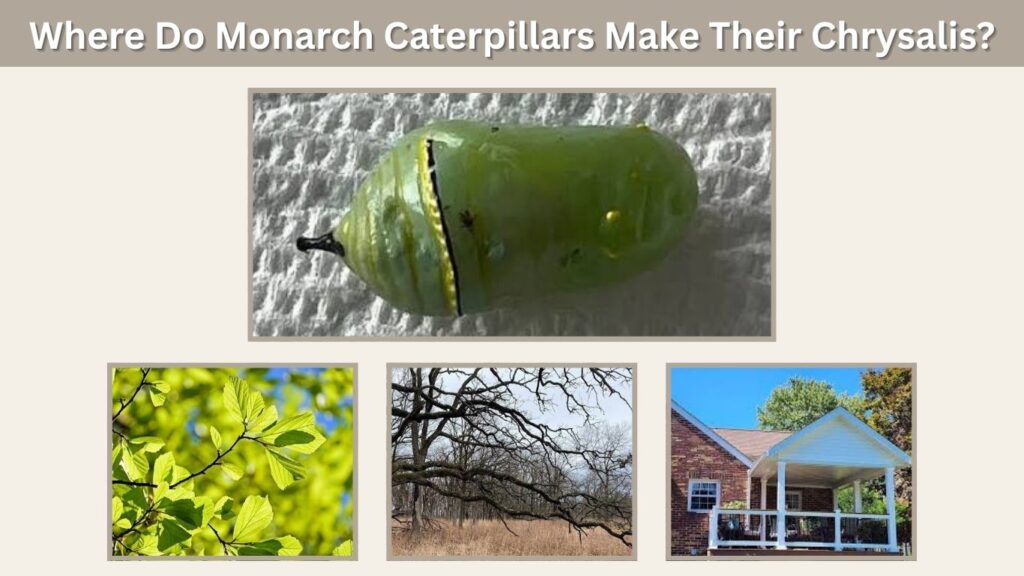
Monarch caterpillars do not necessarily form their chrysalis directly on milkweed.
Once mature, they often leave their host plant and travel in search of a protected attachment site.
They may pupate beneath:
- Leaves
- Branches
- Porch roofs
- Fence rails
- Outdoor furniture
- Building overhangs
- Garden structures
- Enclosure lids
The main requirement is a secure location where the chrysalis can hang vertically.
Monarch Butterfly Chrysalis Care
A healthy chrysalis generally requires very little intervention.
If it is outdoors in a safe natural location, leaving it undisturbed is usually best.
For chrysalises being observed in an enclosure:
- Provide good ventilation.
- Protect them from extreme heat.
- Keep them out of prolonged direct sunlight.
- Avoid frequently touching the chrysalis.
- Leave enough open space beneath it.
- Keep the enclosure clean.
- Allow the emerging butterfly to hang vertically.
Vertical clearance is particularly important because the monarch needs room to expand its wings after emerging.
Can You Move a Monarch Butterfly Chrysalis?
Yes, a monarch chrysalis can sometimes be moved carefully, but relocation should generally be limited to situations where its current position is unsafe.
Examples include a chrysalis attached to an object that must be moved or a location where the butterfly would not have enough room to expand its wings.
If relocation is necessary, it is best to wait until the newly formed chrysalis has hardened rather than disturbing it immediately after pupation.
Handle the attachment area rather than squeezing or putting pressure on the chrysalis itself.
What If a Monarch Chrysalis Falls Off?
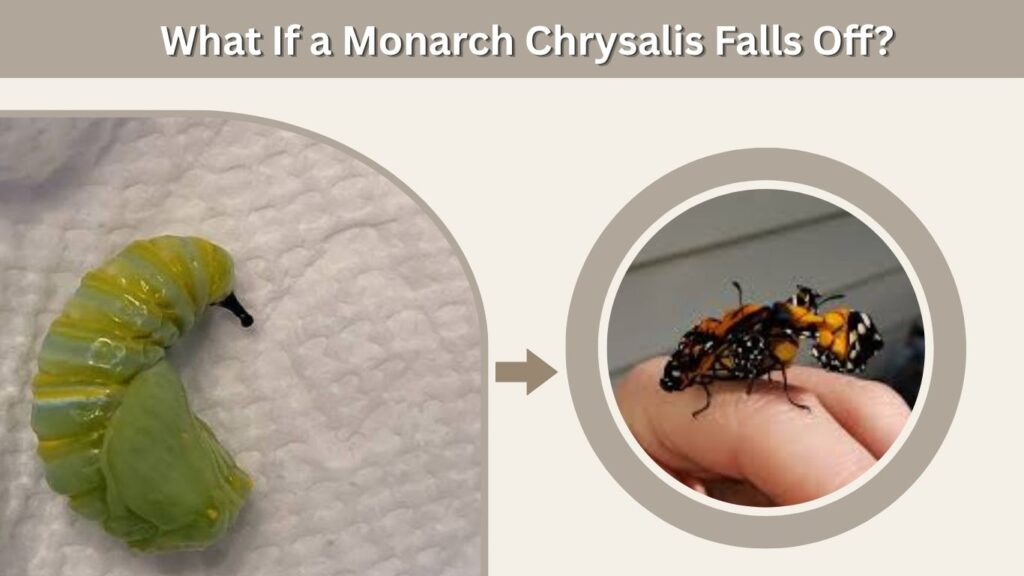
A fallen chrysalis is not automatically dead.
If it is undamaged, development may continue normally.
The chrysalis should ideally be repositioned so that it can hang vertically before emergence. This gives the adult butterfly adequate space to pull itself from the casing and expand its wings.
Inspect it for:
- Cracks
- Leakage
- Crushing
- Severe dents
- Other obvious damage
An intact chrysalis has a much better chance of developing successfully.
Monarch Butterfly Emerging From Chrysalis
When emergence begins, it happens quickly.
The casing splits, and the monarch pulls its body free. At first, its wings look small, wet, and wrinkled.
The butterfly then hangs beneath the empty chrysalis and pumps fluid from its abdomen into the wing veins.
Over the next few hours, the wings expand, straighten, and harden.
Avoid touching or attempting to make a newly emerged monarch fly before its wings are fully developed.
Monarch Butterfly Stuck in Chrysalis
It can be tempting to help when a butterfly seems slow to emerge.
However, manual assistance can easily damage the butterfly, and some monarchs that cannot emerge normally may already have underlying developmental problems.
Normal emergence itself usually happens relatively quickly once the chrysalis opens.
A butterfly that has only recently begun emerging should generally be given space rather than immediately pulled from its casing.
Queen Butterfly Chrysalis vs Monarch Chrysalis
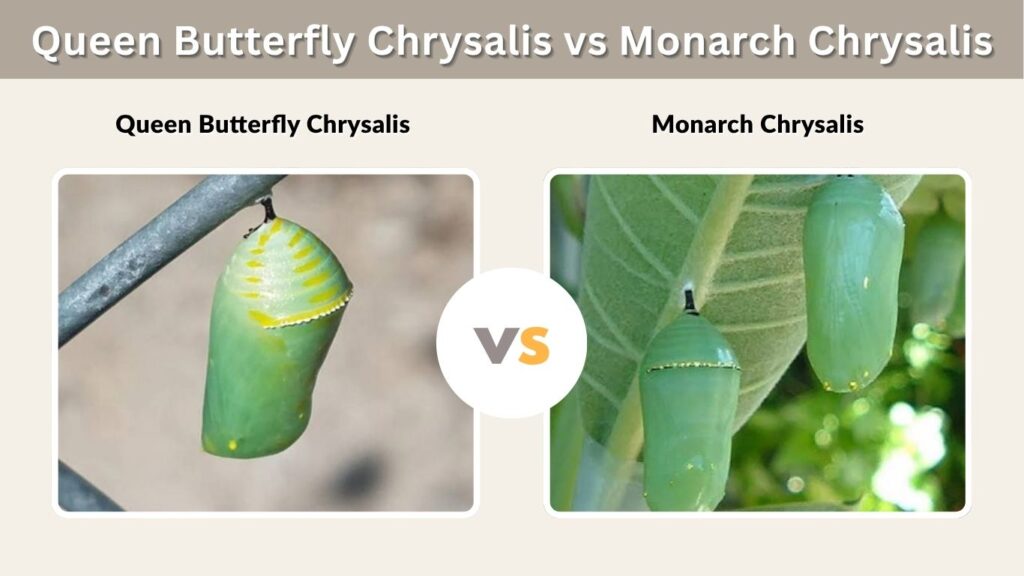
Queen butterflies and monarchs are closely related, so their chrysalises can look similar.
Both may be green and decorated with metallic markings.
However, identification can be helped by considering the caterpillar, location, host plant, and surrounding butterfly populations rather than relying only on chrysalis color.
Adult monarchs have bright orange wings with prominent black veins, while queen butterflies are generally darker reddish-brown.
Monarch Butterfly Chrysalis Facts
The chrysalis is one of the most fascinating parts of monarch development.
A few key facts include:
- Monarchs do not make traditional silk cocoons.
- The pupal stage usually lasts around 8–15 days.
- The chrysalis is approximately 1 inch long.
- Its gold spots are not real gold.
- A black-looking chrysalis can mean emergence is very close.
- The caterpillar usually hangs in a J shape before pupating.
- Monarchs may leave milkweed before forming their chrysalis.
- Adults need vertical space after emerging to expand their wings.
FAQs
How many days from chrysalis to monarch butterfly?
Usually around 8–15 days, with approximately 10–14 days common under warm conditions.
What color is a healthy monarch chrysalis?
For most of its development, a healthy chrysalis is jade green with metallic-looking gold spots.
Does a monarch chrysalis turn black before emerging?
Yes. Shortly before emergence, the casing becomes transparent and the adult’s dark wing pattern becomes visible, making the chrysalis appear black.
How big is a monarch butterfly chrysalis?
A typical monarch chrysalis is approximately 1 inch, or about 2.5 cm, long.
How long after a monarch chrysalis turns black does the butterfly emerge?
When the chrysalis has become transparent and the orange-and-black wings are clearly visible, emergence is generally very close and often occurs within about 24 hours.