
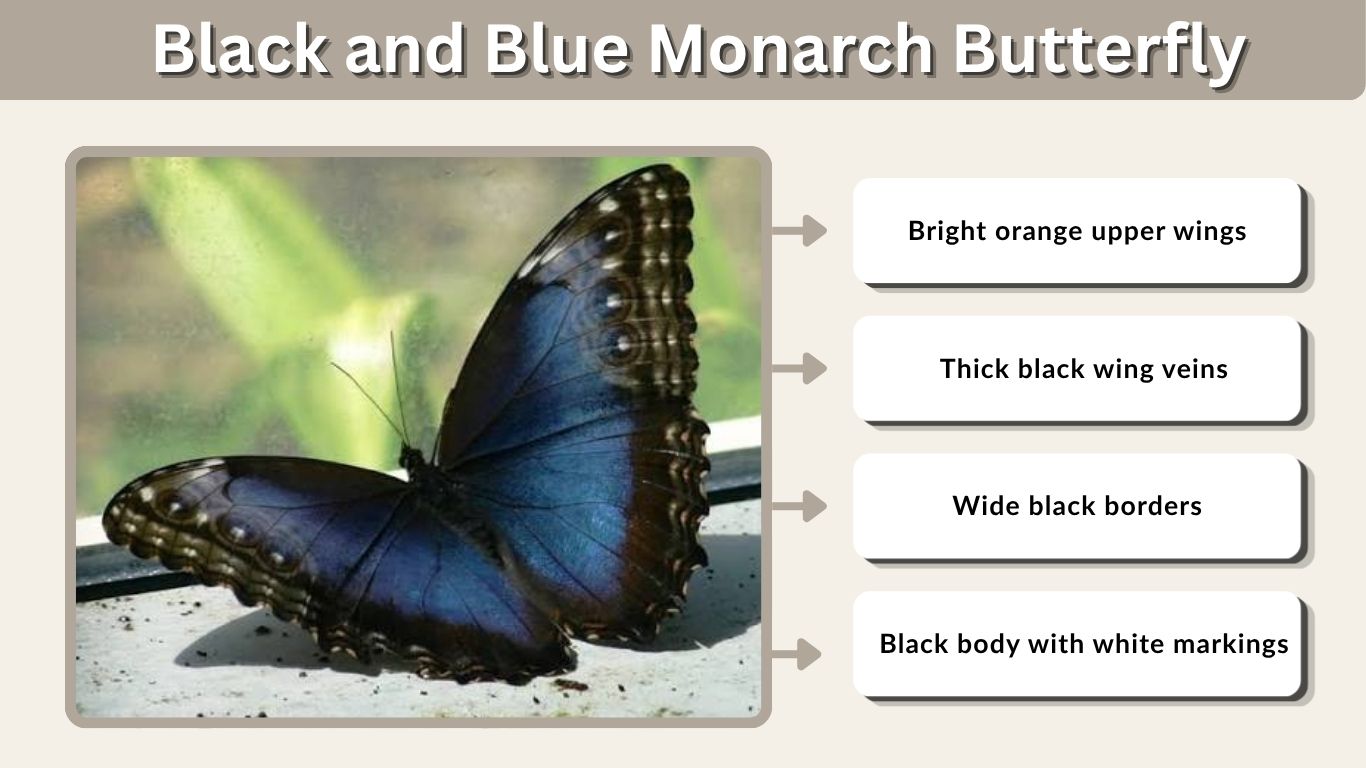
A black and blue monarch butterfly may sound like a rare color variation of the familiar monarch, but true monarch butterflies are primarily orange and black with white spots. A butterfly with strongly blue and black wings is usually another species, such as a pipevine swallowtail, spicebush swallowtail, black swallowtail, or red-spotted purple. Some of these butterflies have brilliant iridescent blue scales that can make identification confusing. Knowing the wing shape, markings, tails, and colors makes it much easier to tell them apart.
Is There a Black and Blue Monarch Butterfly?
There is no standard black-and-blue color form of the monarch (Danaus plexippus). Adult monarchs are characterized by bright orange wings crossed with black veins, broad black wing borders, and rows of white spots. Therefore, a butterfly dominated by black and vivid blue is generally not a monarch, even when its size or flight initially looks similar.
What Does a Real Monarch Look Like?
A typical monarch has several distinctive features:
- Bright orange upper wings
- Thick black wing veins
- Wide black borders
- Two rows of small white spots near the wing edges
- Black body with white markings
- No swallowtail-like projections on the hindwings
Male monarchs also have a small dark scent patch on each hindwing and generally have somewhat thinner black veins than females.
Why Can a Butterfly Appear Blue?
Many butterflies produce shimmering blue or blue-green appearances through microscopic structures in their wing scales. Depending on the viewing angle and light, the coloration may become dramatically brighter or darker.
This iridescence is especially noticeable in several dark swallowtails and the red-spotted purple. A photograph may therefore show brilliant electric-blue sections that look very different when the butterfly changes position.
Butterflies Mistaken for a Black and Blue Monarch
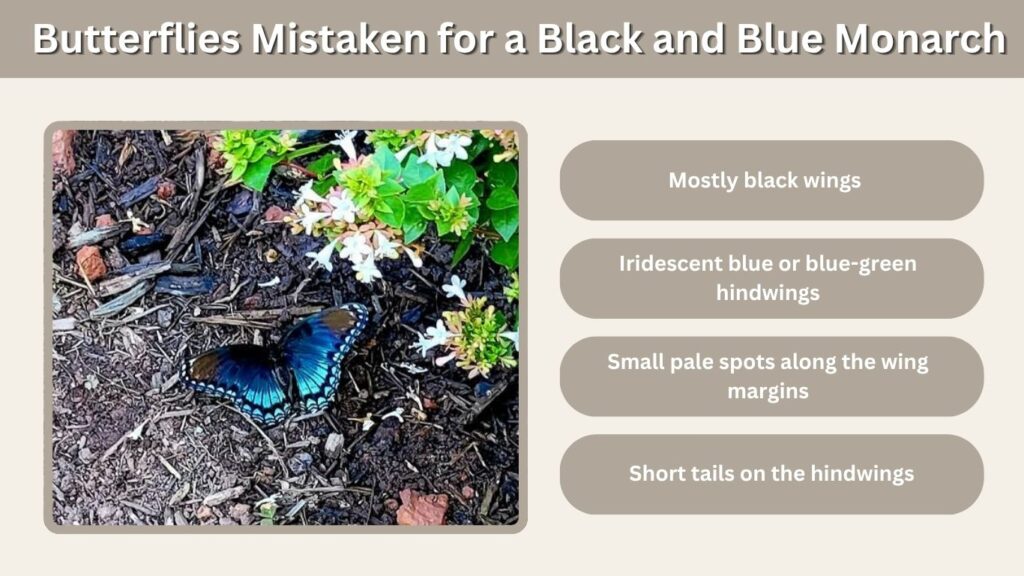
Several North American butterflies match the description “black and blue monarch butterfly” much better than a true monarch. Pipevine swallowtails are particularly notable because their dark wings can contain extensive iridescent blue coloration. Spicebush swallowtails and red-spotted purples can produce a similar visual impression.
1. Pipevine Swallowtail
The pipevine swallowtail (Battus philenor) is one of the strongest candidates when someone reports seeing a large blue and black monarch-like butterfly.
Its upper wings are predominantly black, while the hindwings can display brilliant blue or blue-green iridescence. The underside includes a metallic blue area combined with a row of bright orange spots.
Important identification features include:
- Mostly black wings
- Iridescent blue or blue-green hindwings
- Small pale spots along the wing margins
- Short tails on the hindwings
- Orange spots visible underneath the hindwings
Unlike a monarch, it does not have large orange wing panels divided by thick black veins.
2. Spicebush Swallowtail
The spicebush swallowtail (Papilio troilus) is another dark butterfly that can appear black and blue. It belongs to the swallowtail family rather than the same family group typically associated with monarch appearance.
Spicebush swallowtails have dark wings, noticeable tails, and pale or bluish markings across the hindwings. Spicebush and sassafras are important larval host plants for this butterfly.
The long hindwing tails provide one of the easiest clues that the butterfly is not a monarch.
3. Black Swallowtail
The black swallowtail (Papilio polyxenes) can also cause confusion, particularly females, which are largely dark and may display noticeable bluish scaling on their hindwings.
Black swallowtails have tails and distinctive rows of spots, giving them a very different wing pattern from the orange-and-black monarch.
Their caterpillars commonly use plants from the parsley family, including parsley, dill, fennel, carrots, and related species.
4. Red-Spotted Purple
The red-spotted purple (Limenitis arthemis astyanax) may be the most convincing butterfly if the insect you saw was almost entirely black and brilliant blue.
Its upper wings can appear blue to blue-green with intense iridescence. Unlike swallowtails, however, red-spotted purples do not have tails. Small reddish-orange spots can also appear on portions of the wings.
Because it lacks tails and has a broad butterfly shape, people unfamiliar with the species can easily mistake it for some unusual monarch variation.
Monarch vs. Black and Blue Swallowtail Butterfly
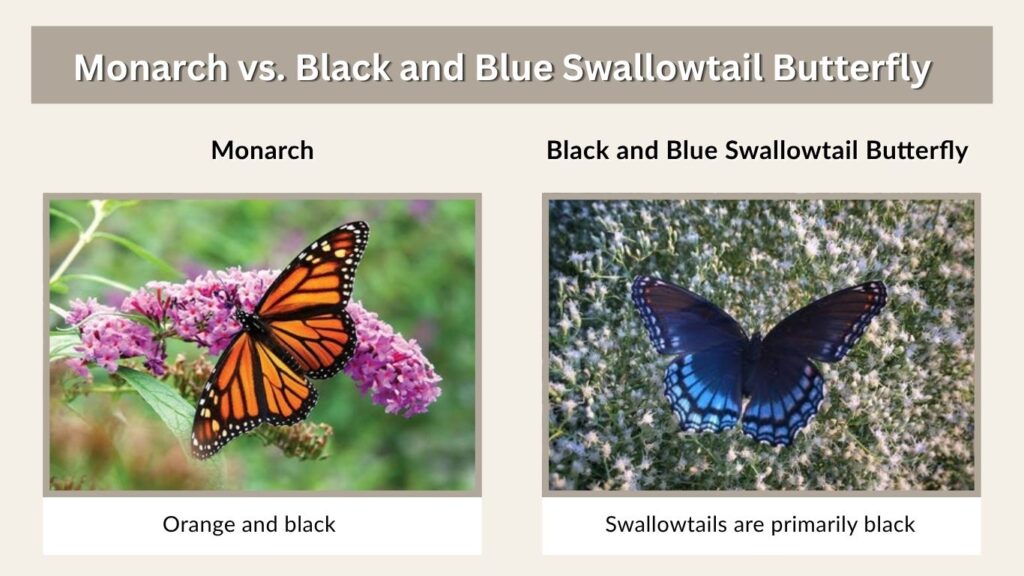
Monarchs and swallowtails can both be large, noticeable butterflies, but their markings are very different. Looking at the hindwings and dominant colors usually provides a quick identification.
Wing Color
Monarchs are predominantly orange and black. The orange sections occupy most of the wing surface, with black veins creating a stained-glass-like pattern.
Pipevine and spicebush swallowtails are primarily black, with areas of blue or blue-green iridescence.
Wing Shape
Monarch hindwings are rounded and lack tails.
Most butterflies commonly described as black-and-blue swallowtails have noticeable projections extending from the hindwings. Pipevine swallowtails have relatively short tails, while spicebush and black swallowtails have more obvious ones.
Orange Markings
A monarch has large orange areas covering much of both wings.
A pipevine swallowtail may have orange spots, but these are concentrated mainly on the underside of the hindwings rather than forming large orange panels.
Blue Color
Strong metallic or iridescent blue is an important clue that you are probably looking at another butterfly rather than a normal monarch. Pipevine swallowtails and red-spotted purples are especially well known for blue or blue-green iridescence.
What About a Yellow, Black, and Blue Monarch Butterfly?
A butterfly containing yellow, black, and blue is also unlikely to be a monarch. Some swallowtails combine these colors, and the amount of yellow or blue can differ between species, sexes, and individuals.
Monarch identification should rely on the complete pattern rather than just one color. The familiar monarch pattern consists of orange fields divided by black veins, surrounded by black borders containing white spots.
If the butterfly has long tails, extensive yellow spots, or large shimmering blue areas, it should be compared with swallowtails rather than assumed to be a monarch.
Black and Blue Monarch Butterfly Meaning
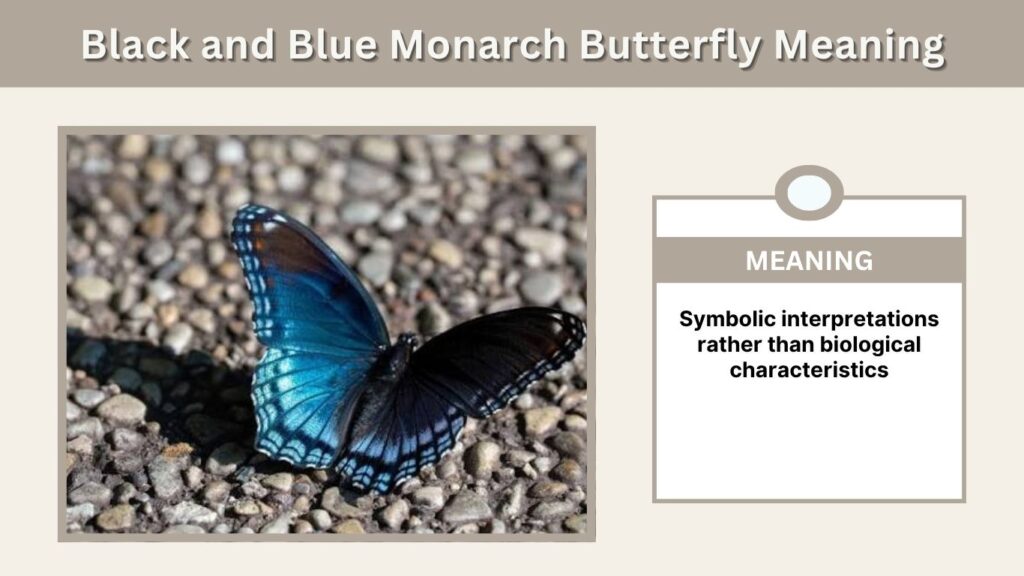
Butterflies are commonly given symbolic meanings in art, spirituality, tattoos, and personal traditions. A black-and-blue butterfly may be associated culturally or personally with ideas such as transformation, change, mystery, freedom, hope, or renewal.
However, these meanings are symbolic interpretations rather than biological characteristics. There is no scientific meaning attached to seeing a black-and-blue butterfly.
Because “black and blue monarch” is not a standard biological species name, interpretations found online may actually refer to several completely different butterflies.
How to Identify a Black and Blue Butterfly
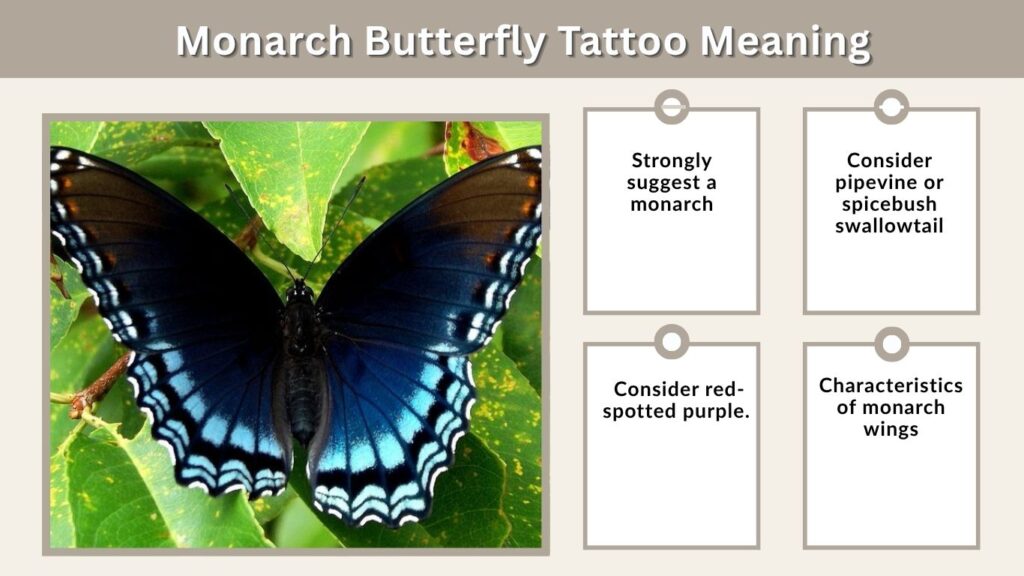
Color is useful, but it should not be the only identification feature. Lighting, viewing angle, wing wear, and photography can significantly change how colors appear.
Check These Features
- Long tails: Usually indicates a swallowtail, not a monarch.
- Large orange panels: Strongly suggest a monarch.
- Metallic blue hindwings: Consider pipevine or spicebush swallowtail.
- Blue wings without tails: Consider red-spotted purple.
- Orange spots beneath black wings: Strong clue for pipevine swallowtail.
- White-spotted black borders: Characteristics of monarch wings.
Location is also useful because butterfly species have different geographic ranges. A clear photograph of both the upper and underside of the wings can make identification considerably easier.
FAQs
Is a black and blue monarch butterfly real?
A normal monarch butterfly is orange, black, and white rather than blue and black. A butterfly dominated by black and blue is more likely to be another species.
What butterfly looks like a black and blue monarch?
The pipevine swallowtail is a common possibility. It has black wings with striking blue or blue-green iridescence on its hindwings.
Is a blue and black monarch butterfly rare?
A genuinely blue-and-black monarch is not a recognized normal monarch color pattern. Reports usually involve another butterfly species, unusual lighting, or color interpretation.
What swallowtail butterfly is black and blue?
Several swallowtails can appear black and blue, particularly the pipevine swallowtail and spicebush swallowtail. Black swallowtails may also show bluish markings.
How can I tell a monarch from a black and blue swallowtail?
Look at the wing colors and tails. Monarchs have large orange panels with black veins and no hindwing tails. Black-and-blue swallowtails are mostly dark, often have blue iridescence, and usually possess noticeable hindwing tails.