
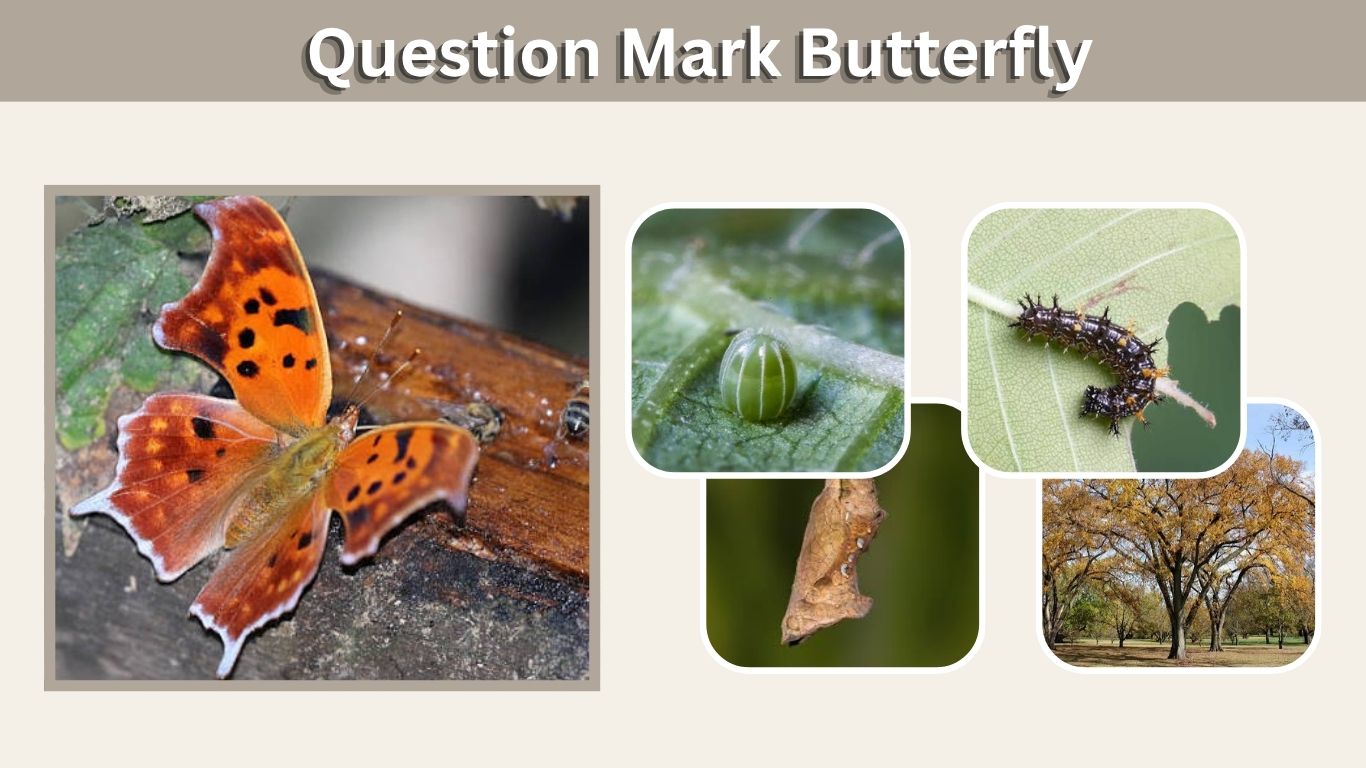
The question mark butterfly is a striking North American species named for the small, silvery punctuation-shaped marking beneath each hindwing. Its ragged wing edges and mottled brown underside provide excellent camouflage, while its upper wings display rich orange and black patterns. Common around woodland edges, parks, gardens, and streams, this butterfly has an unusual diet that includes tree sap and overripe fruit. Learning its markings, host plants, seasonal forms, and differences from the eastern comma makes identification considerably easier.
What Is a Question Mark Butterfly?
The question mark butterfly (Polygonia interrogationis) belongs to the brush-footed butterfly family, Nymphalidae. It is closely related to comma butterflies and is sometimes called the eastern question mark. Adults are known for their angular wings, short hindwing tails, and dramatically different upper and lower wing surfaces.
Why Is It Called a Question Mark Butterfly?
The name comes from a small silver marking on the underside of each hindwing. This marking usually consists of a curved line with a separate dot, resembling a question mark.
When the butterfly closes its wings, the marking appears against a mottled gray-brown background. The punctuation mark may be clear in some individuals and less distinct in others, but the separated dot is an important identification feature.
Scientific Classification
The question mark butterfly can be classified as follows:
- Common name: Question mark butterfly
- Scientific name: Polygonia interrogationis
- Family: Nymphalidae
- Subfamily: Nymphalinae
- Genus: Polygonia
- Order: Lepidoptera
- Native region: North America
Question Mark Butterfly Identification
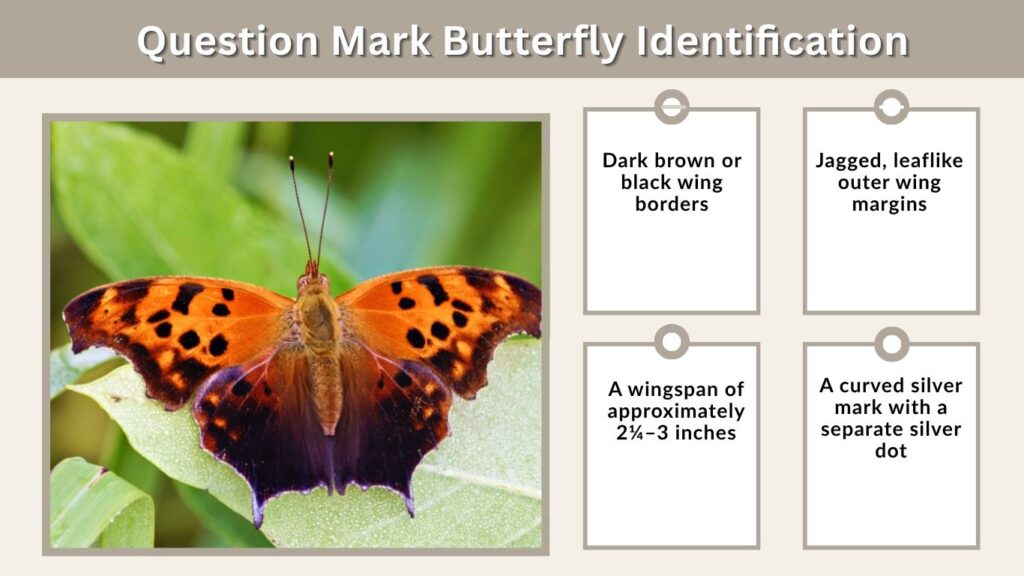
This butterfly changes considerably depending on whether its wings are open or closed. Its bright upper surface helps with communication and mate recognition, while the subdued underside allows it to disappear against bark or dead leaves.
Physical Features
Look for these identifying characteristics:
- Orange upper wings decorated with irregular black spots
- Dark brown or black wing borders
- Jagged, leaflike outer wing margins
- Short tails projecting from the hindwings
- Mottled brown, tan, or gray wing undersides
- A curved silver mark with a separate silver dot
- Four dark spots positioned across the upper forewing
- A wingspan of approximately 2¼–3 inches
- Small blue-violet markings near the hindwing margins in some individuals
The closed wings resemble a dried leaf, making resting adults difficult to notice on tree trunks, fences, or woodland debris.
Summer and Winter Forms
Question mark butterflies occur in two seasonal forms. The summer form generally has darker hindwings, sometimes appearing almost entirely black on the upper surface. The winter form has more orange on the hindwings and develops into a longer-lived adult capable of overwintering.
Temperature and day length experienced during development influence which form emerges. These differences can cause two question mark butterflies to look surprisingly dissimilar.
Male vs. Female
Males and females have similar wing patterns, so distinguishing them from photographs can be challenging. Females are often somewhat larger and have fuller abdomens, while males tend to patrol woodland openings and perch while watching for potential mates.
Behavior is often more useful than color for separating the sexes. A definitive identification may require examining anatomical features that are not visible during ordinary observation.
Question Mark vs. Comma Butterfly
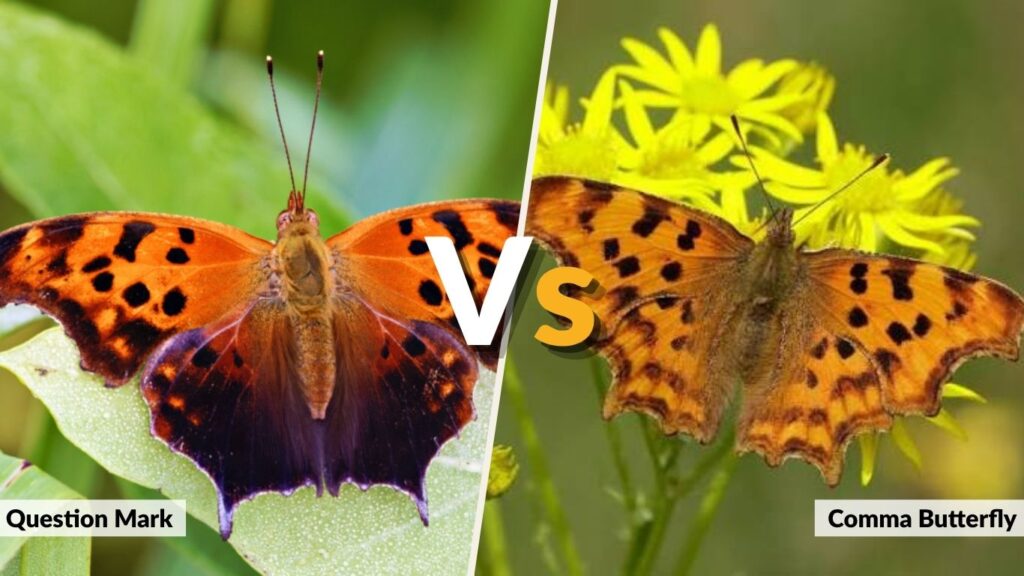
The question mark is frequently confused with the eastern comma because both have orange-and-black wings, jagged margins, brown undersides, and silver punctuation marks. Careful attention to size and markings can separate them.
Key Differences
Use these features when comparing the two butterflies:
- Silver marking: A question mark has a curved silver line and separate dot; an eastern comma normally has a single comma-shaped line.
- Size: The question mark is generally larger than the eastern comma.
- Forewing spots: The question mark usually has four dark spots in a row, while the eastern comma typically has three.
- Hindwing tail: The question mark often has a longer and more noticeable tail.
- Wing shape: Question mark wings may appear more elongated and strongly hooked.
- Seasonal appearance: The question mark’s summer form frequently has dark upper hindwings.
Similarities Between the Species
Both butterflies belong to the genus Polygonia and use their irregular wings as camouflage. They occupy comparable woodland habitats, visit sap and decaying fruit, and overwinter as adults.
Because markings vary among individuals, observers should check several characteristics instead of relying on a single spot or color. A clear view of both the upper and lower wings provides the most reliable identification.
Question Mark Butterfly Habitat and Geographic Range
Question mark butterflies inhabit wooded environments where their caterpillar host plants and adult food sources are available. They tolerate modified landscapes and may appear in suburban gardens when suitable trees, vines, and sheltered overwintering sites are nearby.
Range in North America
The species occurs across much of eastern and central North America. Its range extends from southern Canada through the eastern United States and into parts of Mexico. It can be found in states including New York, New Jersey, Michigan, Wisconsin, Minnesota, Ohio, Indiana, Illinois, Texas, and Florida.
Question mark butterflies may move beyond their regular breeding range during warmer months. Their numbers in northern locations can therefore vary between years.
Preferred Habitat
Common habitats include:
- Deciduous and mixed woodlands
- Forest clearings and woodland edges
- Stream banks and moist bottomlands
- Parks, trails, and wooded gardens
- Fields bordered by trees or shrubs
- Suburban areas containing elm or hackberry
- Tree-fall openings and sunny dirt paths
Adults often rest on tree trunks with their wings closed. Their brown undersides blend into the bark so effectively that the butterfly may seem to disappear.
Host Plants and Caterpillar
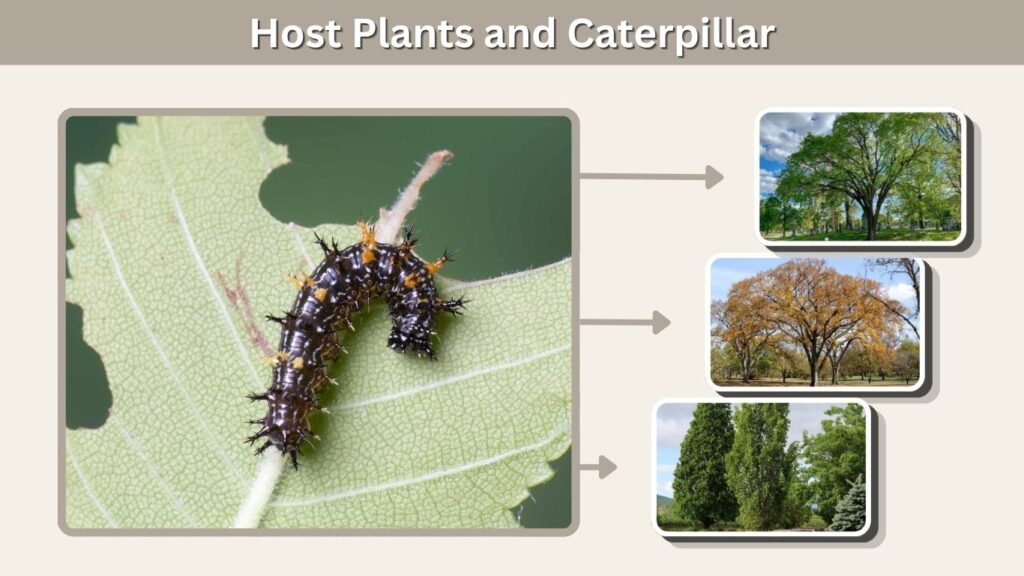
Female question mark butterflies lay eggs on or near plants that will provide food for the emerging larvae. Gardens containing native host plants can support the species even when adults rarely visit conventional nectar flowers.
Question Mark Butterfly Host Plants
Important larval food plants include:
- American elm
- Hackberry
- False nettle
- Stinging nettle
- Hops
- Japanese hops
- Other suitable members of the elm and nettle families
Hackberry and elm are particularly valuable because they can support several butterfly species. Property owners should avoid treating host plants with broad-spectrum insecticides if they want caterpillars to survive.
Caterpillar Identification
Question mark butterfly caterpillars are generally dark-colored and covered with rows of branching spines. Their bodies may display yellow, orange, reddish, or pale markings that become more noticeable as they grow.
The spines make the larva look dangerous, but question mark caterpillars are not considered medically significant stinging caterpillars. Nevertheless, sensitive individuals should avoid unnecessary handling because physical contact with spines may cause minor irritation.
Question Mark Butterfly Diet and Behavior
Unlike butterflies that depend heavily on flower nectar, the question mark obtains much of its nutrition from fermenting or mineral-rich materials. It may ignore blooming flowers while gathering around sap flows or fallen fruit.
What Do Adult Question Mark Butterflies Eat?
Adults commonly feed on:
- Fermenting or overripe fruit
- Tree sap
- Animal dung
- Carrion
- Moist soil containing dissolved minerals
- Occasional flower nectar
They may sometimes visit goldenrod and other late-season flowers, but these are not their only food sources. A butterfly feeding on rotten fruit is displaying normal behavior rather than showing illness.
Territorial and Defensive Behavior
Males frequently perch in sunny openings and fly toward passing insects while defending territories. They may repeatedly return to the same tree trunk, branch, or patch of ground.
When disturbed, a question mark butterfly can fly rapidly and unpredictably. It may then land nearby and close its wings, relying on camouflage rather than traveling far from a favored feeding or basking area.
Question Mark Butterfly Life Cycle and Overwintering
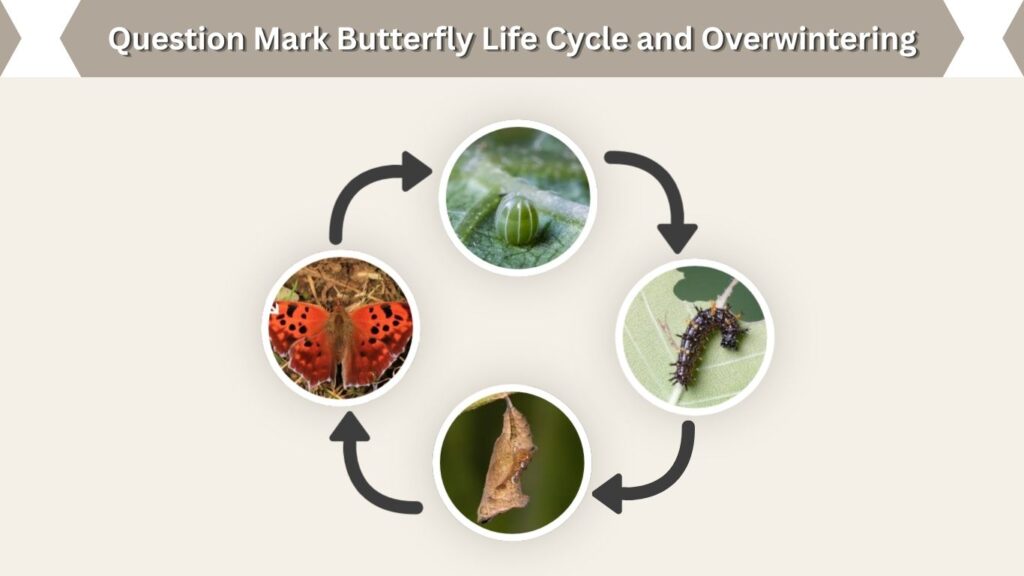
The question mark undergoes complete metamorphosis, progressing through egg, caterpillar, chrysalis, and adult stages. It may produce two or more generations annually, with additional broods possible in warmer parts of its range.
Life Cycle Stages
Its development follows four main stages:
- Egg: The female deposits small eggs on or near a suitable host plant.
- Larva: The spiny caterpillar feeds on leaves and grows through several molts.
- Chrysalis: The mature caterpillar hangs beneath a sheltered surface and forms a brownish pupa.
- Adult: The butterfly emerges, expands its wings, and begins feeding and seeking mates.
The chrysalis has an angular, barklike appearance and may display reflective metallic spots. This shape provides camouflage among dry leaves, stems, and branches.
How Question Mark Butterflies Overwinter
Winter-form adults seek shelter in tree cavities, beneath loose bark, inside woodpiles, or within other protected crevices. They enter a dormant state and may become active during unusually warm winter days.
Because this species overwinters as an adult, some individuals can survive for several months. Summer adults generally have shorter lives, while winter-form butterflies may persist until the following spring.
Question Mark Butterfly Meaning and Symbolism
The question mark butterfly has no single established spiritual meaning. However, its punctuation-shaped marking has inspired associations with curiosity, mystery, unanswered questions, personal discovery, and life changes.
A question mark butterfly tattoo may represent someone who values exploration or accepts uncertainty. These meanings come from modern personal and cultural interpretation rather than the butterfly’s biology.
FAQs
The unusual name and close resemblance to comma butterflies create several common identification questions.
Is the Question Mark Butterfly Rare?
It is not generally considered rare across its primary North American range. However, local numbers fluctuate according to weather, migration, habitat, and host-plant availability.
Does a Question Mark Caterpillar Sting?
Its branching spines look intimidating, but the caterpillar is not regarded as a true stinging species. Direct handling should still be avoided to prevent possible skin irritation.
What Does the Question Mark Butterfly Eat?
Adults primarily consume tree sap, fermenting fruit, dung, carrion, and minerals from damp soil. They occasionally visit flowers, including goldenrod and other late-season blooms.
How Can You Identify Its Underside?
The underside is mottled brown or gray and resembles a dead leaf. A curved silver line accompanied by a separate dot creates the characteristic question-mark shape.
Does the Question Mark Butterfly Migrate?
Some populations move seasonally, particularly into northern areas during warmer months. However, winter-form adults can also overwinter in sheltered locations throughout suitable parts of the range.