
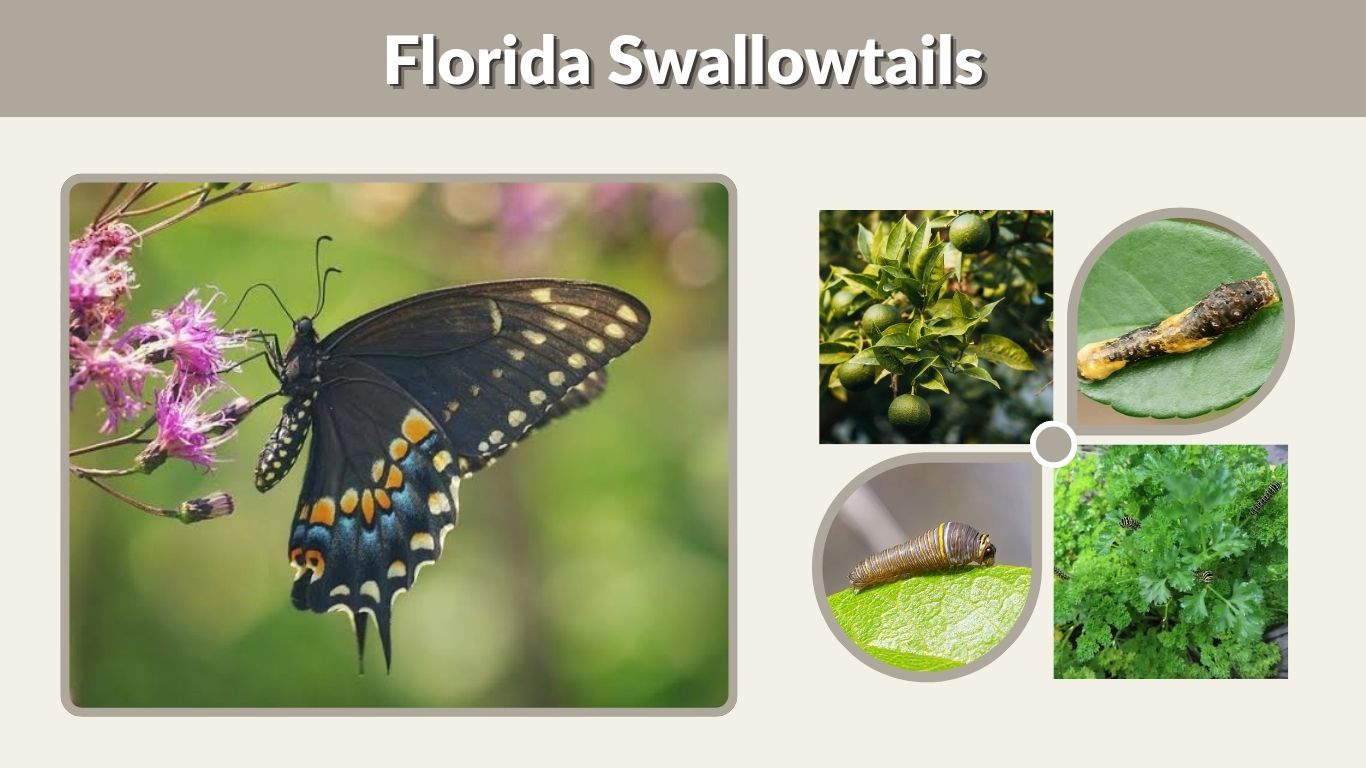
Florida swallowtails are large, colorful butterflies recognized by their broad wings and tail-like projections on the hindwings. Several species occur across the state, including black, giant, pipevine, spicebush, tiger, zebra, Palamedes, polydamas and the endangered Schaus’ swallowtail. Florida’s warm climate, diverse native plants and long flowering season allow many swallowtails to remain active for much of the year. Learning their colors, caterpillars and host plants makes identification easier and helps gardeners create suitable butterfly habitat.
What Are Swallowtail Butterflies?
Swallowtails belong to the butterfly family Papilionidae. Most Florida species are relatively large and strong-flying, although their colors and patterns vary considerably.
The familiar “tails” extend from the hindwings of many species, but not every swallowtail has them. For example, the polydamas swallowtail is a large black-and-yellow butterfly without true hindwing tails.
Florida supports more than 160 breeding butterfly species, along with additional migrants, and swallowtails are among the state’s most noticeable groups. They occupy gardens, forests, wetlands, roadsides, tropical hammocks, fields and suburban neighborhoods.
Common Florida Swallowtail Butterflies
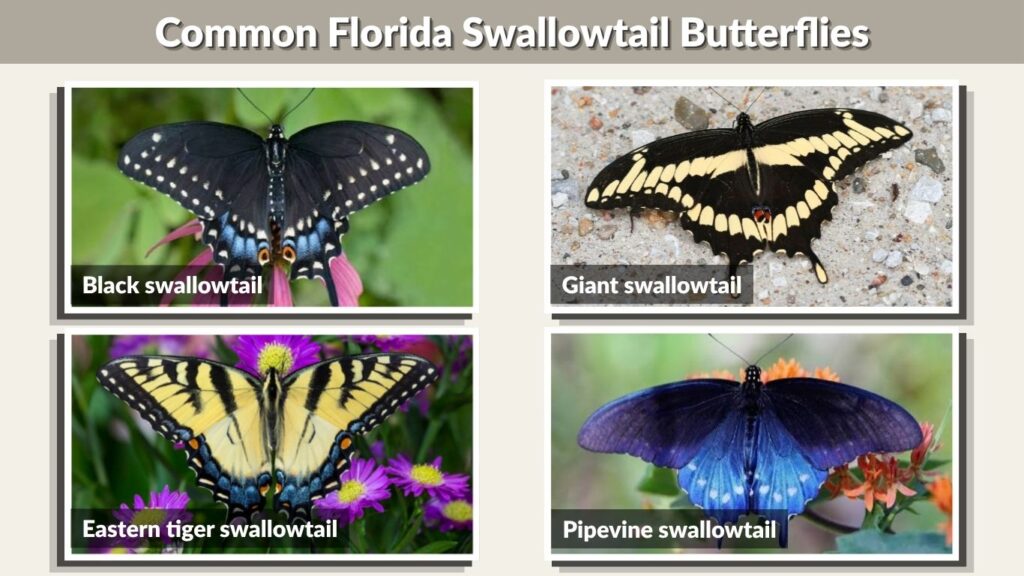
The easiest way to identify a Florida swallowtail is to examine its wing color, markings, tails, habitat and host plant.
| Species | Main adult appearance | Important caterpillar host plants |
|---|---|---|
| Black swallowtail | Black with yellow, blue and orange markings | Parsley, dill and fennel |
| Giant swallowtail | Dark brown or black with broad yellow bands | Citrus, wild lime and Hercules club |
| Eastern tiger swallowtail | Yellow with black tiger-like stripes | Wild cherry, sweetbay and ash |
| Pipevine swallowtail | Black with iridescent blue hindwings | Native pipevines |
| Spicebush swallowtail | Black with blue-green hindwings | Spicebush and redbay |
| Palamedes swallowtail | Dark brown with yellow lines and spots | Redbay and swamp bay |
| Zebra swallowtail | White or pale green with black stripes | Pawpaw |
| Polydamas swallowtail | Black with yellow spots and no tails | Pipevines |
| Schaus’ swallowtail | Brown-black with yellow markings | Wild lime and torchwood |
Black Swallowtail
The eastern black swallowtail, Papilio polyxenes, is one of the most familiar swallowtails in Florida gardens. Adults are mainly black and have rows of yellow spots along the wing edges. Blue scaling appears across the hindwings, especially in females, while each hindwing normally has an orange eyespot.
Males usually display more prominent yellow bands. Females often appear darker and show a wider area of blue. These differences can make females resemble pipevine swallowtails, which may provide some protection from predators.
Black Swallowtail Caterpillar
The mature caterpillar is green with black bands and yellow or orange spots. Young larvae are darker and may resemble bird droppings.
Black swallowtail caterpillars commonly feed on members of the carrot family, including:
- Parsley
- Dill
- Fennel
- Carrot
- Queen Anne’s lace
- Mock bishop’s weed
Gardeners sometimes find them eating culinary herbs. Planting extra parsley or dill allows the caterpillars to feed without sacrificing the entire crop. The Florida Museum lists cultivated and native carrot-family plants as their primary hosts.
Giant Swallowtail
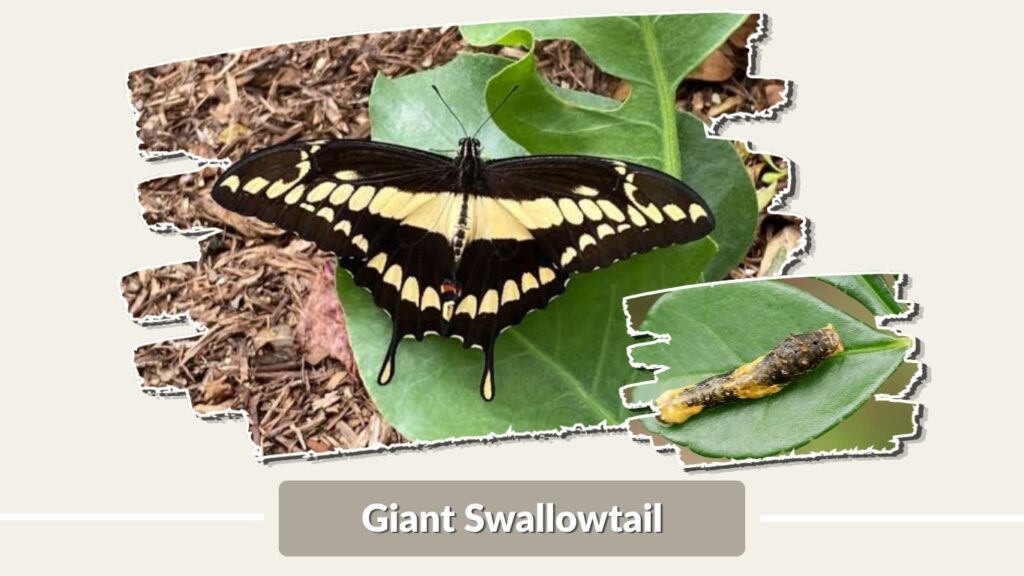
The giant swallowtail is one of Florida’s largest and most impressive butterflies. Its upper wings are dark brown to black with broad yellow bands that form a cross-like pattern. The undersides are mostly yellow with dark markings.
Adults occur in forests, citrus groves, gardens, roadsides and parks. They can fly rapidly and may be difficult to observe when they are not feeding.
Giant Swallowtail Caterpillar
The giant swallowtail caterpillar is often called an orange dog because it commonly feeds on citrus leaves. Its mottled brown, cream and white body resembles bird droppings, helping it escape detection.
Host plants include:
- Orange, lemon and lime trees
- Wild lime
- Hercules club
- Common hoptree
- Other plants in the citrus family
A few caterpillars rarely cause serious damage to a mature citrus tree. Avoid broad-spectrum insecticides when possible because they can kill both caterpillars and beneficial insects.
Giant swallowtails fly from approximately February through November across much of Florida and may be seen throughout the year in South Florida.
Eastern Tiger Swallowtail
The eastern tiger swallowtail is a large yellow butterfly with bold black stripes extending across its wings. Males are normally bright yellow, while females may be yellow or almost entirely dark.
The dark female form can resemble a pipevine swallowtail. However, blue markings, tiger stripes and wing patterns help distinguish it at close range.
Eastern tiger swallowtails inhabit woodlands, river corridors, parks, roadsides, gardens and meadows. Their caterpillars feed on trees rather than small garden herbs.
Important host trees include:
- Wild black cherry
- Sweetbay magnolia
- Tuliptree
- White ash
The species is generally active in Florida from spring through late fall.
Pipevine Swallowtail
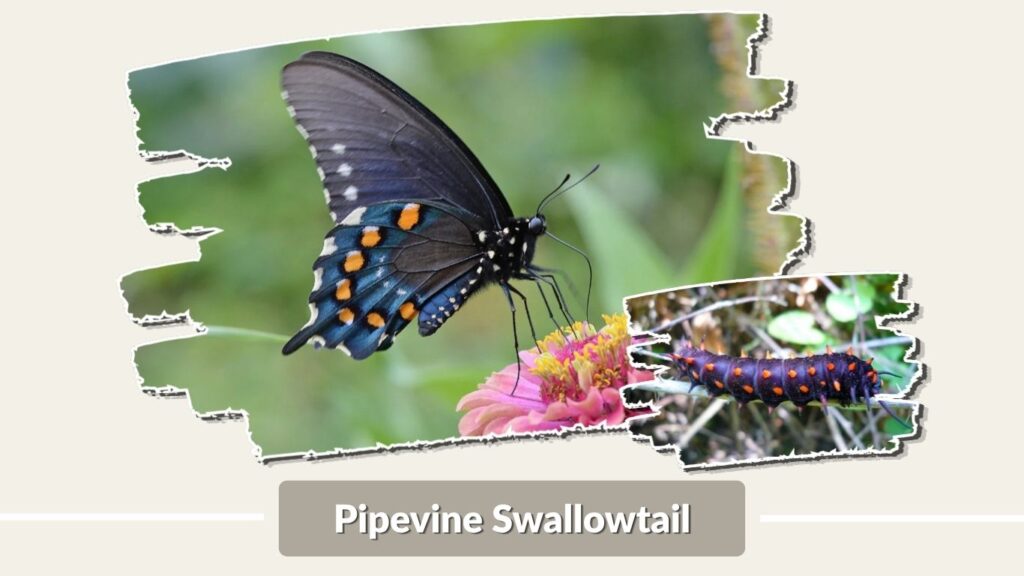
The pipevine swallowtail is mostly black, but the upper hindwings of males often shine with iridescent blue or blue-green. The underside of each hindwing has a curved row of orange spots surrounded by bluish coloring.
Adults frequently keep their wings moving while feeding. Their rapid flight and dark coloration can make them difficult to separate from black and spicebush swallowtails at a distance.
Pipevine Swallowtail Caterpillar
The caterpillar is usually dark red, brown or black and has rows of fleshy projections. It feeds on pipevines in the genus Aristolochia.
Pipevine caterpillars absorb defensive chemicals from their host plants. These chemicals make both the larvae and adult butterflies unpleasant to many predators. Several other butterflies gain protection by resembling the toxic pipevine swallowtail.
Virginia snakeroot is an important Florida host, and the species commonly appears from February through November.
Gardeners should select appropriate native pipevines. Some exotic ornamental species may not be suitable for every native swallowtail and can expose larvae to harmful plant chemistry.
Spicebush and Palamedes Swallowtails
The spicebush swallowtail is a black butterfly with pale spots along the wing margins and blue or greenish coloring on the hindwings. It is associated with wooded habitats, wetlands and gardens containing suitable host plants.
Its mature caterpillar is one of Florida’s most unusual larvae. It is green with two large false eyespots near the head, creating the appearance of a tiny snake. Young caterpillars initially resemble bird droppings.
Spicebush, sassafras and redbay can serve as host plants, depending on the region.
The Palamedes swallowtail is dark brown or black with yellow spots and bands. It is particularly associated with wet forests, swamps and coastal areas. Redbay and swamp bay are major host plants. Because these trees have been affected by laurel wilt disease, preserving healthy native bay trees is important for the butterfly.
Zebra Swallowtail
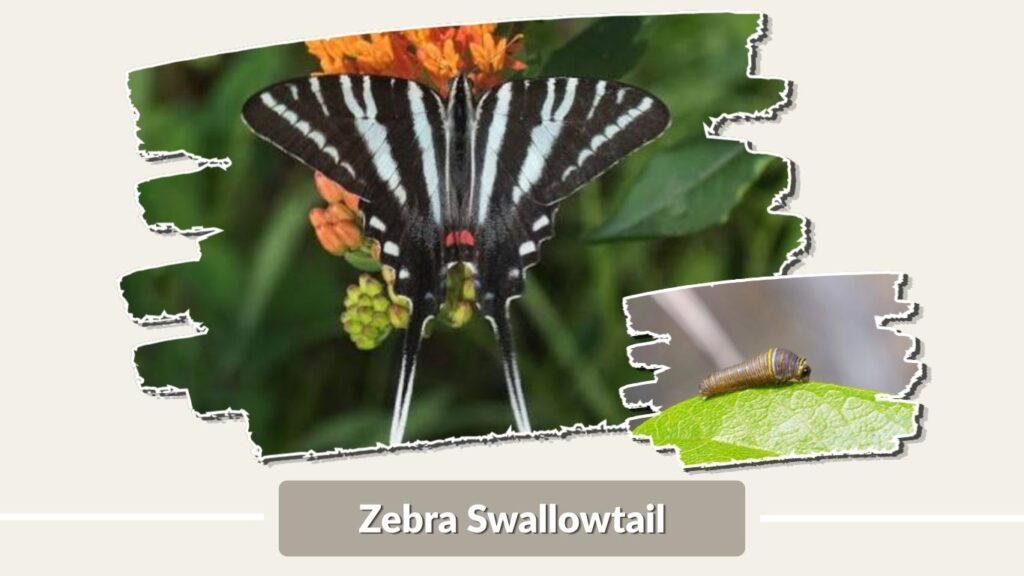
The zebra swallowtail is unmistakable. Its wings are white to pale green and crossed by long black stripes. The hindwings have slender tails and small red markings.
Unlike many dark Florida swallowtails, the zebra swallowtail has a light, delicate appearance. It occurs near woodlands, fields, roadsides and places where pawpaw plants grow.
Its caterpillars feed almost exclusively on pawpaws in the genus Asimina. The Florida butterfly-gardening guide lists pawpaw as the larval host and notes that adults may be observed through much of the year.
Polydamas Swallowtail
The polydamas swallowtail is common in South Florida and may also occur farther north during warm periods. It has black wings bordered by a row of yellow spots but lacks the tail-like projections associated with most swallowtails.
Its caterpillars feed on several ornamental and native pipevines. The mature larvae are dark with fleshy reddish projections and often feed together when young.
Adults occupy gardens, parks, disturbed areas and old fields. Florida Museum records indicate that the species may produce multiple generations and is generally active from March through December.
Schaus’ Swallowtail
The Schaus’ swallowtail is one of Florida’s rarest butterflies. It lives in tropical hardwood hammocks in extreme South Florida and the Florida Keys.
Adults have dark brown or black wings with yellow markings and muted blue coloring. Caterpillars depend mainly on torchwood and wild lime.
Unlike widespread garden swallowtails, this species has a highly restricted range and is protected as endangered under both federal and Florida law.
Conservation programs have included captive breeding, habitat management and releases of larvae into protected areas. In 2024, wildlife researchers released approximately 500 caterpillars into the Florida Keys as part of ongoing recovery work.
People should never collect Schaus’ swallowtails, their eggs or caterpillars.
Florida Swallowtail Caterpillar Identification
Swallowtail caterpillars change considerably as they grow, so young and mature larvae may look like different species.
Common forms include:
- Black swallowtail: green with black bands and yellow spots
- Giant swallowtail: mottled brown and white, resembling bird waste
- Spicebush swallowtail: green with large false snake eyes
- Pipevine swallowtail: dark red or black with fleshy projections
- Zebra swallowtail: green with thin yellow, black and white bands
- Polydamas swallowtail: dark with red-orange projections
When disturbed, many swallowtail caterpillars extend a forked, fleshy organ called an osmeterium from behind the head. It produces a strong odor intended to repel predators. The structure may look alarming, but it is not a stinger.
How to Attract Swallowtails in Florida
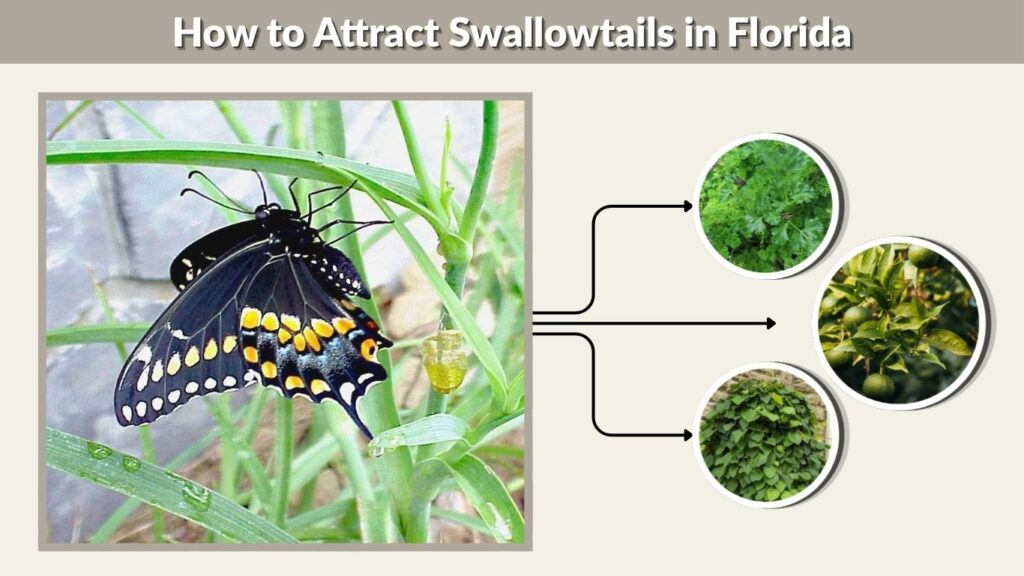
A successful butterfly garden needs both nectar plants for adults and host plants for caterpillars. Flowers alone may attract passing adults, but they will not support reproduction.
Plant the Correct Host Plants
Suitable choices include:
- Parsley and dill for black swallowtails
- Native pipevine for pipevine swallowtails
- Wild lime for giant and Schaus’ swallowtails
- Pawpaw for zebra swallowtails
- Sweetbay and wild cherry for tiger swallowtails
- Redbay for Palamedes and spicebush swallowtails
Select plants suited to your part of Florida because North, Central and South Florida have different climates and butterfly communities.
Provide Nectar Flowers
Adult swallowtails visit lantana, pentas, blazing star, salvia, verbena, native milkweed, buttonbush and many other nectar-rich flowers. A mixture of plants that bloom in different seasons provides a more dependable food supply.
Avoid using insecticides on butterfly plants. Even products described as natural can kill eggs, caterpillars and adult butterflies. Let fallen leaves and some natural vegetation remain where practical, because pupae may be attached to stems or hidden near the ground.
FAQs
How many swallowtail butterflies live in Florida?
Florida supports several resident and regularly observed species, including black, giant, eastern tiger, pipevine, spicebush, Palamedes, zebra, polydamas and Schaus’ swallowtails. Some are statewide, while others are restricted mainly to northern or southern Florida.
What is the largest swallowtail in Florida?
The giant swallowtail is generally considered Florida’s largest butterfly. Its wingspan commonly exceeds four inches, and some individuals are considerably larger. Adults are dark above with broad yellow bands and are frequently seen near citrus plants.
Are Florida swallowtail caterpillars poisonous?
Most are not dangerous to people. Pipevine and polydamas caterpillars obtain defensive compounds from pipevines and may be toxic or distasteful to predators. Caterpillars should not be eaten or handled unnecessarily, but they do not sting people.
What plants attract black swallowtails in Florida?
Black swallowtails lay eggs on parsley, dill, fennel, carrot and related plants. Adults visit many nectar flowers. A garden containing both carrot-family host plants and continuously blooming nectar plants can support the complete lifecycle.
Are swallowtail butterflies in Florida endangered?
Most common Florida swallowtails are not endangered. However, the Schaus’ swallowtail is federally and state protected as an endangered species. It survives mainly in tropical hardwood hammock habitat in extreme South Florida and the Florida Keys.