
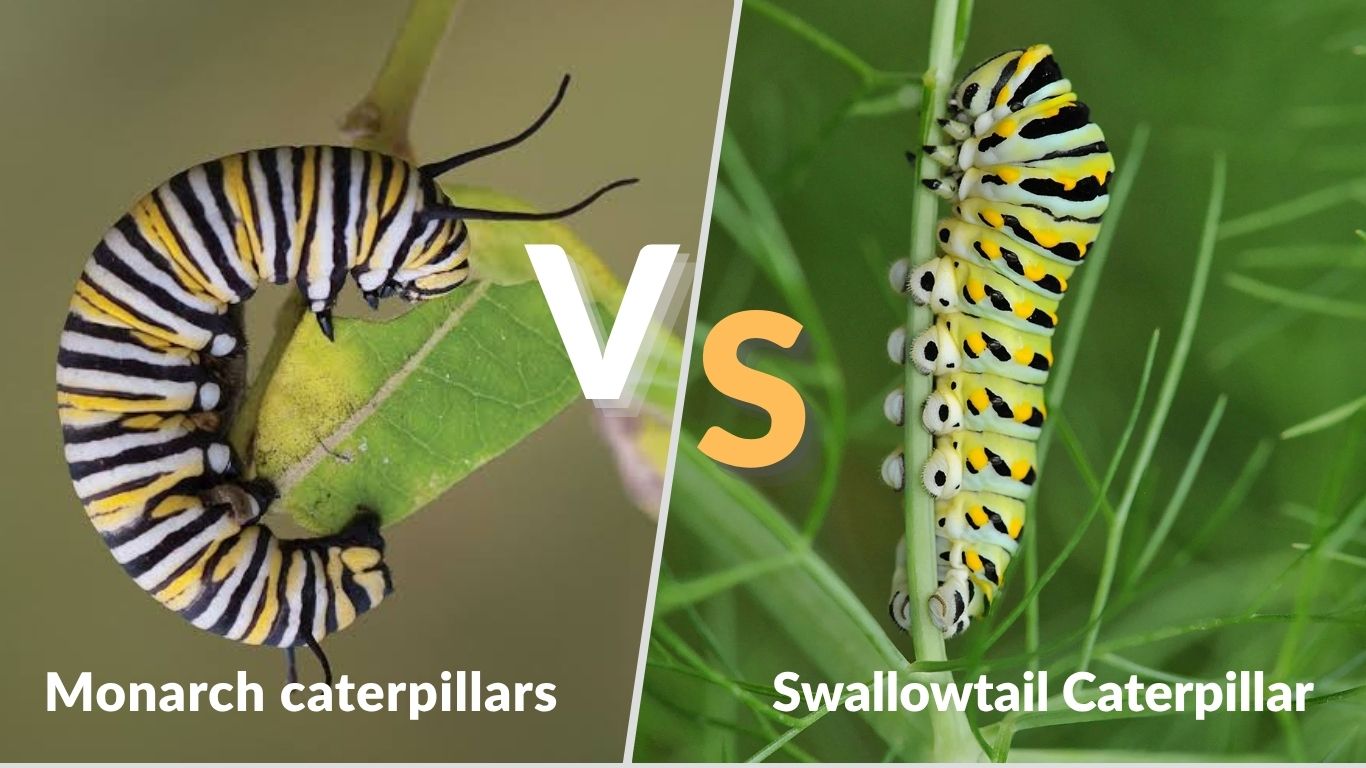
Monarch and swallowtail caterpillars are among the most recognizable butterfly larvae found in gardens. Both may display green, black, yellow, or white markings, which can make identification confusing. However, they belong to different butterfly families and differ in their host plants, body structures, defensive behaviors, and chrysalis formation. Learning these differences helps gardeners identify caterpillars correctly, protect beneficial butterflies, and choose suitable plants for a butterfly-friendly garden.
Monarch vs Swallowtail Caterpillar: Quick Comparison
Although mature black swallowtail caterpillars can resemble monarch caterpillars, several dependable features separate them.
| Feature | Monarch Caterpillar | Swallowtail Caterpillar |
|---|---|---|
| Butterfly family | Nymphalidae | Papilionidae |
| Typical colors | Black, white, and yellow stripes | Varies by species |
| Tentacles | Two pairs of soft black filaments | No permanent tentacle pairs |
| Defensive organ | No osmeterium | Forked osmeterium behind the head |
| Main host plants | Milkweed species | Parsley, dill, fennel, citrus, spicebush, pawpaw, and others |
| Chrysalis position | Hangs downward | Usually upright with a silk girdle |
| Common appearance | Narrow horizontal bands | Spots, bands, eyespots, or bird-dropping camouflage |
The simplest identification method is to examine the plant on which the caterpillar is feeding. Monarch caterpillars depend on milkweed, while swallowtail species use several different groups of host plants.
What Does a Monarch Caterpillar Look Like?
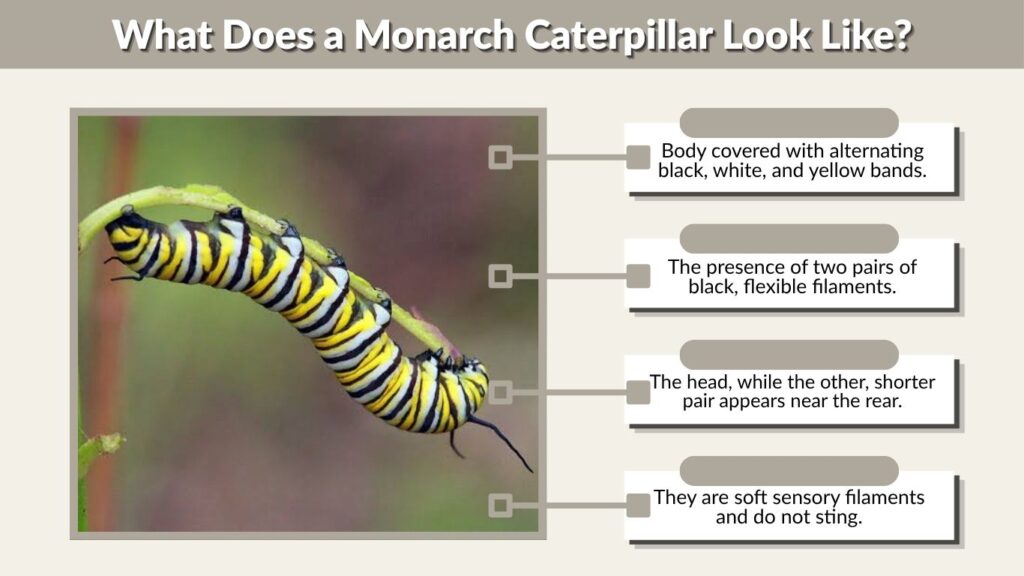
A mature monarch caterpillar has a smooth body covered with alternating black, white, and yellow bands. These bands form narrow rings that extend around most of the body.
One of its most distinctive features is the presence of two pairs of black, flexible filaments. One pair projects near the head, while the other, shorter pair appears near the rear. These structures may look like antennae or horns, but they are soft sensory filaments and do not sting.
Young monarch caterpillars look different from mature ones. Newly hatched larvae are extremely small and may appear pale gray, cream, or translucent. Their characteristic stripes become clearer as they grow and pass through five developmental stages known as instars.
Monarch caterpillars are generally found feeding on milkweed leaves, flowers, seed pods, or tender stems. Milkweed is essential because monarch larvae cannot complete their development on ordinary garden plants.
What Does a Swallowtail Caterpillar Look Like?
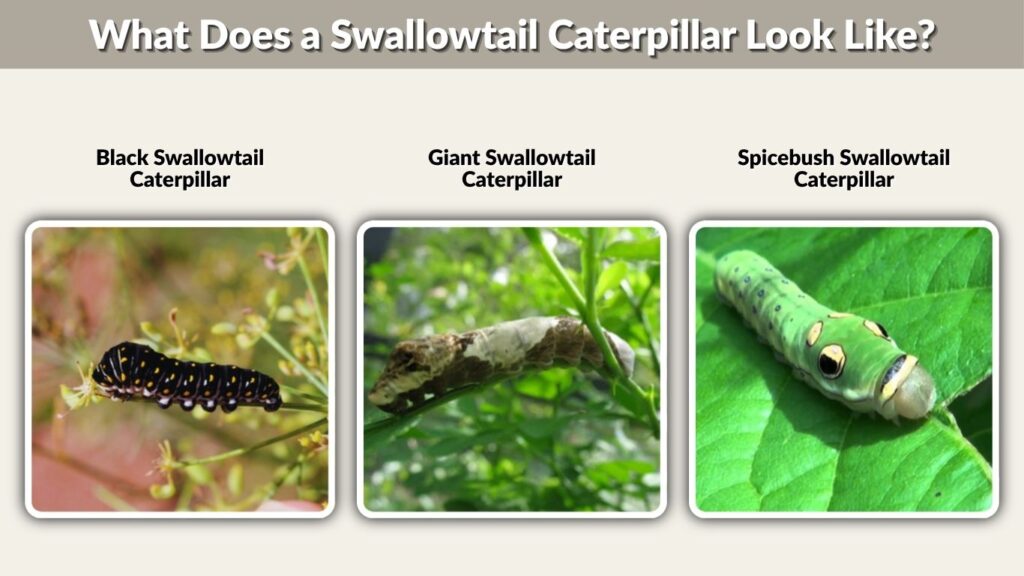
The term “swallowtail caterpillar” describes larvae belonging to many different swallowtail butterfly species. As a result, their appearance varies considerably.
Some mature swallowtail caterpillars are green with black bands and brightly colored spots. Others have large false eyespots, brown camouflage, or markings resembling bird droppings.
Common examples include:
Black Swallowtail Caterpillar
A mature black swallowtail caterpillar is usually green with black horizontal bands. Each black band contains yellow or orange spots. Its striped appearance sometimes causes it to be mistaken for a monarch caterpillar.
Black swallowtail larvae commonly feed on plants in the carrot family, including parsley, dill, fennel, carrots, celery, and Queen Anne’s lace.
Giant Swallowtail Caterpillar
Giant swallowtail caterpillars are brown, cream, and white rather than brightly striped. Their irregular coloring resembles a fresh bird dropping, providing camouflage against predators.
They are sometimes called “orangedogs” because they feed on citrus-family plants. Young citrus trees may experience noticeable leaf loss, although established trees usually tolerate limited feeding.
Spicebush Swallowtail Caterpillar
Mature spicebush swallowtail caterpillars are bright green and have two large false eyespots near the front of the body. These markings make the caterpillar resemble a small snake.
Its actual head is much smaller and positioned beneath the enlarged front section. This unusual appearance may discourage birds and other predators.
Major Identification Differences
Body Stripes and Markings
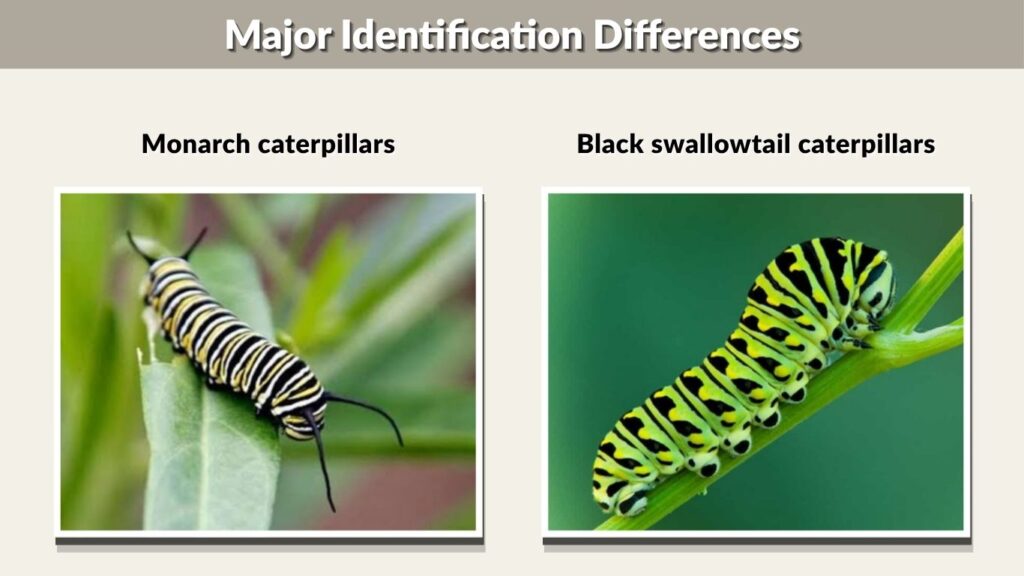
Monarch caterpillars have relatively thin black, white, and yellow bands arranged repeatedly along the body. The pattern is consistent and orderly.
Black swallowtail caterpillars usually have a green base color with wider black bands. Their yellow or orange markings appear as separate dots rather than complete yellow rings.
Not every swallowtail is striped. Giant swallowtail larvae have mottled bird-dropping camouflage, while several other species develop false eyespots.
Tentacles vs Osmeterium
Monarch caterpillars possess four visible black filaments—two near the head and two near the rear. These filaments remain visible while the caterpillar is resting or feeding.
Swallowtail caterpillars do not have the same arrangement. Instead, they possess an osmeterium, a hidden fork-shaped defensive organ located just behind the head. When disturbed, the caterpillar can extend this fleshy structure. It may be yellow, orange, or red and produces an unpleasant odor intended to discourage predators.
Host Plants
Host plant identification is often more dependable than color alone.
Monarch caterpillars eat milkweed plants in the genus Asclepias and closely related milkweed-family plants. A striped caterpillar actively feeding on milkweed is therefore much more likely to be a monarch.
Swallowtail host plants depend on the species:
| Swallowtail species | Common host plants |
|---|---|
| Black swallowtail | Parsley, dill, fennel, carrot and celery |
| Giant swallowtail | Citrus, prickly ash and rue |
| Spicebush swallowtail | Spicebush and sassafras |
| Tiger swallowtail | Tulip tree, cherry, willow and ash |
| Zebra swallowtail | Pawpaw |
A caterpillar found eating parsley or dill is likely a black swallowtail rather than a monarch. Similarly, a brown-and-white caterpillar on a citrus leaf may be a giant swallowtail.
Defensive Strategies
Both caterpillar groups have developed defenses against predators, but they use different methods.
Monarch caterpillars consume milkweed containing defensive chemical compounds. Some of these compounds are stored in the caterpillar’s body and can make it distasteful or harmful to certain predators. Its bright striped pattern serves as warning coloration.
Swallowtails frequently depend on camouflage and mimicry. Young black swallowtail and giant swallowtail larvae can resemble bird droppings. Spicebush swallowtails imitate snakes using false eyespots, while many swallowtail species expose their foul-smelling osmeterium when threatened.
Chrysalis Differences
A monarch caterpillar normally leaves its milkweed plant and finds a protected location before pupating. It forms a silk pad, attaches itself by the rear end, and hangs downward in a J-shaped position. It then transforms into a smooth green chrysalis decorated with small gold-colored markings.
Most swallowtail caterpillars form a chrysalis in an upright or angled position. The chrysalis is attached at the rear and supported around the middle by a thin silk loop called a girdle. Its color may be green or brown, helping it blend with stems, bark, or surrounding vegetation.
Are Monarch and Swallowtail Caterpillars Harmful?
Neither caterpillar is dangerous to people. They do not possess stingers, and their visible projections are not venomous.
Swallowtail caterpillars may release a strong odor through the osmeterium, but this is a defensive response rather than an attack. It is still best to avoid unnecessary handling because caterpillars are delicate and can be injured easily.
Both groups may consume noticeable amounts of foliage. However, their feeding is usually limited to particular host plants. Gardeners can reduce damage by planting extra milkweed, parsley, dill, fennel, or citrus foliage specifically for caterpillars.
FAQs
Can a swallowtail caterpillar live on milkweed?
Most swallowtail caterpillars cannot survive on milkweed. Each swallowtail species requires particular host plants. Black swallowtails need carrot-family plants, while giant swallowtails commonly use citrus-family plants. Caterpillars should not be transferred to unfamiliar plants because they may refuse to eat them.
Do monarch caterpillars have an osmeterium?
No. Monarch caterpillars have two pairs of visible black filaments but do not possess the forked osmeterium found in swallowtail larvae. A caterpillar that exposes an orange or yellow Y-shaped organ when disturbed is probably a swallowtail.
Why do swallowtail caterpillars look like bird droppings?
Bird-dropping mimicry helps young swallowtail caterpillars avoid predators. Birds are less likely to investigate or eat an object resembling waste. Giant swallowtail caterpillars maintain this mottled appearance through much of their larval development.
How can I identify a black swallowtail caterpillar?
Look for a green caterpillar with broad black bands containing yellow or orange dots. Check the host plant as well. Black swallowtails commonly feed on parsley, dill, fennel, carrots, celery, rue, and Queen Anne’s lace.
Which caterpillar has black, yellow, and white stripes?
A caterpillar with narrow black, yellow, and white rings, plus two pairs of black filaments, is probably a monarch. A green caterpillar with black bands and separate yellow dots is more likely a mature black swallowtail.