

The Canadian tiger swallowtail is a striking butterfly known for its bright yellow wings and bold black stripes. It is closely related to the eastern tiger swallowtail but is specially adapted to colder climates. This species is commonly found in northern regions, where it thrives in forests and open landscapes. Its graceful flight and seasonal appearance make it a favorite among butterfly watchers. In this guide, you’ll learn how to identify it, understand its lifecycle, and explore its habitat and behavior.
What Is a Canadian Tiger Swallowtail?
The Canadian tiger swallowtail is a large butterfly species scientifically known as Papilio canadensis. It belongs to the swallowtail family and is recognized for its distinctive wing patterns and strong flying ability. Unlike similar species, it is adapted to survive in cooler climates.
Scientific Classification
The Canadian tiger swallowtail belongs to the Papilionidae family, which includes some of the largest and most colorful butterflies. Its scientific name, Papilio canadensis, distinguishes it from other tiger swallowtail species.
This butterfly is closely related to the eastern tiger swallowtail but has evolved unique traits to survive in colder regions. Its classification helps scientists understand its behavior, lifecycle, and habitat preferences.
Key Characteristics
One of the most noticeable features of this butterfly is its bright yellow wings with bold black stripes, resembling a tiger pattern. These markings make it easy to identify in the wild.
It also has tail-like extensions on its hind wings, which are a defining feature of swallowtail butterflies. These tails add to its elegant appearance and may help confuse predators.
Its flight is strong and graceful, often involving gliding movements followed by quick wing beats. This makes it easy to spot as it moves through open areas.
Canadian Tiger Swallowtail Identification
Identifying the Canadian tiger swallowtail becomes easier once you understand its size, markings, and overall appearance. It shares similarities with other swallowtails but has distinct traits.
Size and Wingspan
The wingspan of the Canadian tiger swallowtail typically ranges from about 2.5 to 4 inches. This makes it a medium to large butterfly.
Although it is slightly smaller than the eastern tiger swallowtail, it is still large enough to be easily noticed in its natural habitat. Its size contributes to its strong flying ability.
Physical Features
The wings are bright yellow with bold black stripes running vertically across them. These stripes create the signature tiger-like pattern.
On the hind wings, you may notice blue and orange markings near the edges. These details add to its beauty and help distinguish it from similar species.
The body is relatively small compared to its wings, and the overall structure is lightweight, allowing for efficient flight.
Canadian Tiger Swallowtail vs Eastern Tiger Swallowtail
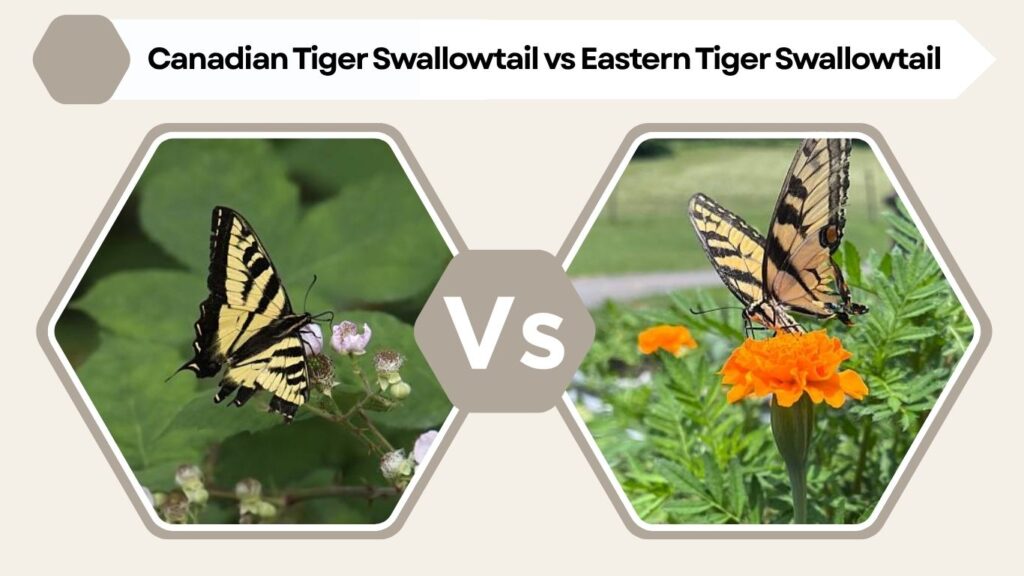
These two species are often confused because of their similar appearance. However, there are several key differences that can help you tell them apart.
| Feature | Canadian Tiger Swallowtail | Eastern Tiger Swallowtail |
| Range | Northern regions | Eastern and southern regions |
| Size | Slightly smaller | Larger |
| Climate | Cooler climates | Warmer climates |
| Generations | One per year | Multiple per year |
| Color Variation | Mostly yellow | Yellow and dark female form |
The Canadian tiger swallowtail is adapted to cooler climates and typically produces only one generation per year due to shorter warm seasons. In contrast, the eastern tiger swallowtail can have multiple generations in warmer regions.
Another key difference is color variation. The eastern species may have darker female forms, while the Canadian species is usually consistently yellow.
Habitat and Distribution
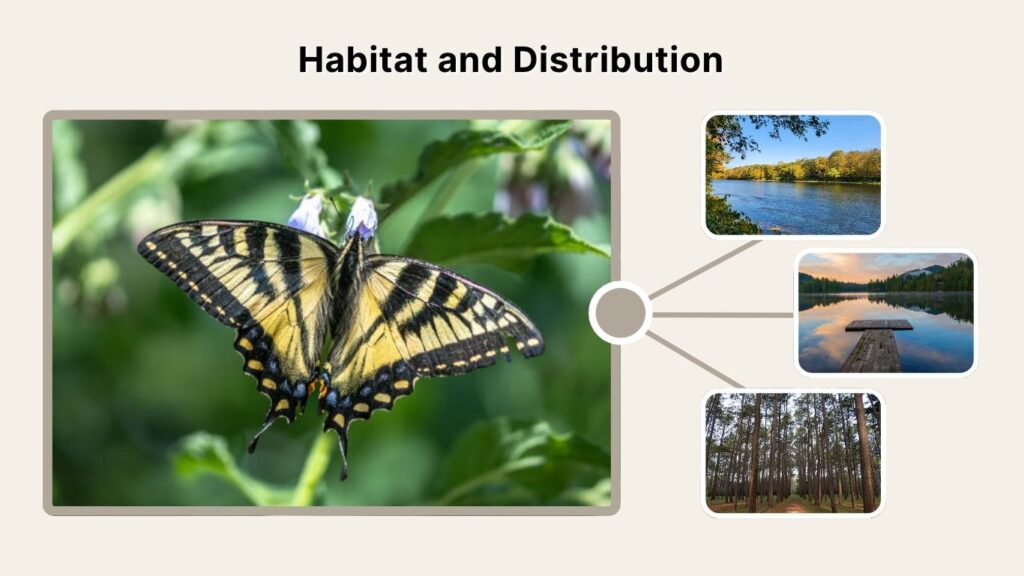
The Canadian tiger swallowtail is found mainly in northern North America and prefers environments that provide both food and shelter.
- Found across Canada and northern United States
- Common in forests and woodlands
- Seen near rivers, lakes, and open clearings
- Prefers cooler climates
- Active during late spring and summer
These butterflies are often seen in areas where trees and flowering plants are abundant. Forest edges and open spaces provide ideal conditions for feeding and reproduction.
Their activity is closely linked to seasonal temperatures. They appear during warmer months when flowers are in bloom and food is available.
Life Cycle of Canadian Tiger Swallowtail
Like all butterflies, the Canadian tiger swallowtail undergoes complete metamorphosis. This process includes four stages: egg, caterpillar, chrysalis, and adult.
Egg Stage
The life cycle begins when the female lays eggs on suitable host plants. These eggs are usually small and green, making them difficult to spot.
They are placed carefully on leaves that will provide food for the caterpillars once they hatch. This ensures the larvae have immediate access to nourishment.
Caterpillar Stage
After hatching, the caterpillar begins feeding on the leaves of the host plant. In its early stages, it is small and less noticeable.
As it grows, it develops a green body with markings that resemble large eyes. This helps protect it from predators by giving it a snake-like appearance.
The caterpillar goes through several growth stages, shedding its skin multiple times as it increases in size.
Chrysalis Stage
Once fully grown, the caterpillar forms a chrysalis. This stage is a protective phase where transformation into a butterfly takes place.
The chrysalis is often attached to a branch or leaf and is well camouflaged to blend into its surroundings. In colder climates, this stage may last through winter.
Inside the chrysalis, the caterpillar undergoes a complete transformation into an adult butterfly.
Adult Butterfly
The adult butterfly emerges when conditions are suitable, usually in late spring or early summer. At first, its wings are soft, but they quickly expand and harden.
The butterfly then begins feeding on nectar and searching for a mate. This stage focuses on reproduction and continuing the life cycle.
Diet and Host Plants
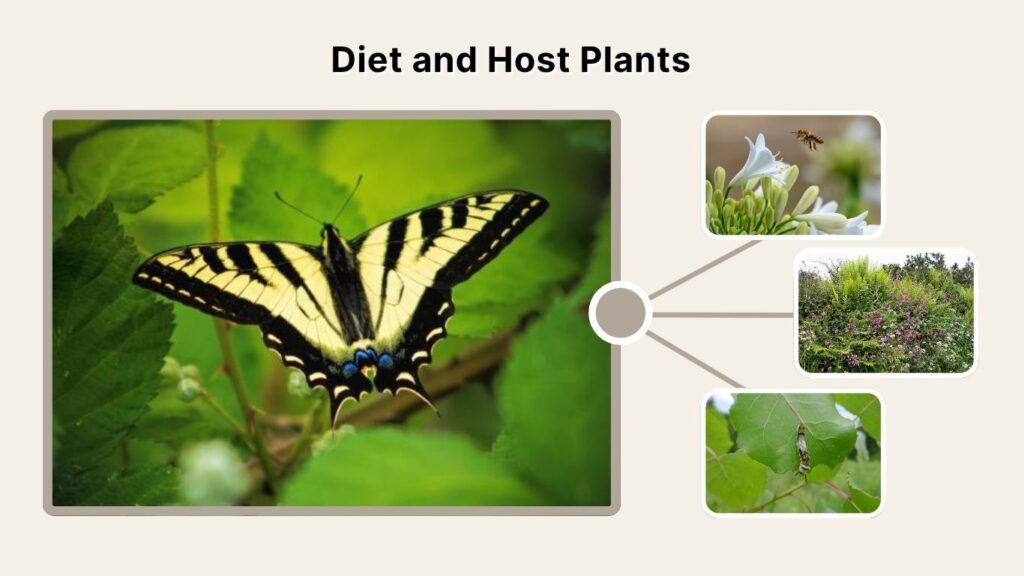
The diet of the Canadian tiger swallowtail changes depending on its stage of life. Both caterpillars and adults rely on different food sources.
- Caterpillars feed on leaves of trees like birch and aspen
- Adults drink nectar from flowers
- Prefer wildflowers and shrubs
- Use long proboscis to access nectar
- Require nutrient-rich plants for survival
Caterpillars depend entirely on host plants for food, which is why females carefully select where to lay eggs. Without these plants, the larvae cannot survive.
Adult butterflies feed mainly on nectar, which provides the energy needed for flight and reproduction. They are often seen visiting flowers in search of food.
Behavior and Flight Pattern
The Canadian tiger swallowtail is known for its graceful and powerful flight, which makes it one of the more noticeable butterflies in its range. Its behavior is closely linked to its environment and seasonal conditions, especially in cooler climates where activity is limited to warmer months. Unlike some smaller butterflies that flutter constantly, this species combines slow gliding with strong wing beats, allowing it to travel efficiently across large areas in search of food and mates.
- Strong, gliding flight with occasional wing flaps
- Active during warm daylight hours
- Males gather minerals from moist soil
- Females search carefully for host plants
- Seasonal activity tied to temperature
Male butterflies are often seen engaging in a behavior known as puddling, where they gather on damp soil or near water sources to absorb minerals. These nutrients are important for reproduction and overall health. Females, on the other hand, spend more time searching for suitable host plants where they can lay their eggs, ensuring that the next generation has access to food immediately after hatching.
Lifespan and Generations
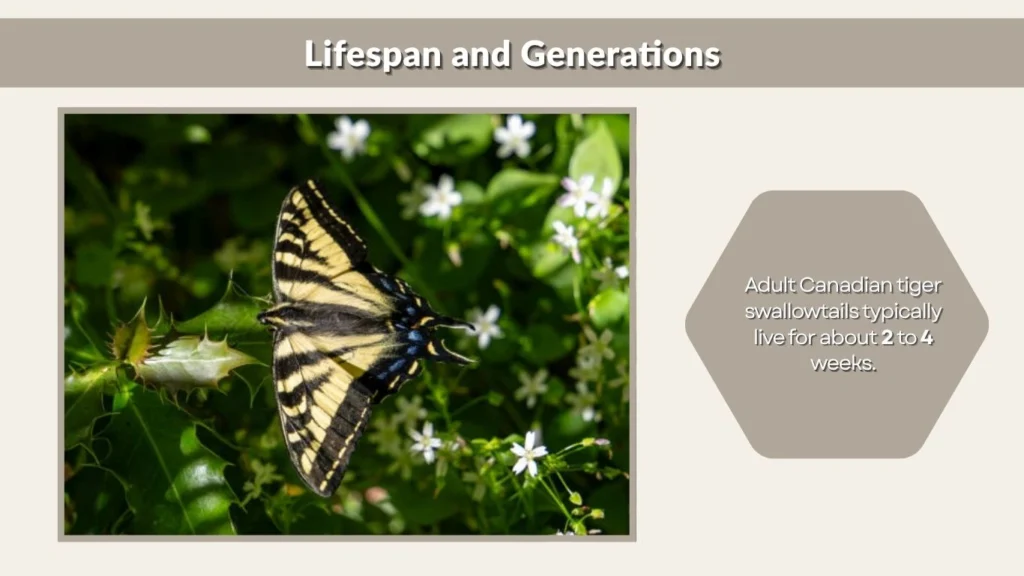
The lifespan of the Canadian tiger swallowtail is relatively short, but it is carefully adapted to the seasonal conditions of its environment. Because this species lives in cooler regions, it has a different life cycle compared to similar butterflies found in warmer climates. The limited warm season means that timing is critical for survival and reproduction.
Lifespan
Adult Canadian tiger swallowtails typically live for about 2 to 4 weeks. During this time, they focus on feeding, mating, and laying eggs. Although their lifespan is brief, they are highly active and play an important role in pollination during this period.
The earlier stages of life, including the caterpillar and chrysalis, can last longer depending on environmental conditions. The chrysalis stage, in particular, may extend through colder months as part of the butterfly’s adaptation to its habitat.
Generations per Year
Unlike the eastern tiger swallowtail, which can produce multiple generations each year, the Canadian tiger swallowtail usually has only one generation annually. This is due to the shorter growing season in northern climates.
This single-generation cycle ensures that the butterfly’s development aligns with the availability of food and favorable weather conditions. It is a key adaptation that allows the species to survive in regions with long winters.
Predators and Survival
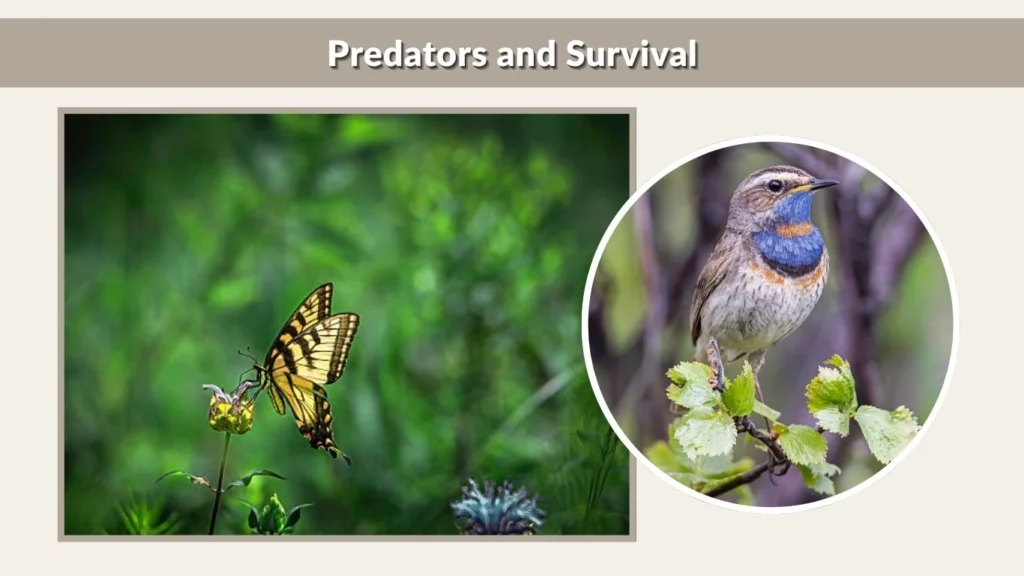
Despite its size and striking appearance, the Canadian tiger swallowtail faces several natural threats throughout its life cycle. Its survival depends on a combination of camouflage, mimicry, and behavior that helps reduce the risk of predation.
- Birds are primary predators
- Spiders capture adults and caterpillars
- Small mammals may prey on larvae
- Other insects can attack eggs and pupae
- Environmental changes impact survival
Caterpillars have developed unique defense mechanisms to protect themselves from predators. Their green coloration helps them blend into leaves, while eye-like markings give them a snake-like appearance that can scare away potential threats. These adaptations increase their chances of reaching adulthood.
Adult butterflies rely more on their ability to fly quickly and unpredictably. Their bright coloration may also serve as a warning or distraction to predators, although it does not provide complete protection.
Interesting Facts About Canadian Tiger Swallowtail
The Canadian tiger swallowtail has several fascinating traits that highlight its uniqueness among butterfly species. These facts help explain why it is such an important and interesting part of its ecosystem.
- Adapted to colder northern climates
- Produces only one generation per year
- Caterpillars mimic snakes for defense
- Important pollinator in forest ecosystems
- Strong and efficient flyer
One of the most interesting aspects of this butterfly is its ability to survive in cooler climates where many other butterflies cannot. Its life cycle is carefully timed to match the short growing season, allowing it to complete its development successfully.
Its role as a pollinator is also significant, as it helps maintain plant diversity and supports the health of its ecosystem. By feeding on nectar and transferring pollen, it contributes to the reproduction of many plant species.
How to Attract Canadian Tiger Swallowtail
Attracting Canadian tiger swallowtail butterflies to your area requires creating an environment that meets their needs for food, shelter, and reproduction. By providing the right plants and conditions, you can encourage them to visit and stay.
Plants to Grow
Planting nectar-rich flowers is one of the best ways to attract adult butterflies. Native wildflowers and shrubs are particularly effective because they provide the nutrients these butterflies need.
Host plants such as birch, aspen, and willow are essential for supporting caterpillars. Without these plants, the butterflies cannot reproduce successfully in the area.
Habitat Tips
Creating a butterfly-friendly environment involves more than just planting flowers. Providing sunny areas for basking and avoiding the use of pesticides can make a big difference.
Adding a small water source or damp soil can also attract males that are looking for minerals. Maintaining a natural and diverse environment increases the chances of attracting these butterflies.
FAQs
What is a Canadian tiger swallowtail?
The Canadian tiger swallowtail is a large yellow butterfly with black stripes, known for its strong flight and adaptation to cooler climates. It belongs to the swallowtail family and is commonly found in northern North America.
Where is the Canadian tiger swallowtail found?
It is mainly found in Canada and the northern United States. It prefers forests, woodlands, and areas near water where host plants and nectar sources are available.
What do Canadian tiger swallowtails eat?
Caterpillars feed on the leaves of trees like birch and aspen, while adult butterflies drink nectar from flowers. This combination of diets supports their growth and energy needs.
How long does the Canadian tiger swallowtail live?
Adult butterflies usually live for about 2 to 4 weeks. However, the full life cycle, including earlier stages, can last longer depending on environmental conditions.
How is it different from the eastern tiger swallowtail?
The Canadian tiger swallowtail is adapted to colder climates and typically has only one generation per year, while the eastern tiger swallowtail lives in warmer regions and can produce multiple generations annually.