
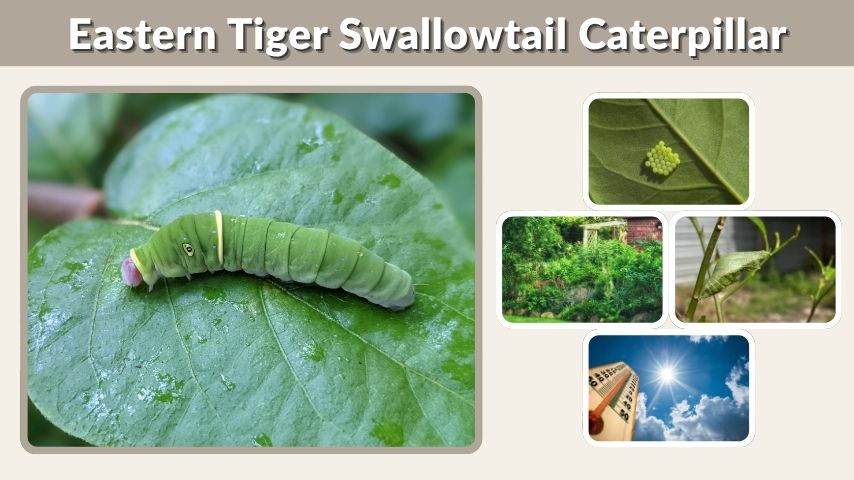
The eastern tiger swallowtail caterpillar is the young stage of the beautiful yellow-and-black eastern tiger swallowtail butterfly, known scientifically as Papilio glaucus. This caterpillar is famous for its green body, fake eye spots, and snake-like defense pose. It changes color and shape as it grows, making identification confusing for beginners. This guide explains what it looks like, what it eats, its host plants, life cycle, chrysalis stage, safety, and simple care tips.
Eastern Tiger Swallowtail Caterpillar Overview
The eastern tiger swallowtail caterpillar goes through dramatic changes before becoming a butterfly. Young caterpillars may look brown, black, or bird-dropping-like, while later stages become smooth green with large false eyes. These changes help protect the caterpillar from predators. Understanding its appearance at each stage makes identification much easier in gardens, forests, and backyard host trees.
What Is an Eastern Tiger Swallowtail Caterpillar?
An eastern tiger swallowtail caterpillar is the larval stage of the eastern tiger swallowtail butterfly. The adult butterfly is usually large, yellow, and marked with black tiger-like stripes. Female butterflies lay eggs on suitable host plants, and the caterpillar feeds on leaves before forming a chrysalis.
The caterpillar’s main job is to eat and grow. It molts several times, passing through stages called instars. Early instars look very different from older ones. This is why people often search for brown eastern tiger swallowtail caterpillars, green caterpillars with fake eyes, or swallowtail caterpillar stages.
Eastern Tiger Swallowtail Caterpillar Identification
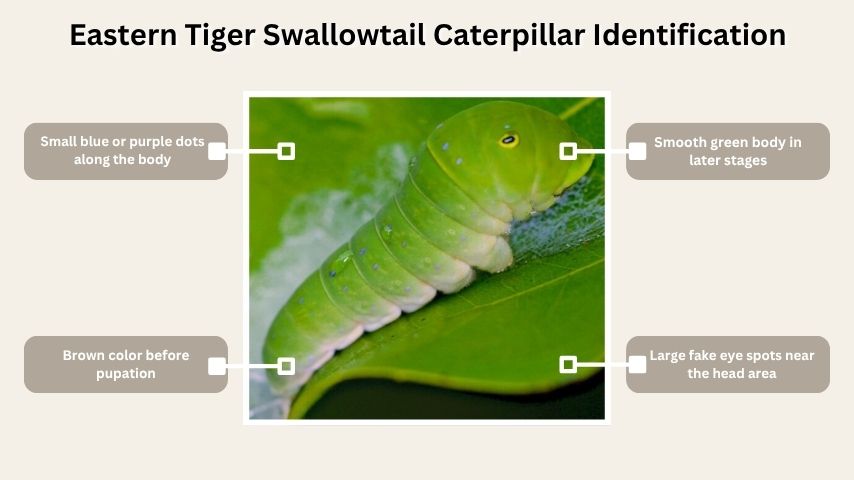
Identifying this caterpillar depends on its age. A young one may not look like the familiar green caterpillar seen in photos. As it matures, the body becomes plump and green, with eye-like markings near the front. These are not real eyes. They are defensive markings designed to make the caterpillar look larger or more threatening.
What Does It Look Like?
A mature eastern tiger swallowtail caterpillar is usually bright green with a thick, smooth body. Near the front, it has two large false eye spots outlined in yellow, black, and blue. These markings can make it look like a tiny snake or cartoon caterpillar.
Important identification features include:
- Smooth green body in later stages
- Large fake eye spots near the head area
- Small blue or purple dots along the body
- Brown color before pupation
- Folded leaf shelter on a host plant
- Plump body without hairy spines
Brown Eastern Tiger Swallowtail Caterpillar
A brown eastern tiger swallowtail caterpillar is usually either an early-stage larva or a caterpillar preparing to pupate. Young caterpillars can look dark and messy, which helps them resemble bird droppings. Before forming a chrysalis, a mature green caterpillar may also turn brownish or darker.
This color change is normal. It does not always mean the caterpillar is sick. However, a caterpillar that is limp, leaking fluid, or not attached properly may be unhealthy.
Eastern Tiger Swallowtail Caterpillar Stages
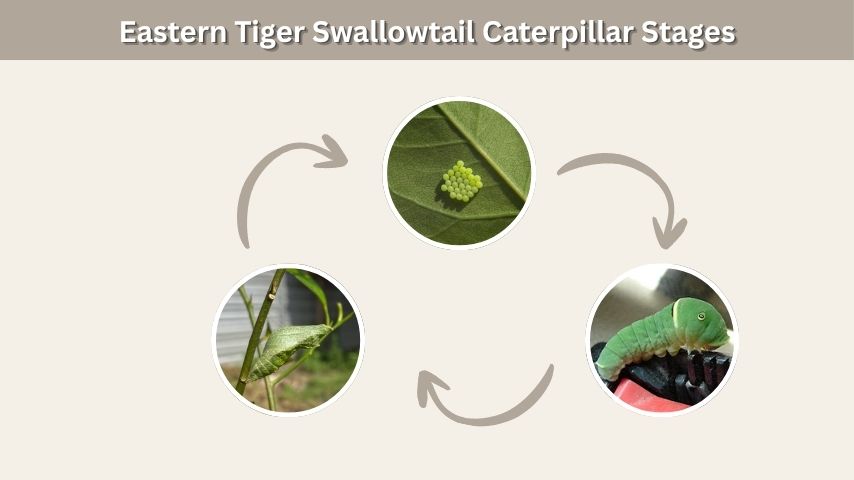
The eastern tiger swallowtail has a complete life cycle: egg, caterpillar, chrysalis, and adult butterfly. The caterpillar stage includes several molts, and each stage may look slightly different. These changes are part of normal growth. Many people confuse the early brown stage with a different insect because it looks nothing like the later green form.
Egg Stage
The life cycle begins when a female butterfly lays a small round egg on a host plant leaf. The egg is usually placed singly rather than in a large cluster. After several days, a tiny caterpillar emerges and begins feeding on the leaf.
Caterpillar Instars
The caterpillar grows through multiple instars. During early instars, it may appear dark brown or black-and-white, often resembling a bird dropping. This disguise helps protect it from birds and other predators.
Later instars become green and develop the famous fake eye spots. The caterpillar may rest on a silk pad and fold part of a leaf around itself for shelter. This behavior makes it harder to spot in trees.
Chrysalis Stage
When fully grown, the caterpillar stops feeding and looks for a safe place to pupate. It forms a chrysalis, not a cocoon. A cocoon is usually made of silk, while a swallowtail chrysalis is the hardened pupa attached by silk.
The chrysalis may be green, brown, or bark-like depending on the surroundings and season. Some chrysalises produce butterflies quickly, while others overwinter and emerge later.
Eastern Tiger Swallowtail Caterpillar Food and Host Plants
Eastern tiger swallowtail caterpillars do not eat random garden leaves. They need specific host plants that support their development. Adult butterflies drink nectar from flowers, but caterpillars feed on leaves from certain trees and shrubs. If you want to help this species, planting or protecting host trees is more useful than offering loose leaves from unknown plants.
What Do Eastern Tiger Swallowtail Caterpillars Eat?
They eat leaves from suitable host plants. Common host plants include:
- Tulip tree
- Wild black cherry
- Sweetbay magnolia
- Ash
- Birch
- Cottonwood
- Willow
- Sassafras
- Hop tree
- Other native hardwood trees in suitable areas
Best Host Plants for Gardens
For home gardens, native trees are usually the best choice. Tulip tree and wild black cherry are two of the most recognized host plants in much of the eastern United States. Sweetbay magnolia can also be useful in wetter areas and wildlife gardens.
If you find a caterpillar on a host plant, it is usually best to leave it there. Moving it to the wrong plant can cause it to stop feeding.
Eastern Tiger Swallowtail Caterpillar Habitat and Range
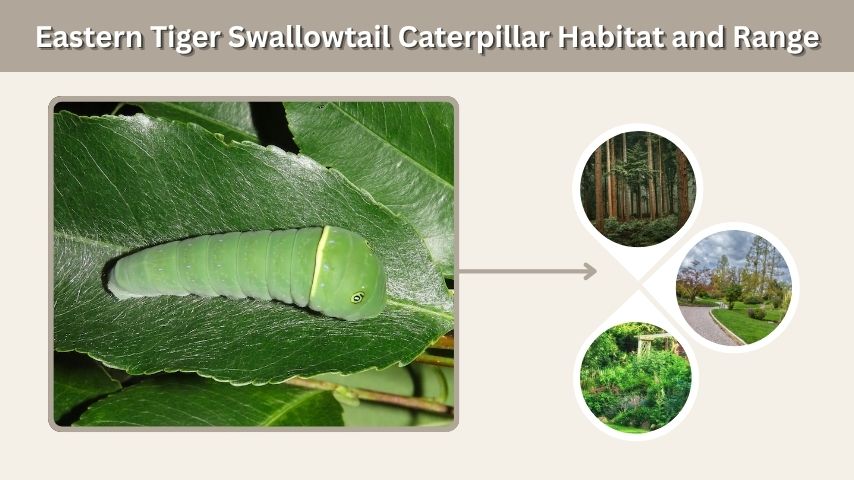
The eastern tiger swallowtail is found across much of eastern North America. Its caterpillars live wherever suitable host plants grow, including forests, woodland edges, parks, yards, roadsides, and native plant gardens. Because adults are strong flyers and use many host trees, the species is familiar in many eastern and southeastern landscapes.
Where You May Find the Caterpillar
The caterpillar is often harder to find than the butterfly. It usually stays on leaves of host trees and may hide in folded leaf shelters. Many host trees are tall, so eggs and caterpillars can be out of easy view.
Gardeners may find caterpillars on young host trees, low branches, or saplings. Look for folded leaves, feeding marks, and small droppings under the leaf area.
Eastern vs Western Tiger Swallowtail Caterpillar
Eastern and western tiger swallowtails are related and can look similar. The best way to separate them is by location, host plant, and adult butterfly range. If you are in the eastern United States, Papilio glaucus is more likely. In western regions, a western tiger swallowtail or another related species may be more likely.
Is the Eastern Tiger Swallowtail Caterpillar Poisonous?
Many people worry because the caterpillar has bold eye spots and a strange defensive organ. However, the eastern tiger swallowtail caterpillar is not considered a dangerous stinging caterpillar. It does not have venomous spines like some hairy caterpillars. Still, it should be handled gently or not handled at all.
Can You Touch It?
You can usually touch it carefully, but it is better to avoid unnecessary handling. Caterpillars are soft, fragile, and easily injured. Oils, lotions, pressure, or dropping can harm them.
If you must move one, let it crawl onto a leaf or small twig. Do not pinch or pull it from a surface. Wash your hands before and after handling.
Does It Bite or Have Teeth?
Eastern tiger swallowtail caterpillars have chewing mouthparts for eating leaves, but they are not dangerous to people. They do not bite in a harmful way. The “teeth” people search for are simply tiny feeding structures used to chew host plant leaves.
Defense and Smell
Like many swallowtail caterpillars, it can extend a forked defensive organ called an osmeterium when threatened. This organ may release a strong smell that helps discourage predators. The fake eye spots, snake-like posture, and odor all help the caterpillar survive.
How to Raise an Eastern Tiger Swallowtail Caterpillar
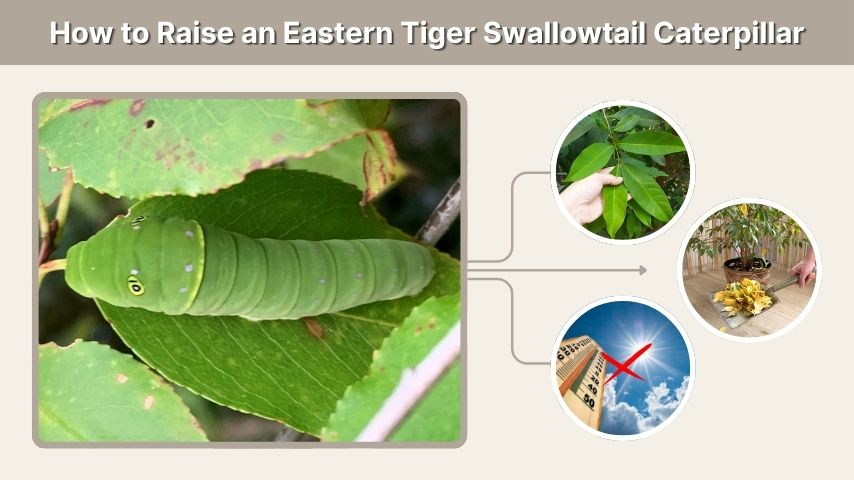
Raising one can be educational, but it requires fresh host plant leaves, cleanliness, airflow, and patience. The safest approach is to raise only caterpillars found naturally on a known host plant. Avoid buying caterpillars from questionable sellers, and never release butterflies far from where they were found.
Basic Care Tips
Use these simple care guidelines:
- Identify the exact host plant first
- Provide fresh leaves from the same plant species
- Keep the container clean and dry
- Remove old leaves and droppings daily
- Provide ventilation, not a sealed jar
- Avoid direct hot sun
- Give the caterpillar space to pupate
- Do not disturb the chrysalis
What to Feed It
Feed only leaves from the correct host plant. If the caterpillar was found on tulip tree, continue using tulip tree leaves. If it was found on wild cherry, continue using wild cherry leaves. Sudden host changes may cause feeding problems.
Do not feed lettuce, grass, fruit, or random ornamental leaves. These foods are not suitable for eastern tiger swallowtail caterpillars.
Eastern Tiger Swallowtail Caterpillar and Caterpie
Many people compare the eastern tiger swallowtail caterpillar to Caterpie from Pokémon. The connection makes sense because both have a soft green body, large eye-like features, and a cute cartoon look. However, Caterpie is a fictional character, while the eastern tiger swallowtail caterpillar is a real butterfly larva with specific host plant needs.
Is Caterpie Based on This Caterpillar?
Caterpie appears to be inspired by swallowtail-type caterpillars in general. The eastern tiger swallowtail caterpillar is one real insect that strongly resembles the idea because of its green body and false eye markings. Other swallowtail caterpillars also share similar defensive features, so it is better to describe Caterpie as swallowtail-inspired rather than based on only one species.
FAQs
What does an eastern tiger swallowtail caterpillar look like?
A mature eastern tiger swallowtail caterpillar is usually green, smooth, and plump with large false eye spots near the front. Younger caterpillars may look brown, dark, or bird-dropping-like. Before forming a chrysalis, the caterpillar may turn brown again.
What do eastern tiger swallowtail caterpillars eat?
They eat leaves from specific host plants, especially native trees. Common food plants include tulip tree, wild black cherry, sweetbay magnolia, ash, birch, willow, cottonwood, sassafras, and hop tree. They should not be fed lettuce, fruit, grass, or random leaves.
Is the eastern tiger swallowtail caterpillar poisonous?
No, it is not considered a poisonous or stinging caterpillar. It does not have dangerous venomous spines. However, it may release a strong smell from a defensive organ when threatened. It is best to observe it gently and avoid rough handling.
Can you touch an eastern tiger swallowtail caterpillar?
You can touch it gently, but it is better to let it crawl onto a leaf or twig instead of picking it up. Caterpillars are soft and easy to injure. Always wash your hands before and after handling any caterpillar.
What is the chrysalis of an eastern tiger swallowtail like?
The chrysalis is the pupa stage between caterpillar and butterfly. It may look green, brown, or bark-like and is attached with silk. Some adults emerge after a short period in warm weather, while others remain in chrysalis through winter.