
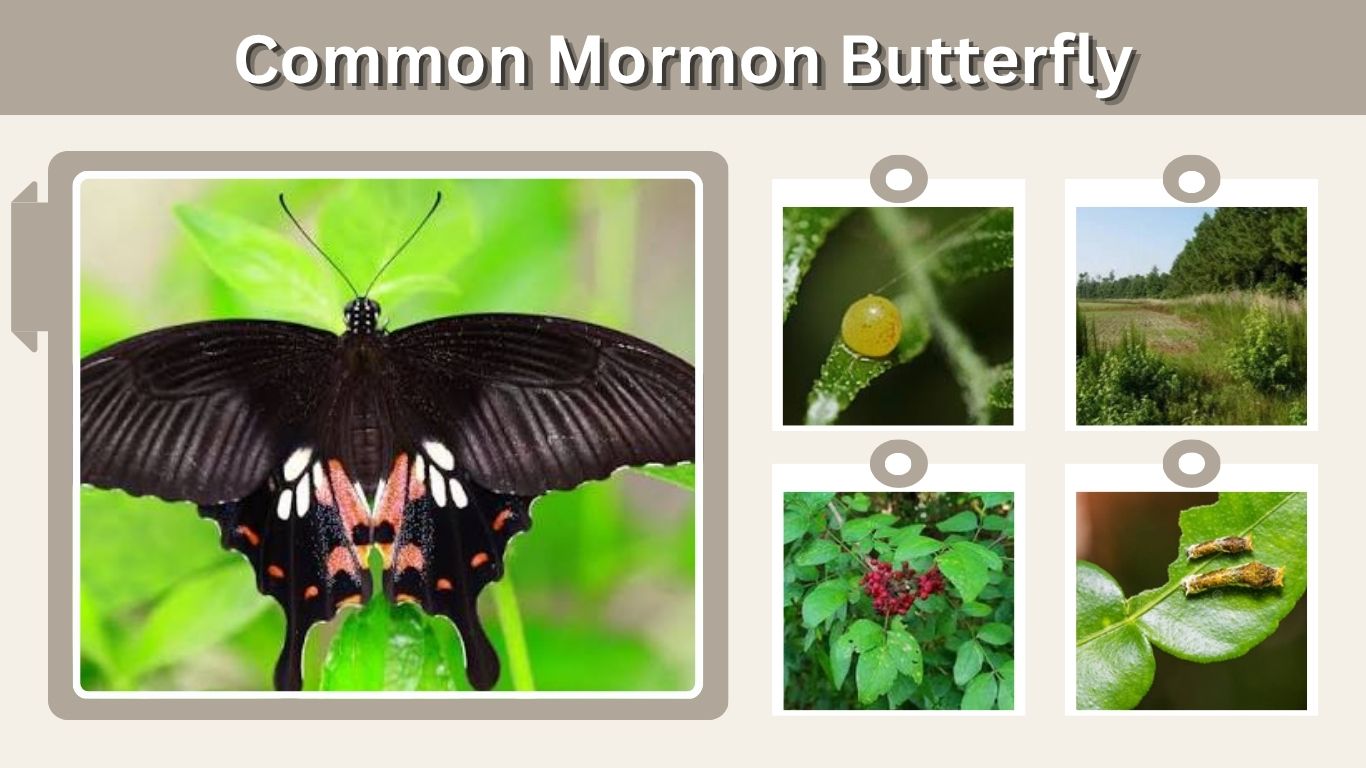
The common Mormon butterfly is a widespread Asian swallowtail recognized by its black wings, creamy-white markings, and long hindwing tails. Its scientific name is Papilio polytes. Males have a fairly consistent appearance, while females occur in several forms—some resemble males and others imitate unpalatable red-bodied swallowtails. Common Mormons frequently visit gardens, parks, forests, and agricultural areas where citrus and curry leaf plants grow.
Common Mormon Butterfly Quick Facts
| Feature | Description |
| Scientific name | Papilio polytes |
| Family | Papilionidae |
| Order | Lepidoptera |
| Wingspan | Commonly around 8 cm |
| Main color | Black with white, cream, or red markings |
| Distribution | South, East, and Southeast Asia |
| Habitat | Gardens, parks, forests, farms, and urban areas |
| Caterpillar food | Citrus, curry leaf, bael, and other Rutaceae |
| Adult food | Flower nectar and mineral-rich moisture |
| Life-cycle stages | Egg, caterpillar, pupa, and adult |
Several subspecies occur across the butterfly’s range. Indian populations include the Indian common Mormon, Papilio polytes romulus, as well as forms associated with the Andaman and Nicobar Islands.
What Does a Common Mormon Butterfly Look Like?
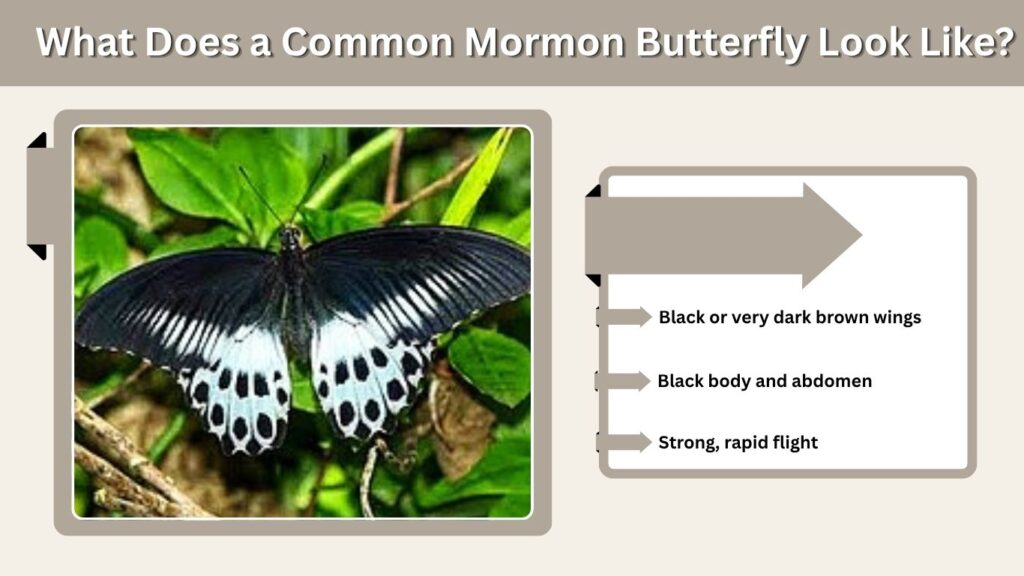
The common Mormon is a medium-to-large swallowtail with predominantly black wings. Each hindwing has a short, broad tail, and pale markings form a broken band across the wings. The exact pattern depends strongly on the butterfly’s sex and the female form.
Identification Features
- Black or very dark brown wings
- Creamy-white band or patches across the hindwings
- Short, spoon-shaped tail on each hindwing
- Black body and abdomen
- Scalloped outer edges on the hindwings
- Strong, rapid flight
- Wingspan commonly close to 8 cm
- Red hindwing markings on some females
The species can be found in forests and nature reserves, but it also adapts well to gardens, urban parks, and other developed areas containing flowers and larval host plants.
Male and Female Common Mormon Butterflies
Male and female common Mormons can look dramatically different. The male has one main pattern, whereas females are polymorphic, meaning that more than one female wing pattern occurs within the species.
Male Common Mormon Butterfly
The male has black forewings and hindwings. A row of elongated creamy-white spots crosses the hindwings and may continue as smaller spots toward the forewings. Small pale marks may also appear near the outer margins.
Male common Mormons often fly quickly through gardens and open spaces while searching for flowers and females. They may also visit damp soil to absorb moisture and dissolved minerals.
Female Common Mormon Butterfly
Female common Mormons occur in both non-mimetic and mimetic forms.
The non-mimetic form, often called form cyrus, looks similar to the male. It has black wings with a broad white band but may be larger and have slightly broader wings.
The mimetic form, often called form polytes, has prominent white patches and red markings on the hindwings. It resembles the unpalatable common rose butterfly, which can discourage predators from attacking it. In some parts of the species’ range, female forms may also resemble other red-bodied swallowtails.
Research has shown that this female-limited mimicry is controlled largely by variation involving the doublesex gene and an associated chromosomal region. Males do not display the same mimetic patterns.
Common Mormon Butterfly in India
The common Mormon is widely distributed in India and is regularly encountered in gardens, towns, woodland edges, farms, and forested habitats. Its ability to use cultivated citrus and curry leaf plants allows it to survive near human settlements.
Recognized Indian subspecies include:
- Papilio polytes romulus — Indian common Mormon
- Papilio polytes stichioides — Andaman common Mormon
- Papilio polytes nikobarus — Nicobar common Mormon
The butterfly is not currently listed as a legally protected Indian species under the schedules noted by Butterflies of India.
Common Mormon Butterfly Habitat
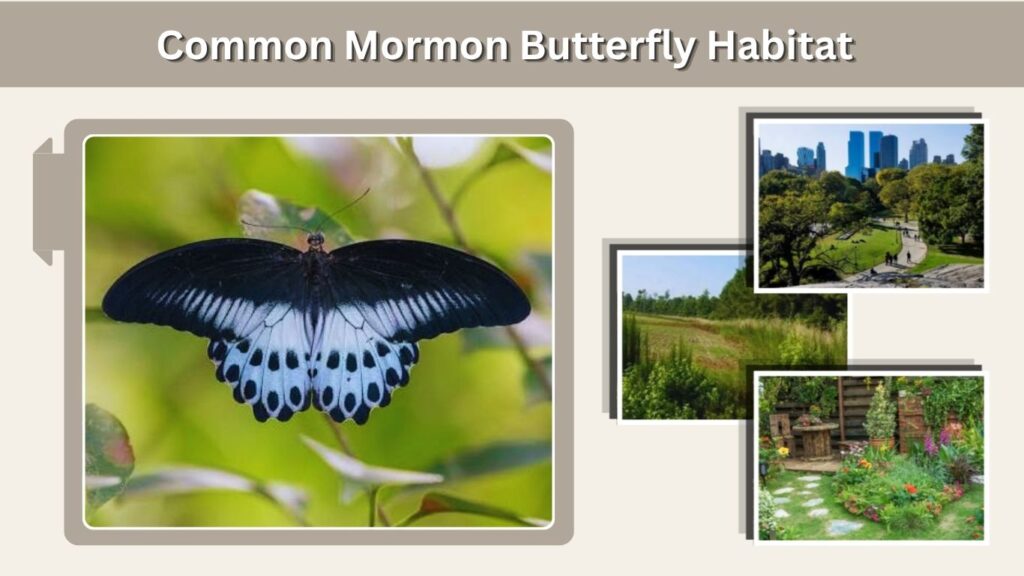
Common Mormons live in a wide range of warm habitats. They may be found in:
- Home gardens
- Urban parks
- Forest edges
- Nature reserves
- Open woodland
- Scrubland
- Orchards
- Agricultural fields
- Roadsides with flowering plants
Adults need flowers for nectar, while breeding females require suitable citrus-family plants on which to deposit their eggs. Singapore’s National Parks describes the species as common in parks, gardens, urban areas, forests, and nature reserves.
What Do Common Mormon Butterflies Eat?
Adult common Mormons drink nectar using a long, coiled proboscis. They visit many kinds of flowers and may feed while holding their wings partly open or continuously fluttering.
Males may also gather on wet ground, stream edges, or muddy paths. This behavior, called mud-puddling, allows them to obtain water and minerals that are scarce in flower nectar.
The caterpillar does not eat the same food as the adult. It feeds exclusively on leaves from suitable host plants.
Common Mormon Butterfly Host Plants
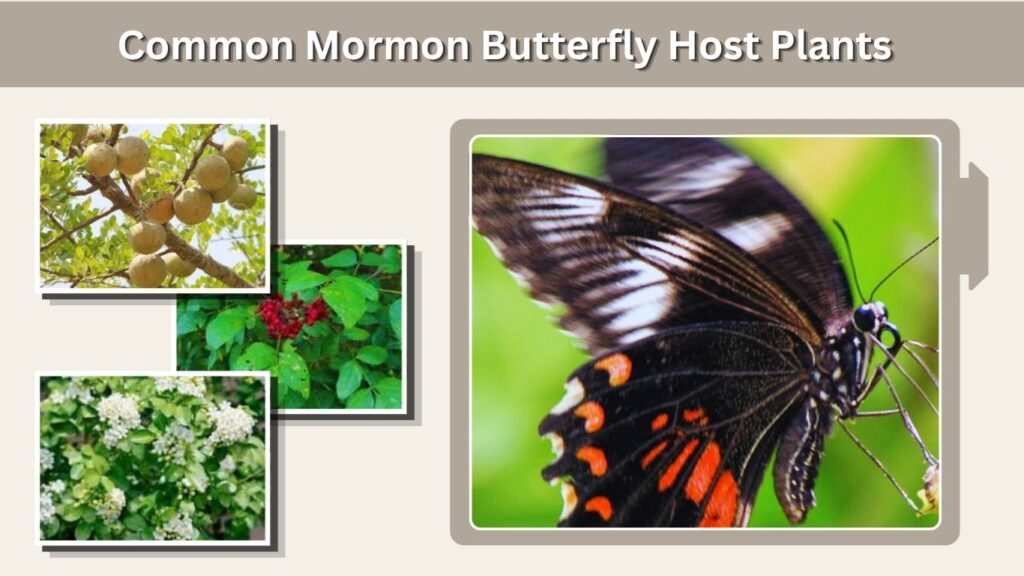
Common Mormon caterpillars primarily feed on plants in the citrus family, Rutaceae. Commonly recorded host plants include:
- Lime and lemon
- Orange and other Citrus species
- Curry leaf plant
- Bael
- Orange jasmine
- Prickly ash
- Glycosmis species
- Atalantia species
Scientific studies have confirmed that larval growth and development can differ depending on the host plant. Citrus species and curry leaf plants are among the most frequently documented choices.
Common Mormon Butterfly Caterpillar
The common Mormon caterpillar changes significantly as it grows.
Early Caterpillar
A newly hatched caterpillar is small, dark, and unevenly marked with white or cream. Its appearance resembles a bird dropping, which helps it remain unnoticed on a leaf.
The young caterpillar begins by eating part of its eggshell before feeding on tender host-plant leaves. It passes through several developmental stages called instars, shedding its outer skin between each one.
Mature Caterpillar
The final-stage caterpillar becomes green and develops pale diagonal or curved markings. The enlarged area behind its head carries false eyespots, giving it a snake-like appearance that may frighten small predators.
Like other swallowtail caterpillars, it possesses an osmeterium—a forked defensive organ hidden behind the head. When threatened, the caterpillar extends this organ and releases a strong smell.
Common Mormon Butterfly Pupa
When fully grown, the caterpillar leaves its feeding location and selects a protected stem, twig, wall, or other surface. It attaches itself using a silk pad at the rear and a narrow silk girdle around the middle of its body.
The pupa, or chrysalis, may be green or brown. These colors help it blend with leaves, stems, bark, and surrounding surfaces. Research on Papilio polytes shows that environmental conditions experienced around pupation influence whether a green or brown pupa develops.
The chrysalis does not eat or move from place to place. Inside it, larval tissues reorganize and the adult butterfly develops. Under controlled warm conditions, one study recorded adults emerging approximately 12 days after pupation, although outdoor development varies with temperature, season, and local climate.
Common Mormon Butterfly Life Cycle
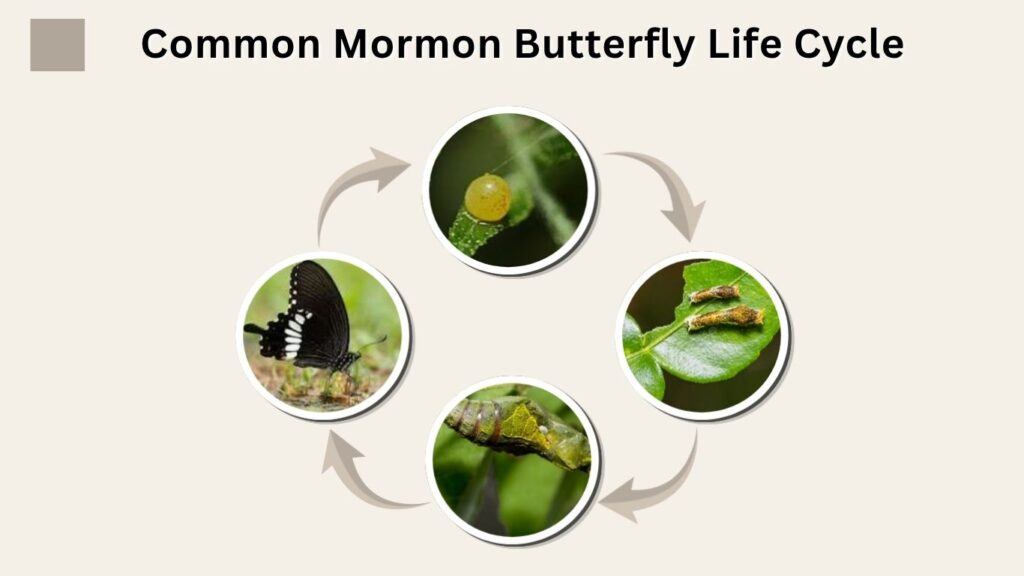
The common Mormon undergoes complete metamorphosis through four stages.
1. Egg
The female places small, rounded eggs individually on young leaves or stems of a suitable host plant. Eggs are usually pale when newly laid and darken before hatching.
2. Caterpillar
The caterpillar feeds on host-plant leaves and grows through several instars. Young caterpillars resemble bird droppings, while mature larvae become green and develop false eyespots.
3. Pupa
The mature caterpillar forms a green or brown chrysalis held in place by silk. The adult body develops inside this protective case.
4. Adult
The adult splits the pupal case, emerges, and hangs nearby while its wings expand and harden. Once capable of flight, it searches for nectar, mates, and begins another generation.
Laboratory studies have recorded the egg-to-adult period at roughly 26–43 days under different conditions. However, host plant, temperature, humidity, season, and location can considerably alter development time.
Common Mormon Butterfly vs Crimson Rose
The mimetic female common Mormon may be confused with the crimson rose or common rose.
| Feature | Common Mormon Female | Crimson or Common Rose |
| Abdomen | Entirely black | Usually red or partly red |
| Wing markings | White patches with red spots | White patches and stronger red markings |
| Host plants | Citrus-family plants | Birthwort-family plants |
| Caterpillar appearance | Green when mature | Dark with fleshy red or white projections |
| Palatability | Generally treated as the mimic | Unpalatable model |
The abdomen provides one of the easiest identification clues. A mimetic common Mormon retains a black body, while the common rose has a conspicuously red abdomen.
FAQs
Is the common Mormon butterfly poisonous?
The common Mormon is not considered dangerous to people. Some females imitate unpalatable swallowtails, gaining protection because predators may mistake them for species that are unpleasant to eat.
What is the scientific name of the common Mormon?
Its scientific name is Papilio polytes. It belongs to the swallowtail family Papilionidae and has several recognized subspecies across Asia.
What plants attract common Mormon butterflies?
Flowering plants provide nectar for adults. Citrus, lemon, lime, curry leaf, bael, orange jasmine, and related Rutaceae plants can attract egg-laying females because their caterpillars eat the leaves.
Does a common Mormon caterpillar damage citrus plants?
Several caterpillars can remove noticeable foliage from a small citrus or curry leaf plant. Established plants generally recover, and hand removal is usually sufficient when plant protection is necessary.
How long does a common Mormon butterfly live?
There is no single fixed lifespan. Development and adult longevity depend on temperature, season, nutrition, host-plant quality, predators, and environmental conditions. Most of the rapid growth from egg to adult occurs over several weeks in warm conditions.