
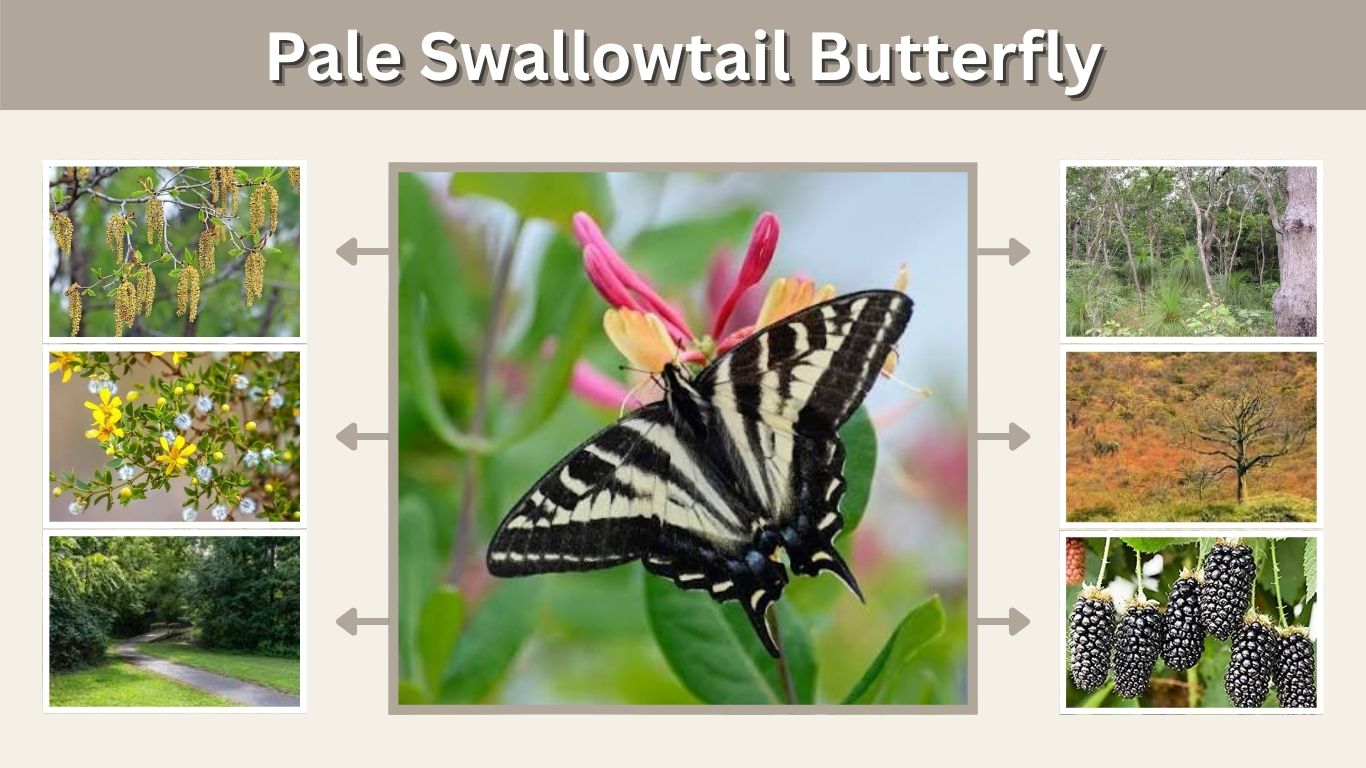
The Pale Swallowtail is a striking western North American butterfly with creamy white wings, bold black stripes, and long tails. Scientifically known as Papilio eurymedon, it is also called the Pale Tiger Swallowtail or Pallid Tiger Swallowtail. Adults inhabit foothills, open woodlands, chaparral, and stream corridors, where they visit flowers for nectar. Although it resembles the Western Tiger Swallowtail, its much paler wings make it one of the easiest western swallowtails to recognize.
What Is a Pale Swallowtail?
The Pale Swallowtail belongs to the swallowtail family Papilionidae. Its accepted scientific name is Papilio eurymedon, though some classifications place it in the genus Pterourus as Pterourus eurymedon. Its wingspan generally ranges from 2½ to 3½ inches, or approximately 6.4–9 centimeters.
| Feature | Description |
| Scientific name | Papilio eurymedon |
| Other names | Pale Tiger Swallowtail, Pallid Tiger Swallowtail |
| Family | Papilionidae |
| Wingspan | About 2½–3½ inches |
| Main colors | Creamy white and black |
| Caterpillar diet | Leaves of selected trees and shrubs |
| Adult diet | Flower nectar and mineral-rich moisture |
| Range | Western North America |
| Winter stage | Chrysalis or pupa |
Pale Swallowtail Identification
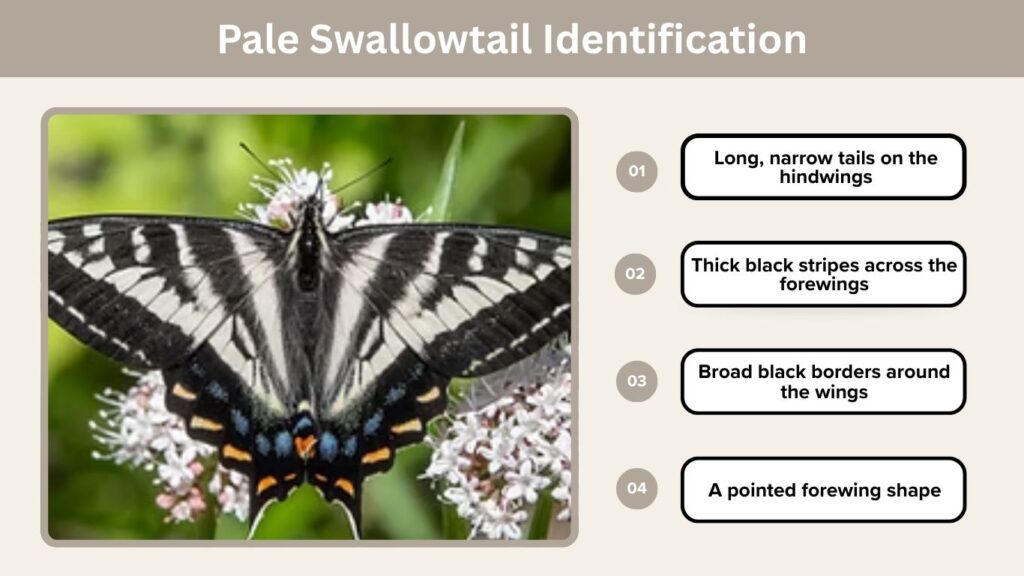
The Pale Swallowtail has creamy white wings crossed by thick black tiger-like stripes. Its forewings are relatively narrow and pointed, while each hindwing carries a long, slender tail that may appear slightly curved or twisted.
Key Identification Features
Look for these characteristics:
- Creamy white rather than bright yellow wings
- Thick black stripes across the forewings
- Broad black borders around the wings
- Long, narrow tails on the hindwings
- Blue markings near the hindwing margins
- Small orange spots near the base of the tails
- A pointed forewing shape
- A dark body with pale lengthwise stripes
The Pale Swallowtail is sometimes described as the only strongly black-and-white swallowtail across much of western North America. However, faded individuals and photographs taken in unusual lighting may make identification more difficult.
Male and Female Pale Swallowtails
Male and female Pale Swallowtails have similar creamy white and black wing patterns. Differences between the sexes are usually more subtle than in some tiger swallowtails.
Male Pale Swallowtail
Males commonly patrol hillsides, forest openings, ridges, and stream corridors while searching for females. They may gather on damp soil or mud to absorb water, salts, and other dissolved minerals.
This behavior is called puddling. Groups of males may sometimes gather closely together around moist ground.
Female Pale Swallowtail
Females spend more time searching for suitable caterpillar host plants. They lay their eggs individually on leaves rather than depositing them in large clusters. Females may appear slightly larger or broader-bodied because of the eggs carried in the abdomen.
Pale Swallowtail Caterpillar
The Pale Swallowtail caterpillar changes significantly as it develops. Young caterpillars may resemble bird droppings, helping them avoid attention from birds and other predators.
Older larvae become green and develop large false eyespots near the front of the body. These markings create the appearance of a snake-like head, although the caterpillar’s actual head is much smaller.
A mature caterpillar usually rests on a silken mat constructed on a leaf. It may partially curl or draw the leaf around its resting place, providing additional concealment. Pale Swallowtail larvae closely resemble Western Tiger Swallowtail caterpillars, but the details of the false eyespots can differ.
Caterpillar Defense
When threatened, the caterpillar may extend a forked organ called an osmeterium from behind its head. This organ releases a strong odor intended to discourage predators.
The osmeterium is defensive and does not function as a stinger. Pale Swallowtail caterpillars are not dangerous to people.
Pale Swallowtail Host Plants
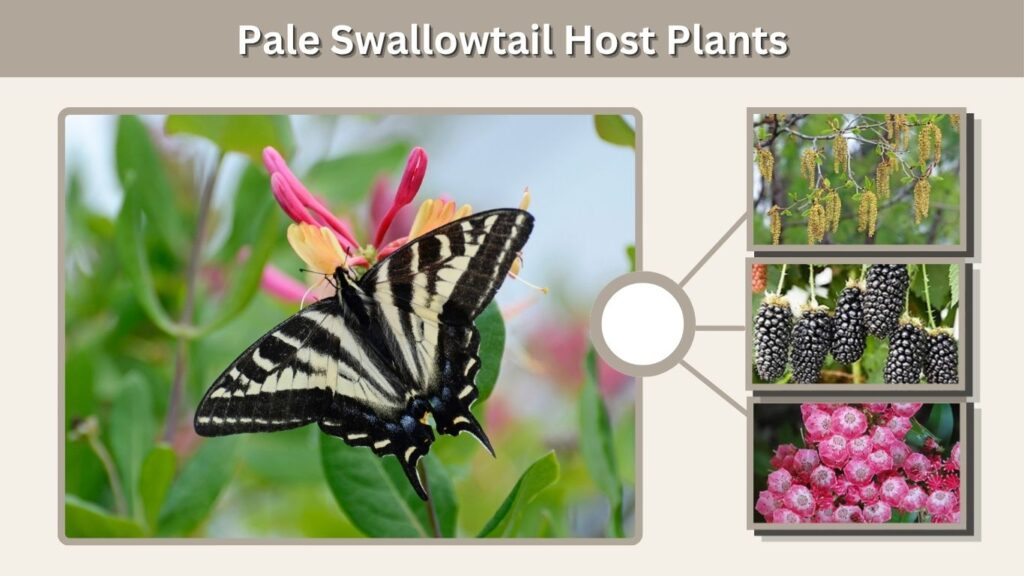
Female Pale Swallowtails select woody plants on which their caterpillars can feed. Documented hosts come from several plant families, including Rosaceae, Rhamnaceae, Oleaceae, and Betulaceae.
Common Host Plants
Known or reported caterpillar food plants include:
- Bitter cherry
- Hollyleaf cherry
- California coffeeberry
- Ceanothus or mountain lilac
- Ash
- Alder
- Other related woody trees and shrubs
Host availability varies across the butterfly’s range. A plant used in California may not be the primary host in British Columbia, Montana, Utah, or New Mexico.
Gardeners hoping to support Pale Swallowtails should choose host plants native to their local region and avoid applying broad-spectrum insecticides to the leaves.
What Do Adult Pale Swallowtails Eat?
Adult Pale Swallowtails drink liquid food through a long, coiled proboscis. They visit flowers for nectar and may feed from California buckeye, wallflower, yerba santa, thistles, and other flowering plants.
Males also visit wet soil, mud, and stream edges. Minerals gathered during puddling may support reproduction and can be transferred to females during mating.
Habitat and Range
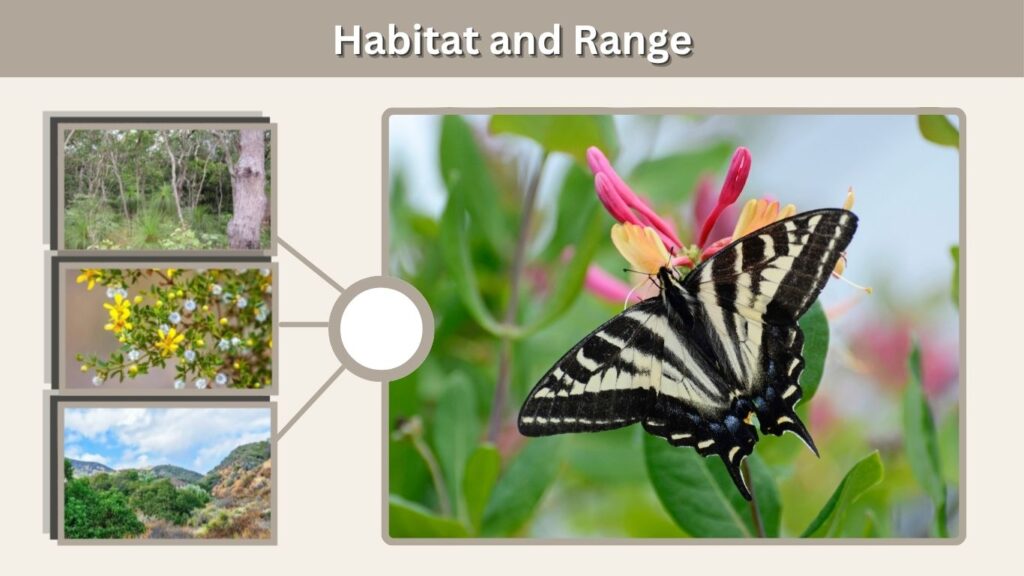
Pale Swallowtails inhabit western North America. Their range extends from British Columbia south through California and Baja California, and east through parts of Montana and the mountainous Southwest to New Mexico.
They may be found in:
- Foothills
- Open woodlands
- Chaparral
- Canyons
- Stream corridors
- Forest clearings
- Rocky slopes
- Mountain valleys
- Gardens near natural habitat
The species occurs in California and may also be observed in Utah, Wyoming, Oregon, Washington, Idaho, Montana, Colorado, and other western areas where habitat and host plants are available. It is generally associated with foothills and middle elevations rather than the highest alpine environments.
Pale Swallowtail Life Cycle
The Pale Swallowtail undergoes complete metamorphosis through four stages: egg, caterpillar, chrysalis, and adult.
Egg and Caterpillar
Females lay eggs individually on host-plant leaves. After hatching, the caterpillar eats the foliage and molts repeatedly as it grows.
Chrysalis
The mature caterpillar leaves its feeding site and forms a chrysalis attached to a sheltered surface. The species commonly overwinters as a pupa, with the adult emerging when conditions become suitable the following spring.
Adult Flight Season
Across northern parts of the range, Pale Swallowtails generally have one annual flight from approximately April through July. Southern California may support several flights, with adults appearing from March into August.
Pale Swallowtail vs. Western Tiger Swallowtail
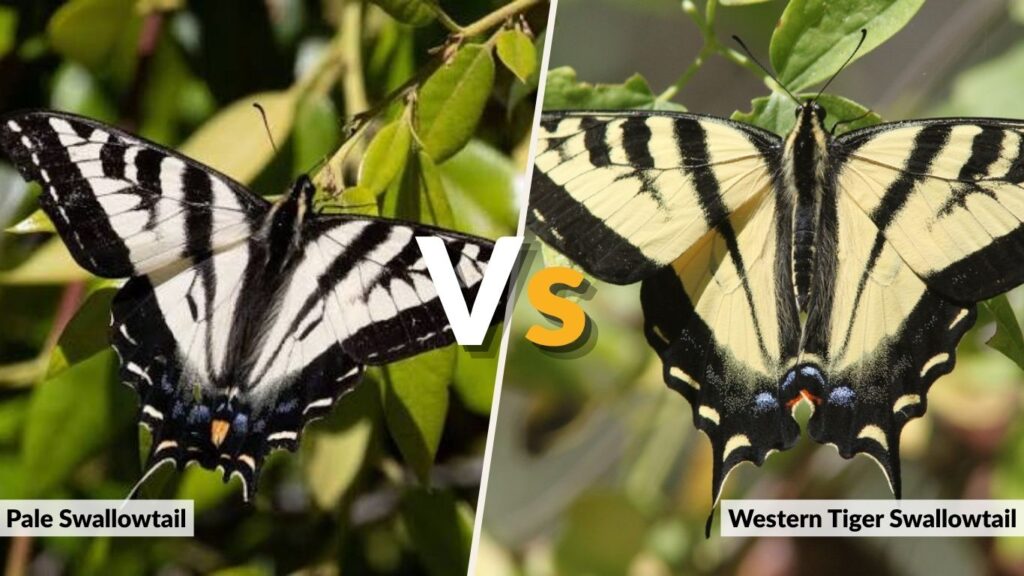
The Pale Swallowtail is often confused with the Western Tiger Swallowtail because both have dark tiger stripes and long hindwing tails.
| Feature | Pale Swallowtail | Western Tiger Swallowtail |
| Scientific name | Papilio eurymedon | Papilio rutulus |
| Main wing color | Creamy white | Bright yellow |
| Black markings | Thick and strongly contrasting | Black stripes over yellow |
| Forewing shape | Narrower and more pointed | Slightly broader |
| Caterpillar | Green with false eyespots | Similar green caterpillar |
| Typical habitat | Foothills, chaparral, woodland and streamsides | Woodlands, cities, gardens and river valleys |
Wing color is normally the quickest distinction. A fresh Pale Swallowtail is white or cream, whereas the Western Tiger Swallowtail is distinctly yellow.
Pale Swallowtail vs. Black Swallowtail
The Black Swallowtail is primarily black with rows of yellow spots and lacks the Pale Swallowtail’s broad creamy white bands. It is also more strongly associated with parsley-family host plants, whereas Pale Swallowtail caterpillars feed on woody trees and shrubs.
The two butterflies have very different ranges and patterns, so adults are unlikely to be confused when seen clearly.
FAQs
Is the Pale Swallowtail the same as the Canadian Tiger Swallowtail?
No. The Canadian Tiger Swallowtail is Papilio canadensis and has yellow wings with black stripes. The Pale Swallowtail is Papilio eurymedon and has creamy white wings. Their ranges may approach one another in parts of western Canada, but they are separate species.
Is the Pale Swallowtail rare?
The species is considered globally secure, although it may be uncommon or locally rare near the edges of its range. Its visibility also changes according to season, weather, elevation, host-plant availability, and the condition of local woodland and streamside habitats.
Can Pale Swallowtails be found in California?
Yes. California is an important part of the species’ range. Pale Swallowtails occur in suitable chaparral, foothill, woodland, canyon, and streamside habitats. Southern California may produce multiple adult flights between early spring and late summer.
Are Pale Swallowtail caterpillars poisonous?
They are not considered dangerous to humans. A threatened caterpillar may display a foul-smelling osmeterium, but it cannot sting. Avoid handling it unnecessarily because pressure and repeated disturbance can injure the caterpillar.
How can you attract Pale Swallowtails?
Grow locally native host plants such as cherry, coffeeberry, ceanothus, ash, or alder where appropriate. Add nectar-rich flowers, leave a small area of damp soil for puddling, and avoid using broad-spectrum pesticides that could kill eggs, caterpillars, or adult butterflies.