
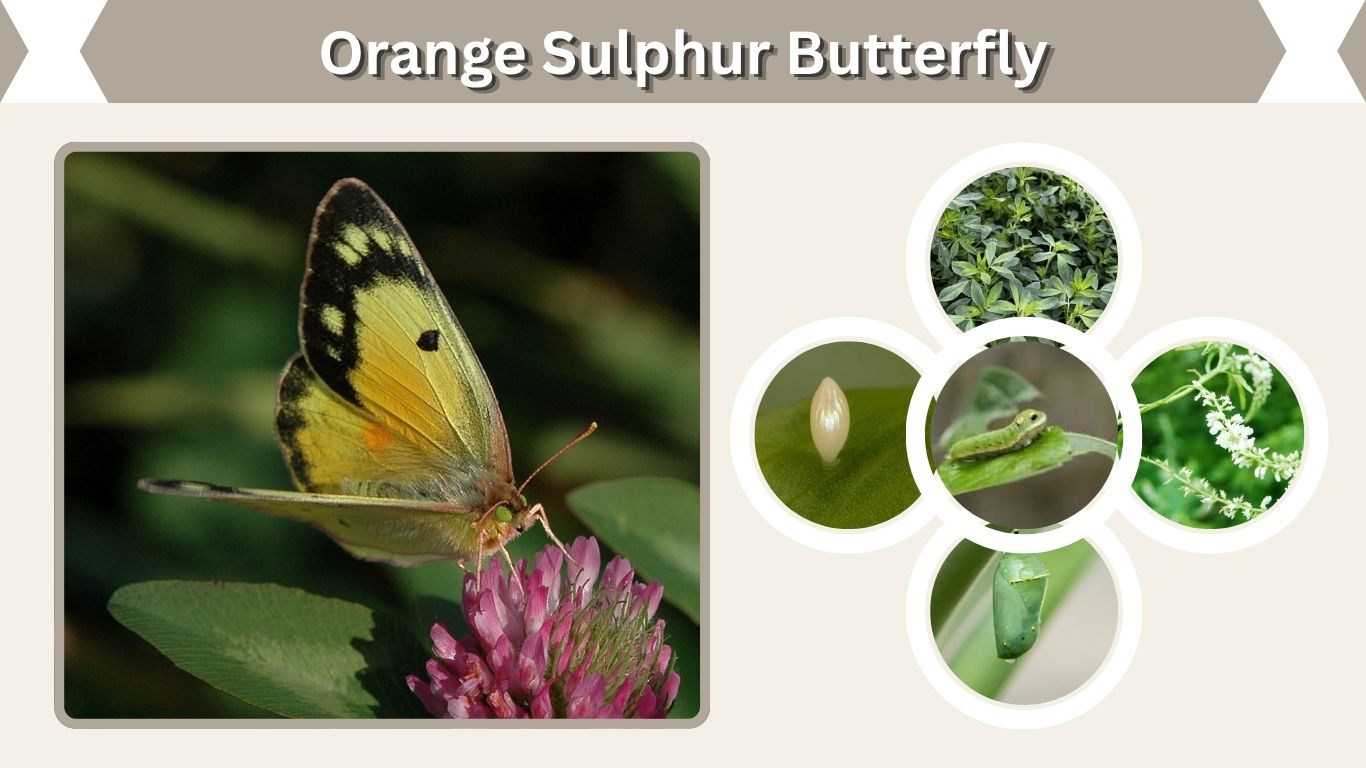
The orange sulphur butterfly is a fast-flying yellow-orange butterfly commonly seen over alfalfa fields, meadows, roadsides, and gardens. Also called the alfalfa butterfly, it is recognizable by the orange coloring on its upper wings, dark borders, and quick, low flight. However, it closely resembles the clouded sulphur, and the two species can be difficult to separate when their wings are closed.
What Is an Orange Sulphur Butterfly?
The orange sulphur, scientifically known as Colias eurytheme, belongs to the Pieridae family of whites and sulphurs. It is a widespread North American butterfly closely associated with clover, alfalfa, vetch, and other plants in the pea family.
| Feature | Description |
| Scientific name | Colias eurytheme |
| Other name | Alfalfa butterfly |
| Family | Pieridae |
| Wingspan | About 1½–2½ inches |
| Main color | Yellow with orange or golden shading |
| Caterpillar hosts | Alfalfa, clover, vetch and other legumes |
| Habitat | Meadows, pastures, fields, roadsides and gardens |
Orange Sulphur Butterfly Identification
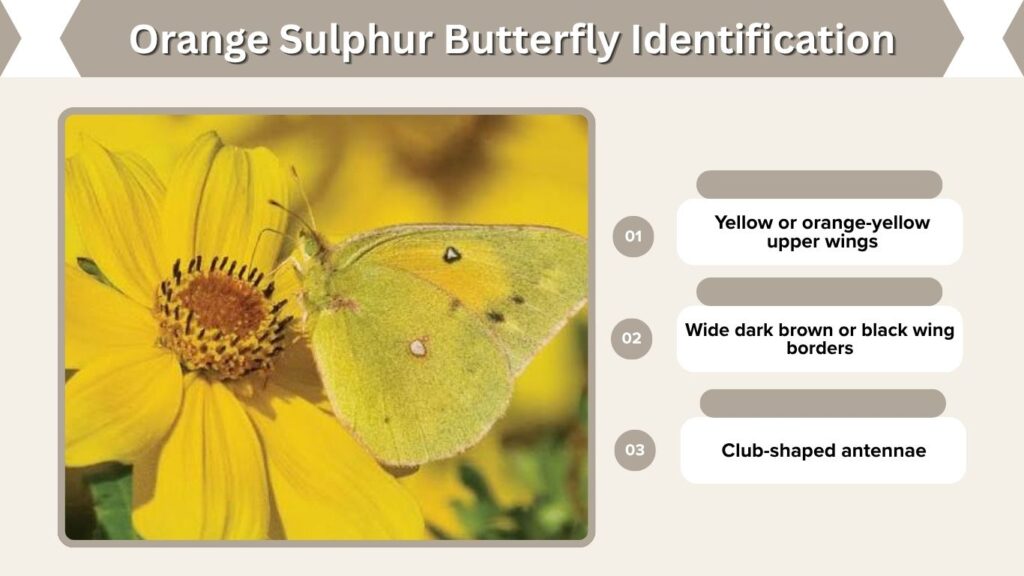
Orange sulphurs are highly variable. Some individuals are richly orange, while others appear mostly yellow with only a small orange patch. Because they usually land with their wings closed, the most important orange markings may only be visible while the butterfly is flying.
Key Identification Features
- Yellow or orange-yellow upper wings
- Orange or golden coloring near the center of the wings
- Wide dark brown or black wing borders
- A black spot near the center of each forewing
- An orange spot near the center of each hindwing
- Yellowish or greenish-yellow undersides
- A silver hindwing spot surrounded by reddish rings
- Club-shaped antennae
- Wingspan of approximately 1½–2½ inches
The simplest identification clue is the presence of at least some orange or gold on the upper wing surface.
Male vs Female Orange Sulphur
Male orange sulphurs usually have solid black borders around their upper wings. Females have broader, less even borders containing yellow spots.
Some females occur in a pale white form called alba. These females may look white, cream, or greenish rather than orange. White-form orange sulphurs are nearly impossible to separate from white-form clouded sulphurs in the field.
Orange Sulphur Caterpillar
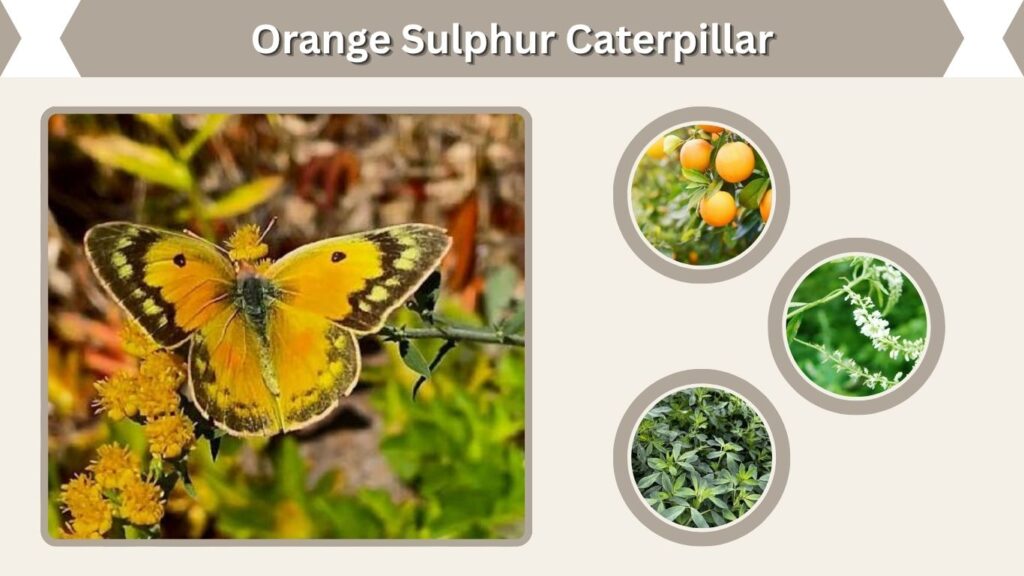
The orange sulphur caterpillar is designed to blend into the green leaves and stems of its food plants. It is smooth-bodied and lacks the spines or hairs found on many other caterpillars.
What Does the Caterpillar Look Like?
The caterpillar is usually grass green or dark green. A pale stripe runs along each side of its body and may include white, pink, red, yellow, or black markings.
Orange sulphur caterpillars look almost identical to clouded sulphur caterpillars. Identifying the species from the caterpillar alone is therefore unreliable unless the adult is raised and observed.
What Do Orange Sulphur Caterpillars Eat?
The caterpillars feed mainly on members of the pea family, including:
- Alfalfa
- White clover
- Red clover
- Sweet clover
- Vetches
- Other herbaceous legumes
Large populations can occasionally damage commercial alfalfa fields, which explains why the species was historically called the alfalfa butterfly.
Orange Sulphur Life Cycle
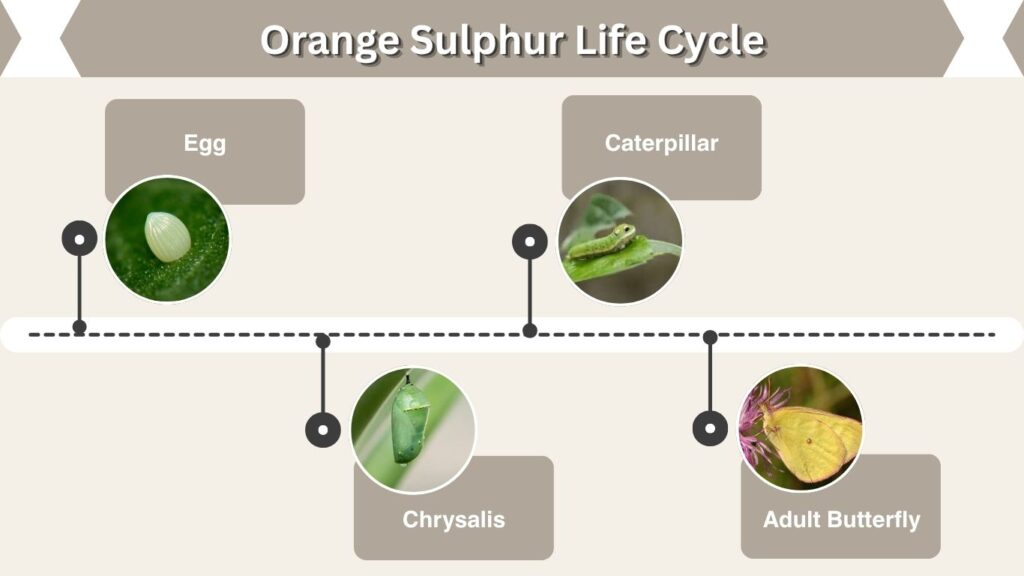
Orange sulphurs undergo complete metamorphosis through four stages: egg, caterpillar, chrysalis, and adult. Several generations may develop during one warm season, depending on the local climate.
Egg
The female lays small spindle-shaped eggs individually on the leaves of suitable host plants. Newly laid eggs are white or cream-colored but gradually become orange-red or crimson before hatching.
Eggs may hatch within four or five days during warm weather.
Caterpillar
After hatching, the young caterpillar begins eating its host plant. It grows through several stages called instars and may feed primarily at night.
The larval stage generally lasts several weeks. Its green coloring and pale side stripe provide camouflage against clover, alfalfa, and vetch foliage.
Chrysalis
The mature caterpillar forms a green chrysalis marked with small yellow and black lines or dashes. It attaches itself upright to a plant stem or another suitable surface.
In many northern locations, the chrysalis is the main overwintering stage. However, the stage in which the butterfly survives winter can vary according to climate and location.
Adult Butterfly
An adult emerges from the chrysalis, expands its wings, and soon begins searching for nectar and potential mates. Orange sulphurs can produce as many as four broods between spring and late summer in suitable climates. Adults that do not overwinter generally live for only a few weeks.
Orange Sulphur Butterfly Habitat and Range
Orange sulphurs favor open, sunny environments containing low-growing vegetation and abundant flowers. They are especially common where alfalfa, clover, or other legumes grow.
Typical habitats include:
- Alfalfa and clover fields
- Meadows and pastures
- Agricultural land
- Roadsides
- Vacant lots
- Lawns and gardens
- Prairies and open mountain meadows
The species occurs across much of North America, from southern Canada through the United States and into central or southern Mexico.
What Do Adult Orange Sulphur Butterflies Eat?
Adult orange sulphurs drink nectar rather than eating leaves. They use a long, coiled feeding tube called a proboscis to reach nectar inside flowers.
Common nectar sources include alfalfa, clover, milkweed, goldenrod, asters, dandelions and other meadow flowers. Males may also gather on wet soil to absorb moisture, salts and dissolved minerals through a behavior known as mud-puddling.
Orange Sulphur vs Clouded Sulphur
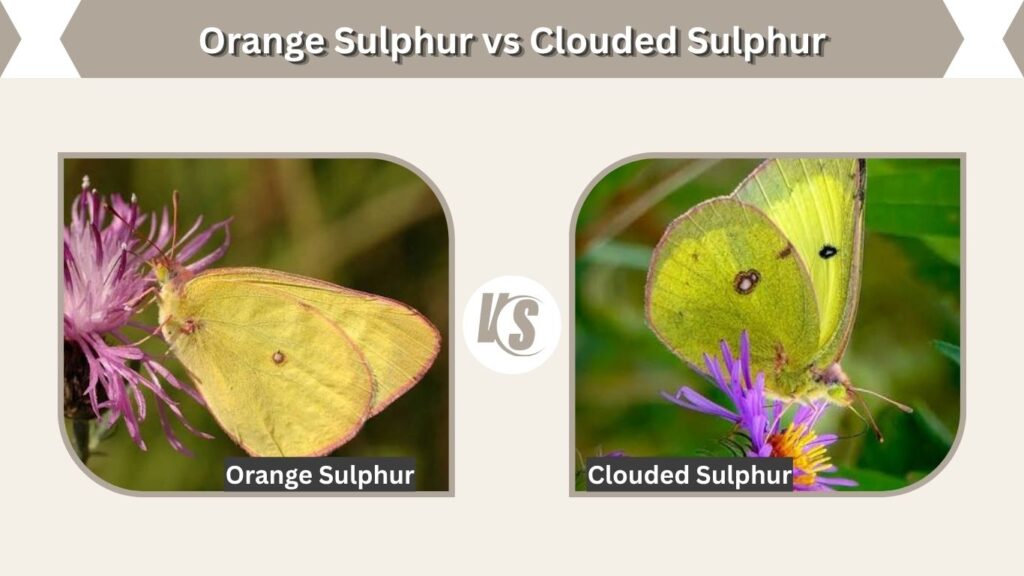
These closely related butterflies frequently share the same habitat and host plants. Their size, flight style and underside markings are extremely similar.
| Feature | Orange Sulphur | Clouded Sulphur |
| Scientific name | Colias eurytheme | Colias philodice |
| Upper-wing color | Orange-yellow or golden | Lemon or greenish yellow |
| Orange coloring | Usually present | Normally absent |
| Dark borders | Solid in males; spotted in females | Similar male and female pattern |
| White female form | Present | Present |
| Caterpillar | Nearly indistinguishable | Nearly indistinguishable |
The most useful difference is the orange sulphur’s orange or golden upper-wing coloring. Clouded sulphurs remain lemon yellow without a distinct orange center. Unfortunately, both butterflies normally rest with their wings closed, making identification difficult.
Is It an Orange-Barred or Large Orange Sulphur?
The orange sulphur should not be confused with the orange-barred sulphur or large orange sulphur. These are separate butterflies in the genus Phoebis.
The orange-barred sulphur is much larger, with a wingspan reaching approximately four inches. Males have bright yellow-orange wings with noticeable red-orange bars. Its caterpillars commonly feed on cassia or senna plants rather than alfalfa and clover.
Orange Sulphur Butterfly Meaning
The orange sulphur has no scientifically established spiritual meaning. Symbolically, however, its bright color and transformation from caterpillar to butterfly may represent energy, optimism, renewal, personal growth and positive change.
These meanings come from cultural interpretations of butterflies rather than the butterfly’s biology.
Interesting Orange Sulphur Butterfly Facts
- It is sometimes called the alfalfa butterfly.
- Some females are white instead of orange-yellow.
- It usually rests with its wings closed.
- Males often patrol low over fields while searching for females.
- The butterfly can see ultraviolet wing patterns invisible to humans.
- Orange sulphurs and clouded sulphurs sometimes produce hybrids.
- Their bouncing, irregular flight may help them escape predators.
FAQs
Are orange sulphur butterflies rare?
Orange sulphurs are generally widespread and common throughout much of North America. They are particularly abundant in open habitats where alfalfa, clover, vetch and nectar-producing flowers grow. Their numbers often become highest during late summer.
Are orange sulphur butterflies harmful?
Adult orange sulphurs are harmless to people and do not bite or sting. Their caterpillars feed on legumes and may occasionally become agricultural pests when unusually large populations develop in commercial alfalfa fields.
How long do orange sulphur butterflies live?
The complete life cycle varies with temperature and season. Eggs hatch within several days, and the caterpillar stage may last about a month. Individual adults generally live for several weeks, although overwintering individuals may remain dormant much longer.
How can I attract orange sulphur butterflies?
Grow clover, native legumes, asters, goldenrod, milkweed and other nectar-rich flowers in a sunny location. Avoid broad pesticide use and allow part of the lawn or garden to remain slightly wild so caterpillar host plants can grow.
Is an orange sulphur a moth?
No. The orange sulphur is a butterfly in the Pieridae family. It is active mainly during daylight, has slender antennae ending in small clubs and typically rests with its wings held upright over its body.