
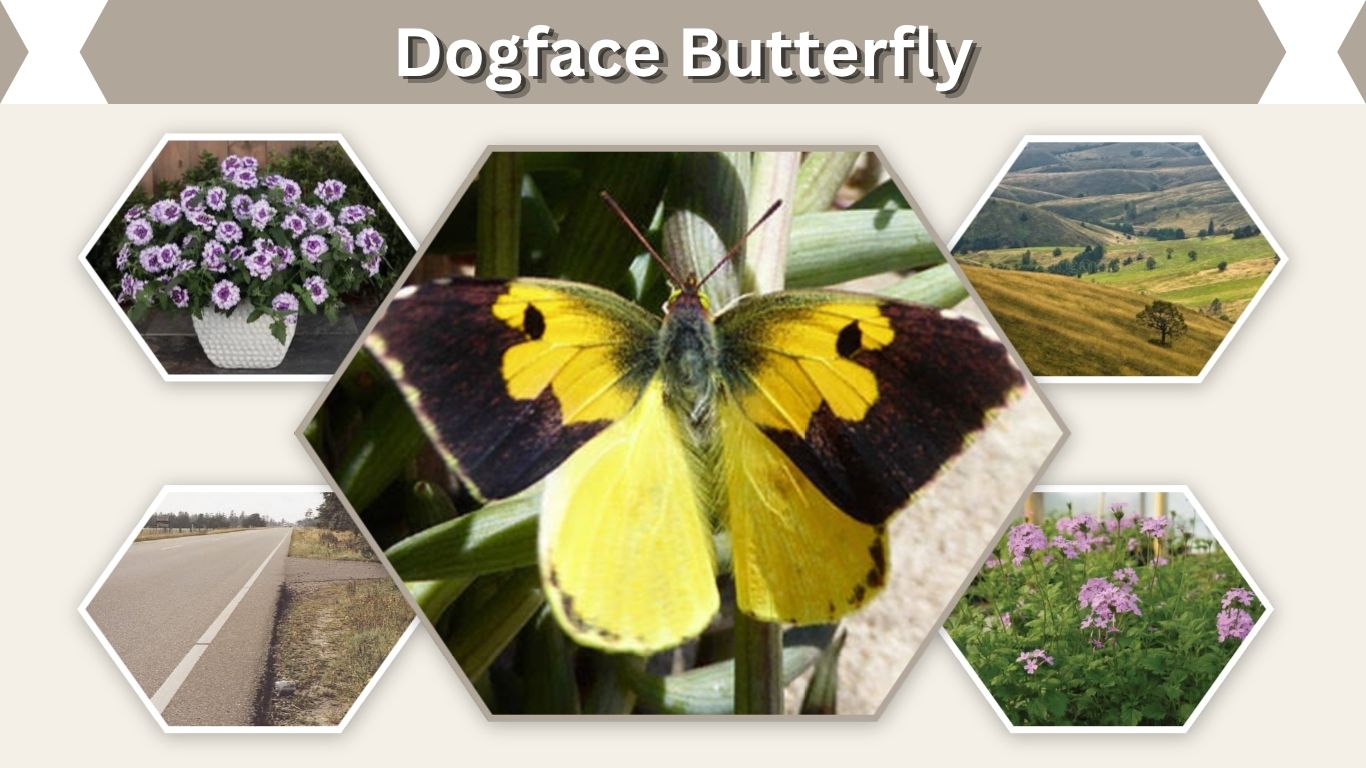
The dogface butterfly is a bright yellow butterfly named for the dark pattern on its upper forewings, which resembles the profile of a dog’s head. The name usually refers to the Southern dogface, Zerene cesonia, a fast-flying member of the white and sulphur butterfly family. It inhabits open fields, roadsides, prairies, woodland edges, and gardens across the southern United States and much of the Americas. Its caterpillars depend mainly on plants in the pea family, while adults visit various flowers for nectar.
What Is a Dogface Butterfly?
The Southern dogface belongs to the family Pieridae, which includes white, yellow, and sulphur butterflies. Its scientific name is Zerene cesonia, although older publications may list it as Colias cesonia.
The genus Zerene also includes the California dogface, Zerene eurydice. Although these two butterflies are closely related, they have different ranges and wing patterns.
| Classification | Name |
| Kingdom | Animalia |
| Phylum | Arthropoda |
| Class | Insecta |
| Order | Lepidoptera |
| Family | Pieridae |
| Subfamily | Coliadinae |
| Genus | Zerene |
| Scientific name | Zerene cesonia |
Why Is It Called a Dogface Butterfly?
When the wings are open, the black markings on each yellow forewing form what looks like the side profile of a dog’s head. The central black spot represents the eye, while the surrounding black border creates the nose, forehead, and neck.
The pattern is usually boldest on males. Females have similar markings, but the black areas may be paler, narrower, or less clearly defined. The design may still be faintly visible through the wings when the butterfly rests with them closed.
Southern Dogface Butterfly Identification
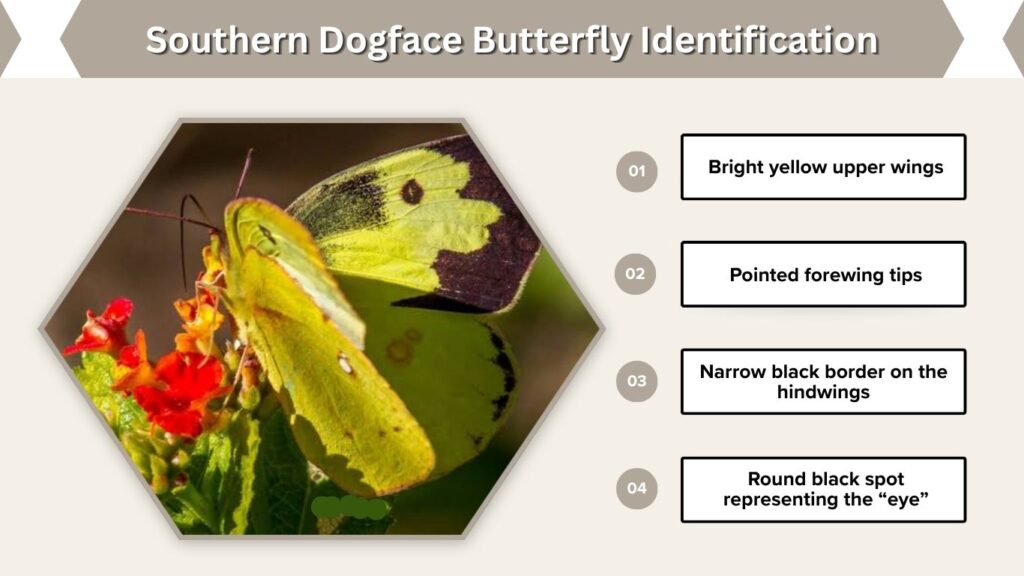
The Southern dogface is a medium-sized yellow butterfly with pointed forewings and distinctive black markings. It flies quickly and may be difficult to observe closely unless it stops to drink nectar.
Size and Wing Markings
Adults have a wingspan of approximately 1¾–3 inches, although measurements differ slightly among regional sources. Their upper wings are mainly lemon yellow, with black borders and a round black spot on each forewing.
Important identification features include:
- Bright yellow upper wings
- Black dog-head pattern on each forewing
- Round black spot representing the “eye”
- Pointed forewing tips
- Narrow black border on the hindwings
- Paler and less defined markings on females
- Two small silvery spots beneath each hindwing
The underside varies seasonally. Summer or wet-season individuals are generally yellow underneath, while winter or dry-season individuals may develop pink, reddish, or dark mottling. This pinkish winter form is sometimes called the “rosa” form.
Male vs Female Dogface Butterfly
Male Southern dogfaces are typically brighter yellow and have stronger black markings. They patrol open spaces while searching for females and may fly continuously over fields, roadsides, and low vegetation.
Females are often slightly duller, with more diffuse black borders. After mating, they search for suitable pea-family plants and lay their eggs on the undersides of young leaves near the ends of stems.
Southern Dogface Caterpillar
The Southern dogface caterpillar is usually green, allowing it to blend in with its host plant. Its appearance can vary considerably between individuals.
Caterpillar Identification
Southern dogface larvae may appear in at least two common forms. One is green with a pale white side stripe containing small orange or reddish spots. Another has yellow and dark crossbands running across its body. Both forms generally have a green head.
Young caterpillars are small and difficult to notice. They commonly rest along leaf stems or veins, where their colouring provides camouflage from birds and other predators.
Southern Dogface Caterpillar Food
The caterpillars feed primarily on small-leaved plants in the pea family, Fabaceae. Important host plants include:
- Alfalfa
- Prairie clovers
- Indigo species
- Dalea species
- True clovers
- Other small-leaved legumes
Planting locally appropriate native prairie clovers or indigo species can provide egg-laying sites and food for developing caterpillars.
Dogface Butterfly Life Cycle
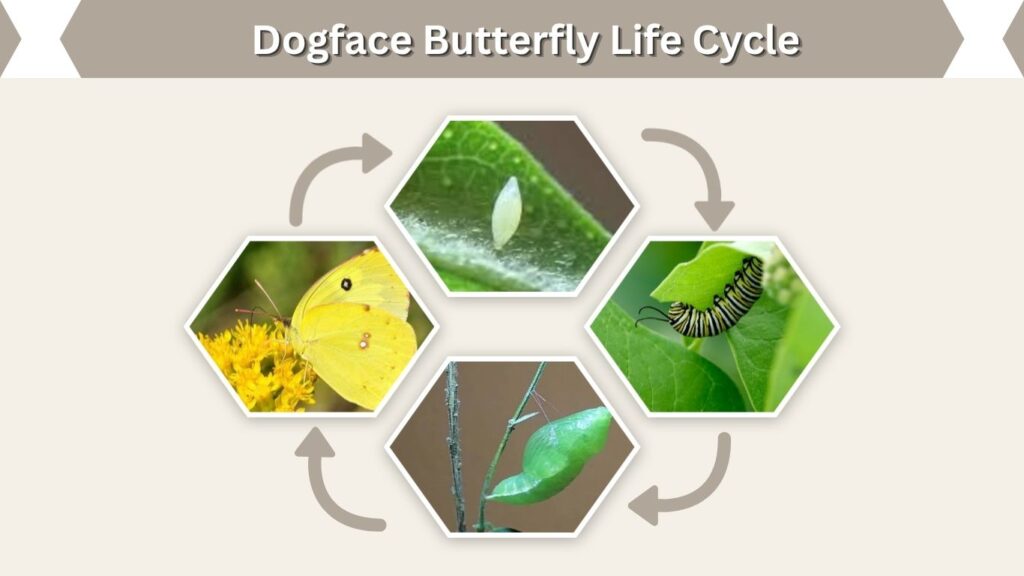
Like other butterflies, the Southern dogface undergoes complete metamorphosis through four distinct stages: egg, caterpillar, chrysalis, and adult.
Egg
The female deposits whitish, spindle-shaped eggs individually or in small groups on suitable host plants. Eggs are usually placed on the undersides of young terminal leaves.
Caterpillar
After hatching, the caterpillar consumes the host plant’s leaves and grows through several stages called instars. Its green colouring and narrow body make it difficult to see among the foliage.
Chrysalis
A mature caterpillar attaches itself to a protected plant surface and forms a chrysalis. The developing butterfly remains inside until its wings and adult body are complete.
Adult
The adult emerges, expands its wings, and begins searching for nectar and potential mates. Southern states may have three main flight periods, while individuals reaching colder northern regions may produce only one generation or may not reproduce there successfully. Adults in warmer parts of the range can overwinter in a state of reproductive inactivity.
Southern Dogface Butterfly Habitat
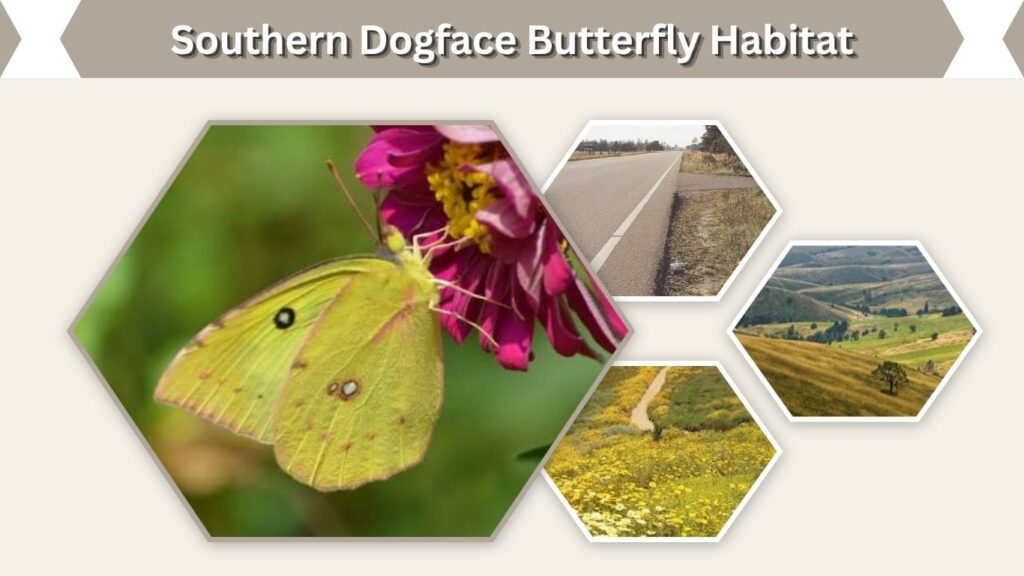
Southern dogfaces prefer sunny, dry, open landscapes rather than dense forests. They are commonly encountered in:
- Short-grass prairies
- Open woodland
- Scrub and thorny vegetation
- Dry hillsides
- Road edges
- Washes and stream corridors
- Pastures and old fields
- Gardens containing nectar and host plants
Their fast, direct flight allows them to move between scattered flowers and host-plant patches. Males are often seen patrolling open spaces, while females spend more time searching vegetation for egg-laying locations.
Southern Dogface Butterfly Range
The Southern dogface is a resident from South America northward into southern Texas and peninsular Florida. It regularly expands beyond its permanent range during warmer months.
Strays and temporary breeding populations may appear across much of the eastern United States, the Great Lakes region, and parts of the western United States. It is found in Texas, but it is more consistently established in the warmer southern part of the state. Northern sightings are usually more frequent during summer and early fall.
What Does the Southern Dogface Butterfly Eat?
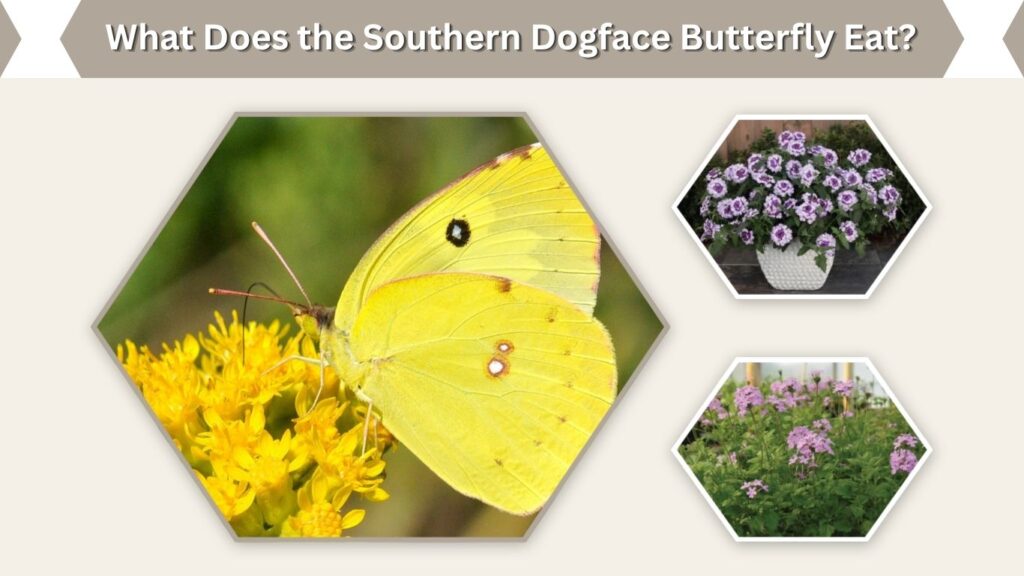
Adult dogface butterflies drink nectar through a long, coiled feeding tube called a proboscis. When the butterfly lands on a flower, it extends this tube into the bloom to reach liquid nectar.
Frequently visited flowers include:
- Alfalfa
- Coreopsis
- Verbena
- Houstonia
- Coneflowers
- Asters
- Other open, nectar-rich wildflowers
Adults may also obtain minerals and moisture from damp soil, mud, or shallow puddles. Caterpillars do not drink nectar; they eat the leaves of their legume host plants.
Southern Dogface vs California Dogface
The California dogface is a separate species called Zerene eurydice. It is closely associated with California and adjacent Baja California, while the Southern dogface has a much wider range across the Americas. California officially designated its dogface butterfly as the state insect in 1972.
| Feature | Southern dogface | California dogface |
| Scientific name | Zerene cesonia | Zerene eurydice |
| Main colour | Bright yellow and black | Yellow, black, and sometimes violet |
| Female pattern | Dogface marking often visible | Female usually lacks a clear dogface pattern |
| Range | Southern US through much of the Americas | California and adjacent Baja California |
| Special status | Widespread species | California’s state insect |
The male California dogface may show an iridescent violet or purplish sheen within its dark forewing pattern. The Southern dogface’s corresponding inner marking remains yellow.
Southern Dogface vs American Snout
The Southern dogface and American snout may occur in the same open habitats, but they are easy to separate when their major features are visible.
The Southern dogface is predominantly yellow and has the black dog-head wing pattern. The American snout is brown and orange with white forewing spots. It also has unusually long mouthpart structures extending from its face, creating the appearance of a long nose.
How to Attract Dogface Butterflies
A suitable butterfly garden should provide both nectar flowers for adults and host plants for caterpillars. A garden containing flowers alone may attract visiting adults but will not support their complete life cycle.
Plant native prairie clovers, indigo, or other locally suitable legumes in a sunny location. Add nectar plants such as verbena, coreopsis, asters, and coneflowers. Avoid applying broad-spectrum insecticides because they may kill caterpillars and adult butterflies along with unwanted insects.
FAQs
Is the Southern dogface butterfly poisonous?
No. Southern dogface butterflies are not poisonous and cannot bite or sting people. Their caterpillars are also harmless to touch, although unnecessary handling may injure the insect.
Do Southern dogface butterflies live in Texas?
Yes. Southern Texas forms part of the species’ established North American range. Individuals also occur farther north in Texas, especially during warmer months when butterflies disperse beyond their permanent breeding areas.
What is the Southern dogface butterfly’s host plant?
Its primary host plants are small-leaved members of the pea family. These include alfalfa, prairie clovers, true clovers, indigo, and several Dalea species.
Where do dogface butterflies sleep?
They generally rest among grasses, shrubs, or other vegetation with their wings held upright and closed. The pale or mottled undersides of the wings help them remain less noticeable while resting.
Is the dogface butterfly rare?
The Southern dogface is considered globally secure and is not generally regarded as a threatened species. However, it may be uncommon near the outer edges of its range or in places lacking suitable open habitat and host plants.