
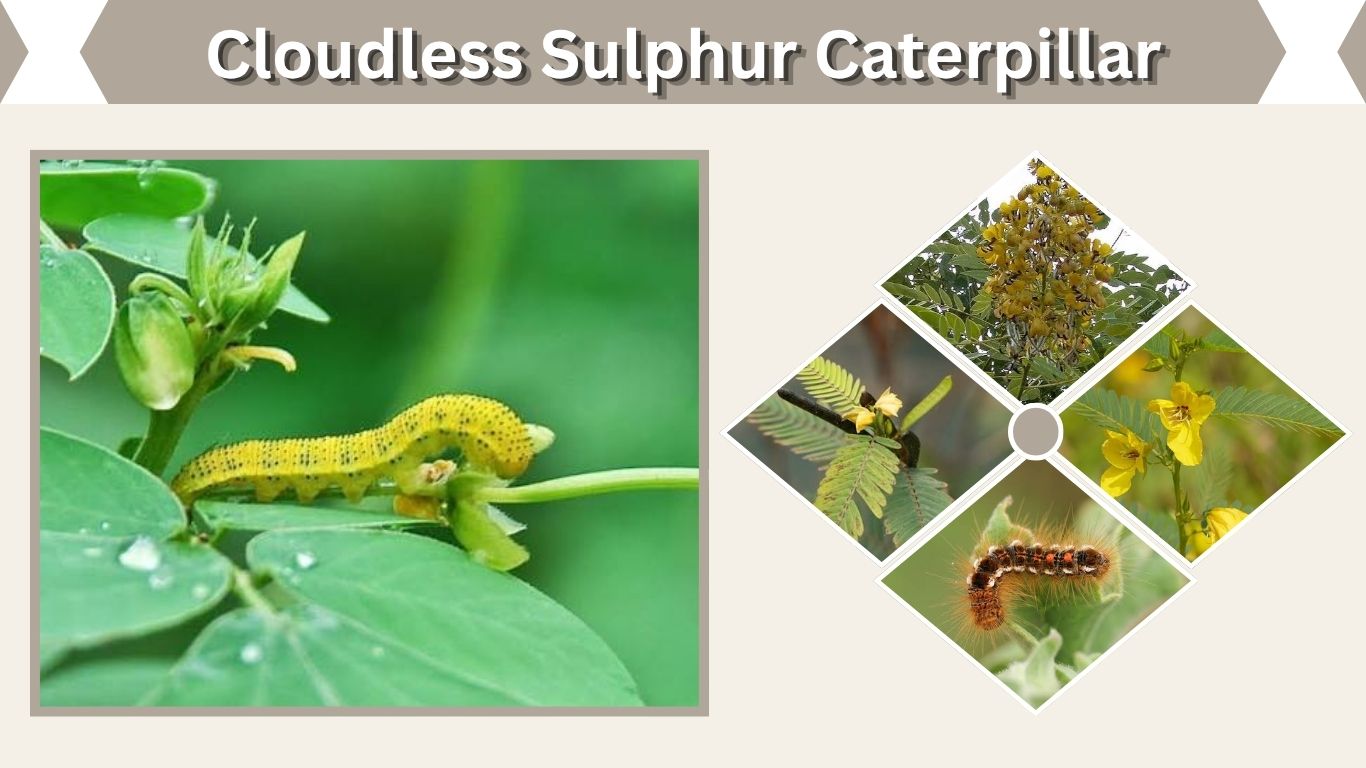
The cloudless sulphur caterpillar is the larval stage of the cloudless sulphur butterfly, Phoebis sennae. It may be bright green, yellow-green, or vivid yellow, depending partly on which part of its host plant it eats. These caterpillars are commonly found on senna, cassia, and partridge pea plants, especially in Florida and other warm parts of the Americas. Although they may consume noticeable amounts of foliage and flowers, they usually cause only temporary cosmetic damage and eventually become large, fast-flying yellow butterflies.
What Is a Cloudless Sulphur Caterpillar?
The cloudless sulphur caterpillar belongs to the family Pieridae, which includes white and sulphur butterflies. “Sulphur” is the traditional spelling used in the butterfly’s common name, while “sulfur” is also frequently used in searches and informal writing.
Its scientific name is Phoebis sennae. The species occurs throughout the southern United States, the West Indies, Central America, and South America. Migrating adults can travel much farther north during warmer months.
| Classification | Name |
| Order | Lepidoptera |
| Family | Pieridae |
| Subfamily | Coliadinae |
| Genus | Phoebis |
| Species | Phoebis sennae |
| Adult form | Cloudless sulphur butterfly |
Cloudless Sulphur Caterpillar Identification
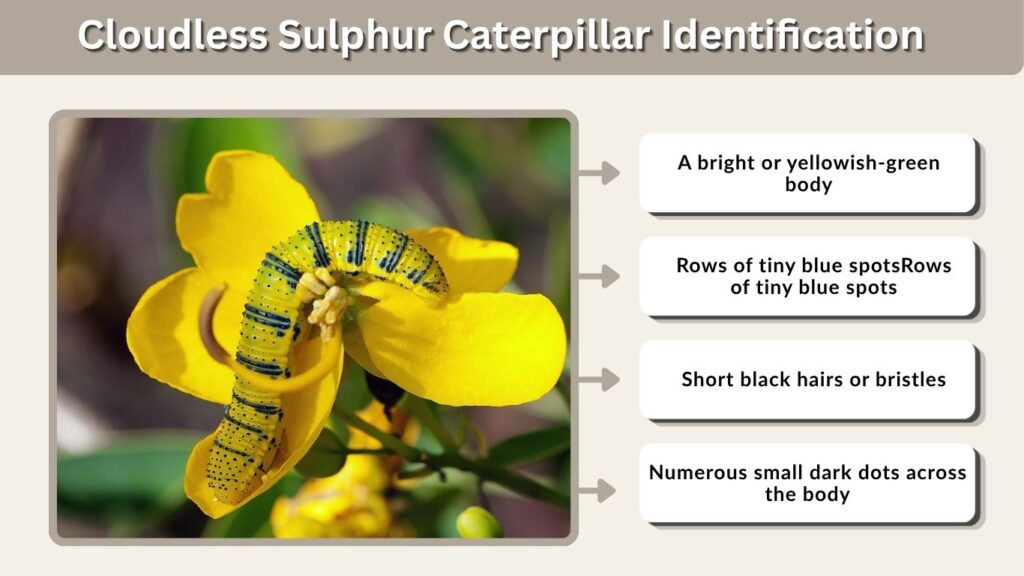
Cloudless sulphur caterpillars are long, cylindrical larvae covered with tiny dark hairs. Their colours help them blend into the leaves, buds, flowers, and seedpods of their host plants.
Green Cloudless Sulphur Caterpillar
A caterpillar that feeds mainly on leaves is generally green. This form may have:
- A bright or yellowish-green body
- A yellow or cream line along each side
- Small blue patches near the side stripe
- Rows of tiny blue spots
- Short black hairs or bristles
- Numerous small dark dots across the body
The caterpillar’s markings can appear brighter or duller depending on its age, host plant, lighting, and individual variation.
Yellow Cloudless Sulphur Caterpillar
Some cloudless sulphur caterpillars are neon yellow with dark crossbands. This does not usually represent a different species.
Larvae that feed predominantly on yellow senna flowers are more likely to develop yellow bodies with black transverse bands. Caterpillars feeding mainly on green foliage usually remain green. This colour change provides camouflage against the plant part on which the caterpillar is feeding.
A bright yellow caterpillar found on a senna or cassia plant in Florida is therefore a strong candidate for a cloudless sulphur, although a photograph and host-plant identification are still useful for confirmation.
What Does a Cloudless Sulphur Caterpillar Eat?
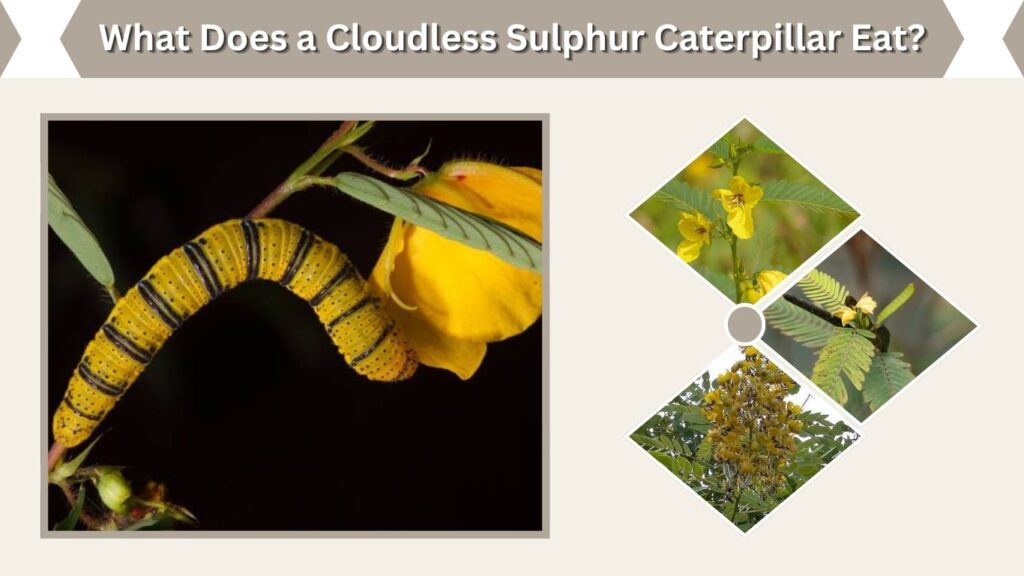
Cloudless sulphur caterpillars feed on the foliage, buds, and flowers of selected plants in the pea family, Fabaceae. They do not normally feed on unrelated garden plants.
Primary Host Plants
Common cloudless sulphur caterpillar host plants include:
- Partridge pea
- Maryland wild senna
- Sensitive pea
- Privet wild senna
- Chapman’s wild senna
- Candlestick plant
- Coffeeweed or sicklepod
- Christmas senna
- Popcorn senna
- Septicweed
Plants in the genera Senna and Chamaecrista are particularly important. Female butterflies search for suitable host plants and lay their eggs individually on the plant rather than depositing a large clustered egg mass.
Cloudless Sulphur Caterpillar on Partridge Pea
Partridge pea, Chamaecrista fasciculata, is an important native host plant. Its yellow flowers and delicate leaves provide food for developing larvae.
The plant also has extrafloral nectaries that attract ants. Although these ants may protect the plant from some herbivores, they can also remove butterfly eggs or very young caterpillars.
Cloudless Sulphur Caterpillar Life Cycle
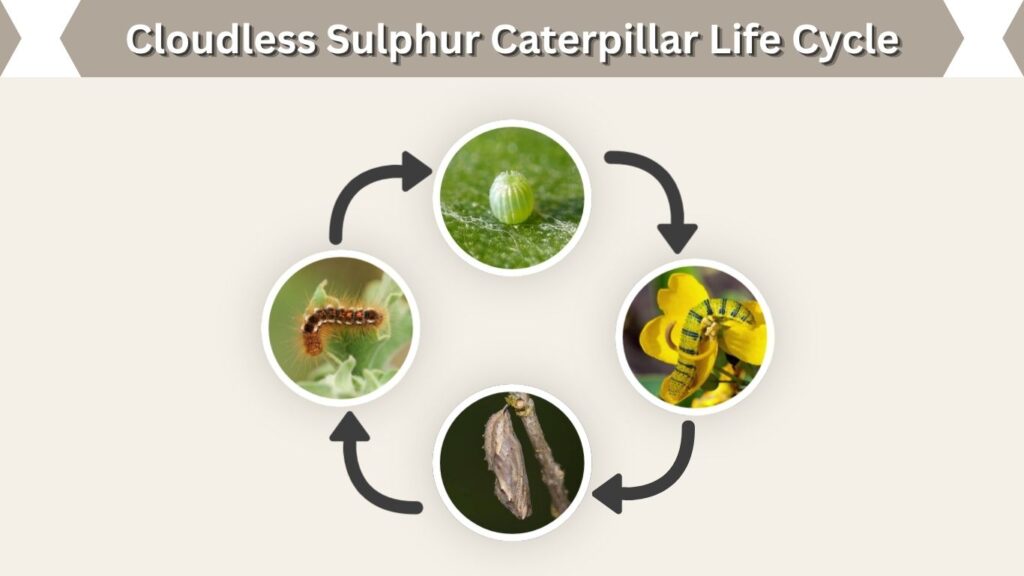
The cloudless sulphur undergoes complete metamorphosis through four stages: egg, caterpillar, chrysalis, and adult butterfly.
Egg Stage
The female lays eggs singly on an appropriate host plant. Newly laid eggs are cream coloured but gradually become orange as the caterpillar develops inside.
A tiny first-instar caterpillar emerges from the egg and begins feeding on tender plant tissue.
Caterpillar Instars
The caterpillar grows through several developmental stages called instars. At the end of each instar, it sheds its old skin because the skin cannot expand enough to accommodate continued growth.
Early instars are extremely small and may be difficult to see. Later instars eat more actively and develop stronger side stripes, blue markings, dark dots, or contrasting black bands.
The length of the caterpillar stage varies with temperature, food quality, season, and environmental conditions. Development is generally faster in consistently warm weather. Cloudless sulphurs continue developing without an immature-stage diapause, meaning the egg, caterpillar, and chrysalis do not enter a specialised winter dormancy.
Turning Into a Chrysalis
When fully grown, the caterpillar stops eating and leaves its feeding position to find a secure pupation site. It attaches itself to a plant stem, leaf, wall, or another firm surface using silk.
The chrysalis hangs upright, supported by a silk attachment at the rear and a silk girdle around the middle. It may be green or pinkish with yellow lines, allowing it to blend into surrounding vegetation.
Adult Butterfly
The adult emerges as a large yellow butterfly with a wingspan of approximately 1.9–2.6 inches. Males are generally clear, bright yellow, while females may be yellow or nearly white and usually have darker wing markings.
Does a Cloudless Sulphur Caterpillar Build a Tent?
No. Cloudless sulphur caterpillars do not create silk tents, rolled-leaf shelters, or webbed nests. They live exposed on the host plant while feeding on leaves, buds, and flowers.
Because they remain uncovered, their green or yellow colouring is important camouflage. A caterpillar may rest along a leaf stem, flower cluster, or developing seedpod where its body is difficult to notice.
Webbing on a senna plant is more likely to have been produced by another caterpillar species, a spider, or another arthropod.
Clouded Sulphur vs Cloudless Sulphur Caterpillar
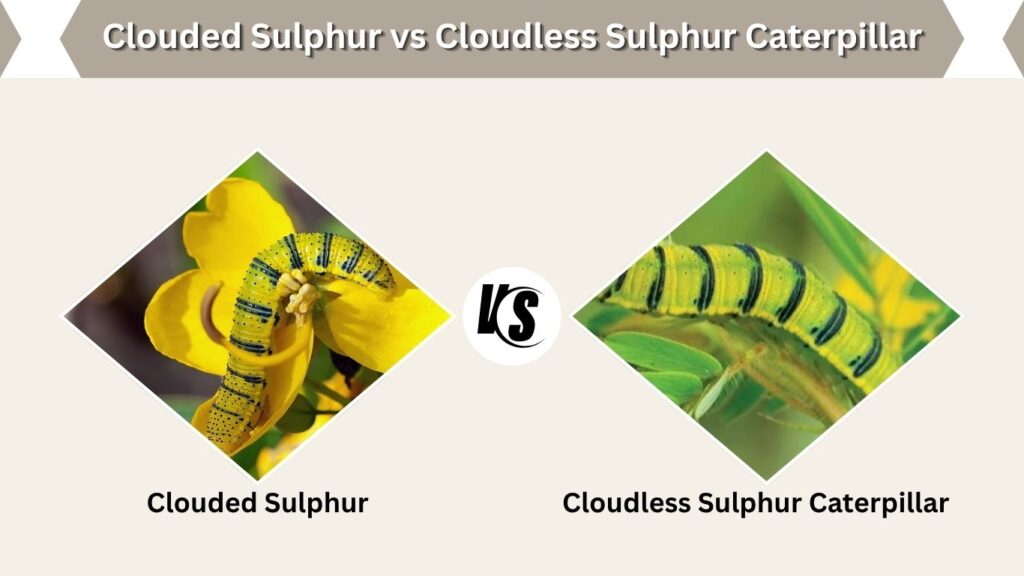
Clouded and cloudless sulphur caterpillars are related but belong to different genera.
| Feature | Cloudless sulphur | Clouded sulphur |
| Scientific name | Phoebis sennae | Colias philodice |
| Typical colour | Green or bright yellow | Mainly green |
| Notable markings | Blue spots, side stripe, or black crossbands | Faint side stripe and small dark dots |
| Common host plants | Senna and partridge pea | Clover, alfalfa, and pea |
| Adult size | Relatively large | Smaller |
The host plant is often one of the best identification clues. A green or yellow caterpillar on senna is more likely to be a cloudless sulphur, while one found on alfalfa or clover may be a clouded or orange sulphur.
Are Cloudless Sulphur Caterpillars Harmful to Plants?
The caterpillars can chew holes in leaves and consume developing flowers and buds. Several larvae on a small plant may cause obvious defoliation, but established sennas often recover.
UF/IFAS recommends hand-picking only when control is genuinely necessary and states that chemical control is generally neither required nor recommended. Using broad-spectrum insecticides would also kill beneficial caterpillars and other pollinators.
Gardeners who want butterflies should tolerate moderate feeding or grow several host plants so the damage is distributed.
How to Attract Cloudless Sulphur Caterpillars
Planting suitable host plants is essential because adult nectar flowers alone cannot support the caterpillar stage.
Choose native species appropriate for your area, such as partridge pea, wild senna, or sensitive pea. Place them in a sunny garden with nearby nectar flowers for adult butterflies.
Avoid introducing potentially invasive ornamental senna varieties. For example, Christmas senna is considered invasive in South Florida and should not be planted there.
FAQs
Is a cloudless sulphur caterpillar poisonous?
Cloudless sulphur caterpillars are not known as stinging caterpillars. Their small black hairs are part of their normal body covering rather than the prominent venom-delivering spines found on medically important caterpillar species.
Why is my cloudless sulphur caterpillar yellow?
The colour is often associated with diet. Caterpillars feeding mainly on yellow flowers may become bright yellow with black bands, while those eating green leaves are generally green with yellow, blue, and black markings.
What plants do cloudless sulphur caterpillars eat?
They primarily eat plants in the genera Senna and Chamaecrista. Common examples include partridge pea, wild senna, sensitive pea, candlestick plant, coffeeweed, and Christmas senna.
Do cloudless sulphur caterpillars make webs?
No. They feed openly and do not construct protective silk tents or webbed shelters. Finding extensive webbing on the plant may indicate that another insect or spider is present.
Should I remove cloudless sulphur caterpillars?
Removal is usually unnecessary when the host plant is healthy. If a small or valuable plant is being heavily defoliated, move the caterpillars carefully to another suitable senna or partridge pea rather than applying a broad-spectrum pesticide.