
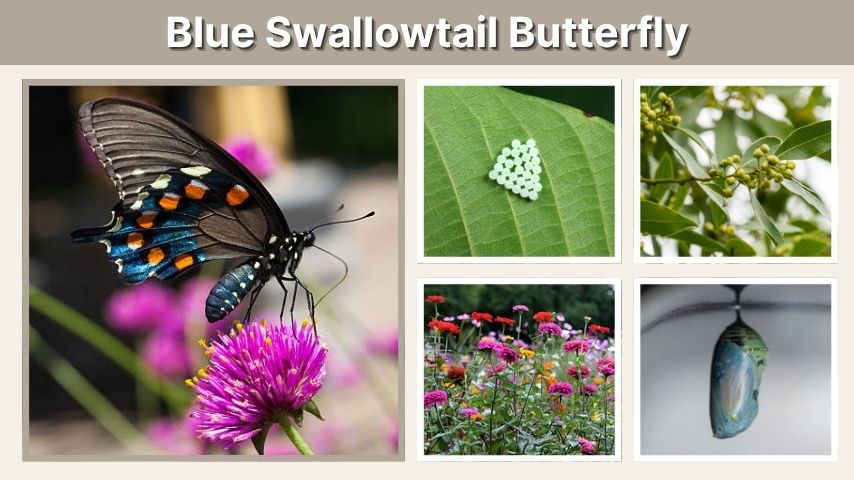
The blue swallowtail butterfly is not always one single species. Many people use this name for swallowtail butterflies with black wings, blue markings, or bright electric-blue color. In North America, the name often points to the pipevine swallowtail, spicebush swallowtail, or black swallowtail females. In Australia and nearby regions, it may refer to the blue mountain swallowtail, also called the Ulysses butterfly.
What Is a Blue Swallowtail Butterfly?
A blue swallowtail butterfly is usually a member of the swallowtail family with noticeable blue coloring on its wings. Swallowtails are large butterflies known for their graceful flight and the tail-like points on their hindwings.
The blue color may appear in different ways. Some species have deep metallic blue hindwings. Others have blue spots, blue bands, or blue-green shading. Because several butterflies share this look, identification depends on wing pattern, location, size, and host plants.
Why the Name Can Be Confusing
The phrase “blue swallowtail butterfly” is a common name people use after seeing a butterfly, not always an official species name. A black and blue swallowtail in a North American garden may be a pipevine swallowtail, spicebush swallowtail, black swallowtail, or dark female eastern tiger swallowtail. A bright electric-blue butterfly in Australia may be the Ulysses butterfly.
This is why a good identification starts with three questions:
- Where did you see the butterfly?
- Was it mostly black with blue markings or mostly bright blue?
- Did it have orange spots, white spots, yellow spots, or long tails?
Common Types of Blue Swallowtail Butterflies
Several swallowtail butterflies may match the “blue swallowtail” description. Some are common in North America, while others live in tropical or subtropical regions.
Pipevine Swallowtail
The pipevine swallowtail is one of the butterflies most often called a blue swallowtail. Its scientific name is Battus philenor. Males are especially striking, with black forewings and iridescent blue hindwings. Females usually have a softer blue sheen and more visible pale spots.
This butterfly is found in parts of North America and Central America. Its caterpillars feed on pipevine plants in the genus Aristolochia. Because the caterpillars absorb defensive chemicals from these host plants, adults are distasteful to many predators.
Spicebush Swallowtail
The spicebush swallowtail, Papilio troilus, is another black swallowtail with blue or blue-green markings. It is common in many eastern parts of North America. The upper side is dark, with pale spots near the wing edges and a bluish wash on the hindwings.
Its caterpillar is famous for looking like a tiny snake or tree frog. It has large false eyespots that may scare away predators. The caterpillars usually feed on spicebush, sassafras, red bay, and related plants.
Black Swallowtail With Blue Markings
The black swallowtail, Papilio polyxenes, can also look blue, especially the female. Females often have larger blue patches on the hindwings than males. They also show rows of yellow and orange spots.
This species is commonly seen in gardens because its caterpillars feed on plants in the carrot family, such as parsley, dill, fennel, carrot tops, and Queen Anne’s lace.
Blue Mountain Swallowtail or Ulysses Butterfly
The blue mountain swallowtail is better known as the Ulysses butterfly, Papilio ulysses. It is a large tropical swallowtail famous for brilliant electric-blue wings. It lives in Australia, Papua New Guinea, Indonesia, and nearby regions.
Unlike many North American black-and-blue swallowtails, the Ulysses butterfly looks intensely blue across much of the upper wing surface. The underside is darker and more muted, which helps it disappear when resting with closed wings.
Blue-Spotted Purple: Not a True Swallowtail
Some people confuse the red-spotted purple or blue-spotted purple with a swallowtail because it is dark with blue coloring. However, it is not a true swallowtail and does not have the same long tail extensions. It belongs to a different butterfly group.
Blue Swallowtail Butterfly Quick Identification Guide
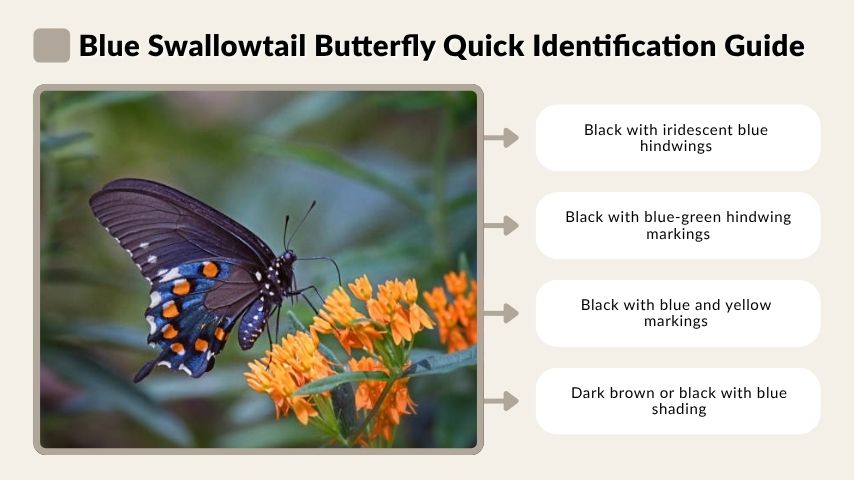
Blue swallowtail identification depends on wing color, markings, region, and host plants. The table below compares several butterflies people often mean when they say “blue swallowtail butterfly.”
| Butterfly | Main Colors | Common Range | Caterpillar Host Plants |
| Pipevine swallowtail | Black with iridescent blue hindwings | North and Central America | Pipevine plants |
| Spicebush swallowtail | Black with blue-green hindwing markings | Eastern North America | Spicebush, sassafras, red bay |
| Black swallowtail female | Black with blue and yellow markings | Much of North America | Parsley, dill, fennel, carrot family |
| Dark female eastern tiger swallowtail | Dark brown or black with blue shading | Eastern North America | Tulip tree, wild cherry, ash, birch |
| Ulysses butterfly | Bright electric blue and black | Australia and nearby regions | Citrus relatives and rainforest plants |
Black and Blue Swallowtail Butterfly Identification
A black and blue swallowtail butterfly can be difficult to identify at first glance. Many species use a similar dark-wing pattern because it helps with mimicry and protection.
Pipevine vs Spicebush Swallowtail
Pipevine swallowtails often show a strong metallic blue on the hindwings. When the wings are folded, the underside has bold orange spots. Spicebush swallowtails usually have blue-green markings and pale spots around the wing edges. Their underside has orange spots and a blue-green wash, but the pattern differs from pipevine.
A useful clue is the host plant nearby. Pipevine swallowtails need pipevine plants. Spicebush swallowtails are often found near spicebush, sassafras, or wooded habitats.
Black Swallowtail vs Pipevine Swallowtail
Female black swallowtails can have blue patches, but they also show rows of yellow spots. Pipevine swallowtails usually look darker and smoother on top, with a stronger blue sheen and fewer yellow markings.
Black swallowtail caterpillars are commonly found on parsley, dill, fennel, and carrot-family plants. Pipevine swallowtail caterpillars feed on pipevine plants instead.
Blue Eastern Tiger Swallowtail
A “blue eastern tiger swallowtail” is usually a dark-form female eastern tiger swallowtail. It is not fully blue, but it may show blue scales on the hindwings. These females can look black at a distance and may be mistaken for pipevine or spicebush swallowtails.
Blue Swallowtail Butterfly Caterpillar
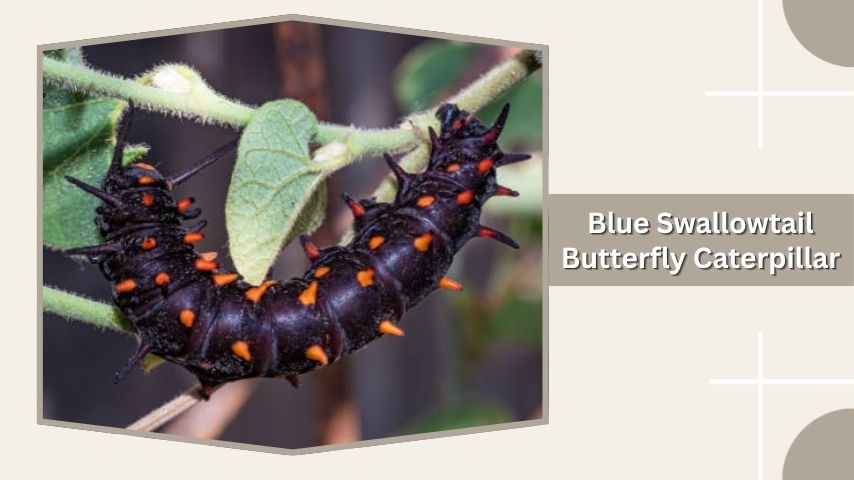
There is no single blue swallowtail caterpillar because the adult name may refer to different species. Caterpillars vary greatly depending on the butterfly.
Pipevine Swallowtail Caterpillar
Pipevine swallowtail caterpillars are usually dark, reddish, or black with fleshy projections. They feed on pipevine plants. Their unusual look and chemical defenses make them easier to distinguish from many other caterpillars.
Because they rely on specific host plants, planting the correct native pipevine is important. Some ornamental or tropical pipevines may not be safe for all pipevine swallowtail larvae, so local native species are usually the better choice.
Spicebush Swallowtail Caterpillar
The spicebush swallowtail caterpillar is one of the most memorable swallowtail larvae. Young caterpillars may resemble bird droppings. Older caterpillars are green or yellowish-green with large false eyespots. They often hide inside folded leaves.
These caterpillars create leaf shelters by using silk to pull a leaf around themselves. This helps them stay hidden during the day.
Black Swallowtail Caterpillar
Black swallowtail caterpillars are green, black, and yellow or white striped. They are often found on herb plants, especially dill, parsley, fennel, and carrot tops. Gardeners sometimes notice them quickly because they feed openly on familiar kitchen herbs.
Blue Swallowtail Butterfly Host Plants
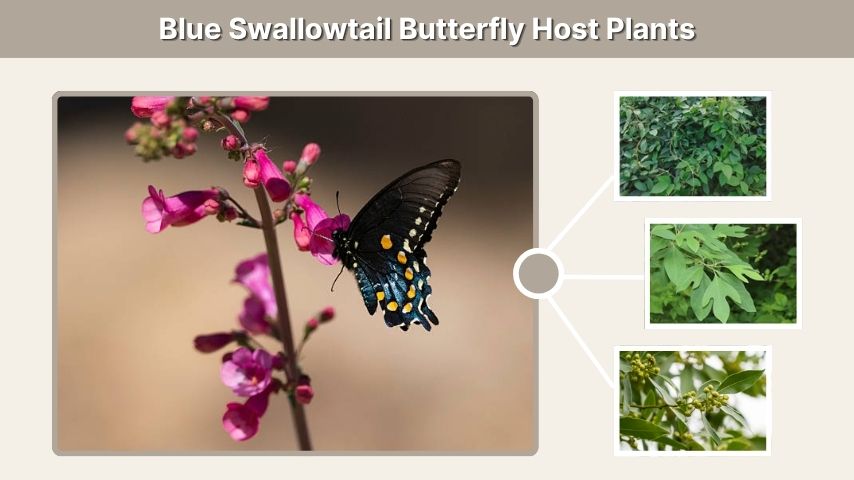
Host plants are essential because female butterflies lay eggs on the plants their caterpillars can eat. Adult butterflies drink nectar from many flowers, but caterpillars are much more selective.
Common Host Plants by Species
Different blue-looking swallowtails need different host plants:
- Pipevine swallowtail: native pipevine plants
- Spicebush swallowtail: spicebush, sassafras, red bay, sweet bay
- Black swallowtail: dill, parsley, fennel, carrot, Queen Anne’s lace
- Eastern tiger swallowtail: tulip tree, wild cherry, birch, ash, willow
- Ulysses butterfly: rainforest plants and citrus relatives in its native range
If you want to attract a specific swallowtail, choose host plants that match your region and the butterfly species found there.
Nectar Plants for Adult Butterflies
Adult blue swallowtail butterflies visit many nectar flowers. They often prefer sunny blooms with enough space to land.
Good nectar plants include:
- Milkweed
- Zinnia
- Lantana
- Verbena
- Joe-Pye weed
- Thistle
- Ironweed
- Phlox
- Coneflower
- Native asters
- Butterfly bush
Native flowering plants are usually the best long-term choice because they support more insects and fit local ecosystems better than many ornamental plants.
Blue Swallowtail Butterfly Habitat and Range
Blue swallowtails live in different habitats depending on the species. Pipevine swallowtails may appear in open woods, gardens, stream edges, and places where pipevine grows. Spicebush swallowtails prefer wooded areas, forest edges, wetlands, and shaded gardens. Black swallowtails are often found in open fields, meadows, farms, and herb gardens.
The Ulysses butterfly lives in tropical rainforest regions and nearby gardens where its host plants grow. It is especially associated with northeastern Australia and the Wet Tropics.
Blue Swallowtail Butterfly in the United States
In the United States, a blue swallowtail sighting is most likely one of the black-and-blue swallowtails. In eastern states, pipevine, spicebush, black swallowtail, and dark female eastern tiger swallowtail are common possibilities. In California, the pipevine swallowtail can also occur where native pipevine grows.
In states such as Ohio, Arkansas, Florida, Wisconsin, and Virginia, the exact species depends on local range, habitat, and season. A photo of the upper and lower wings is usually the fastest way to confirm the identification.
Blue Swallowtail Butterfly Life Cycle
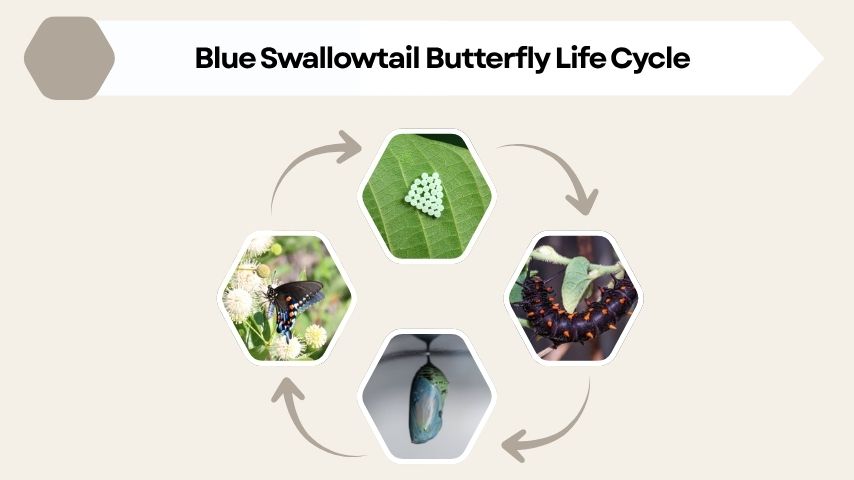
Like all butterflies, blue swallowtails go through complete metamorphosis. Their life cycle has four stages: egg, caterpillar, chrysalis, and adult.
Egg Stage
The female lays eggs on or near a suitable host plant. The eggs are small and easy to miss. Some are laid singly, while others may be placed in small clusters depending on the species.
Caterpillar Stage
After hatching, the caterpillar begins feeding on the host plant. It grows through several stages called instars. Many swallowtail caterpillars change appearance as they grow, often starting as bird-dropping mimics and later developing brighter colors or false eyespots.
Chrysalis Stage
When fully grown, the caterpillar forms a chrysalis. This stage may last days, weeks, or through winter, depending on species and climate. The chrysalis is often green or brown to blend with stems, bark, or leaves.
Adult Stage
The adult butterfly emerges, expands its wings, and begins searching for nectar, mates, and host plants. Adults often live only a few weeks, although timing varies by species and environment.
Are Blue Swallowtail Butterflies Rare or Endangered?
Most blue-looking swallowtails are not globally rare, but local populations can decline when host plants disappear. A butterfly may be common in one region and scarce in another.
The pipevine swallowtail, for example, depends heavily on pipevine plants. If those plants are removed, local populations may vanish. Spicebush swallowtails need healthy woodland edges and host shrubs. Black swallowtails are more adaptable because they use common garden herbs and wild carrot-family plants.
Habitat loss, pesticide use, and removal of native plants can affect many swallowtails. Planting native host plants is one of the best ways to support them.
Blue Swallowtail Butterfly Meaning and Symbolism
The blue swallowtail butterfly is often seen as a symbol of transformation, renewal, freedom, and beauty. Its blue color adds meanings connected with calm, intuition, hope, and spiritual awareness.
Spiritual Meaning
Spiritually, a blue swallowtail may represent change guided by peace rather than fear. Because butterflies transform completely, many people connect them with personal growth, healing, and new beginnings. The blue color can add a sense of trust, clarity, and emotional balance.
Black and Blue Swallowtail Meaning
A black and blue swallowtail may symbolize mystery, protection, resilience, and hidden strength. The dark wings suggest survival and camouflage, while the blue markings suggest beauty, insight, and renewal.
Tattoo Meaning
A blue swallowtail butterfly tattoo can represent transformation, freedom, elegance, and personal rebirth. Some people choose the pipevine swallowtail for its dramatic black-and-blue contrast. Others prefer the Ulysses butterfly for its bright electric-blue wings and tropical beauty.
How to Attract Blue Swallowtail Butterflies
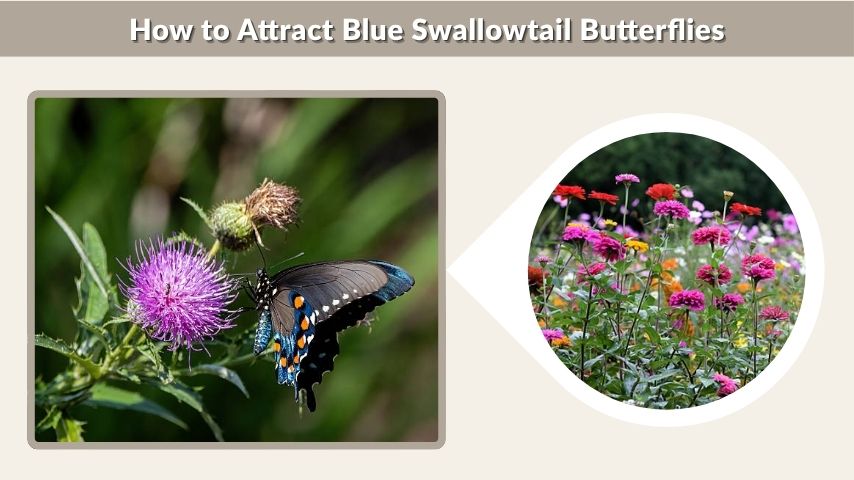
To attract blue swallowtails, grow both host plants and nectar plants. Nectar flowers may bring adults to your garden, but host plants allow them to lay eggs and complete their life cycle.
Butterfly Garden Tips
Use these steps to create a better habitat:
- Plant host plants for the species found in your region.
- Add nectar flowers that bloom from spring through fall.
- Avoid pesticides on herbs, shrubs, trees, and flowers.
- Leave some natural leaf litter and sheltered areas.
- Grow native plants whenever possible.
- Provide a sunny, wind-protected feeding area.
A butterfly garden does not need to be large. Even a small patch of dill, parsley, native flowers, or pipevine can help if it matches the butterflies in your area.
FAQs
Is there a real blue swallowtail butterfly?
Yes, but the name can refer to different species. In North America, it often means the pipevine swallowtail, which has black wings and iridescent blue hindwings. In Australia, people may mean the Ulysses butterfly, also called the blue mountain swallowtail, which has bright electric-blue wings.
What does a blue swallowtail caterpillar look like?
It depends on the species. Pipevine swallowtail caterpillars are often dark or reddish with fleshy projections. Spicebush swallowtail caterpillars are green with large false eyespots and hide in folded leaves. Black swallowtail caterpillars are striped and often feed on parsley, dill, fennel, and carrot-family plants.
What does a blue swallowtail butterfly eat?
Adult blue swallowtail butterflies drink nectar from flowers such as milkweed, zinnia, lantana, verbena, thistle, coneflower, and native asters. Caterpillars eat specific host plants. Pipevine swallowtail larvae eat pipevine, spicebush swallowtail larvae eat spicebush or sassafras, and black swallowtail larvae eat carrot-family plants.
What does a blue swallowtail butterfly mean spiritually?
A blue swallowtail butterfly often symbolizes transformation, peace, renewal, and hope. The butterfly’s life cycle represents change, while the blue color is commonly linked with calmness, intuition, and emotional clarity. A black and blue swallowtail may also suggest resilience and hidden strength.
Are black and blue swallowtail butterflies poisonous?
Some are distasteful or chemically defended rather than dangerous to people. Pipevine swallowtails can be toxic to predators because their caterpillars absorb chemicals from pipevine host plants. However, they do not sting, bite, or harm humans. It is best to observe them without handling them.