
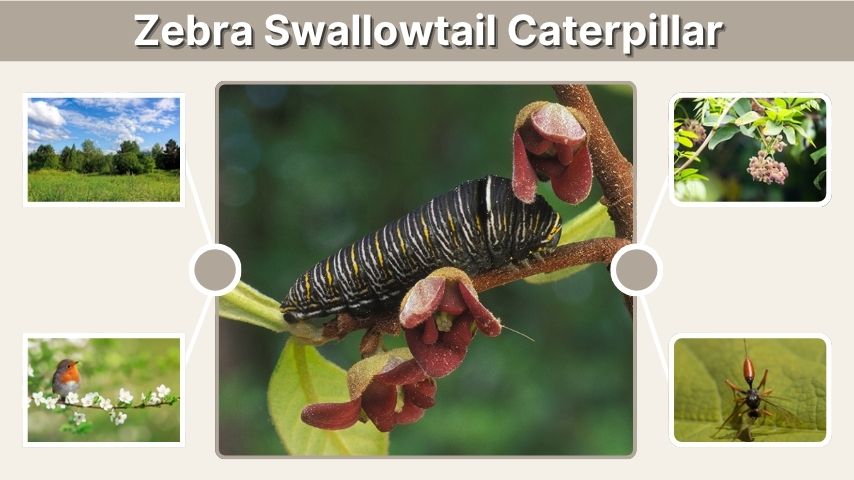
The zebra swallowtail caterpillar is the young larval stage of the zebra swallowtail butterfly, a striking black-and-white butterfly found in the eastern United States. While the adult butterfly is known for its long tails and zebra-like wing pattern, the caterpillar has its own fascinating story. Its life is closely tied to pawpaw trees, making this species a perfect example of how one plant can support an entire butterfly life cycle.
What Is a Zebra Swallowtail Caterpillar?
The zebra swallowtail caterpillar is the larva of the zebra swallowtail butterfly, scientifically known as Protographium marcellus. Some older references may also list the species as Eurytides marcellus. Like all butterflies, the zebra swallowtail goes through complete metamorphosis: egg, caterpillar, chrysalis, and adult.
The caterpillar stage is focused almost entirely on feeding and growth. During this period, the larva eats pawpaw leaves, molts several times, and stores energy for pupation. Although it may look small and delicate, it is highly specialized for survival on a specific host plant.
Unlike many garden caterpillars that feed on a wide range of plants, zebra swallowtail caterpillars are specialists. They rely on pawpaw species, especially common pawpaw, Asimina triloba, across much of their range. Pawpaw is widely recognized as an important food source for zebra swallowtail larvae.
What Does a Zebra Swallowtail Caterpillar Look Like?
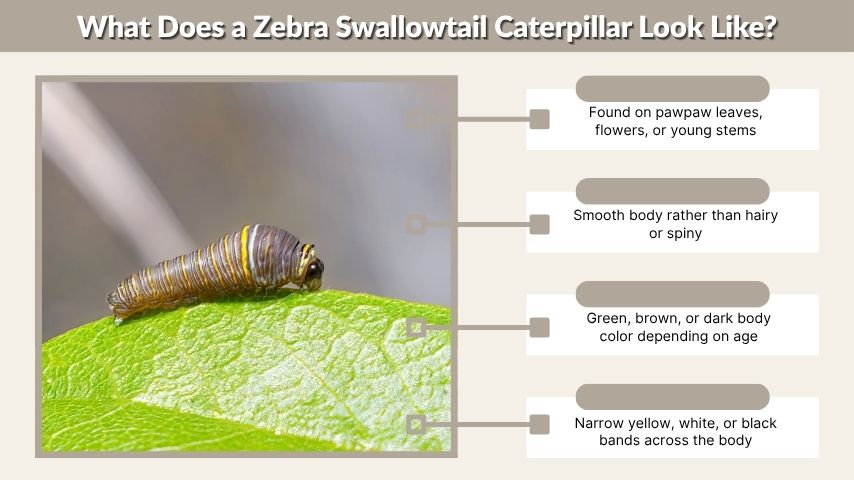
Zebra swallowtail caterpillars change appearance as they grow. Young larvae are often darker and may have striping that helps them blend into leaf shadows, stems, or damaged plant tissue. As they mature, they can become green, yellow-green, brownish, or dark with narrow bands.
A full-grown caterpillar often has a smooth, slightly plump body with fine stripes running across it. Some individuals show pale green bodies with yellow, white, and black striping, while others are darker with yellow or whitish bands. This variation can make identification confusing, but the host plant is an important clue.
Common Identification Features
- Found on pawpaw leaves, flowers, or young stems
- Smooth body rather than hairy or spiny
- Green, brown, or dark body color depending on age
- Narrow yellow, white, or black bands across the body
- Slightly swollen front section in later stages
- Usually seen alone rather than in large groups
The caterpillar may also have a defensive organ called an osmeterium, which is common in swallowtail caterpillars. When disturbed, this forked organ can be pushed out from behind the head and may release an unpleasant odor to discourage predators.
The Pawpaw Connection
The most important thing to know about zebra swallowtail caterpillars is that they depend on pawpaw. Females lay eggs on pawpaw leaves, and the caterpillars hatch directly onto the food they need. In North Carolina, Extension sources describe pawpaw and small-flowered pawpaw as critical larval food sources for this butterfly.
Pawpaw trees grow in rich woods, stream banks, shaded edges, and naturalized landscapes. Their broad leaves provide food for the caterpillars, while their thickets create the sheltered habitat adult butterflies search when laying eggs.
Why Pawpaw Matters
Pawpaw is not just a random food choice. Zebra swallowtail caterpillars are adapted to chemicals in pawpaw leaves. These compounds may help make the caterpillars less appealing to predators. Because the caterpillars are so closely connected to pawpaw, the butterfly’s range and abundance often depend on where pawpaw grows.
For gardeners, this means planting pawpaw is one of the best ways to support zebra swallowtails. Nectar flowers may attract adult butterflies, but pawpaw gives them a place to reproduce.
Life Cycle of the Zebra Swallowtail Caterpillar
The zebra swallowtail life cycle begins when a female butterfly lays an egg on a pawpaw leaf. Eggs are usually laid singly rather than in clusters. This helps reduce competition because each caterpillar needs access to fresh leaves after hatching. BugGuide notes that eggs are laid singly on the host plant and that larvae feed on pawpaw species.
Once the egg hatches, the tiny caterpillar begins feeding. It eats and grows through several stages called instars. Each time the caterpillar outgrows its skin, it molts. After reaching full size, it stops feeding, empties its gut, and searches for a suitable place to pupate. University of Florida information notes that full-grown larvae begin wandering before pupation and usually pupate on the undersides of living or dead host-plant leaves.
Basic Life Cycle Stages
- Egg laid singly on a pawpaw leaf
- Tiny caterpillar hatches and begins feeding
- Larva grows through several molts
- Mature caterpillar stops feeding and wanders
- Chrysalis forms on or near the host plant
- Adult zebra swallowtail emerges
In warm regions, zebra swallowtails may have multiple generations in one year. In colder areas, development slows, and the chrysalis may overwinter before the adult butterfly emerges.
Habitat and Range
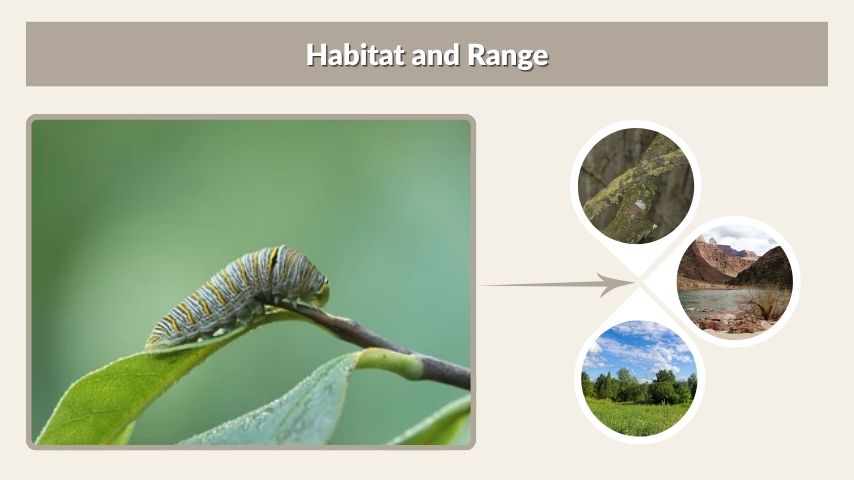
The zebra swallowtail is mostly associated with the eastern United States, especially where pawpaw grows naturally. It is often found near moist woods, river bottoms, forest edges, shaded trails, and naturalized gardens with pawpaw trees.
Because the caterpillar cannot survive without its host plant, adult zebra swallowtails are strongly linked to pawpaw patches. You may see adults flying along woodland edges, near streams, or around clearings where pawpaw thickets grow nearby.
Places to Look for Caterpillars
- Undersides of pawpaw leaves
- Young pawpaw shoots in spring and summer
- Pawpaw thickets near streams or wooded areas
- Native plant gardens with established pawpaw
- Leaf edges with small feeding marks
- Shaded woodland borders
When searching, look carefully and gently. Caterpillars may rest along the midrib or underside of leaves where they are harder to see.
What Zebra Swallowtail Caterpillars Eat
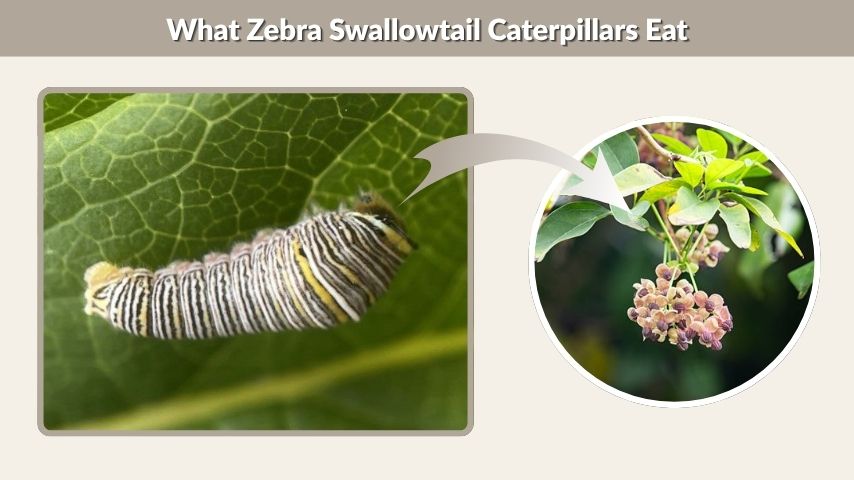
Zebra swallowtail caterpillars eat pawpaw leaves. In many areas, common pawpaw is the main host plant. Other Asimina species may also serve as hosts depending on region. The adult butterflies, however, feed on nectar from flowers and are not limited to pawpaw for food.
| Life Stage | Main Food Source | Notes |
|---|---|---|
| Egg | None | Laid on pawpaw leaves |
| Caterpillar | Pawpaw leaves | Main growth stage |
| Chrysalis | None | Uses stored energy |
| Adult butterfly | Flower nectar and minerals | Needs host plants for egg-laying |
This difference between caterpillar food and adult food is important. A garden with many flowers may attract adult butterflies, but without pawpaw, it cannot support the caterpillar stage.
Are Zebra Swallowtail Caterpillars Harmful?
Zebra swallowtail caterpillars are not harmful to people. They do not sting, bite, or damage homes. They may chew pawpaw leaves, but they usually do not cause serious harm to healthy, established trees.
A small pawpaw seedling may lose more leaf tissue if several caterpillars feed on it, but in most natural settings, the damage is minor. Since zebra swallowtails are native butterflies, their caterpillars are generally considered welcome visitors rather than pests.
If you find one on your pawpaw tree, the best response is usually to leave it alone. The caterpillar is part of a natural relationship between the butterfly and the plant.
Natural Defenses and Predators
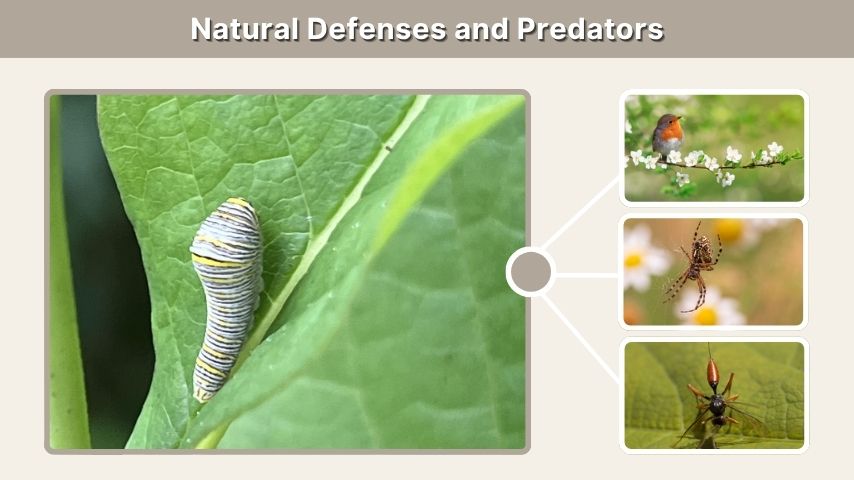
Like many caterpillars, zebra swallowtail larvae face threats from birds, spiders, predatory insects, parasitic wasps, and weather. Their coloration helps them blend into their surroundings, while the osmeterium provides chemical defense when they are disturbed.
The pawpaw diet may also offer protection. Pawpaw plants contain compounds that can be unpleasant or toxic to some animals. By feeding on pawpaw, caterpillars may gain a defensive advantage over species that feed on more ordinary leaves.
Survival Strategies
- Blending with leaf surfaces and shadows
- Resting on leaf undersides
- Feeding alone rather than in obvious groups
- Using an osmeterium when disturbed
- Relying on pawpaw chemistry for protection
Even with these defenses, many caterpillars do not survive to adulthood. This is normal in butterfly life cycles and helps explain why females lay multiple eggs across host plants.
How to Support Zebra Swallowtail Caterpillars
The best way to support zebra swallowtail caterpillars is to grow pawpaw trees and protect natural pawpaw patches. Pawpaw does well in woodland, riparian, naturalized, pollinator, and rain garden settings, making it useful for wildlife-friendly landscapes.
Young pawpaw trees often prefer some shade and consistent moisture, while mature trees can handle more sun. If you plant pawpaw, choose a location where it has room to spread and develop naturally.
Butterfly-Friendly Garden Tips
- Plant native pawpaw species suited to your region
- Avoid spraying insecticides on or near host plants
- Keep some leaf litter and natural shelter nearby
- Add nectar flowers for adult butterflies
- Protect young pawpaw trees while they establish
- Allow minor leaf chewing as part of the ecosystem
Avoid moving caterpillars to unrelated plants. A zebra swallowtail caterpillar placed on the wrong plant will not be able to feed properly.
Zebra Swallowtail Caterpillar vs Other Swallowtail Caterpillars
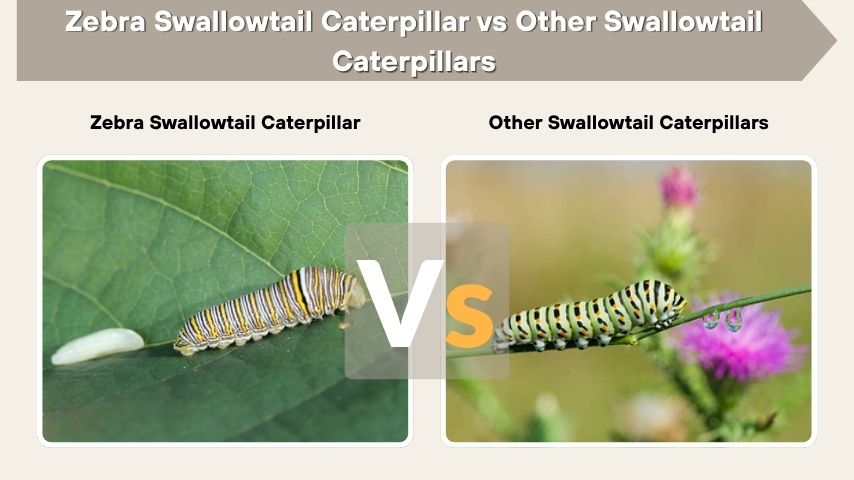
Zebra swallowtail caterpillars can be confused with other swallowtail larvae, especially when they are young or dark-colored. The easiest identification clue is the host plant. If the caterpillar is feeding on pawpaw, it is likely a zebra swallowtail.
Black swallowtail caterpillars usually feed on plants in the carrot family, such as parsley, dill, fennel, and Queen Anne’s lace. Spicebush swallowtail caterpillars feed on spicebush and sassafras. Tiger swallowtail caterpillars use several trees, including cherry, tulip tree, and ash.
Host plant identification often solves the mystery faster than color alone.
FAQs
What does a zebra swallowtail caterpillar turn into?
A zebra swallowtail caterpillar turns into a zebra swallowtail butterfly. After feeding on pawpaw leaves and growing through several molts, the caterpillar forms a chrysalis. Inside the chrysalis, it transforms into the adult butterfly with black-and-white striped wings and long swallowtail tails.
What do zebra swallowtail caterpillars eat?
Zebra swallowtail caterpillars eat pawpaw leaves. Common pawpaw is the main host plant across much of their range, while other Asimina species may also be used in some areas. They should not be moved to unrelated garden plants because they are specialized feeders.
Are zebra swallowtail caterpillars poisonous?
They are not dangerous to touch, but it is best not to handle them. Their pawpaw diet and defensive osmeterium may make them unpleasant to predators. If you need to move one for safety, gently move the leaf it is resting on rather than touching the caterpillar directly.
Where can I find zebra swallowtail caterpillars?
Look for them on pawpaw trees, especially on the undersides of leaves. They are often found in moist woods, streamside areas, forest edges, and native plant gardens where pawpaw grows. Small feeding marks on pawpaw leaves can be a clue that caterpillars are present.
How can I attract zebra swallowtails to my garden?
Plant native pawpaw trees for the caterpillars and provide nectar-rich flowers for adults. Avoid insecticides, protect young pawpaws, and create a naturalized area with some shelter. Adult butterflies may visit flowers, but they need pawpaw nearby to lay eggs.