
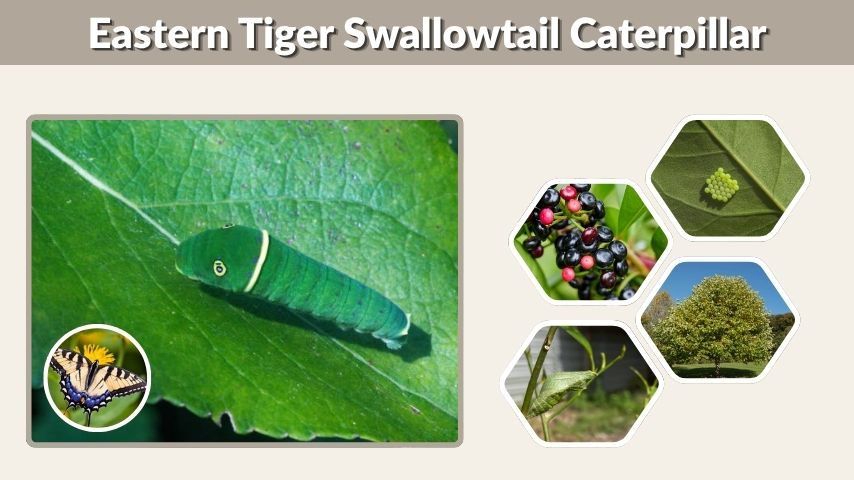
The eastern tiger swallowtail caterpillar is one of the most fascinating caterpillars found in eastern North America. Known for its large false eyespots, smooth green body, and dramatic transformation, this caterpillar eventually becomes the bright yellow eastern tiger swallowtail butterfly. Learning how to identify its stages, food plants, and look-alike species can help gardeners protect this beautiful native butterfly.
What Is an Eastern Tiger Swallowtail Caterpillar?
The eastern tiger swallowtail caterpillar is the larval stage of the eastern tiger swallowtail butterfly, also known by its scientific name, Papilio glaucus. It goes through several growth stages before forming a chrysalis and later emerging as an adult butterfly.
Why People Notice This Caterpillar
Many people first notice this caterpillar because of its unusual “face.” Mature caterpillars are usually green and have large false eyespots near the front of the body. These markings can make the caterpillar look like a tiny snake or cartoon character, which helps scare away predators.
Common reasons people search for it include:
- Finding a green caterpillar with fake eyes
- Seeing one on a tree or shrub
- Trying to identify a brown caterpillar that later turns green
- Wanting to know if it is poisonous or safe to touch
- Looking for host plants to attract swallowtail butterflies
Eastern Tiger Swallowtail Caterpillar Identification
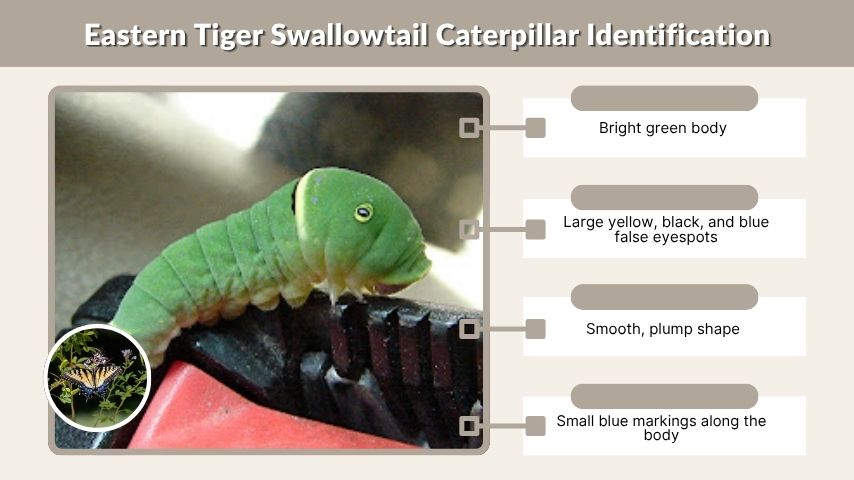
Identification depends on the caterpillar’s stage. Young caterpillars look very different from older ones, so color alone can be misleading.
Early Stage Appearance
In the early stages, the caterpillar often looks brown, blackish, or bird-dropping-like. This camouflage helps it avoid birds and other predators. At this stage, it may not look like the familiar green swallowtail caterpillar people expect.
Early signs include:
- Small brown or dark body
- Pale or whitish saddle-like marking
- Resting on the upper surface of leaves
- Blending in with debris or bird droppings
Mature Caterpillar Appearance
As it grows, the eastern tiger swallowtail caterpillar becomes smooth and green. The most recognizable feature is the pair of false eyespots near the front of its body.
Mature caterpillars usually have:
- Bright green body
- Large yellow, black, and blue false eyespots
- Smooth, plump shape
- Small blue markings along the body
- A slightly swollen front section
The eyespots are not real eyes. They are defensive markings that may make predators hesitate before attacking.
Brown Eastern Tiger Swallowtail Caterpillar
A brown eastern tiger swallowtail caterpillar may be either a young caterpillar or a mature caterpillar preparing to pupate. Before forming a chrysalis, the caterpillar may darken, leave its feeding area, and search for a protected place to transform.
Eastern Tiger Swallowtail Caterpillar Stages
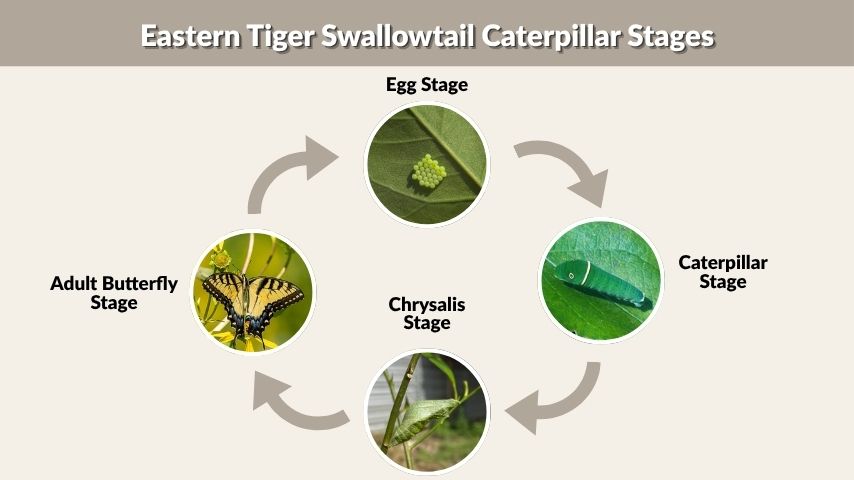
The eastern tiger swallowtail has a complete life cycle with four main stages: egg, caterpillar, chrysalis, and adult butterfly. The caterpillar stage itself includes several molts, also called instars.
| Stage | What Happens | What to Look For |
|---|---|---|
| Egg | Female lays a single egg on a host plant | Tiny round egg on a leaf |
| Young caterpillar | Caterpillar hatches and begins feeding | Brown or bird-dropping-like body |
| Mature caterpillar | Caterpillar grows larger and turns green | Green body with false eyespots |
| Chrysalis | Caterpillar attaches and pupates | Brown or greenish chrysalis |
| Adult butterfly | Butterfly emerges and expands wings | Yellow butterfly with black tiger stripes |
Egg Stage
Female eastern tiger swallowtails lay eggs on suitable host plants. The egg is usually placed singly on a leaf rather than in a large cluster.
Caterpillar Stage
After hatching, the caterpillar eats leaves from its host plant. It molts several times as it grows. Each stage between molts is called an instar.
Chrysalis Stage
When fully grown, the caterpillar stops feeding and looks for a secure place to pupate. It forms a chrysalis, sometimes called a cocoon by casual observers, although butterflies technically form chrysalises rather than true cocoons.
Adult Butterfly Stage
The adult eastern tiger swallowtail butterfly is large, graceful, and usually yellow with black tiger-like stripes. Some females, especially in parts of the southern range, may appear dark.
What Do Eastern Tiger Swallowtail Caterpillars Eat?
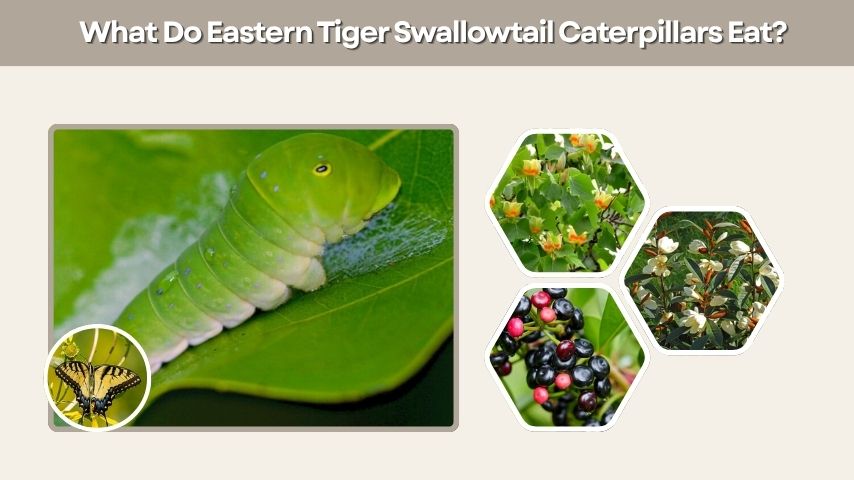
Eastern tiger swallowtail caterpillars eat leaves from specific host plants. They do not feed on just any garden plant, and they are most often associated with trees and woody plants.
Common Host Plants
Eastern tiger swallowtail caterpillar host plants include:
- Tulip tree or tulip poplar
- Wild black cherry
- Sweetbay magnolia
- Ash
- Cottonwood
- Willow
- Hoptree or wafer ash
- Birch in some related tiger swallowtail ranges
If you find a caterpillar on one of these trees, avoid moving it to herbs like parsley or dill. Those plants are used by black swallowtail caterpillars, not eastern tiger swallowtail caterpillars.
Do They Eat Garden Herbs?
Eastern tiger swallowtail caterpillars usually do not eat parsley, dill, fennel, carrot tops, or celery. If you find a striped green, black, and yellow caterpillar on those plants, it is more likely an eastern black swallowtail caterpillar.
Eastern Tiger Swallowtail vs Eastern Black Swallowtail Caterpillar
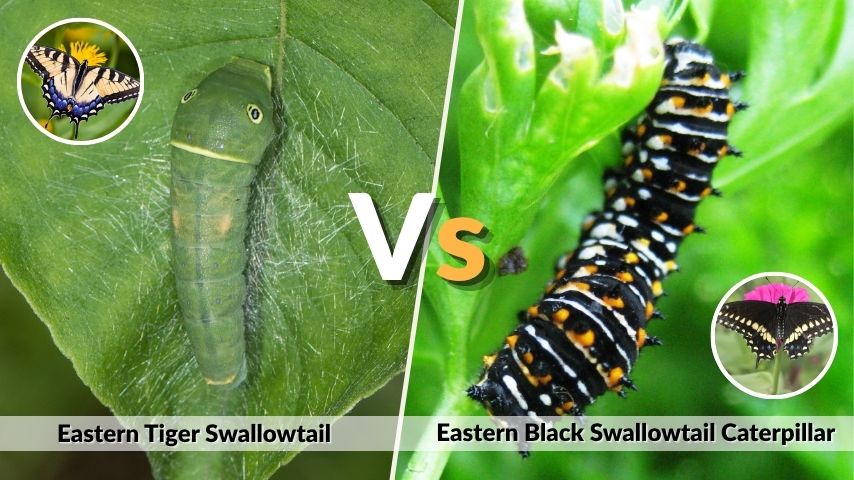
Many people confuse eastern tiger swallowtail caterpillars with eastern black swallowtail caterpillars because both become swallowtail butterflies. However, their caterpillars look and feed differently.
Eastern Tiger Swallowtail Caterpillar
The eastern tiger swallowtail caterpillar is usually found on trees and woody host plants. Mature caterpillars are green with large false eyespots.
Key traits include:
- Green body in later stages
- Big false eyespots
- Tree-feeding habit
- Host plants like tulip tree, wild cherry, magnolia, and ash
Eastern Black Swallowtail Caterpillar
The eastern black swallowtail caterpillar is often called the parsleyworm. It is commonly found on parsley-family plants in gardens.
Key traits include:
- Green, black, and yellow striped body
- Often found on dill, parsley, fennel, carrot, and celery
- No large snake-like false eyespots
- Common in herb and vegetable gardens
Are Eastern Tiger Swallowtail Caterpillars Poisonous?
Eastern tiger swallowtail caterpillars are not considered dangerous to people. They do not sting, and they are not poisonous in the way some brightly colored caterpillars can be.
Can You Touch an Eastern Tiger Swallowtail Caterpillar?
You can gently touch one, but it is better not to handle it unless necessary. Caterpillars are delicate, and oils or pressure from your hands can injure them. If you need to move one, guide it onto a leaf or small twig from its host plant.
Do Eastern Tiger Swallowtail Caterpillars Bite?
They are not known for biting people. Their mouthparts are designed for chewing leaves, not defending themselves against humans. If threatened, they may release a defensive organ called an osmeterium, which can give off an unpleasant smell.
Eastern Tiger Swallowtail Caterpillar Defense
This caterpillar has several clever defenses that help it survive.
Bird-Dropping Mimicry
Young caterpillars often resemble bird droppings. This makes them look unappealing to predators.
Fake Eyes
Older caterpillars have large false eyespots. These markings may make birds or other predators think the caterpillar is larger or more dangerous than it really is.
Osmeterium
When disturbed, swallowtail caterpillars can extend a small forked organ called an osmeterium. It releases a strong smell that may discourage predators.
How to Care for an Eastern Tiger Swallowtail Caterpillar
If you find one in your yard, the best care is usually to leave it on its host plant. Caterpillars need fresh leaves from the correct plant to survive.
Basic Care Tips
If you are observing one closely:
- Keep it on the same host plant where you found it
- Provide fresh, pesticide-free leaves
- Avoid touching it repeatedly
- Keep the container ventilated if temporarily observing indoors
- Do not mix caterpillars from different species
- Release the butterfly after it emerges
Avoid Pesticides
Even organic sprays can harm caterpillars. If you want butterflies in your garden, avoid spraying host plants where eggs or caterpillars may be present.
How to Attract Eastern Tiger Swallowtail Caterpillars
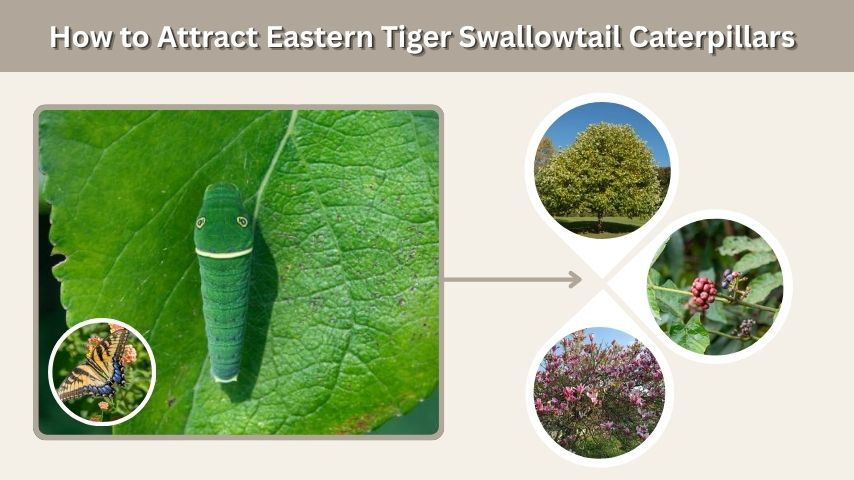
To attract eastern tiger swallowtail caterpillars, you need both host plants for larvae and nectar plants for adults. Adult butterflies visit flowers, but caterpillars need specific trees to feed on.
Plant Host Trees
Consider planting or preserving native host trees such as:
- Tulip tree
- Wild cherry
- Sweetbay magnolia
- Native ash species
- Willow
- Hoptree
Provide Nectar Flowers
Adult eastern tiger swallowtails visit many nectar flowers. A butterfly-friendly garden with blooming plants throughout spring and summer gives adults a reason to stay nearby and lay eggs.
Good garden practices include:
- Growing native flowering plants
- Keeping sunny open areas
- Avoiding insecticides
- Leaving some natural edges or woodland habitat
- Providing shallow muddy or damp areas for butterfly puddling
Eastern Tiger Swallowtail Caterpillar Look-Alikes
Several caterpillars may be confused with the eastern tiger swallowtail, especially when people search for “eastern swallowtail caterpillar.”
Spicebush Swallowtail Caterpillar
The spicebush swallowtail caterpillar also has large false eyespots and a green body. It can look very similar but usually feeds on spicebush and sassafras.
Eastern Black Swallowtail Caterpillar
This caterpillar is striped green, black, and yellow. It is common on parsley, dill, fennel, carrots, and related garden plants.
Giant Swallowtail Caterpillar
The giant swallowtail caterpillar often looks like bird droppings for much of its caterpillar stage. It commonly feeds on citrus-family plants, including prickly ash and rue.
Monarch Caterpillar
Monarch caterpillars have black, white, and yellow bands and feed only on milkweed. They do not have the large false eyespots seen on mature eastern tiger swallowtail caterpillars.
FAQs
What does an eastern tiger swallowtail caterpillar look like?
A mature eastern tiger swallowtail caterpillar is usually green with large false eyespots near the front of its body. Younger caterpillars may look brown, dark, or bird-dropping-like before they turn green in later stages.
What does an eastern tiger swallowtail caterpillar eat?
It eats leaves from host trees and woody plants such as tulip tree, wild cherry, sweetbay magnolia, ash, cottonwood, willow, and hoptree. It does not usually feed on parsley, dill, fennel, or carrot tops.
Is the eastern tiger swallowtail caterpillar poisonous?
No, it is not considered poisonous or dangerous to humans. However, it may use defensive tricks such as false eyespots and a smelly osmeterium to discourage predators when threatened.
Can I raise an eastern tiger swallowtail caterpillar?
Yes, but it must have fresh leaves from the correct host plant. Keep it in a ventilated container, avoid pesticides, do not overhandle it, and release the adult butterfly once it emerges.
Why does my caterpillar look like it has eyes?
The “eyes” are false eyespots, not real eyes. They help protect the caterpillar by making it look larger or more threatening to birds and other predators.