
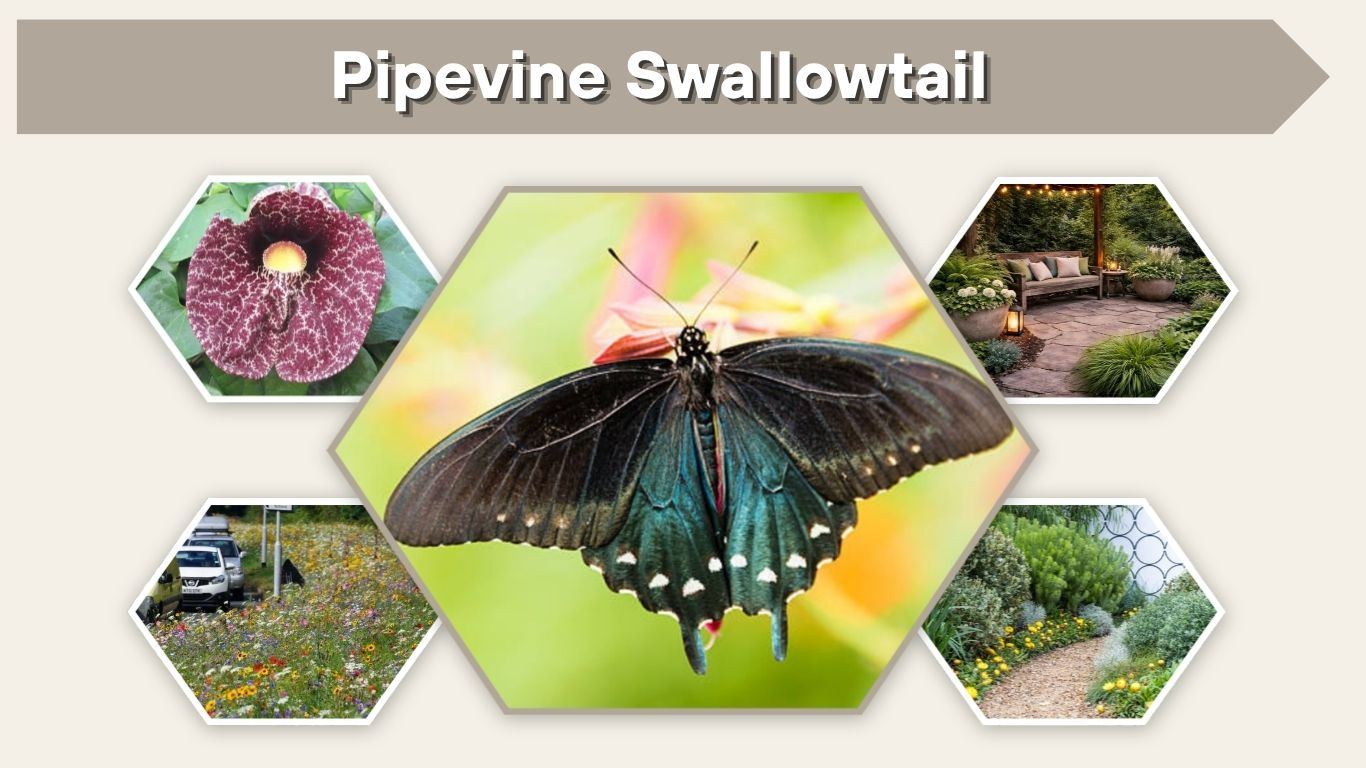
The pipevine swallowtail is a dark, shimmering butterfly best known for its blue-green hindwings, orange underside spots, and unusual relationship with pipevine plants. Its caterpillars feed on Aristolochia species, storing bitter plant compounds that help protect them from predators. From eggs to chrysalis to adult butterfly, this species is one of the most interesting swallowtails found across much of North America.
What Is a Pipevine Swallowtail?
The pipevine swallowtail is a large swallowtail butterfly with the scientific name Battus philenor. It belongs to the family Papilionidae and is also called the blue swallowtail in some regions. Adults are usually seen flying in gardens, woodland edges, meadows, roadsides, and areas where pipevine host plants grow.
Key Identification Features
- Scientific name: Battus philenor
- Family: Papilionidae
- Wingspan: about 2.75 to 5 inches
- Upper wings: mostly black with blue or blue-green shine on the hindwings
- Underside: bright orange spots on a blue-black background
- Body: dark with small pale spots along the sides
- Wing shape: tailed hindwings, like many swallowtails
- Caterpillars: dark red, blackish, or reddish-brown with soft fleshy projections
The underside pattern is one of the best clues for identification. When the butterfly closes its wings, the row of orange spots on the hindwing becomes easier to see. These spots warn predators that the butterfly may taste bad.
Male vs Female Pipevine Swallowtail
Male and female pipevine swallowtails look similar, but they are not identical. Males usually have stronger blue-green iridescence on the upper side of the hindwings. Females are often darker and may show larger pale spots along the outer wing margins.
Females also tend to look slightly less glossy from above. This difference helps when comparing adults in the field, although lighting can make the blue color look brighter or duller. In shaded woodland edges, even males may appear mostly black until sunlight hits the wings.
Pipevine Swallowtail Size
Adult pipevine swallowtails are medium to large butterflies. Their wingspan commonly ranges from about 2.75 to 5 inches. Size may vary depending on location, food quality during the caterpillar stage, climate, and individual development.
Fresh adults often appear sleek and colorful, while older butterflies may have faded wings, torn tails, or missing scales. A worn butterfly can still be identified by the general black body, hindwing shape, and orange underside spots.
Pipevine Swallowtail Range and Habitat
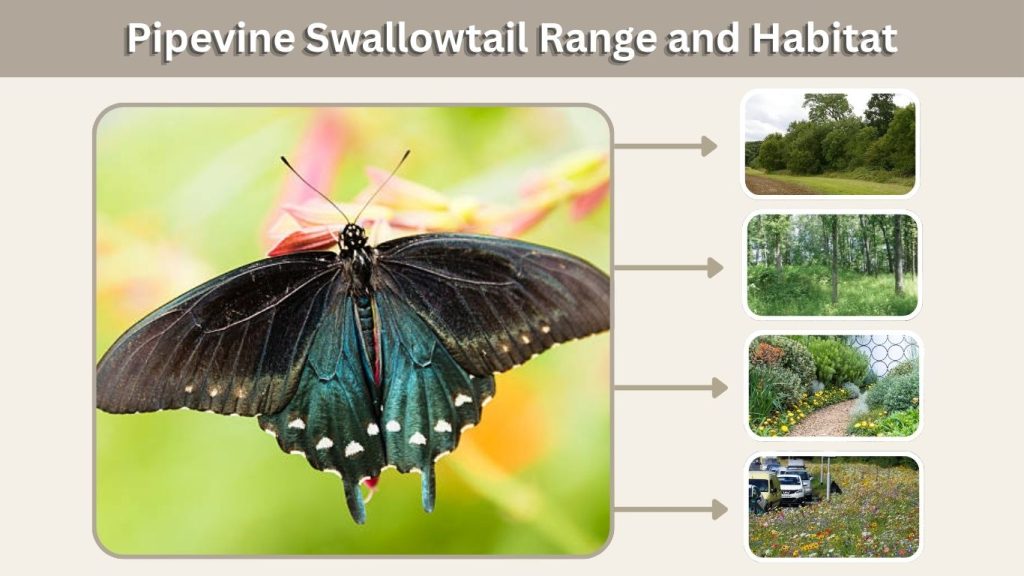
Pipevine swallowtails occur across a wide part of North America, but their local presence depends strongly on host plants. They are most common where native pipevines grow naturally or where people plant safe host plants in gardens.
Where They Live
Pipevine swallowtails are found in many eastern, southern, and southwestern parts of the United States. They also occur in parts of California and other western areas where suitable pipevine species grow. Regional searches often mention Texas, Florida, Arizona, Ohio, Illinois, Michigan, North Carolina, and California because people notice them in gardens and natural habitats.
In the eastern United States, they may be found around woodlands, stream edges, open fields, and gardens. In the West, the California pipevine swallowtail is closely tied to California pipevine and may be more localized.
Preferred Habitat
This butterfly prefers warm places with both nectar flowers and host plants. It may visit:
- Woodland edges
- Open forests
- Meadows
- Native plant gardens
- Streamside areas
- Roadsides
- Brushy fields
- Backyard butterfly gardens
Adults need nectar flowers, but caterpillars need pipevine plants. A garden with flowers but no host plant may attract adults temporarily, but it will not support the full life cycle.
Pipevine Swallowtail in Gardens
Gardeners often attract this species by planting native Aristolochia host plants and nectar flowers. However, choosing the right pipevine is important. Some ornamental or tropical pipevines may not be safe for local caterpillars. Native host plants are usually the best option because local butterflies have adapted to them.
Pipevine Swallowtail Host Plants
Host plants are the most important part of the pipevine swallowtail’s life cycle. Females lay eggs on pipevine plants, and the caterpillars feed on the leaves after hatching. Without the correct host plant, the caterpillars cannot survive.
Common Host Plants
| Host Plant | Scientific Name | Notes |
| Dutchman’s pipe | Aristolochia macrophylla | Common eastern host plant |
| Woolly Dutchman’s pipe | Aristolochia tomentosa | Native to parts of the southeastern and central U.S. |
| Virginia snakeroot | Aristolochia serpentaria | Used by larvae in parts of the eastern U.S. |
| Texas pipevine | Aristolochia reticulata | Important in Texas and nearby areas |
| California pipevine | Aristolochia californica | Key host for California populations |
What Do Pipevine Swallowtail Caterpillars Eat?
Pipevine swallowtail caterpillars eat leaves of Aristolochia plants. They may feed together when young and become more spread out as they grow. Their feeding can make pipevine leaves look ragged, but healthy established vines usually recover.
The caterpillars do not eat parsley, dill, fennel, or carrot tops. Those plants are used by black swallowtail caterpillars, not pipevine swallowtails. This difference is one of the easiest ways to separate the two species during the caterpillar stage.
Nectar Plants for Adults
Adult pipevine swallowtails drink nectar from many flowers. They may visit phlox, thistle, ironweed, milkweed, buttonbush, lantana, zinnia, verbena, and other nectar-rich blooms. Purple, pink, red, and orange flowers often attract them.
A good butterfly garden should include flowers blooming at different times of the season. This gives adults a steady food source while host plants support eggs and caterpillars.
Pipevine Swallowtail Life Cycle
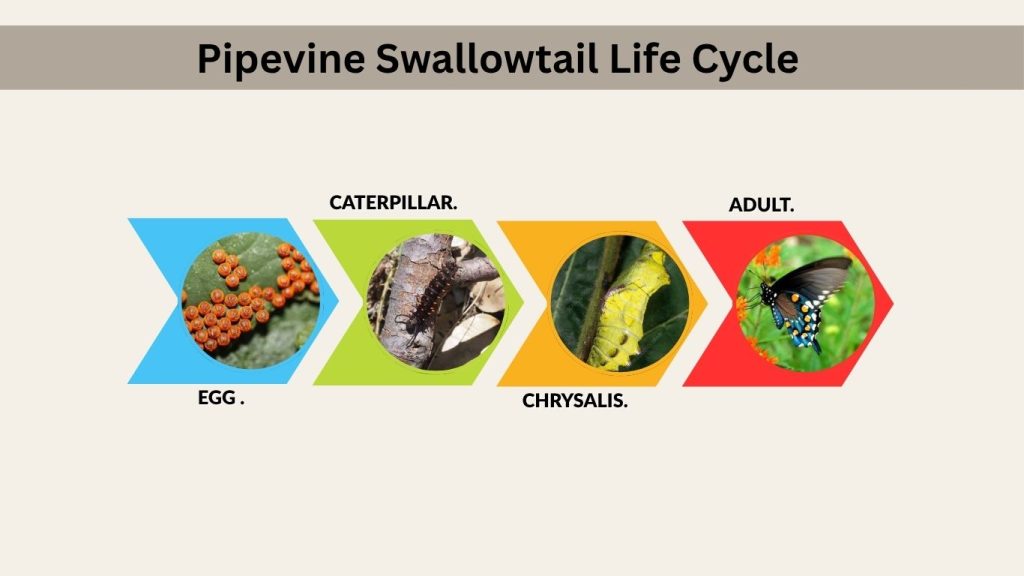
The pipevine swallowtail has a complete life cycle with four main stages: egg, caterpillar, chrysalis, and adult. The number of generations per year depends on climate. Warmer regions may support several broods, while cooler areas may have fewer.
Eggs
Female pipevine swallowtails lay eggs in clusters on host plant leaves or stems. The eggs are small and round, often reddish to orange in color. A female usually chooses young, tender growth because newly hatched caterpillars need fresh leaves.
Eggs hatch after several days, depending on temperature. Warm weather speeds development, while cool weather may slow it down.
Caterpillar Stage
The caterpillar stage is one of the most recognizable parts of this butterfly’s life. Young larvae often feed together in groups. As they grow, they become larger, darker, and more dramatic in appearance.
Pipevine swallowtail caterpillars may look black, reddish, dark brown, or orange-red. Their bodies have soft fleshy projections that can make them look spiny, but they do not have hard stinging spines. These caterpillars are bold in appearance because their color warns predators to avoid them.
Chrysalis or Pupa
After the caterpillar finishes growing, it forms a chrysalis. Many people call this a cocoon, but butterflies form a chrysalis, not a true silk cocoon like many moths. The chrysalis may be brown, greenish, or tan and is usually attached to a stem, wall, fence, or other solid surface.
Some pipevine swallowtails overwinter in the chrysalis stage. In warm seasons, adults may emerge after a shorter pupal period.
Adult Butterfly
The adult emerges from the chrysalis with soft folded wings. It pumps fluid into the wings, waits for them to harden, and then begins flying. Adult butterflies search for nectar, mates, and host plants. Males often patrol likely habitat, while females look for suitable pipevine leaves for egg laying.
Are Pipevine Swallowtails Poisonous?
Pipevine swallowtails are not dangerous to handle in the way bees, wasps, or some stinging caterpillars can be. However, they are considered chemically defended because the caterpillars feed on pipevine plants that contain aristolochic acids. These compounds can make the caterpillars and adults distasteful or toxic to predators if eaten.
Are Caterpillars Poisonous to Touch?
Pipevine swallowtail caterpillars are not known for stinging. Their fleshy projections may look sharp, but they are soft. Still, it is better to avoid unnecessary handling. Caterpillars are delicate, and oils or pressure from human hands can injure them.
If you need to move one, gently guide it onto a leaf or stem from its host plant. After touching any caterpillar or host plant, wash your hands.
Are They Poisonous to Humans?
Pipevine swallowtails are not a threat to people during normal observation. The chemical defense matters mainly when predators try to eat them. People should not eat the caterpillars, butterflies, or host plants. Pipevine plants themselves can contain toxic compounds, so they should be treated with care.
Why Predators Avoid Them
The warning colors of the caterpillar and adult butterfly help teach birds and other predators to avoid them. The orange spots on the adult’s underside and the bold colors of the caterpillar act like a visual warning. This defense is so effective that some other butterflies mimic the pipevine swallowtail’s dark-and-blue appearance.
Pipevine Swallowtail vs Similar Butterflies
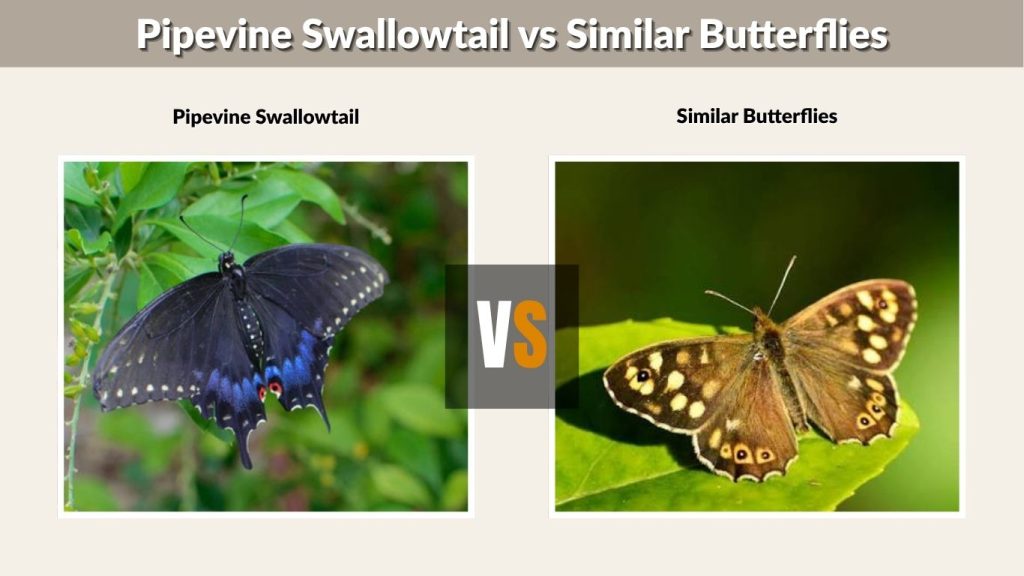
Several dark swallowtails and dark butterflies can look similar at first glance. Careful attention to wing pattern, host plants, and underside markings makes identification easier.
Pipevine Swallowtail vs Black Swallowtail
The black swallowtail often has more yellow spots, especially in females and males. Its caterpillars feed on plants in the carrot family, such as parsley, dill, fennel, and Queen Anne’s lace. Pipevine swallowtails use Aristolochia host plants instead.
Pipevine swallowtails also show a strong row of orange spots on the underside of the hindwing. The blue shine may be stronger and more solid on males, while black swallowtails usually show a more patterned appearance.
Pipevine Swallowtail vs Spicebush Swallowtail
The spicebush swallowtail is another dark butterfly with blue on the hindwings. It usually has pale greenish or bluish spots on the underside, rather than the bold orange spot row seen in the pipevine swallowtail. Its caterpillars feed on spicebush, sassafras, and related plants.
Pipevine swallowtail caterpillars are dark and bumpy-looking, while spicebush swallowtail caterpillars often look like small snakes with large eyespots in later stages.
Pipevine Swallowtail and Mimicry
Because the pipevine swallowtail is distasteful to many predators, other butterflies may gain protection by looking similar. Red-spotted purples and some dark swallowtails can resemble the pipevine swallowtail in color. This mimicry helps reduce attacks from birds that have learned to avoid dark butterflies with blue or warning-like patterns.
California Pipevine Swallowtail
The California pipevine swallowtail is a well-known regional form associated with California pipevine. It is especially valued by butterfly gardeners and native plant enthusiasts in parts of California. Its presence depends on habitat quality and the availability of local host plants.
California Host Plant
California pipevine, Aristolochia californica, is the key host plant for this regional population. It is a native vine that grows in parts of California, often in woodland or riparian habitats. Planting the correct native pipevine can help support local butterflies.
Why Local Host Plants Matter
Using local native host plants reduces the risk of planting unsuitable species. Some nonnative pipevines may attract egg-laying females but fail to support healthy caterpillar development. For conservation gardening, native and regionally appropriate species are the safest choice.
Is It Rare?
The pipevine swallowtail is not globally rare, but local abundance can vary. In some areas it may be common, while in others it may be uncommon or tied to scattered host plant patches. Habitat loss, lack of host plants, pesticide use, and poor plant choices can all reduce local populations.
How to Attract Pipevine Swallowtails
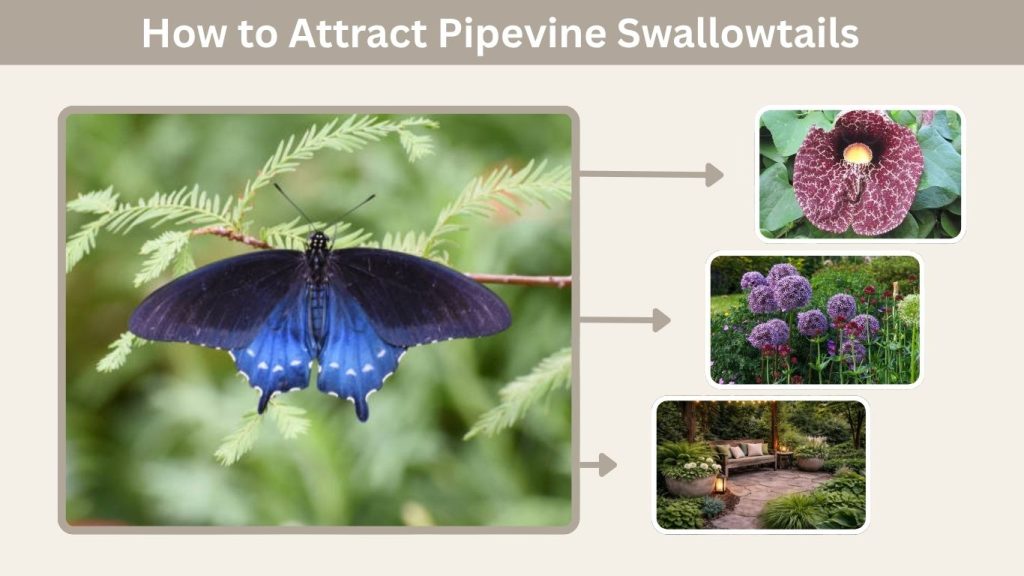
Attracting pipevine swallowtails means supporting both adults and caterpillars. Nectar flowers bring adult butterflies into the garden, but host plants allow them to reproduce.
Garden Setup Tips
- Plant native Aristolochia species suitable for your region
- Add nectar flowers that bloom from spring through fall
- Avoid broad insecticide use around host plants
- Leave some caterpillar feeding damage on pipevine leaves
- Provide sunny edges and sheltered spots
- Use native plants whenever possible
- Keep host plants healthy with proper watering and space
A pipevine swallowtail garden may look a little wild during caterpillar season. Chewed leaves are a sign that the plant is doing its job.
Safe Plant Choice
Before buying pipevine, check whether the species is safe for your local pipevine swallowtails. Native plant nurseries, extension offices, and regional butterfly groups can help identify the right plant. Avoid unknown tropical pipevines unless you are certain they are suitable for the species in your area.
Avoid Pesticides
Caterpillars are sensitive to pesticides. Even products used for other pests can harm butterfly larvae. If you want pipevine swallowtails, keep host plants untreated and avoid spraying nearby flowers that adult butterflies visit.
FAQs
What is the host plant for pipevine swallowtail?
The host plants are Aristolochia species, commonly called pipevines or Dutchman’s pipe. Examples include Dutchman’s pipe, woolly Dutchman’s pipe, Virginia snakeroot, Texas pipevine, and California pipevine. The best choice depends on your region, so native local pipevines are usually safest for supporting caterpillars.
Are pipevine swallowtail caterpillars poisonous?
Pipevine swallowtail caterpillars are chemically defended because they feed on pipevine plants that contain aristolochic acids. This makes them distasteful or toxic to many predators if eaten. They are not known for stinging people, but it is still best to avoid handling them unnecessarily.
Can you touch a pipevine swallowtail caterpillar?
You can gently move one if needed, but frequent handling is not recommended. The caterpillars are delicate, and pressure from fingers can injure them. If one must be moved, let it crawl onto a leaf or stem from its host plant, then wash your hands afterward.
What does a pipevine swallowtail chrysalis look like?
The chrysalis is usually brown, tan, or greenish and may look angular or leaflike. It is attached to a surface with silk support. Depending on season and climate, the adult may emerge after a short period, or the butterfly may overwinter in the chrysalis stage.
How do you tell male and female pipevine swallowtails apart?
Males usually have brighter blue-green iridescence on the upper hindwings, while females are often darker and may show larger pale spots along the wing edges. Lighting can affect the appearance, so checking several features together gives the most reliable identification.