
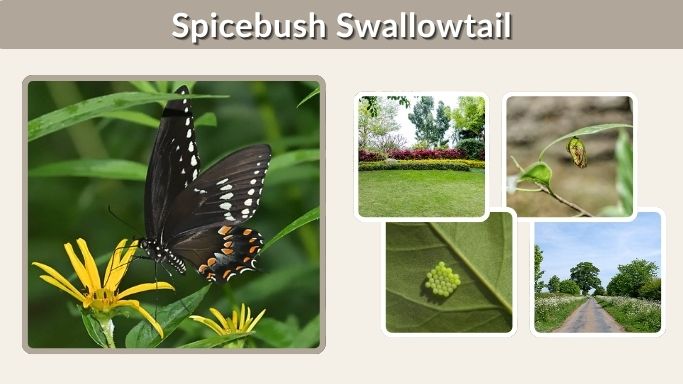
The spicebush swallowtail is a large dark butterfly known for its blue-green hindwings and famous “snake-like” caterpillar. Its caterpillars live on spicebush, sassafras, and related host plants, often hiding inside folded leaves. From tiny eggs to bright green larvae and brown or green chrysalis, this butterfly has one of the most fascinating life cycles among eastern North American swallowtails.
What Is a Spicebush Swallowtail?
The spicebush swallowtail is a black swallowtail butterfly with the scientific name Papilio troilus. It belongs to the swallowtail family, Papilionidae. Adults are strong, fast flyers and are often seen around woodland edges, gardens, roadsides, parks, and damp forest openings where nectar flowers and host plants are available.
Identification
- Scientific name: Papilio troilus
- Common name: Spicebush swallowtail
- Family: Papilionidae
- Adult wingspan: about 3 to 4 inches
- Upper wings: mostly black with pale spots along the edges
- Hindwings: blue-green on males, more blue on females
- Underside: pale greenish or bluish spots on the hindwings
- Caterpillar: green or yellow-orange in later stages with large false eyespots
- Chrysalis: usually green or brown
The adult butterfly can look almost black in shade. In sunlight, the hindwings show a beautiful blue or blue-green glow. The caterpillar is even more memorable because its large false eyespots make it look like a tiny snake.
Male vs Female Spicebush Swallowtail
Male and female spicebush swallowtails look similar, but there are a few useful differences. Males usually have a stronger blue-green wash on the hindwings. Females often show a wider blue area and may look slightly larger or darker overall.
The best way to compare them is to look at the upper side of the hindwings. Males often appear more greenish-blue, while females usually show a deeper blue shade. Lighting can change the appearance, so these differences are easier to see when the butterfly is resting or feeding slowly.
Spicebush Swallowtail Size
The spicebush swallowtail is a medium to large butterfly. Most adults have a wingspan of about 3 to 4 inches. Fresh adults look smooth and colorful, while older butterflies may have faded wings, missing tails, or damaged edges.
Even worn adults can usually be identified by the dark body, tailed hindwings, blue-green hindwing area, and pale greenish spots on the underside.
Spicebush Swallowtail Range and Habitat
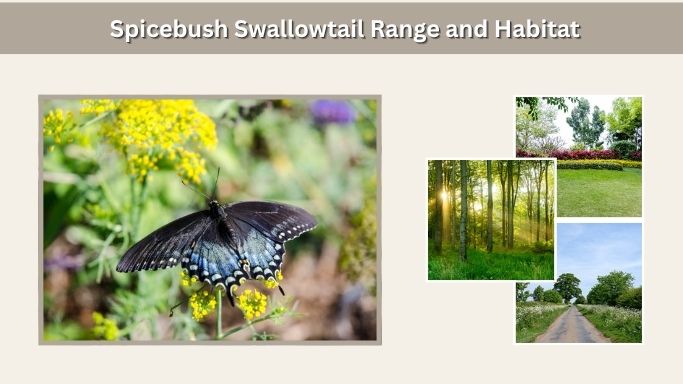
The spicebush swallowtail is mainly an eastern North American butterfly. It is most common where wooded habitat, moisture, nectar flowers, and host plants occur together. Its range can vary locally depending on the availability of spicebush, sassafras, red bay, and similar larval food plants.
Where They Live
Spicebush swallowtails occur across much of the eastern United States and parts of southern Canada. They are also found in Florida, the Southeast, and westward into parts of Texas and Oklahoma. In some northern or western areas of the range, they may be less common.
They are often associated with shady or partly shaded places. Unlike some butterflies that prefer open fields, spicebush swallowtails often fly low and fast through woodland edges and forest paths.
Preferred Habitat
This butterfly is commonly seen in:
- Deciduous woods
- Woody swamps
- Forest edges
- Parks and gardens
- Roadsides
- Pine barrens
- Wetland margins
- Meadows near wooded areas
The caterpillars need host plants, while adults need nectar. A habitat with both is much more valuable than a flower garden alone.
Spicebush Swallowtail in Florida
In Florida, spicebush swallowtails can be common in woodlands, parks, gardens, roadsides, pastures, and meadows. Florida populations may use red bay, swamp bay, sassafras, spicebush, and other related plants. In warm regions, they can have more generations per year than northern populations.
Spicebush Swallowtail Host Plants
Host plants are essential because female spicebush swallowtails lay eggs on leaves that the caterpillars can eat. The butterfly’s name comes from spicebush, one of its most important host plants, but it also uses several related trees and shrubs.
Common Host Plants
| Host Plant | Scientific Name | Notes |
| Spicebush | Lindera benzoin | One of the main host plants |
| Sassafras | Sassafras albidum | Common host in many eastern areas |
| Red bay | Persea borbonia | Important in the Southeast |
| Swamp bay | Persea palustris | Used in wetland and coastal habitats |
| Sweet bay | Magnolia virginiana | Used in some regions |
| Tulip tree | Liriodendron tulipifera | Sometimes reported as a host |
What Do Spicebush Swallowtail Caterpillars Eat?
Spicebush swallowtail caterpillars eat the leaves of their host plants. Spicebush and sassafras are two of the best-known choices. In southern areas, red bay and swamp bay may also be important.
The caterpillars do not eat parsley, dill, fennel, or carrot tops. Those plants are usually associated with black swallowtail caterpillars. If you find a green caterpillar with false eyespots on spicebush or sassafras, it is more likely to be a spicebush swallowtail.
Nectar Plants for Adults
Adult spicebush swallowtails drink nectar from many flowers. They may visit milkweed, thistle, joe-pye weed, ironweed, phlox, coneflower, lantana, verbena, zinnia, buttonbush, and other nectar-rich plants.
A good butterfly garden should include both host plants and nectar plants. Host plants support eggs and caterpillars, while flowers feed adult butterflies.
Spicebush Swallowtail Caterpillar Stages
The caterpillar is one of the main reasons people notice this species. It changes appearance as it grows, moving from a small, dark larva into a bright green or yellow-orange caterpillar with large false eyespots.
Early Caterpillar Stage
Young spicebush swallowtail caterpillars often look dark brown or blackish. This helps them resemble bird droppings, which may protect them from predators. At this stage, they are small and usually stay close to the leaf where they hatched.
They often create a shelter by folding or rolling part of a leaf and holding it with silk. This leaf shelter gives them a hidden place to rest when they are not feeding.
Green Caterpillar With False Eyes
As the caterpillar grows, it becomes green and develops large false eyespots. These spots are not real eyes. They are markings that make the caterpillar look like a small snake or threatening animal.
This mimicry can scare birds and other predators. The caterpillar may also tuck its head down and swell the front part of its body to make the eyespots look even more convincing.
Orange or Yellow Caterpillar Before Chrysalis
Late-stage caterpillars may turn yellowish or orange before pupating. This color change often happens when the caterpillar is ready to leave the host plant and find a safe place to form a chrysalis.
At this stage, it may wander away from the feeding area. This is normal behavior and usually means the caterpillar is preparing for the next stage of life.
Spicebush Swallowtail Life Cycle
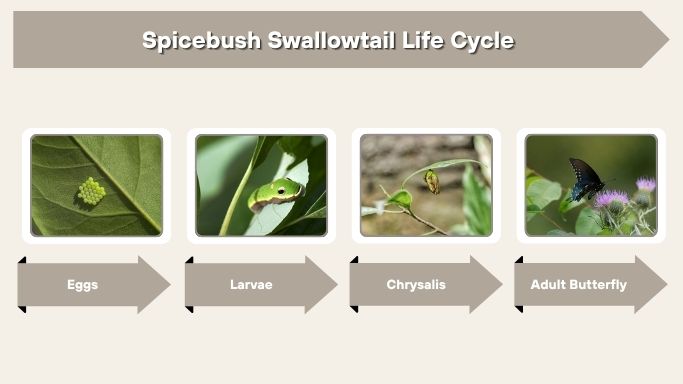
The spicebush swallowtail has a complete life cycle with four stages: egg, caterpillar, chrysalis, and adult butterfly. The number of generations per year depends on climate. Northern areas may have fewer broods, while warm southern regions can support several.
Eggs
Female spicebush swallowtails lay eggs on suitable host plant leaves. The eggs are small and usually laid singly rather than in large clusters. Females choose plants that newly hatched caterpillars can eat immediately.
Egg development depends on weather. Warm conditions usually speed hatching, while cooler temperatures slow it down.
Larvae
After hatching, the caterpillar begins feeding on the host plant. It passes through several growth stages called instars. During these stages, it sheds its skin and becomes larger.
The larva uses several survival tricks. Young caterpillars resemble bird droppings, while older caterpillars resemble snakes. They also hide in folded leaves, which makes them harder for predators to find.
Chrysalis
When fully grown, the caterpillar forms a chrysalis. Many people call this a cocoon, but butterflies form a chrysalis rather than a true cocoon. The chrysalis can be green or brown and is attached to a stem, twig, or another firm surface.
Some pupae develop quickly and emerge as adults in the same season. Others may overwinter and emerge the following year when conditions are right.
Adult Butterfly
The adult butterfly emerges with soft wings that must expand and harden before flight. Adults feed on nectar, search for mates, and continue the life cycle. Males often patrol woodland edges and trails, while females search for host plants where they can lay eggs.
Are Spicebush Swallowtail Caterpillars Poisonous?
Spicebush swallowtail caterpillars are not considered dangerous to people. They do not have stinging spines, and their false eyespots are only a defense display. However, they are delicate insects, so handling should be avoided unless necessary.
Are They Poisonous to Touch?
Spicebush swallowtail caterpillars are generally harmless to touch. The large eyespots may look intimidating, but they are just markings. The caterpillar does not bite or sting in normal situations.
Still, it is best to avoid touching them often. Caterpillars can be injured easily, and oils or pressure from human hands may harm them.
Safe Handling Tips
- Let the caterpillar crawl onto a leaf instead of picking it up
- Avoid squeezing or pinching the body
- Keep it on the correct host plant
- Do not move it far from where it was found
- Wash your hands after contact with insects or plants
- Never use pesticides near caterpillar host plants
If you find one in a leaf shelter, leave the shelter intact. Opening the folded leaf may expose the caterpillar to predators and stress.
Are Adult Spicebush Swallowtails Poisonous?
Adult spicebush swallowtails are not dangerous to humans. They are harmless nectar-feeding butterflies. Their main defense is appearance and behavior, not a threat to people. They should be observed gently and left undisturbed.
Spicebush Swallowtail vs Similar Butterflies
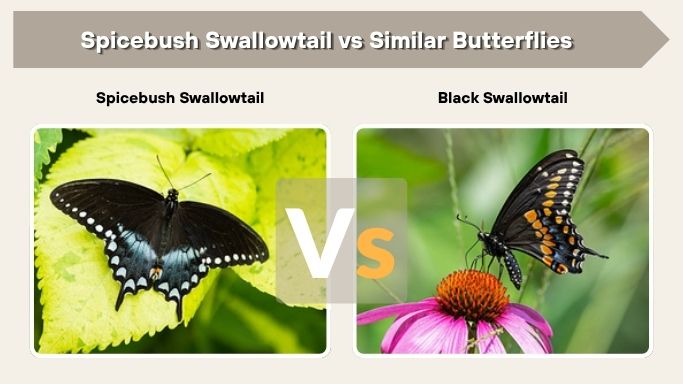
Several dark swallowtail butterflies can look similar. The most common confusion involves black swallowtails, pipevine swallowtails, and sometimes dark female tiger swallowtails. Looking at host plants, wing spots, and caterpillar appearance can help separate them.
Spicebush Swallowtail vs Black Swallowtail
Black swallowtails often have more yellow spots, especially on the upper wing surface. Their caterpillars feed on parsley, dill, fennel, carrot, Queen Anne’s lace, and other carrot-family plants.
Spicebush swallowtail caterpillars feed on spicebush, sassafras, red bay, and related plants. Adults usually show pale greenish spots on the underside of the hindwing, while black swallowtails have a different pattern of yellow, blue, orange, and black markings.
Spicebush Swallowtail vs Pipevine Swallowtail
Pipevine swallowtails are also dark with blue hindwings, but they usually show bright orange spots on the underside of the hindwing. Their caterpillars feed on pipevine plants in the genus Aristolochia.
Spicebush swallowtails usually have pale greenish or bluish spots underneath, not the bold orange row seen in pipevine swallowtails. Their caterpillars are famous for snake-like eyespots and leaf shelters.
Spicebush Swallowtail vs Tiger Swallowtail
A female tiger swallowtail can sometimes be dark and confusing. However, tiger swallowtails are usually larger, and yellow-form individuals show clear tiger-like stripes. Their caterpillars use different host plants, including tulip tree, wild cherry, ash, and others.
Spicebush swallowtails are usually more tied to woodland edges and spicebush-related host plants.
How to Attract Spicebush Swallowtails
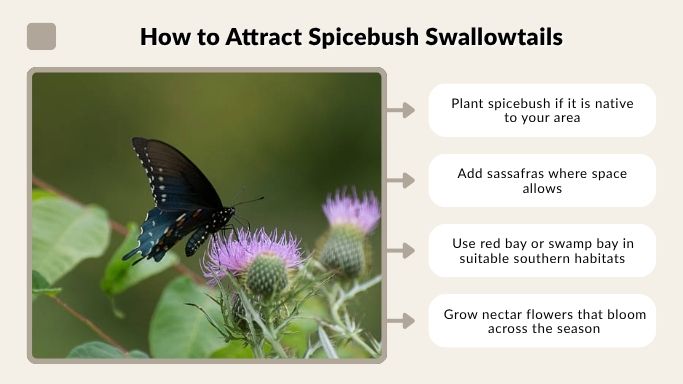
Attracting spicebush swallowtails requires more than planting flowers. Adults need nectar, but females need host plants for eggs. A garden with both can support the full life cycle.
Garden Setup Tips
- Plant spicebush if it is native to your area
- Add sassafras where space allows
- Use red bay or swamp bay in suitable southern habitats
- Grow nectar flowers that bloom across the season
- Avoid pesticides around host and nectar plants
- Keep some leaf shelters undisturbed
- Provide sunny openings near shrubs or woodland edges
Spicebush works especially well in naturalistic gardens, woodland gardens, and moist edges. It can also support other wildlife by providing cover and food.
Best Place to Plant Host Plants
Spicebush grows best in partial shade to light sun and often prefers moist, well-drained soil. Sassafras likes more space and may not fit small gardens. Red bay and swamp bay are better suited to warmer southern regions.
Choose plants based on your region. Native host plants are usually better than random nursery plants because local butterflies are adapted to them.
Avoid Common Mistakes
Do not remove folded leaves if you are trying to raise butterflies naturally. Those folded leaves may contain caterpillars. Also avoid spraying shrubs for insects during caterpillar season. Even mild pesticides can kill larvae.
A little leaf damage is a good sign. It means the plant is supporting butterfly life.
FAQs
What is the host plant for spicebush swallowtail?
The main host plants are spicebush and sassafras. In some regions, caterpillars also use red bay, swamp bay, sweet bay, and related plants. The best host plant depends on your location. Native local plants are usually the safest choice for supporting healthy caterpillar development.
What does a spicebush swallowtail caterpillar eat?
A spicebush swallowtail caterpillar eats leaves from host plants such as spicebush, sassafras, red bay, and swamp bay. It does not feed on parsley, dill, or fennel. Those plants are more closely linked with black swallowtail caterpillars.
Is the spicebush swallowtail caterpillar poisonous?
The spicebush swallowtail caterpillar is not considered dangerous to people and does not have stinging spines. Its large eyespots are a defense trick, not real eyes. It is best to avoid unnecessary handling because caterpillars are soft-bodied and easy to injure.
Why does the spicebush swallowtail caterpillar look like a snake?
Older caterpillars have large false eyespots and a swollen front body that make them look like a small snake. This mimicry can scare birds and other predators. Younger caterpillars use a different strategy by looking more like bird droppings.
How long do spicebush swallowtail butterflies live?
The adult butterfly stage usually lasts only a few weeks, depending on weather, predators, and food availability. The full life cycle is longer because it includes egg, caterpillar, and chrysalis stages. In some regions, the chrysalis may overwinter before the adult emerges.