
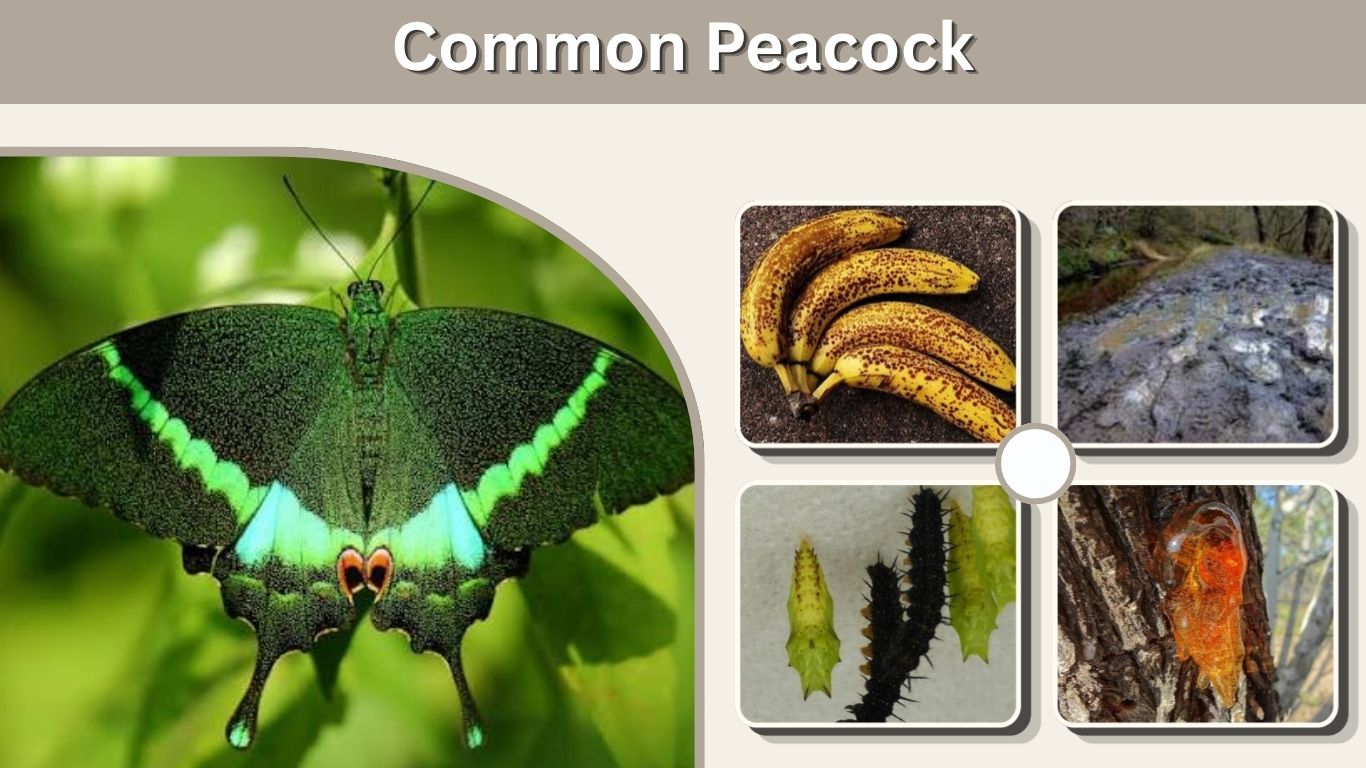
The common peacock is a large Asian swallowtail butterfly admired for its shimmering green-blue wings and long hindwing tails. Its scientific name is Papilio bianor, and it belongs to the swallowtail family Papilionidae. The butterfly occurs across parts of East, South, and Southeast Asia, particularly in forested and mountainous regions. Its caterpillars feed primarily on plants in the citrus family, Rutaceae.
Common Peacock Quick Facts
| Feature | Description |
| Scientific name | Papilio bianor |
| Family | Papilionidae |
| Order | Lepidoptera |
| Other names | Chinese peacock and Chinese peacock swallowtail |
| Wingspan | Approximately 80–110 mm, sometimes larger |
| Main colors | Black with iridescent green, blue, and red markings |
| Caterpillar diet | Mainly plants in the citrus family |
| Adult diet | Flower nectar and minerals from damp ground |
| Habitat | Forests, mountain valleys, woodland edges, and gardens |
| Distribution | East, South, and Southeast Asia |
Its wingspan varies among regions and subspecies, but adults commonly measure approximately 80–110 mm across the open wings.
What Does a Common Peacock Butterfly Look Like?
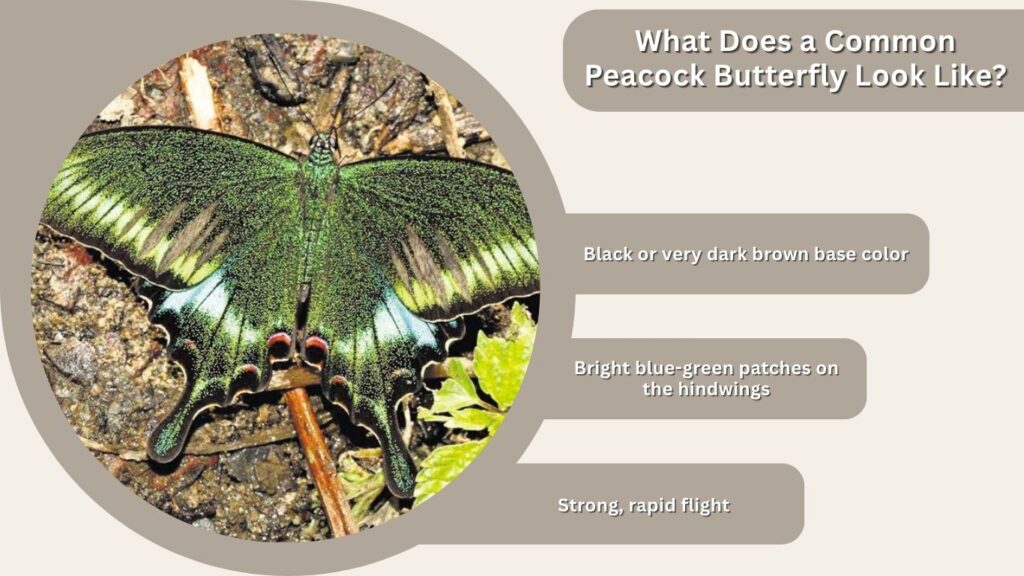
The common peacock has dark wings covered with thousands of metallic scales. In direct sunlight, these scales reflect green, turquoise, blue, or bronze colors. In shade, the same butterfly may appear almost black.
Identification Features
- Large swallowtail body and broad wings
- Black or very dark brown base color
- Metallic green or blue scales across all four wings
- Bright blue-green patches on the hindwings
- Red or orange crescent-shaped markings near the hindwing margins
- One long tail extending from each hindwing
- Dark body dusted with green scales
- Strong, rapid flight
The colors are produced by a combination of pigments and microscopic structures in the wing scales. Changing the viewing angle alters the reflected light, explaining why the wings seem to change color as the butterfly moves.
Male Common Peacock
Males are normally more intensely iridescent than females. Their green-blue scales may cover much of the upper wing surface, while the hindwings carry brilliant blue patches and red marginal markings.
Males frequently patrol paths, riverbanks, forest clearings, and ridges in search of females. They may also gather on damp ground to absorb salts and minerals—a behavior called mud-puddling.
Female Common Peacock
Females are generally larger, with broader and more rounded wings. Their green scaling may appear less brilliant or more widely scattered, although appearance varies considerably between populations.
A female searches for suitable host plants before placing her eggs individually on young leaves. Correct plant selection is essential because newly hatched caterpillars cannot travel far to find another food source.
Common Peacock Butterfly Distribution
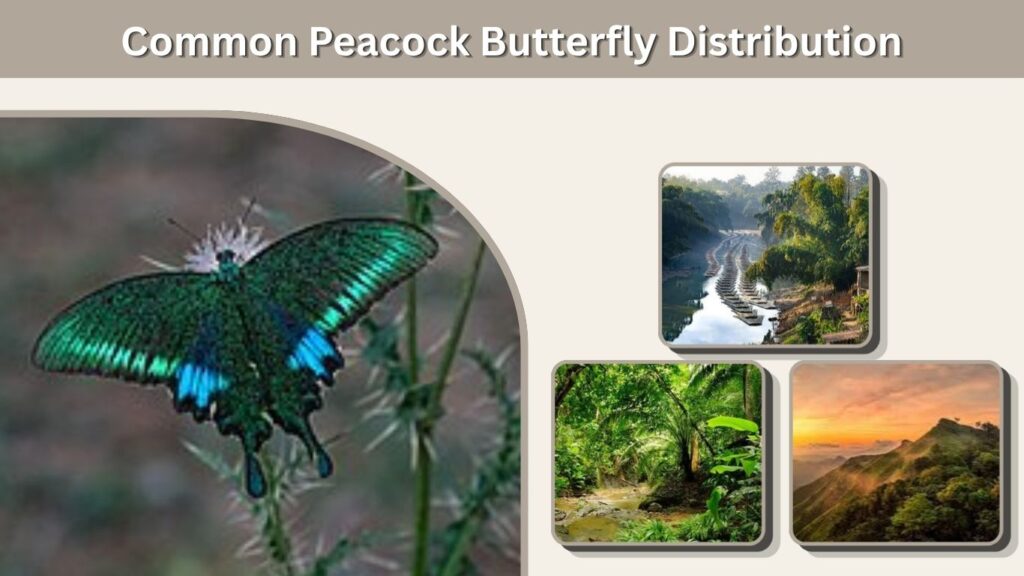
Papilio bianor has a broad Asian range extending from southeastern Russia through China, Korea, Japan, parts of India, Myanmar, Thailand, and Vietnam. In India, currently recognized populations occur mainly in the eastern Himalayas and northeastern states.
Indian records include:
- Arunachal Pradesh
- Assam
- Manipur
- Meghalaya
- Mizoram
- Nagaland
- Sikkim
- West Bengal
Older records may also list the common peacock from the western Himalayas, including Uttarakhand, Himachal Pradesh, and Jammu and Kashmir. However, recent taxonomic work separates the western Himalayan form as the woolly-branded peacock, Papilio polyctor.
Common Peacock Butterfly in Uttarakhand
Uttarakhand officially selected the common peacock as its state butterfly when the western Himalayan population was classified as Papilio bianor polyctor. Modern taxonomy now treats that population as a separate species, Papilio polyctor. Consequently, the butterfly historically called Uttarakhand’s common peacock is more accurately referred to as the woolly-branded peacock.
This change does not mean the state selected a different butterfly. It reflects a scientific revision in how the same population is classified.
Habitat and Behavior
Common peacock butterflies favor wooded landscapes where larval host plants and nectar-producing flowers are available. They may inhabit lowland forest, mountain woodland, river valleys, forest edges, clearings, and gardens near suitable habitat.
Adults are powerful fliers. They often move rapidly through the canopy but descend to visit flowers, damp soil, animal droppings, or mineral-rich streambanks. Males may repeatedly patrol the same route and defend favorable locations from other butterflies.
The species can also occur in suburban and urban areas when appropriate host plants remain available. However, forest loss and removal of native food plants can reduce local populations.
What Do Common Peacock Butterflies Eat?
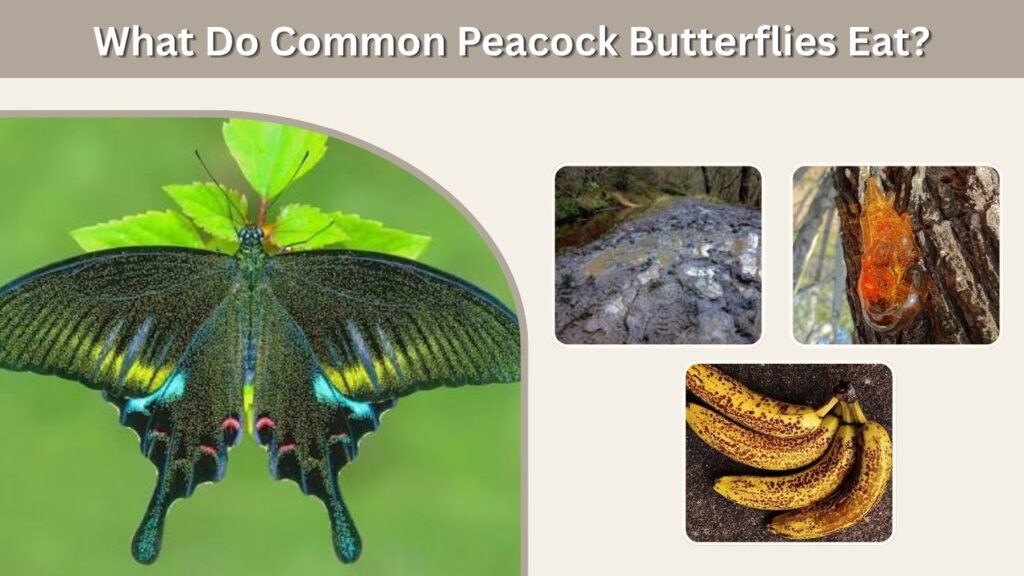
Adult butterflies use a long, coiled feeding tube called a proboscis to drink liquids. Their primary energy source is sugar-rich flower nectar.
Adults may visit many flowering plants and can also obtain moisture and minerals from:
- Damp soil
- Riverbanks
- Muddy paths
- Tree sap
- Overripe fruit
- Animal dung
Male swallowtails are especially likely to engage in mud-puddling because minerals such as sodium can support reproduction.
Common Peacock Caterpillar
The common peacock caterpillar looks completely different from the adult. Young caterpillars are dark brown and marked with pale patches, giving them an appearance similar to bird droppings. This disguise may discourage birds and other predators.
Caterpillar Identification
As the caterpillar grows, it becomes:
- Bright or dark green
- Thick-bodied and smooth
- Marked with pale diagonal bands
- Equipped with false eyespots near the front
- Well camouflaged against green leaves
The false eyespots can make the front of the caterpillar resemble a small snake. Its actual head is positioned beneath the enlarged front portion of the body.
When threatened, the caterpillar can extend an orange or reddish forked organ called an osmeterium from behind its head. This structure releases a strong odor that may repel ants, birds, and other predators.
Common Peacock Caterpillar Host Plants
Common peacock larvae mainly eat plants in the Rutaceae, or citrus family. Recorded host plants include species of:
- Zanthoxylum
- Orixa
- Phellodendron
- Tetradium
- Citrus
Studies have shown that females respond to chemical compounds and odors released by these plants when selecting places to lay eggs. Zanthoxylum and Orixa species are particularly important to several populations.
Common Peacock Life Cycle
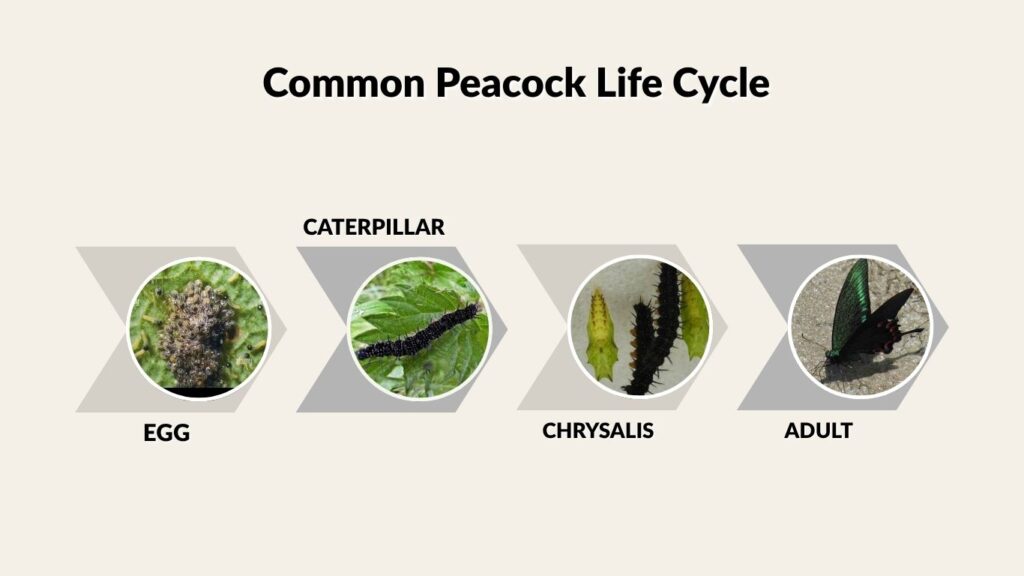
The common peacock undergoes complete metamorphosis through four stages: egg, caterpillar, chrysalis, and adult.
Egg
A female lays a round egg on a suitable host plant. She normally places eggs separately rather than creating a large cluster. The young larva begins feeding after hatching.
Caterpillar
The caterpillar passes through several growth stages called instars. It must shed its skin each time its body becomes too large for the existing outer covering.
During the early stages, its bird-dropping disguise provides protection. Older caterpillars become green and blend into the foliage.
Chrysalis
Once fully grown, the caterpillar attaches itself to a stem or branch with a silk pad and a supporting silk band around its body. It then transforms into a chrysalis.
The chrysalis may be green or brown, allowing it to resemble surrounding leaves, twigs, or bark. Some individuals remain dormant through unfavorable seasons before emerging.
Adult Butterfly
The adult splits the chrysalis and pulls itself free. Its wings initially appear soft and folded. The butterfly pumps fluid into them, waits for them to expand and harden, and then takes its first flight.
Under warm rearing conditions, the species’ complete development may take approximately 40–50 days. Outdoor development can take longer depending on temperature, season, food quality, and whether the chrysalis enters dormancy.
Common Peacock vs Common Banded Peacock
The common peacock and common banded peacock are separate species despite their similar names and colors.
| Feature | Common Peacock | Common Banded Peacock |
| Scientific name | Papilio bianor | Papilio crino |
| Main pattern | Green scales spread across the wings | More defined blue-green transverse band |
| Distribution | Primarily East Asia, northeastern India, and Southeast Asia | Indian subcontinent and Sri Lanka |
| Hindwing | Iridescent patches with red marginal markings | Strong continuous blue-green band |
| Major host plants | Various Rutaceae | Especially Ceylon satinwood and related plants |
The common banded peacock’s bright blue-green band crosses both wings more clearly. Its known range includes India, Nepal, Bhutan, and Sri Lanka.
FAQs
Is the common peacock a butterfly or a bird?
The common peacock is a swallowtail butterfly. Its name comes from the shimmering blue and green colors that resemble the feathers of a peacock bird.
What is the scientific name of the common peacock butterfly?
Its scientific name is Papilio bianor. The species belongs to the butterfly family Papilionidae and the genus Papilio.
Is the common peacock poisonous?
It is not considered dangerous or poisonous to people. Caterpillars can release an unpleasant-smelling defensive secretion, but they do not sting and should simply be left undisturbed.
What plants attract common peacock butterflies?
Adult butterflies are attracted to nectar-producing flowers, while females need Rutaceae host plants for their caterpillars. Zanthoxylum, Orixa, Phellodendron, and certain citrus relatives may support reproduction.
Is the common peacock the same as the European peacock butterfly?
No. The European peacock is Aglais io, a reddish butterfly with large eyespots. The Asian common peacock, Papilio bianor, is a dark green-blue swallowtail with long hindwing tails.