
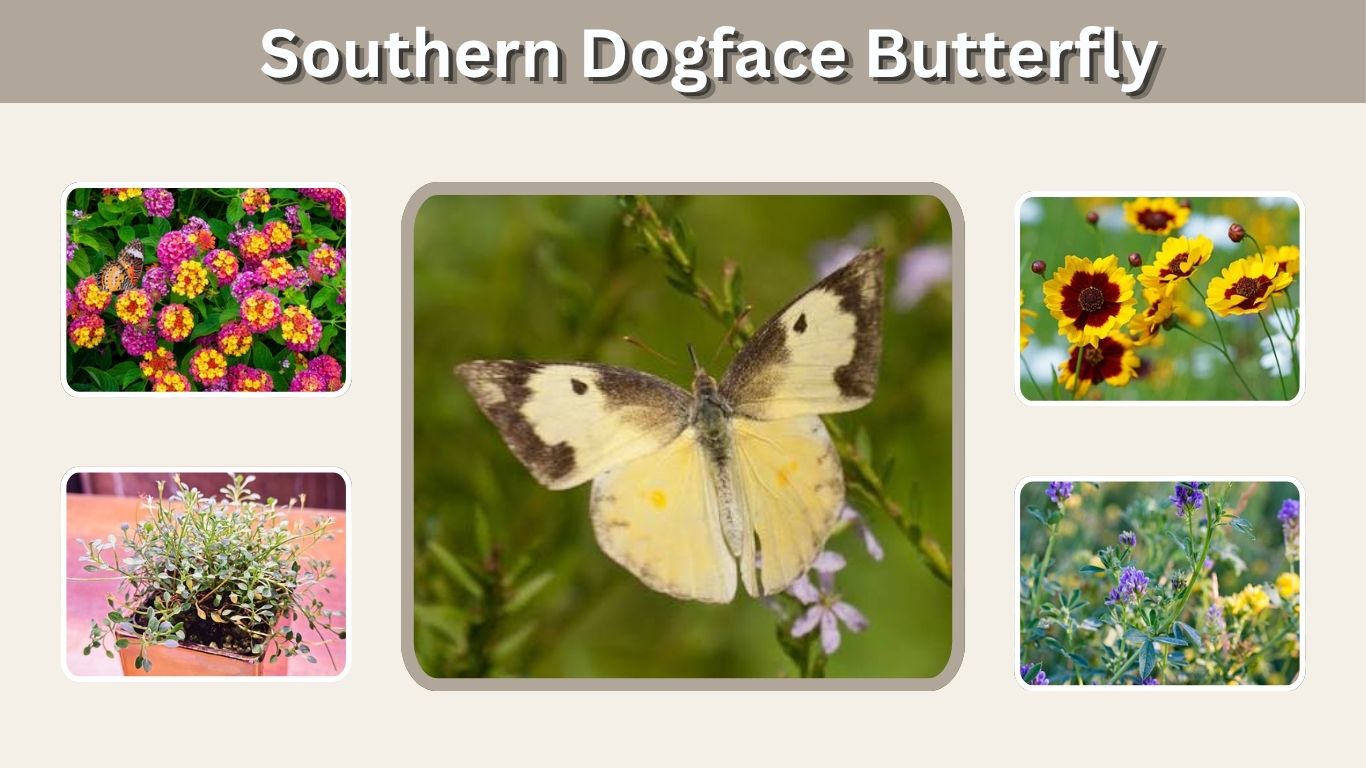
The southern dogface, Zerene cesonia, is a bright-yellow butterfly named for the black marking on each forewing that resembles the profile of a dog’s head. It belongs to the Pieridae family, which includes whites, yellows, and sulphurs. Southern dogfaces inhabit prairies, roadsides, pastures, open woodlands, and other sunny habitats from South America into the southern United States, with seasonal movements much farther north.
Southern Dogface Quick Facts
| Feature | Description |
| Scientific name | Zerene cesonia |
| Family | Pieridae |
| Subfamily | Coliadinae |
| Wingspan | About 2⅛–3 inches |
| Main color | Bright yellow with black markings |
| Caterpillar color | Green with pale stripes or dark crossbands |
| Habitat | Prairies, roadsides, pastures, and open woodland |
| Caterpillar food | Plants in the pea family |
| Adult food | Flower nectar |
| Human danger | Harmless |
The butterfly was formerly placed in the genus Colias and may appear in older publications as Colias cesonia.
How to Identify a Southern Dogface Butterfly
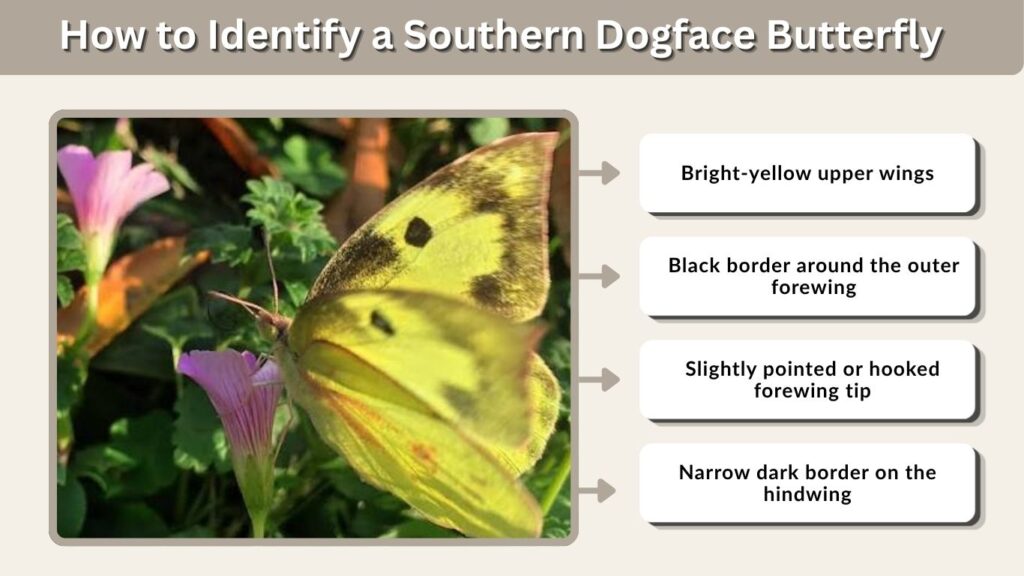
The southern dogface has pointed forewings and bright-yellow upper wing surfaces. Its distinctive black pattern is easiest to see when the butterfly opens its wings in flight or while basking.
Main Identification Features
- Bright-yellow upper wings
- Black border around the outer forewing
- Yellow dog-head shape enclosed by black
- Small dark spot representing the dog’s “eye”
- Slightly pointed or hooked forewing tip
- Narrow dark border on the hindwing
- One dark-ringed spot beneath the forewing
- One or two pale silver spots beneath the hindwing
- Wingspan commonly between 2⅛ and 3 inches
The dog-shaped marking may remain faintly visible through the wings when the butterfly rests with them closed. Other yellow sulphurs can have dark wing borders, but they do not usually show such a recognizable dog-head pattern.
Why Is It Called the Southern Dogface?
The name comes from the pattern on the upper side of each forewing. The surrounding black scales form the outline of a dog’s head, while a small dark spot resembles its eye.
The word “southern” reflects the species’ strongest resident range in warm regions. Populations remain established from South America north into southern Texas and peninsular Florida, although adults frequently disperse northward during warm months.
Male vs Female Southern Dogface
Male and female southern dogfaces share the characteristic dog-head pattern, but their coloration and behavior differ slightly.
| Feature | Male | Female |
| Yellow coloration | Usually brighter | Often paler |
| Black markings | Darker and more defined | Duller or more diffuse |
| Abdomen | Slender | Fuller, especially before egg-laying |
| Typical behavior | Patrols open areas | Searches for host plants |
| Egg-laying | No | Yes |
Males actively patrol open spaces in search of females and may gather on moist soil to absorb salts and minerals. Females spend more time inspecting pea-family plants before placing eggs on suitable leaves.
Seasonal Color Forms
Southern dogfaces can look different depending on the season.
The typical summer or wet-season form has a clear-yellow underside. The cooler-season form, sometimes called the rosa form, develops pink or rosy mottling along the wing margins and veins. Females can show particularly noticeable seasonal variation.
This pink coloration does not indicate a different species. It is a seasonal form of the same butterfly.
Southern Dogface Caterpillar
The southern dogface caterpillar is green and well camouflaged among the leaves of its food plants. Its appearance may vary between individuals.
Caterpillar Identification
- Green head and body
- Fine wrinkles around each segment
- Pale or white stripe along each side
- Orange, yellow, or black spots near the side stripe
- Short black-and-yellow crossbands in some individuals
- Smooth appearance without large spines
- Slender body resembling a plant stem
The caterpillar’s colors make it difficult to notice on clover, prairie clover, alfalfa, and other leafy legumes.
Southern Dogface Host Plants
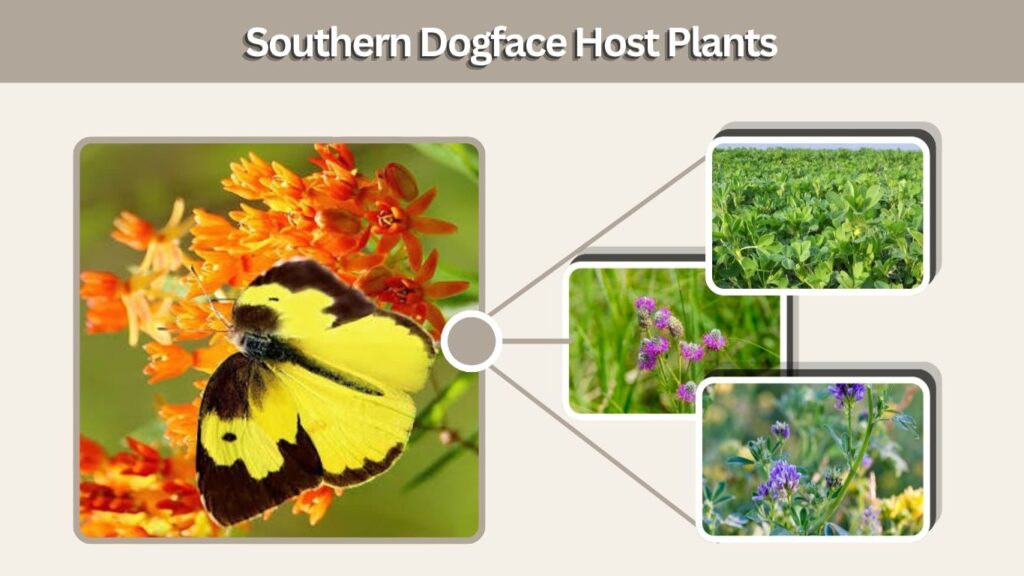
Female southern dogfaces lay their eggs on small-leaved plants in the pea family, Fabaceae. These plants provide food for the caterpillars after hatching.
Common host plants include:
- Alfalfa
- Prairie clovers
- Purple prairie clover
- White and red clovers
- Indigo and leadplant
- False indigo or indigo bush
- Summer farewell
- Soybean
In Florida, documented host plants include summer farewell, Dalea pinnata, and false indigo, Amorpha fruticosa. Host availability helps determine where breeding populations can become established.
What Does the Southern Dogface Eat?
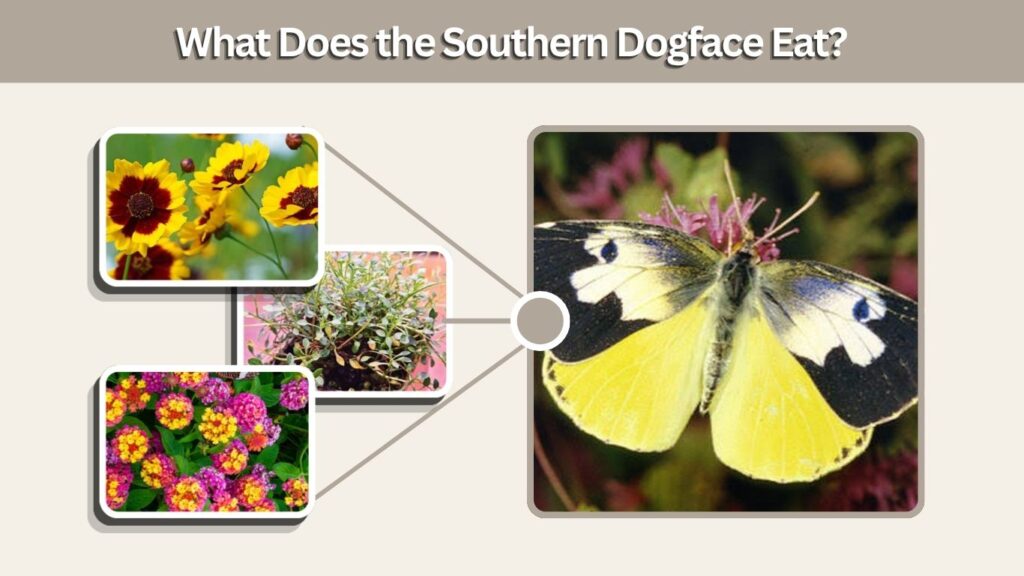
Southern dogface caterpillars eat the leaves of their host plants. Adults drink nectar using a long, coiled proboscis.
Adult nectar sources include:
- Alfalfa flowers
- Coreopsis
- Verbena
- Houstonia
- Coneflowers
- Asters
- Other small wildflowers
Adults may also visit damp ground, puddles, and muddy areas to obtain moisture and dissolved minerals. This behavior is particularly common among males.
Habitat and Range
Southern dogfaces favor dry, sunny, open habitats rather than dense, shaded forests. They can be found in short-grass prairies, scrub-oak openings, pastures, roadsides, abandoned fields, woodland edges, washes, gardens, and disturbed areas containing host plants.
Their permanent range extends from South America northward into southern Texas and peninsular Florida. During warm weather, dispersing butterflies may appear throughout the eastern United States, the Great Plains, the Southwest, the Great Lakes region, and occasionally southern Canada. Northern populations may be temporary because eggs, caterpillars, and chrysalides cannot survive severe winter freezes.
Do Southern Dogface Butterflies Live in Texas?
Yes. Southern dogfaces live and reproduce in Texas, particularly in warmer areas. Texas Parks and Wildlife includes the species among butterflies seen at wildlife-viewing locations, and verified records occur in several Texas counties.
Texas provides suitable open habitats, warm temperatures, nectar flowers, and pea-family host plants. Adults may be observed through much of the year in warmer southern parts of the state.
Southern Dogface Life Cycle
The life cycle has four stages: egg, caterpillar, chrysalis, and adult.
Egg
Females place whitish, spindle-shaped eggs singly or in small groups on host plants. Eggs are commonly attached beneath young or terminal leaves.
Caterpillar
After hatching, the green caterpillar feeds on the host plant and grows through several molts. Its pale side stripe and dark markings help camouflage it among stems and leaves.
Chrysalis
The mature caterpillar becomes a green chrysalis with a slightly pointed head. Like many butterflies, it does not make a silk cocoon. Instead, the chrysalis is attached to vegetation by a silk pad and supported around the middle by a thin silk girdle.
Adult
The adult emerges, expands its wings, feeds on nectar, and searches for a mate. In the southern part of its range, adults can survive winter in reproductive arrest. Farther north, the species usually recolonizes during the following warm season.
Southern Dogface vs American Snout
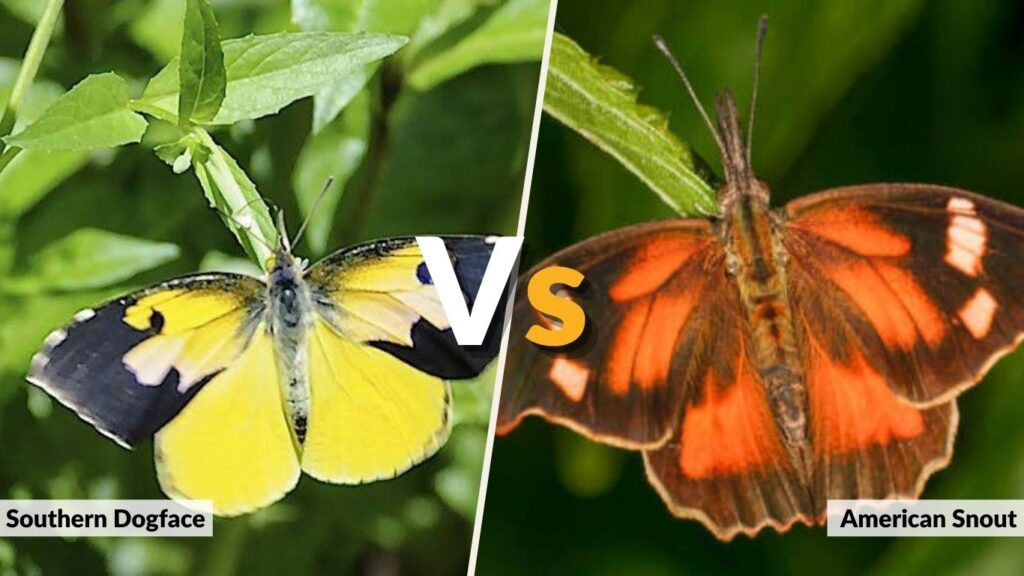
The southern dogface and American snout may occur in the same open habitats, but they look very different.
| Southern dogface | American snout |
| Bright yellow | Brown and orange |
| Dog-head forewing marking | Long projecting mouthparts |
| Pointed, curved wingtip | Squared forewing tip |
| Family Pieridae | Family Nymphalidae |
| Caterpillars eat legumes | Caterpillars eat hackberry |
The American snout is named for its unusually long forward-projecting labial palps. It has brown wings with orange patches and white forewing spots, whereas the southern dogface is predominantly yellow with its distinctive black dog-head design.
Are Southern Dogface Butterflies Dangerous?
Southern dogfaces are harmless to people, pets, and livestock. They do not bite, sting, or contain medically significant venom. Caterpillars may consume small amounts of foliage, but they are not generally considered serious garden or agricultural pests.
These butterflies also contribute to flower pollination while feeding on nectar and serve as prey for birds, spiders, and other insect-eating animals.
FAQs
What family does the southern dogface belong to?
The southern dogface belongs to Pieridae, the family containing whites, sulphurs, and yellows. Its scientific name is Zerene cesonia.
What does a southern dogface caterpillar eat?
Its caterpillar eats pea-family plants, including alfalfa, clover, prairie clover, leadplant, false indigo, summer farewell, and occasionally soybean.
Where can southern dogfaces be found?
Look in sunny prairies, pastures, road edges, open woodlands, gardens, and fields. Permanent populations occur in warm southern areas, while adults disperse farther north during summer.
Why do some southern dogfaces look pink?
The winter or rosa form develops rosy-pink mottling beneath the wings. This seasonal coloration is especially noticeable during cooler parts of the year.
How big is a southern dogface butterfly?
Its wingspan is generally around 2⅛–3 inches, although measurements vary slightly among individuals and regional field guides.