
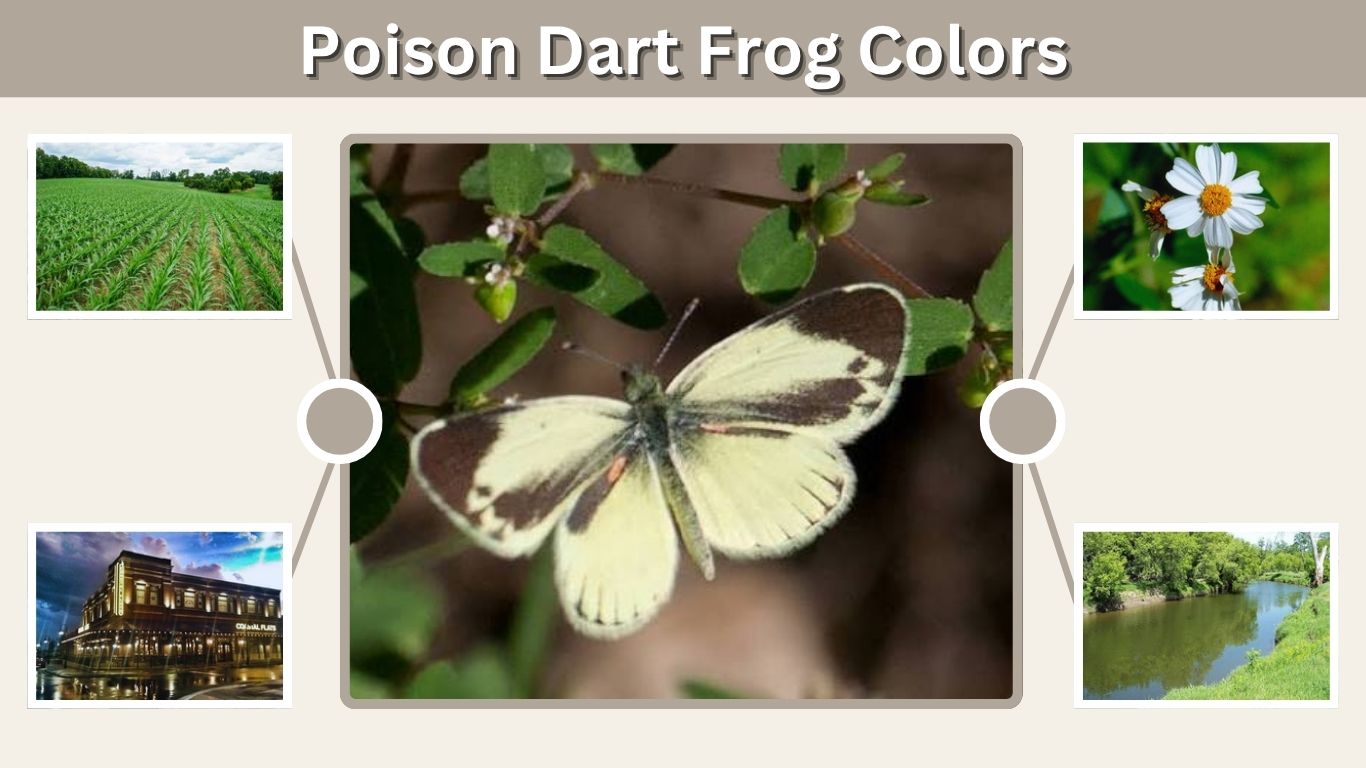
The dainty sulphur is a tiny yellow butterfly commonly seen flying close to the ground in fields, roadsides, pastures, and other open habitats. Scientifically known as Nathalis iole, it is one of the smallest sulphur butterflies in North America. Its elongated wings, lemon-yellow coloring, dark forewing markings, and low, rapid flight help distinguish it from similar species. This guide covers its appearance, caterpillar, host plants, life cycle, habitat, and distribution in Florida, Arizona, and Ohio.
What Is a Dainty Sulphur?
The dainty sulphur, also called the dwarf yellow, belongs to the Pieridae family of whites, yellows, and sulphurs. Adults have a wingspan of only about ¾–1¼ inches, making them easy to overlook among low vegetation.
| Feature | Description |
| Scientific name | Nathalis iole |
| Family | Pieridae |
| Other name | Dwarf yellow |
| Wingspan | About ¾–1¼ inches |
| Main color | Lemon yellow to orange-yellow |
| Caterpillar color | Green with yellow or reddish-purple stripes |
| Main host plants | Spanish needles, beggarticks and carpetweed |
| Habitat | Fields, roadsides, pastures and disturbed sites |
Unlike many sulphur caterpillars that depend on legumes, dainty sulphur larvae commonly feed on low-growing plants in the aster family and on carpetweed. Adults obtain energy by drinking flower nectar.
How to Identify a Dainty Sulphur
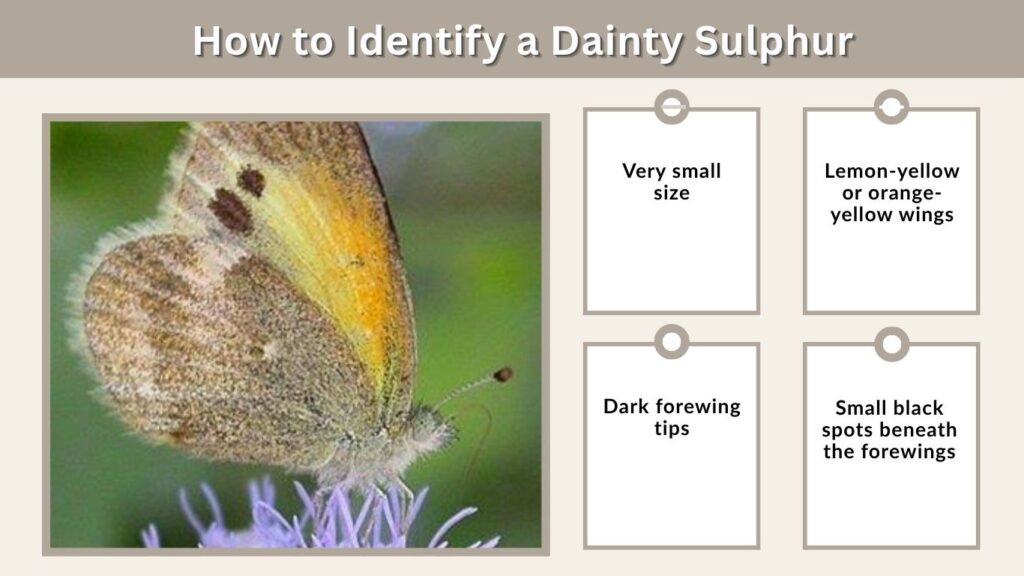
The dainty sulphur has narrow, elongated forewings and a relatively delicate body. Its upper wings are generally yellow, with black or dark-brown markings around the forewing tips and along the inner wing edges.
Key Identification Features
Look for:
- Very small size
- Lemon-yellow or orange-yellow wings
- Elongated, slightly pointed forewings
- Dark forewing tips
- Black bars near the inner edges of the wings
- Small black spots beneath the forewings
- Greenish, yellowish or gray hindwings when closed
- Low flight only a few inches above vegetation
Females generally have more extensive black markings than males. Males possess a specialized scent patch within the dark bar on the hindwing. A rare white form has also been recorded.
Summer and Winter Forms
Summer individuals typically have pale-yellow undersides. Butterflies produced during cooler, shorter days may develop heavily pigmented gray-green or dusty-green hindwings.
The additional dark scaling helps the butterfly absorb heat from sunlight more efficiently. Both forms may be present during autumn in warmer regions.
Dainty Sulphur Caterpillar
The dainty sulphur caterpillar is slender and small, reaching approximately ⅝ inch when fully grown. Its narrow shape and green coloring help it blend with the stems, leaves and flower buds of its host plant.
Caterpillar Identification
A dainty sulphur caterpillar may have:
- A light- to dark-green body
- A green or yellow-green head
- A thin yellow stripe along each lower side
- Reddish, rosy-purple or brown longitudinal stripes
- Fine short hairs covering the body
- No prominent horn at the rear
Color varies considerably. Some individuals are almost entirely green, while others display wide reddish-purple stripes. This variation can make identification difficult unless the caterpillar is found feeding on a known host plant.
Dainty Sulphur Host Plants
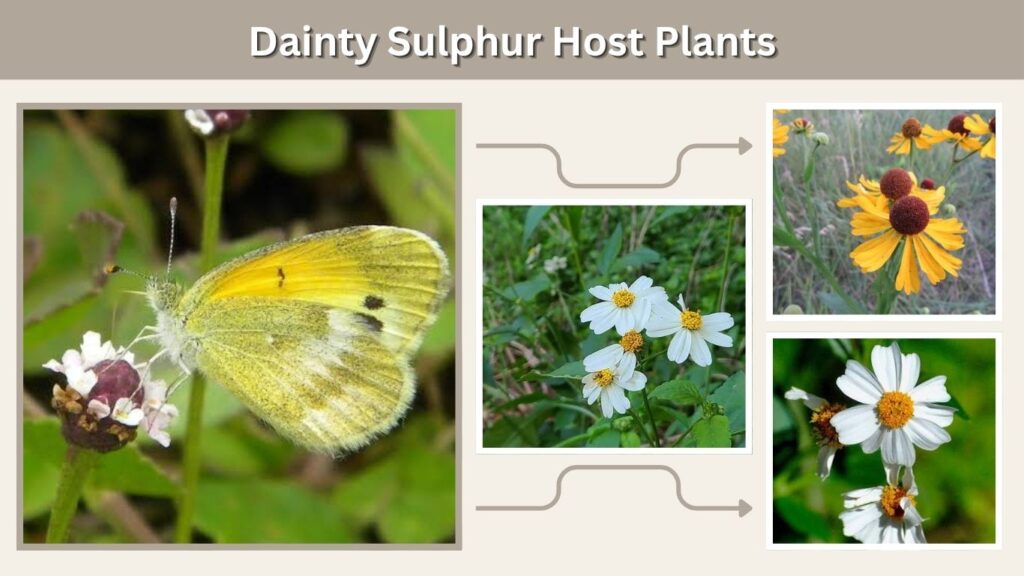
Female dainty sulphurs deposit their eggs singly on young leaves or seedlings. The caterpillars commonly use low-growing members of the aster family, although carpetweed is also an important host.
Important host plants include:
- Spanish needles
- Shepherd’s needle
- Beggarticks
- Sneezeweed
- Fetid marigold or dogweed
- Cultivated marigolds
- Green carpetweed
- Indian chickweed
Host use differs slightly by region. Spanish needles and green carpetweed are particularly well documented in the southeastern United States.
Host Plants in Florida
In Florida, Spanish needles—often identified as Bidens alba—is one of the best-known host plants. Indian chickweed or green carpetweed, Mollugo verticillata, is also used.
The butterfly occurs throughout the year in Florida’s disturbed sites, roadsides and pastures. It is considered common, although its small size and low flight make it easy to miss.
Dainty Sulphur Life Cycle
The dainty sulphur undergoes complete metamorphosis through four stages.
1. Egg
The female places small, yellow, spindle-shaped eggs individually on suitable host plants. Egg-laying may occur on young leaves, buds or developing stems.
2. Caterpillar
After hatching, the larva feeds on the host plant and grows through several stages. It may consume leaves, flowers and other soft plant growth.
3. Chrysalis
The mature caterpillar forms a small green chrysalis attached to vegetation. Unlike the pupae of many related butterflies, its head is rounded rather than sharply pointed.
4. Adult
The adult emerges, expands its wings and begins searching for nectar and mates. Males patrol only inches above the ground, while females frequently remain concealed within low plants except when feeding or laying eggs. Multiple generations can occur in warm regions.
Where Do Dainty Sulphurs Live?
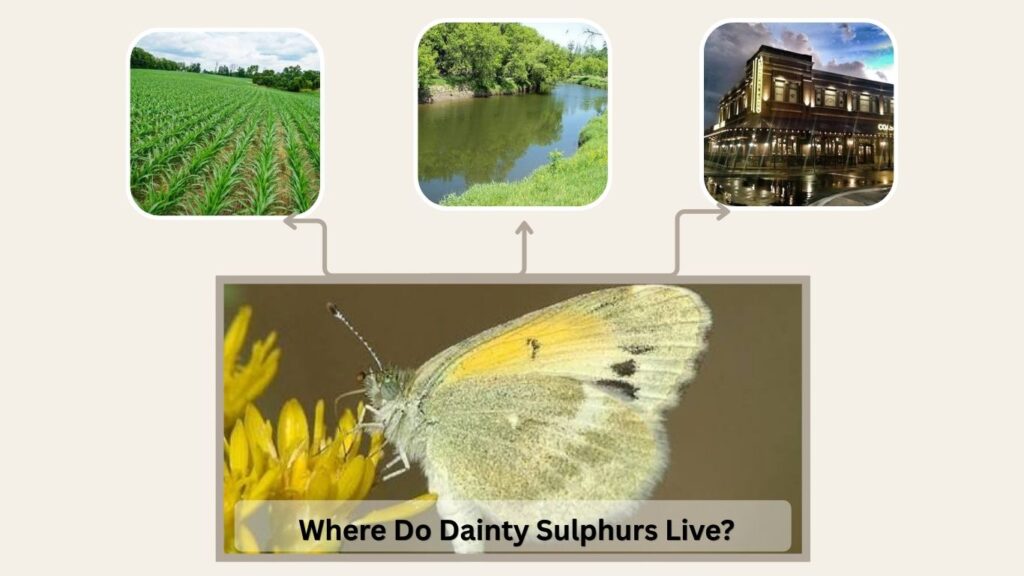
Dainty sulphurs prefer open environments containing short vegetation and plentiful wildflowers. They are commonly associated with:
- Roadsides
- Pastures
- Vacant lots
- Grasslands
- Coastal flats
- Riverbanks
- Farmland
- Utility corridors
- Disturbed gardens
- Dry meadows
Their low flight keeps them close to host plants and small nectar flowers. They may be overlooked because they frequently fly below the height at which people normally watch for butterflies.
Dainty Sulphur Butterflies in Arizona
The Southwest is an important part of the dainty sulphur’s range, and the species is regularly encountered in suitable Arizona habitats. It favors warm, open and often dry environments where low-growing host plants and nectar flowers are available.
Arizona observers may find adults near desert roadsides, gardens, washes, grasslands and disturbed ground. Their activity is closely influenced by temperature, rainfall and the growth of seasonal plants.
Is the Dainty Sulphur Resident in Ohio?
The dainty sulphur is not considered a dependable year-round Ohio resident. It cannot tolerate prolonged freezing conditions and usually reaches northern states as a seasonal migrant or wandering colonist.
Ohio may experience occasional influxes during favorable years. The state’s field guide describes migratory butterflies as species that arrive and may attempt to reproduce, while regional records classify the dainty sulphur as a very rare visitor in northeastern Ohio.
Temporary colonies may develop when females arrive, find appropriate hosts and lay eggs. However, the resulting population generally cannot survive a normal cold Ohio winter.
What Do Adult Dainty Sulphurs Eat?
Adults drink nectar from small, shallow flowers that their short proboscis can reach easily. They may visit Spanish needles, asters, marigolds and other low-growing wildflowers.
Naturalized lawns containing small flowering plants can provide both nectar and larval habitat. Avoiding frequent mowing and broad-spectrum insecticides can allow host plants, eggs and caterpillars to survive.
Dainty Sulphur vs Little Yellow
The dainty sulphur may be confused with the little yellow, but the dainty sulphur is usually smaller and has narrower, more elongated forewings.
| Feature | Dainty sulphur | Little yellow |
| Size | Very small | Slightly larger |
| Forewing shape | Narrow and elongated | Broader and rounder |
| Main host plants | Asters and carpetweed | Partridge pea and sensitive pea |
| Flight behavior | Very low to the ground | Usually somewhat higher |
| Winter underside | Often dusty green or gray | Less heavily mottled |
Host plants can be especially useful for identification because the two species belong to the same butterfly family but use different plant groups.
FAQs
Is the dainty sulphur rare?
It can be common in Florida, Texas, Mexico and parts of the Southwest. Farther north, it may be uncommon or appear only during migration years. Its tiny size and low flight can also make it seem rarer than it really is.
Does a dainty sulphur butterfly bite?
No. It cannot bite or sting people. Adults use a slender proboscis to drink flower nectar, while the harmless caterpillars feed on selected plants.
What does a dainty sulphur caterpillar eat?
The caterpillar commonly eats Spanish needles, beggarticks, sneezeweed, dogweed, marigolds and green carpetweed. The precise host used depends on which suitable plants grow in the butterfly’s location.
Is a dainty sulphur a moth?
No. It is a daytime-flying butterfly in the Pieridae family. It has clubbed antennae and normally rests with its wings closed above its body.
How can I attract dainty sulphurs?
Allow Spanish needles, carpetweed or other locally appropriate host plants to grow in a sunny area. Add small nectar flowers, reduce pesticide use and avoid cutting all low vegetation during the butterfly’s active season.