
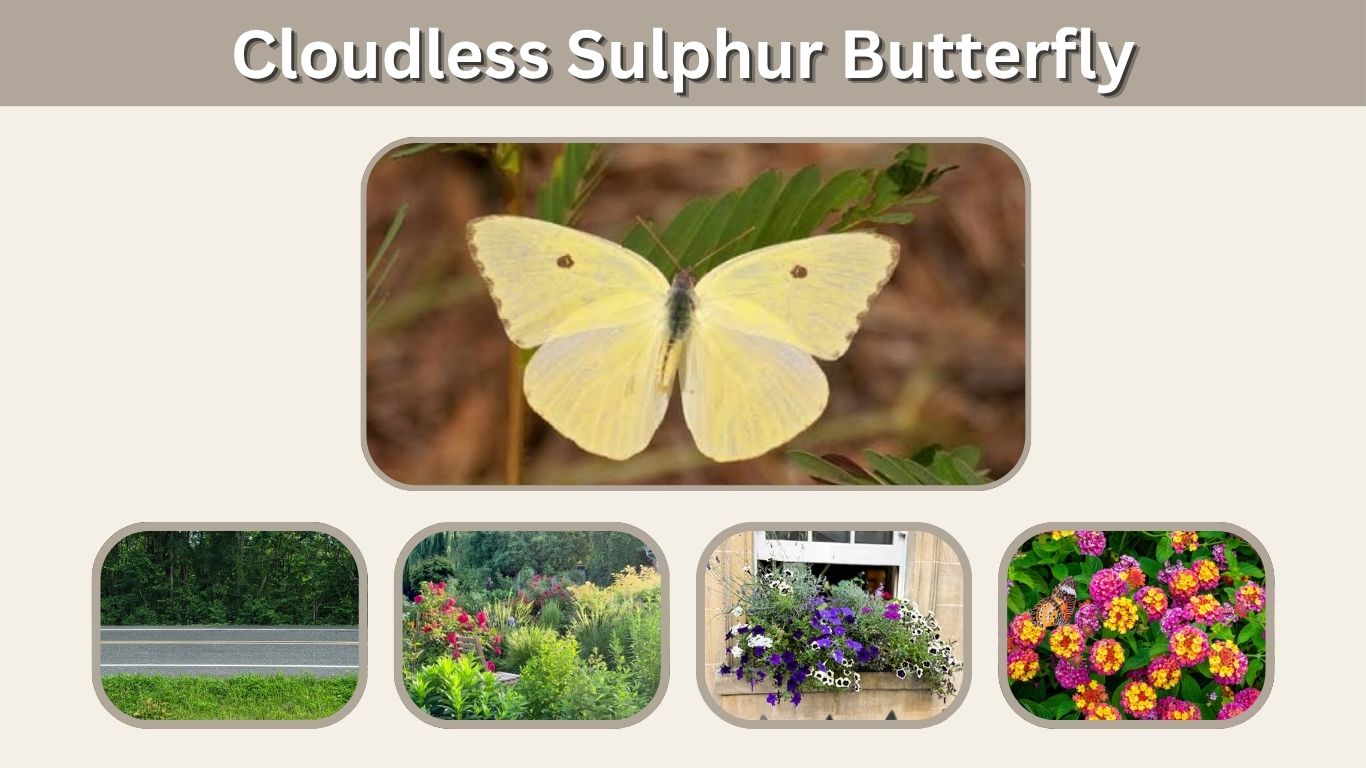
The cloudless sulphur butterfly, Phoebis sennae, is a large, fast-flying yellow butterfly common across the southern United States. Males are usually clear lemon yellow, while females may be yellow, pale greenish-white, or nearly white with dark wing markings. Its caterpillars feed primarily on senna and partridge pea plants, and adults are especially noticeable during their southward fall migration.
Cloudless Sulphur Quick Facts
| Feature | Description |
| Scientific name | Phoebis sennae |
| Family | Pieridae |
| Subfamily | Coliadinae |
| Wingspan | About 1.9–3.1 inches |
| Male color | Clear lemon yellow |
| Female color | Yellow, pale greenish-white, or white |
| Caterpillar color | Green or yellow with blue and black markings |
| Host plants | Senna and Chamaecrista species |
| Adult food | Flower nectar |
| Habitat | Fields, gardens, roadsides, parks, and forest margins |
| Human danger | Harmless |
The spelling cloudless sulfur butterfly is also widely used, especially in the United States. Both “sulphur” and “sulfur” refer to the same species.
How to Identify a Cloudless Sulphur Butterfly
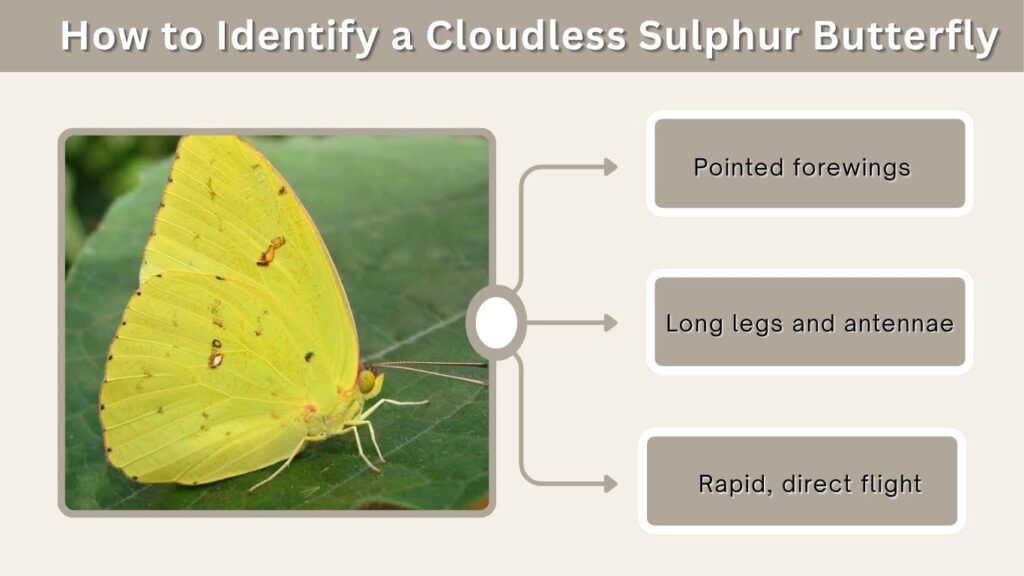
Cloudless sulphurs are among the larger yellow butterflies. Their pointed forewings, rapid flight, and relatively plain yellow upper surfaces help distinguish them from smaller sulphurs.
Main Identification Features
- Large yellow or yellow-white wings
- Pointed forewings
- One or two pink-edged silver spots beneath each hindwing
- Long legs and antennae
- Rapid, direct flight
- Wings usually closed while resting
- Long proboscis for reaching tubular flowers
- Wingspan of approximately 1.9–3.1 inches
The undersides of the wings may have reddish-brown speckles, especially in females and seasonal forms. Individuals produced during cooler or drier periods can have heavier markings than warm-season butterflies.
Male vs Female Cloudless Sulphur
Male and female cloudless sulphurs can usually be separated by their upper-wing patterns.
| Feature | Male | Female |
| Main color | Bright lemon yellow | Yellow, pale greenish-white, or white |
| Dark wing border | Usually absent | Irregular dark border present |
| Forewing cell spot | Usually absent above | Dark hollow spot present |
| Abdomen | Slender | Fuller |
| Behavior | Patrols for females | Searches for host plants |
| Egg-laying | No | Yes |
Male upper wings are generally clear yellow without strong markings. Females have irregular black or dark-brown borders and a noticeable spot in the center of each forewing. Both sexes show pink-edged silvery spots beneath the hindwings.
Cloudless Sulphur Caterpillar
The cloudless sulphur caterpillar can be green or yellow depending partly on what it has been eating. Caterpillars feeding mainly on leaves are commonly green, while those consuming flowers may become more yellow.
Caterpillar Identification
- Green or bright-yellow body
- Yellow stripe along each side
- Rows of small blue spots
- Short black hairs
- Dark transverse bands in yellow individuals
- Smooth, slender shape
- Usually found on senna or partridge pea
Green caterpillars blend into host-plant leaves. Yellow caterpillars with dark crossbands are better camouflaged among yellow senna flowers. This variation can make the two forms look like separate species even though both are cloudless sulphur larvae.
Are Cloudless Sulphur Caterpillars Poisonous?
Cloudless sulphur caterpillars are not considered dangerous or medically significant to humans. Their short hairs are not comparable to the venomous spines of stinging caterpillars.
They may occasionally regurgitate or move defensively when disturbed, but they do not sting. Avoid unnecessary handling because small caterpillars can be easily injured.
Cloudless Sulphur Host Plants
Female cloudless sulphurs lay their eggs on plants in the pea family, particularly species belonging to Senna and Chamaecrista. Caterpillars consume the foliage, buds, and flowers.
Common host plants include:
- Partridge pea
- Sensitive pea
- Maryland senna
- Privet senna
- Sicklepod or coffeeweed
- Candlestick plant
- Chapman’s senna
- Coffee senna
Partridge pea is one of the most useful native host plants for attracting cloudless sulphurs. Gardeners should choose host species suited to their region because some ornamental sennas can become invasive outside their native ranges.
What Do Cloudless Sulphur Butterflies Eat?
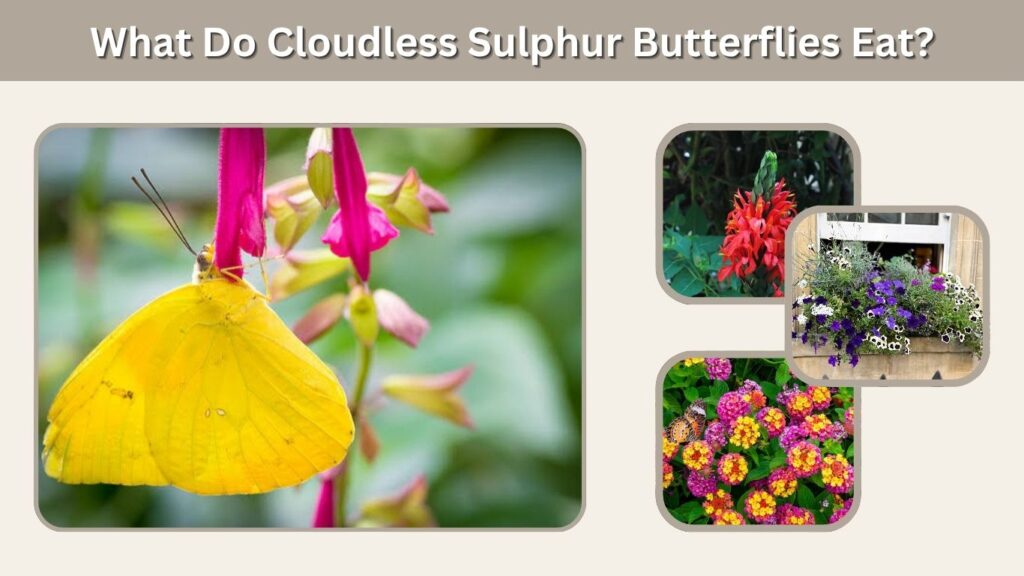
Adult cloudless sulphurs drink nectar rather than eating leaves. Their relatively long proboscis allows them to reach nectar inside deep, tubular flowers.
Popular nectar sources include:
- Scarlet sage
- Lantana
- Cardinal flower
- Hibiscus
- Bougainvillea
- Morning glory
- Cypressvine
- Cordia
They show a particular preference for red, pink, and orange tubular flowers. Males may also gather on damp soil to absorb dissolved salts and minerals, a behavior known as puddling.
Cloudless Sulphur Life Cycle
The cloudless sulphur undergoes complete metamorphosis with four stages: egg, caterpillar, chrysalis, and adult.
Eggs
Females place cream-colored, spindle-shaped eggs individually on young leaves, flower buds, or other tender parts of host plants. The eggs gradually become orange as they develop.
Caterpillar
After hatching, the caterpillar feeds openly on leaves, buds, and flowers. It does not construct a protective leaf tent. The larva grows through several instars, shedding its skin between each growth stage.
Chrysalis
The mature caterpillar attaches itself to a plant using a silk pad at the tail and a thin silk girdle around the body. The resulting chrysalis is pointed and leaf-like and may be green, yellow, pink, or a combination of those colors.
Cloudless sulphurs do not make cocoons. A cocoon is a silk covering produced by many moth caterpillars, whereas this butterfly forms an exposed chrysalis.
Adult
The adult emerges from the chrysalis, expands its wings, and begins feeding on nectar. Males spend much of the day patrolling gardens and open areas for receptive females. Several generations may occur annually in warm climates.
Habitat and Range
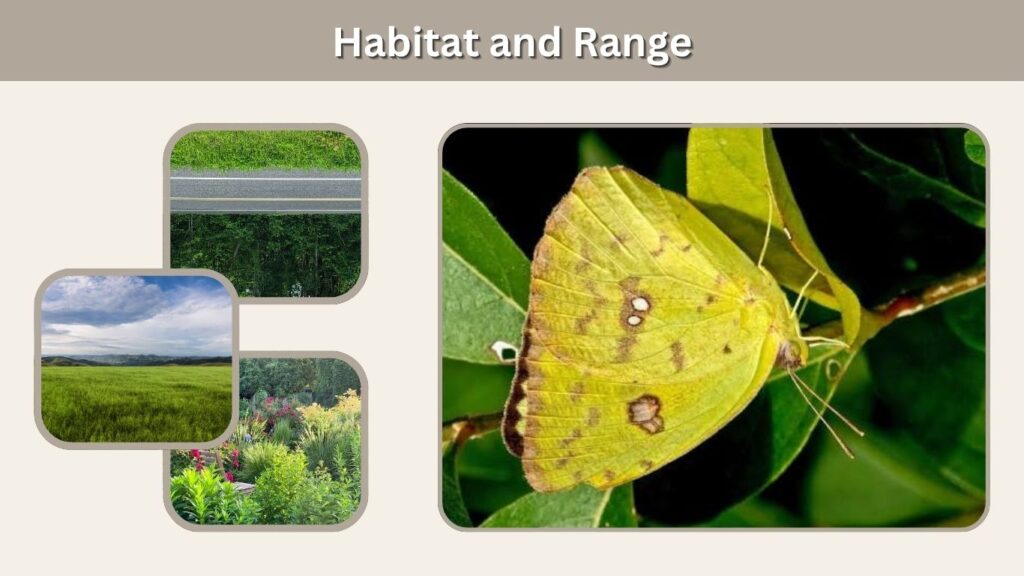
Cloudless sulphurs breed in sunny, disturbed environments where host and nectar plants grow. Typical habitats include:
- Open fields
- Roadsides
- Gardens and yards
- Parks
- Beaches
- Forest edges
- Scrubland
- Abandoned farmland
The species is a permanent resident from Argentina through Central America, the Caribbean, southern Texas, Florida, and other parts of the Deep South. During warm months, migrants and temporary colonies can occur across much of the eastern United States, the Southwest, and occasionally Canada.
Cloudless Sulphur Migration
Cloudless sulphurs are strong seasonal migrants. Large numbers fly southward through the southeastern United States during fall, generally abandoning northern breeding areas where freezing winter temperatures would kill them.
Spring movement is less conspicuous, but surviving adults move northward and establish new warm-season populations. Migrating butterflies usually fly low over open ground and can appear to cross roads steadily in the same direction.
A sudden increase in cloudless sulphurs around a yard may therefore reflect migration, nearby flowering plants, or the presence of senna host plants.
Clouded Sulphur vs Cloudless Sulphur
Despite their similar names, the clouded sulphur and cloudless sulphur belong to different genera.
| Feature | Cloudless sulphur | Clouded sulphur |
| Scientific name | Phoebis sennae | Colias philodice |
| Size | Larger | Smaller |
| Wing shape | Longer and more pointed | Shorter and rounder |
| Male upper wings | Usually plain yellow | Black outer border |
| Female pattern | Irregular dark markings | More defined dark borders |
| Typical movement | Strong and migratory | Lower, less direct flight |
| Main host plants | Senna and partridge pea | Clover, alfalfa, and legumes |
A male clouded sulphur normally has a prominent black border around the upper wings. A male cloudless sulphur is larger and usually lacks that border.
Cloudless Sulphur Butterfly Meaning
The cloudless sulphur has no scientifically established spiritual meaning. In symbolic interpretations, its bright-yellow color is sometimes associated with happiness, hope, personal growth, change, or renewed energy.
These meanings come from personal or cultural beliefs rather than the butterfly’s biology. Ecologically, seeing one usually indicates warm weather, nearby nectar flowers, migration activity, or suitable caterpillar host plants.
FAQs
Why is it called a cloudless sulphur?
The name refers to the male’s mostly clear, uninterrupted yellow wings. Unlike many related sulphur butterflies, a mature male usually lacks broad dark borders or heavy markings across the upper wing surface.
Where do cloudless sulphur butterflies live?
They live in gardens, fields, parks, roadsides, beaches, forest margins, and other sunny open habitats. Permanent populations occur in warm southern regions, while migrants travel much farther north during summer and fall.
What does a female cloudless sulphur look like?
A female may be yellow, pale greenish-white, or nearly white. She has irregular dark borders along the wing edges and a hollow dark spot near the center of each forewing.
What do cloudless sulphur caterpillars eat?
They eat the leaves, flowers, and buds of senna and Chamaecrista plants. Important hosts include partridge pea, sensitive pea, Maryland senna, sicklepod, candlestick plant, and privet senna.
Is the cloudless sulphur butterfly rare?
It is common in Florida and many other warm southern locations. It may be less common or only seasonally present farther north, where most sightings involve summer or fall migrants.