
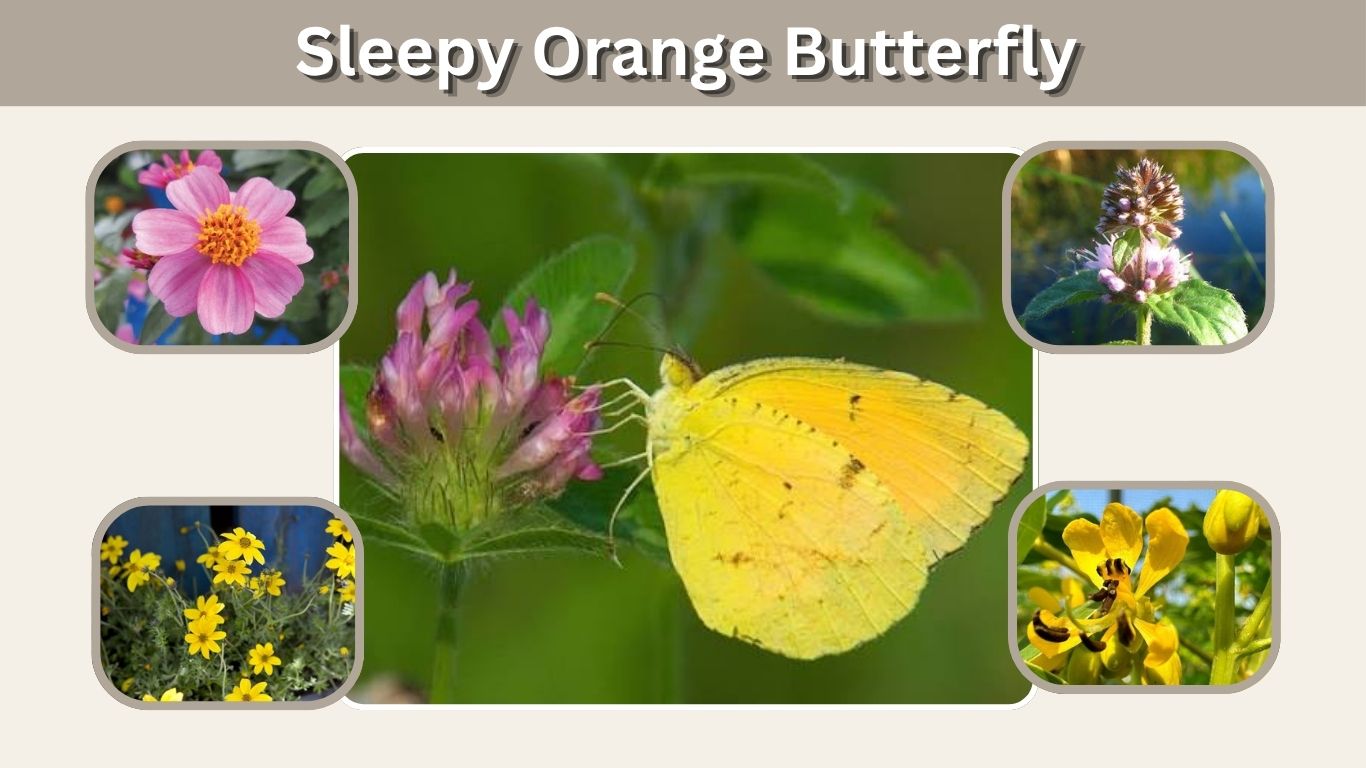
The sleepy orange butterfly is a small but brilliantly colored species found in warm, open habitats across parts of North and Central America. Despite its name, it is not unusually sleepy. The name refers to a short black marking on each forewing that resembles a closed eye. Scientifically known as Abaeis nicippe, this butterfly can be identified by its orange wings, irregular dark borders, rapid flight, and seasonal color changes. Its caterpillars feed mainly on partridge pea and wild senna plants.
What Is a Sleepy Orange Butterfly?
The sleepy orange belongs to the Pieridae family, which includes sulphurs, yellows, and white butterflies. It may also be called the sleepy orange sulphur.
Some references classify the species as Abaeis nicippe, while others use the older or alternative name Eurema nicippe. Both names refer to the same butterfly.
| Feature | Description |
| Scientific name | Abaeis nicippe |
| Alternative name | Eurema nicippe |
| Family | Pieridae |
| Wingspan | Approximately 1.4–2.25 inches |
| Main color | Bright orange or yellow-orange |
| Caterpillar color | Pale to bright green |
| Primary host plants | Partridge pea and wild sennas |
| Habitat | Fields, gardens, roadsides, and woodland edges |
The Florida Museum reports a wingspan of approximately 1.4–2.25 inches and identifies North and Central America as its geographic origin.
How to Identify a Sleepy Orange
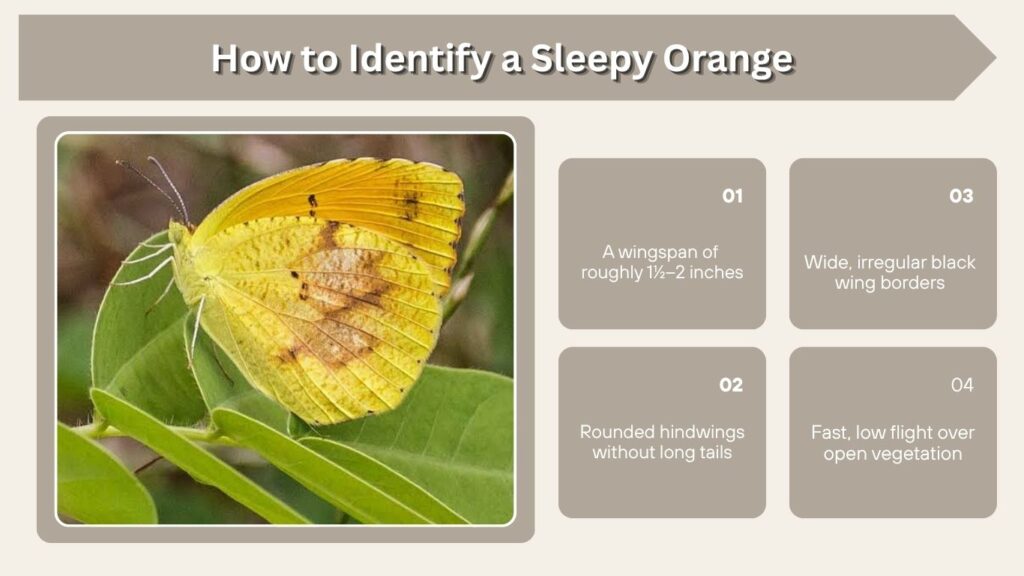
When its wings are open, the sleepy orange displays bright orange upper surfaces surrounded by uneven black or dark-brown margins. Males tend to be more uniformly orange, while females may appear paler or more yellow-orange.
Key Identification Features
Look for:
- Bright orange or yellow-orange upper wings
- Wide, irregular black wing borders
- A short black dash near the center of each forewing
- Rounded hindwings without long tails
- A wingspan of roughly 1½–2 inches
- Fast, low flight over open vegetation
- Brownish seasonal markings beneath the wings
The short forewing dash resembles a closed or “sleepy” eye and is responsible for the butterfly’s common name. It does not indicate that the insect is slow or inactive. In fact, sleepy oranges may fly rapidly when disturbed.
Summer and Winter Color Forms
The underside of the sleepy orange’s wings changes noticeably with the season. These seasonal forms can make the same species look like two different butterflies.
Summer or Wet-Season Form
Summer individuals generally have yellow or orange-yellow undersides with relatively light brown markings. Their coloration appears cleaner and brighter.
Winter or Dry-Season Form
Winter individuals often have tan, reddish-brown, or brick-colored undersides with heavier markings. These darker patterns provide camouflage among dried leaves and dormant vegetation.
The long, smudged brown line crossing the underside of the hindwing remains an important identification feature in both seasonal forms.
Where Do Sleepy Orange Butterflies Live?
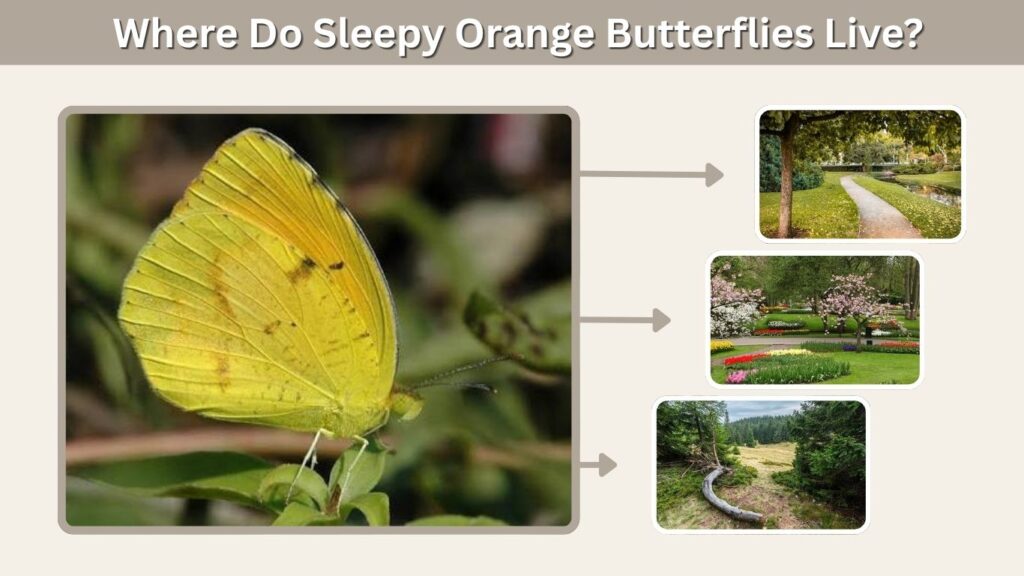
Sleepy oranges prefer sunny, relatively open environments where their caterpillar host plants grow. Typical habitats include:
- Agricultural fields
- Old fields and meadows
- Roadsides
- Parks and gardens
- Woodland openings
- Forest edges
- Pond and stream margins
- Disturbed ground
- Wet meadows
They may also enter open woodland during spring. The species is widespread in the southern United States and occurs from Central America northward, with individuals sometimes dispersing considerably farther north during warm weather.
Sleepy Orange Butterflies in Hawaii
The sleepy orange has also been documented in Hawaii, where it is considered non-native. Hawaiian environmental records list the species under both Abaeis nicippe and Eurema nicippe.
It should not be confused with Hawaii’s native Kamehameha butterfly, which is larger and has a more complex pattern of orange, black, brown, and white.
Sleepy Orange Caterpillar
The sleepy orange caterpillar is much less colorful than the adult. Its green body helps it remain hidden along the leaves and stems of its host plants.
Caterpillar Identification
A typical caterpillar has:
- A slender, elongated green body
- Fine, short hairs
- A narrow pale or white stripe along each side
- A small green head
- Coloration closely matching host-plant foliage
Young caterpillars can be difficult to notice. They frequently rest along the central vein of a leaf, where their narrow shape and green coloring provide effective camouflage.
Sleepy orange caterpillars do not have the large rear horn seen on tomato and tobacco hornworms. They are also smaller and more slender than many giant silk moth caterpillars.
Sleepy Orange Butterfly Host Plants
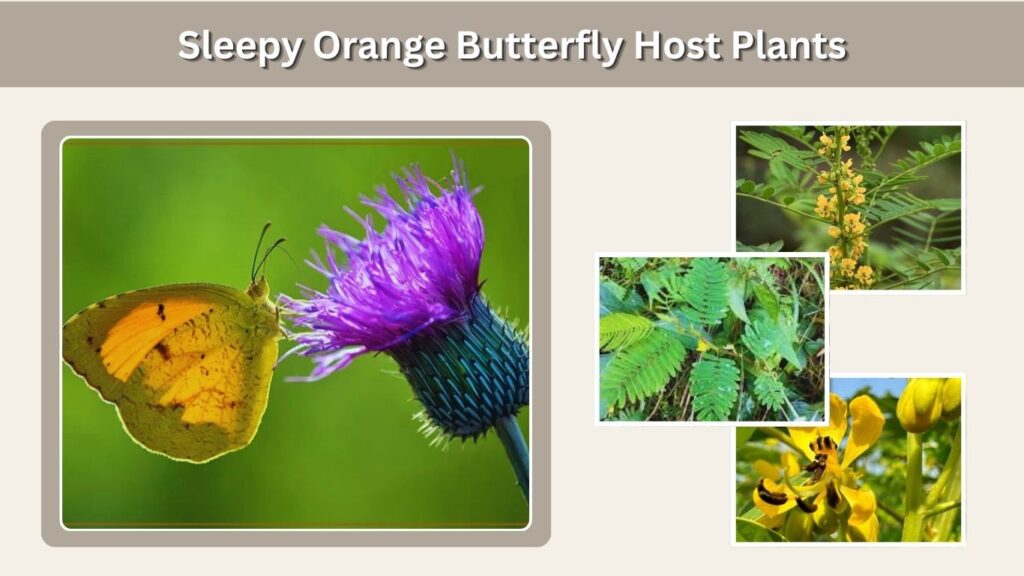
Female sleepy oranges lay their eggs on plants that can feed the caterpillars after hatching. The larvae primarily use members of the pea family, especially Senna and Chamaecrista species.
Important host plants include:
- Common partridge pea
- Wild sensitive pea
- American wild senna
- Maryland wild senna
- Coffeeweed or sicklepod
- Privet senna
- Mexican senna
Partridge pea is one of the most useful host plants for attracting sleepy oranges. It grows in sunny, disturbed locations and produces yellow flowers that also benefit bees and other pollinators. Documented host plants in Alabama include common partridge pea, sicklepod, Maryland wild senna, and American senna.
Do Adults Eat the Host Plants?
Adult butterflies do not eat leaves. They use a coiled feeding tube called a proboscis to drink nectar from flowers.
Host plants feed the caterpillars, while nectar-producing flowers feed the adults. A butterfly garden therefore needs both types of plants.
Life Cycle of the Sleepy Orange
The sleepy orange undergoes complete metamorphosis through four distinct stages.
1. Egg
A female deposits small, spindle-shaped eggs on suitable host foliage, often on the undersides of leaves. Fresh eggs are pale or white and may become yellowish as they develop.
2. Caterpillar
After hatching, the caterpillar begins eating host-plant leaves. It grows through several stages, shedding its outer skin whenever it becomes too small.
3. Chrysalis
A mature caterpillar attaches itself to vegetation and forms a chrysalis. Its color may range from pale green to darker brown, helping it blend with surrounding stems and leaves.
4. Adult Butterfly
The fully developed butterfly emerges from the chrysalis, expands its wings, and begins searching for nectar and mates.
Sleepy oranges can produce multiple generations during a year. In southern areas, adults may be observed for much of the year, while individuals in colder regions survive unfavorable periods through seasonal dormancy or recolonize northern areas during warm weather.
How Long Does a Sleepy Orange Live?
The precise adult lifespan varies with temperature, predators, food availability, and seasonal conditions. Adults generally live for a limited number of weeks rather than many months.
The complete life cycle lasts longer because it includes the egg, caterpillar, chrysalis, and adult stages. Southern populations may complete several generations in one year, while cooler conditions slow development and restrict seasonal activity.
What Do Sleepy Orange Butterflies Eat?
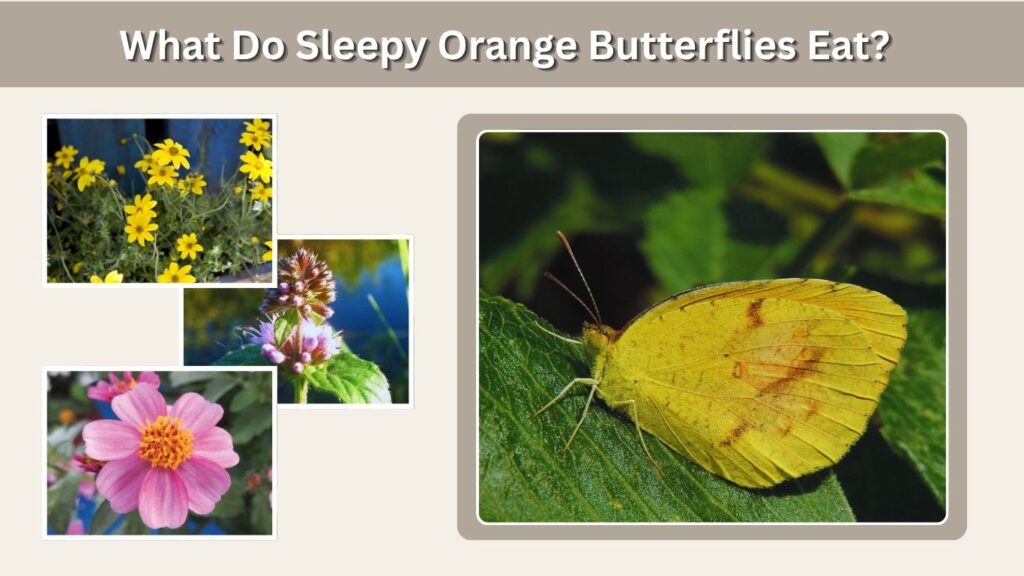
Adult sleepy oranges drink nectar from various small and medium-sized flowers. They may visit:
- Asters
- Goldenrods
- Bidens
- Dogbane
- Mints
- Clovers
- Verbena
- Lantana
- Other open, nectar-rich flowers
Males may also gather on damp soil, mud, or gravel to absorb water and dissolved minerals. This behavior is called puddling.
The caterpillars eat only appropriate host foliage, especially partridge pea and wild senna leaves.
Sleepy Orange vs Orange Sulphur
The sleepy orange may be confused with the orange sulphur, but several differences help separate them.
| Feature | Sleepy orange | Orange sulphur |
| Size | Usually smaller | Often slightly larger |
| Upper-wing color | Strong orange with dark borders | Yellow-orange with variable orange areas |
| Forewing mark | Short black “sleepy eye” dash | Small central spot |
| Hindwing border | Broad dark border | Usually narrower or less extensive |
| Host plants | Senna and partridge pea | Clover, alfalfa, and related legumes |
| Seasonal underside | Strong summer and winter variation | Less dramatically altered |
The sleepy orange’s forewing dash, broad hindwing border, and compact size provide the most useful clues.
How to Attract Sleepy Orange Butterflies
Planting both caterpillar hosts and adult nectar sources can encourage sleepy oranges to remain and reproduce in a garden.
Useful steps include:
- Grow native partridge pea or wild senna.
- Add nectar-rich native wildflowers.
- Provide sunny, sheltered garden areas.
- Avoid broad-spectrum insecticides.
- Leave some natural vegetation around property edges.
- Maintain a shallow area of moist soil for puddling.
- Allow minor caterpillar feeding without spraying the plants.
The caterpillars normally remove only a limited amount of foliage and rarely cause serious harm to established host plants.
FAQs
Why is it called the sleepy orange butterfly?
Its name comes from a short black dash on the upper forewing that resembles a closed or sleepy eye. The name does not describe its behavior. Sleepy orange butterflies are active during daylight and can fly quickly when approached.
Is a sleepy orange a butterfly or moth?
It is a butterfly in the Pieridae family. It has clubbed antennae, flies during the day, and commonly rests with its wings held upright. Its family also includes sulphurs, yellows, and white butterflies.
Is the sleepy orange butterfly poisonous?
It is not considered dangerous or poisonous to humans. It cannot sting and poses no threat to people, pets, houses, or gardens. Its caterpillars may eat small amounts of senna or partridge-pea foliage.
What does a sleepy orange caterpillar eat?
The caterpillar primarily eats plants in the pea family, particularly partridge pea, sensitive pea, coffeeweed, and several wild senna species. It should not be moved to unrelated plants because it may refuse unsuitable foliage.
Are sleepy orange butterflies rare?
They are widespread and may be common in suitable southern habitats. Their abundance varies by location, season, host-plant availability, and weather. They may appear uncommon farther north, where many records involve seasonal migrants or temporary populations.