
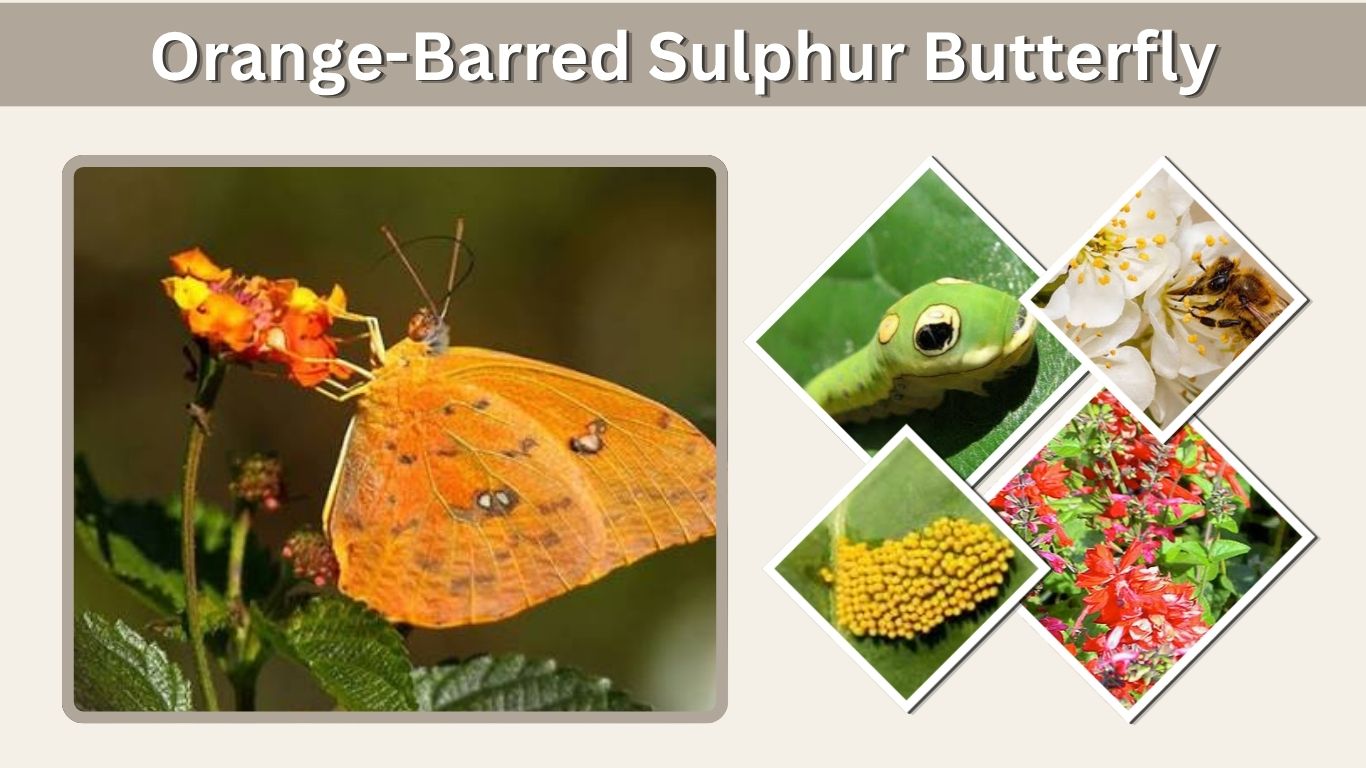
The Orange-barred Sulphur (Phoebis philea) is a large, fast-flying yellow butterfly distinguished by vivid orange markings across its wings. It is especially common in tropical and subtropical parts of the Americas and is a familiar sight in Florida gardens, parks, roadsides, and other sunny areas containing senna plants. Males are typically bright yellow-orange, while females occur in both yellow and pale forms. The caterpillars feed mainly on Senna or Cassia plants, and adults visit many flowers for nectar.
What Is an Orange-Barred Sulphur?
The Orange-barred Sulphur is a butterfly in the family Pieridae, the group containing whites, yellows, and sulphurs.
Its scientific name is Phoebis philea.
| Feature | Orange-Barred Sulphur |
| Scientific name | Phoebis philea |
| Family | Pieridae |
| Subfamily | Coliadinae |
| Wingspan | 2.75–4 inches |
| Main colors | Yellow and orange |
| Caterpillar food | Senna/Cassia |
| Adult food | Flower nectar |
| Habitat | Gardens, parks, forest edges |
| U.S. stronghold | Florida |
Its wingspan ranges from approximately 7–10.2 cm (2.75–4 inches), making it one of the larger sulphur butterflies.
Orange-Barred Sulphur Identification
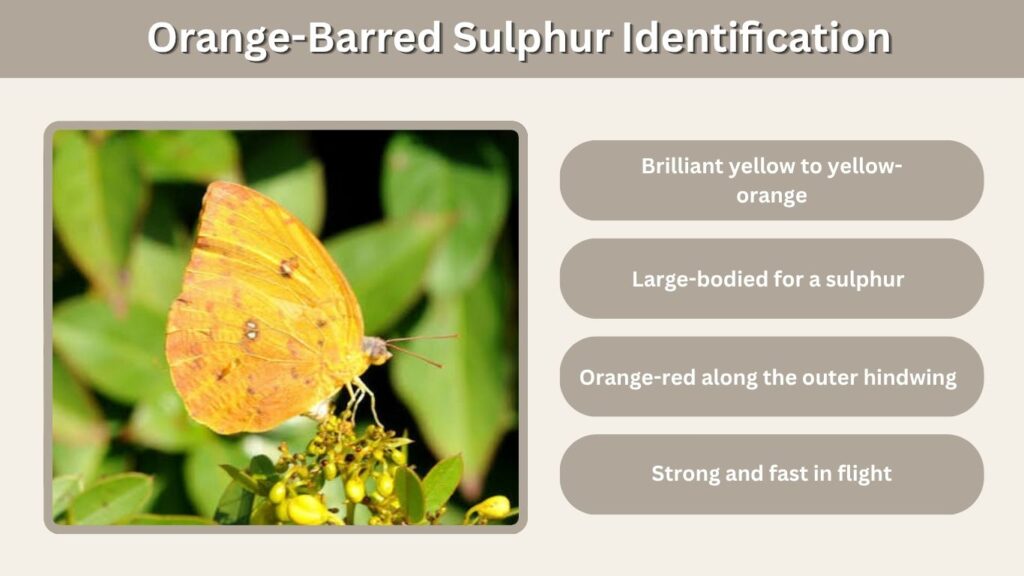
Color and size make this butterfly fairly distinctive when its wings are open.
Male Identification
Adult males are usually:
- Brilliant yellow to yellow-orange
- Marked with a red-orange bar on each forewing
- Orange-red along the outer hindwing
- Large-bodied for a sulphur
- Strong and fast in flight
The orange markings are especially obvious when the butterfly opens its wings.
When resting, however, sulphurs normally hold their wings closed, hiding much of the bright upper-wing pattern.
Female Identification
Females are noticeably larger and more variable.
Two major female forms occur:
- Yellow-orange
- Pale cream or off-white
Females typically show a solid black spot in the forewing cell and broken dark markings toward the outer wing. In the yellow form, much of the outer hindwing may be orange-red.
This variation means a pale female can look surprisingly different from a bright male of the same species.
Where Do Orange-Barred Sulphur Butterflies Live?
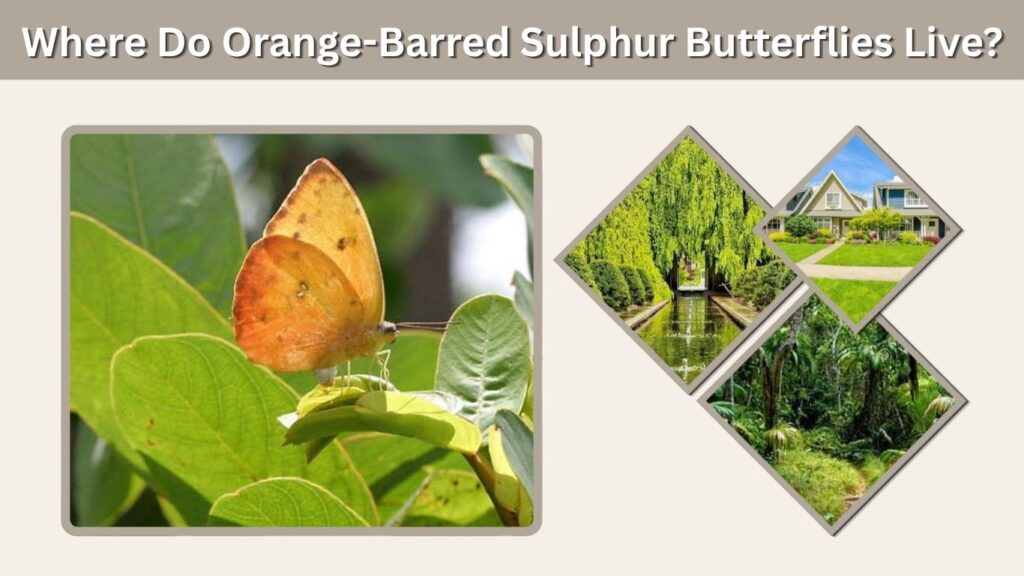
The species has a predominantly tropical distribution.
Its established range extends from South America north through Central America and the Caribbean to peninsular Florida and the Florida Keys. Individuals sometimes wander farther north or west.
In the United States, Florida is the best place to see them regularly.
UF/IFAS reports the species throughout Florida, particularly in human-modified environments containing suitable host plants.
Typical Habitat
Orange-barred Sulphurs favor open, sunny locations such as:
- Gardens
- Parks
- Neighborhoods
- Forest edges
- Roadsides
- Open lowlands
- Butterfly gardens
- Areas containing senna plants
They are well adapted to landscaped environments and can become regular visitors when both host and nectar plants are available.
What Do Orange-Barred Sulphur Butterflies Eat?
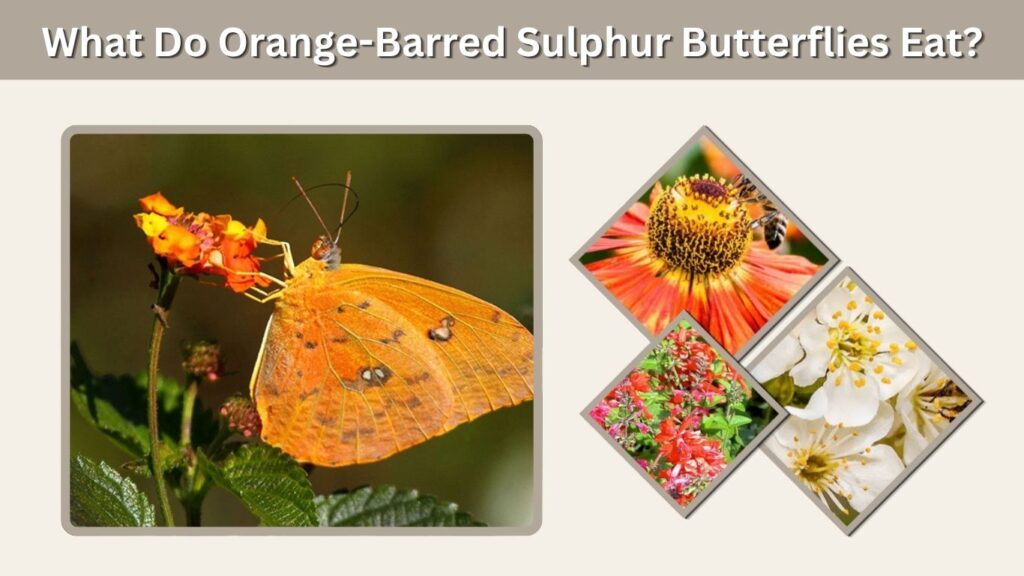
Adult Orange-barred Sulphurs drink nectar from flowers using a long proboscis.
Unlike their caterpillars, adults do not eat leaves.
They visit a wide range of flowering plants. UF/IFAS notes that their relatively long proboscis allows them to feed effectively from long or funnel-shaped flowers such as hibiscus.
Other nectar-rich garden flowers can also attract adults.
Orange-Barred Sulphur Host Plants
The caterpillars primarily use plants historically referred to as Cassia, with many commonly placed today in the genus Senna.
These plants belong to the pea family, Fabaceae.
Common host choices can include ornamental and wild sennas growing within the butterfly’s range.
Female Orange-barred Sulphurs actively search for suitable plants before depositing eggs.
A verified Florida observation documents a female laying eggs on Senna bicapsularis.
Orange-Barred Sulphur Caterpillar
The caterpillar is quite different from the brilliantly colored adult.
Larval coloration can vary with age and diet, helping caterpillars blend into the senna plants they feed upon.
Caterpillar Identification
Typical characteristics include:
- Elongated cylindrical body
- Greenish to yellowish coloration
- Small dark markings
- Fine hairs
- Camouflage matching leaves or flowers
BAMONA notes an interesting feeding preference: caterpillars often favor the flowers of their host plants, although they also occur on the foliage.
A documented Florida caterpillar measured about 3 cm long and was found on a Senna host plant.
Orange-Barred Sulphur Eggs
Females deposit their eggs individually rather than in large clusters.
Eggs are laid on suitable portions of host plants, including leaves and flowers.
Once an egg hatches, the small caterpillar begins feeding and passes through several larval stages as it grows.
The female’s choice of host plant is critical because newly hatched larvae have limited ability to travel far in search of food.
Orange-Barred Sulphur Chrysalis
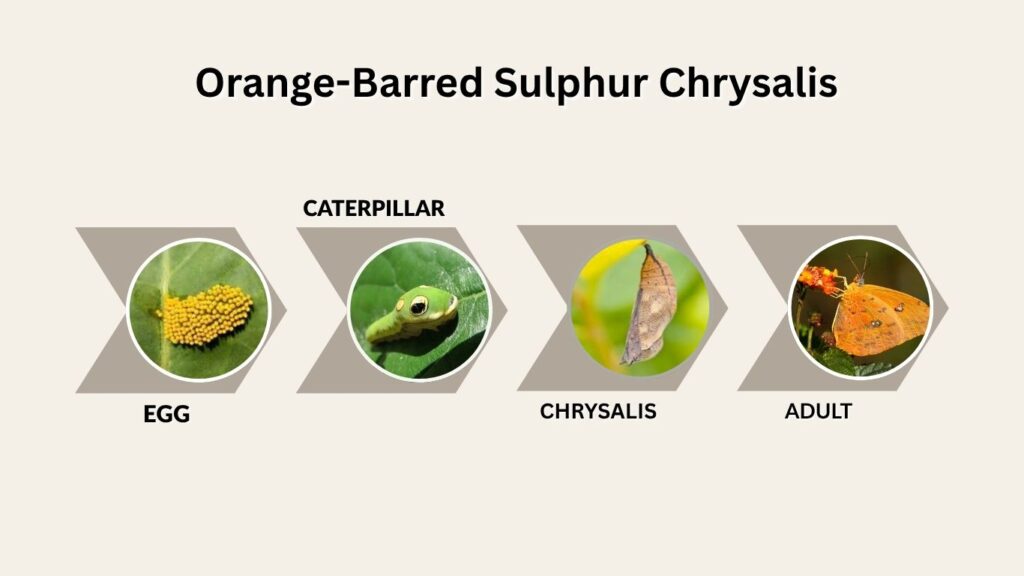
After completing its caterpillar growth, the larva forms a chrysalis, or pupa.
The life cycle follows:
Egg → Caterpillar → Chrysalis → Adult
The chrysalis is usually attached to vegetation and can blend remarkably well with leaves or stems.
A verified Florida observation documented an Orange-barred Sulphur caterpillar before and after pupation, with the resulting chrysalis strongly camouflaged against vegetation.
Inside the chrysalis, the caterpillar undergoes the major transformation that produces the adult butterfly.
Orange-Barred Sulphur Life Cycle
Like all butterflies, this species undergoes complete metamorphosis.
1. Egg
The female lays individual eggs on senna or related host plants.
2. Caterpillar
The larva feeds heavily on host-plant material, particularly flowers and foliage.
3. Chrysalis
The mature caterpillar stops feeding and pupates on nearby vegetation.
4. Adult
The winged butterfly emerges, expands and dries its wings, then begins feeding on nectar and searching for mates.
BAMONA reports continuous development during the wet season in suitable tropical environments.
When Are Orange-Barred Sulphurs Active?
Flight periods differ substantially by climate.
In Florida, the species can have two or three major flights, and UF/IFAS records adults during nearly every month of the year. Farther north, wandering individuals are much more seasonal and are generally seen during mid- to late summer.
Warm climates allow the species to remain active for much longer periods.
Orange-Barred Sulphur vs. Cloudless Sulphur
The Cloudless Sulphur (Phoebis sennae) is one of the species most likely to be confused with an Orange-barred Sulphur.
| Feature | Orange-Barred Sulphur | Cloudless Sulphur |
| Scientific name | Phoebis philea | Phoebis sennae |
| Male upper wings | Yellow with strong orange bars | Mostly clear lemon-yellow |
| Orange hindwing area | Prominent | Usually absent |
| Size | Large | Large |
| Host plants | Senna/Cassia | Senna/Cassia |
| Family | Pieridae | Pieridae |
The large orange patches on the male’s upper wings are the easiest distinction when the wings are visible.
With the wings closed, identification can be more difficult because both species are predominantly yellow and may have scattered markings underneath.
Orange-Barred Sulphur vs. Large Orange Sulphur
The Large Orange Sulphur (Phoebis agarithe) is another similar tropical species.
Both are large and may show yellow-orange coloring.
The Orange-barred Sulphur is distinguished particularly by the arrangement and intensity of its orange upper-wing markings. BugGuide also notes differences in the arrangement of dark markings on the underside of the forewing when separating P. philea from P. agarithe.
Good photographs of both upper and lower wings make identification much easier.
Are Orange-Barred Sulphurs Rare?
Globally, the Orange-barred Sulphur is not considered rare or threatened.
BAMONA lists it as globally secure and notes that special conservation management is generally not required. However, it can be uncommon or appear only as an occasional wanderer near the edges of its range.
In southern Florida, it can be a familiar butterfly in gardens and neighborhoods.
Are Orange-Barred Sulphurs Dangerous?
No. Orange-barred Sulphurs are harmless to humans and pets.
They:
- Cannot sting
- Do not bite people
- Are not venomous
- Do not attack humans
Their caterpillars feed on plants rather than animals and lack the prominent venomous spines associated with dangerous stinging caterpillars.
Interesting Orange-Barred Sulphur Facts
- Its scientific name is Phoebis philea.
- Males have striking orange-red wing bars.
- Females can be yellow or almost white.
- The wingspan can reach about 4 inches.
- It is a strong and fast flier.
- Caterpillars specialize on senna and cassia plants.
- Caterpillars often feed on host-plant flowers.
- Females lay eggs individually.
- Adults drink nectar from many flowers.
- Florida supports resident populations.
- Individuals occasionally wander far beyond their regular range.
- The species is considered globally secure.
FAQs
1. What is an Orange-barred Sulphur butterfly?
The Orange-barred Sulphur (Phoebis philea) is a large yellow-and-orange butterfly in the family Pieridae. It occurs throughout tropical parts of the Americas and is a resident butterfly in peninsular Florida and the Florida Keys.
2. What do Orange-barred Sulphur caterpillars eat?
The caterpillars feed mainly on Senna and Cassia species in the pea family. They may eat both foliage and flowers, with BAMONA noting that the larvae particularly prefer feeding on flowers.
3. How big is an Orange-barred Sulphur?
Adults have a wingspan of approximately 2.75–4 inches (7–10.2 cm). Females are generally larger than males, making the Orange-barred Sulphur one of the more impressive sulphur butterflies.
4. Where can you find Orange-barred Sulphur butterflies?
They are residents from South America north through tropical regions to peninsular Florida and the Keys. In Florida, they commonly occur in gardens, parks, neighborhoods, forest edges, and other open areas containing senna plants.
5. What is the difference between an Orange-barred and Cloudless Sulphur?
Male Orange-barred Sulphurs have conspicuous red-orange bars on the forewings and orange-red coloration on the outer hindwings. Male Cloudless Sulphurs are generally more uniformly lemon-yellow and lack those bold orange upper-wing patches.