
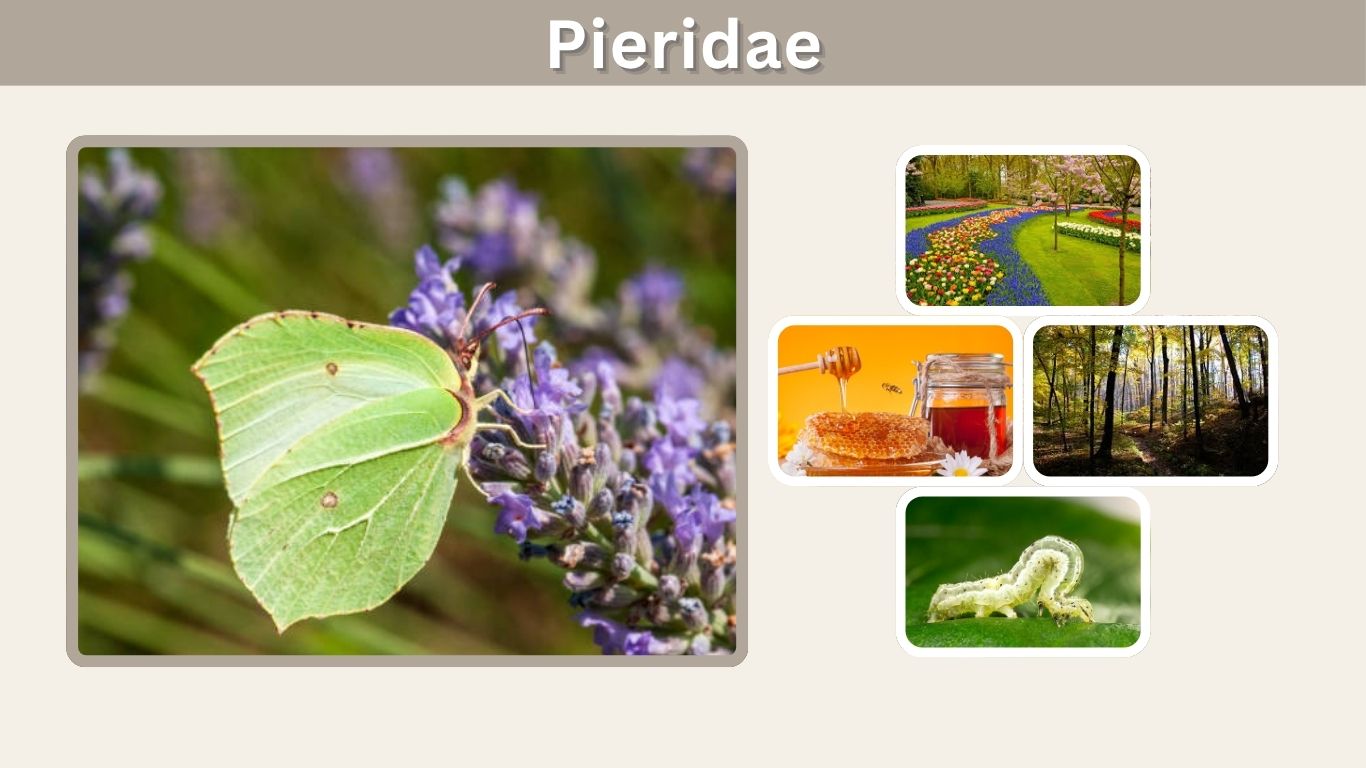
Pieridae is a large butterfly family best known for white, yellow, and orange butterflies. These butterflies are common in gardens, fields, forests, and open landscapes around the world. Many species are easy to notice because of their bright wings and active flight. Understanding Pieridae helps explain their identification, life cycle, caterpillars, habitat, and ecological importance.
What Is Pieridae?
Pieridae is a family of butterflies within the order Lepidoptera. Members of this family are often called whites, yellows, sulphurs, and orange-tips. They are among the most familiar butterflies because many species visit flowers, gardens, agricultural fields, and roadside plants.
The word “Pieridae” refers to the scientific family name, not one single butterfly species. This family includes many genera and species, such as cabbage whites, clouded yellows, orange-tips, and sulphur butterflies.
Pieridae Common Name
The common names of Pieridae butterflies are usually based on wing color. White species are often called “whites,” yellow species are called “yellows” or “sulphurs,” and some orange-marked species are called “orange-tips.” These names make the family easier to understand for beginners, even though the scientific classification is broader.
For example, the cabbage white butterfly belongs to Pieridae and is one of the best-known members of the family. Sulphur butterflies also belong to this group and are recognized by their bright yellow wings. In many regions, people may simply call them white butterflies or yellow butterflies.
Pieridae Scientific Classification
Pieridae butterflies belong to the order Lepidoptera, which includes butterflies and moths. Their family name is Pieridae. This family is divided into several subfamilies, including groups that contain whites, sulphurs, and orange-tips.
Scientific classification helps separate Pieridae from other butterfly families such as Nymphalidae, Papilionidae, Lycaenidae, and Hesperiidae. While some butterflies may look similar at a glance, wing structure, color pattern, caterpillar host plants, and body features help place them in the correct family.
Pieridae Characteristics
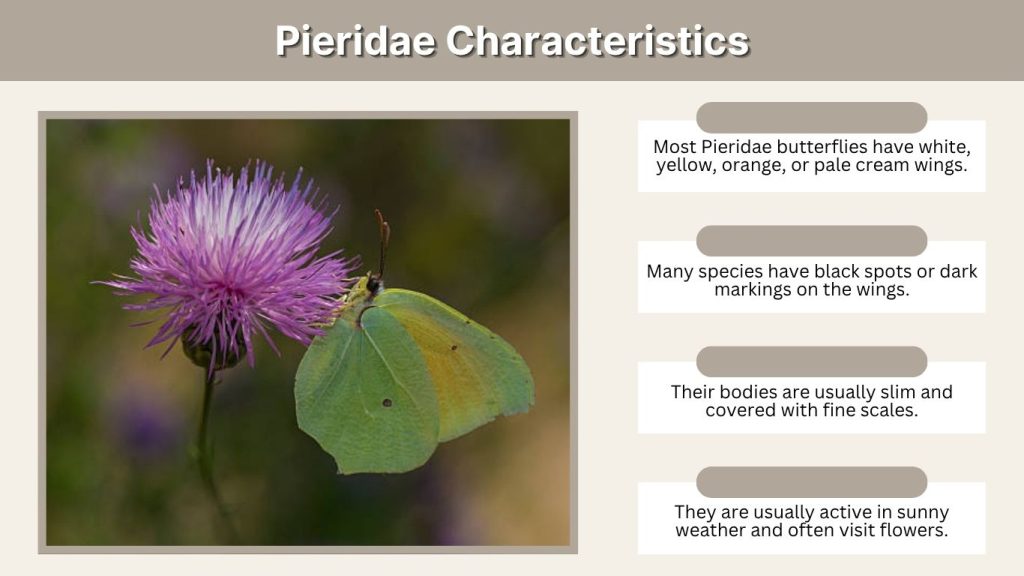
Pieridae butterflies have several features that help with identification. Most species are medium-sized, brightly colored, and active during the day. Their wings are commonly white, yellow, orange, or a combination of these colors.
Many Pieridae butterflies also have black markings near the wing tips or along the wing edges. Some species show seasonal color differences, and males and females may look slightly different.
Key Identification Features
- Most Pieridae butterflies have white, yellow, orange, or pale cream wings.
- Many species have black spots or dark markings on the wings.
- Their bodies are usually slim and covered with fine scales.
- The wings often look smooth and simple compared with heavily patterned butterflies.
- They are usually active in sunny weather and often visit flowers.
- Many species fly low to medium height over fields, gardens, and meadows.
- Caterpillars are often green and blend well with host plants.
- Some species have different male and female wing patterns.
Pieridae Butterfly Appearance
Pieridae butterflies can look simple, but their markings are useful for identification. White butterflies may have black wing tips, small dark spots, or pale underside markings. Yellow sulphurs often have rounded wings with soft orange or greenish tones. Orange-tip butterflies usually have bright orange patches on the forewings, especially in males.
The underside of the wings can also be important. Some species have greenish, yellowish, or mottled undersides that help them hide when resting. Because many Pieridae butterflies close their wings while perched, underside patterns can be just as useful as upper-wing colors.
Difference From Other Butterfly Families
Pieridae butterflies are often confused with other light-colored butterflies, but they have a cleaner and simpler wing appearance than many other families. Nymphalidae butterflies often have more complex patterns, eye spots, or stronger wing shapes. Papilionidae butterflies are usually larger and may have tail-like wing extensions. Lycaenidae butterflies are often smaller and may have blue, copper, or hairstreak-like patterns.
Pieridae butterflies are generally recognized by their bright white or yellow coloration, moderate size, and common presence around flowers and host plants.
Pieridae Habitat
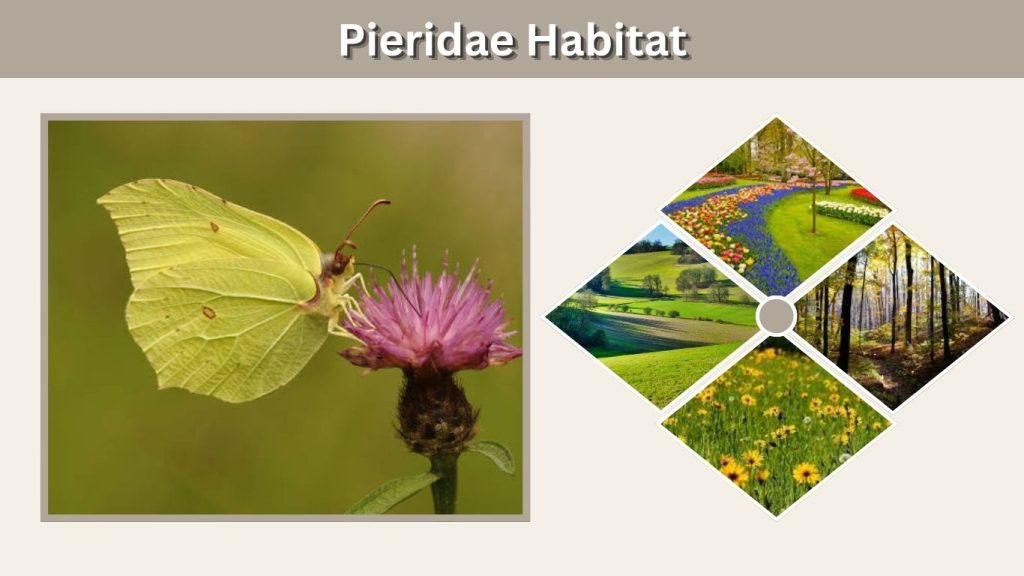
Pieridae butterflies live in many habitats, depending on the species. They are found in open fields, gardens, meadows, forests, wetlands, mountains, agricultural land, and even urban areas. Their wide distribution makes them one of the most commonly seen butterfly families.
These butterflies usually need two things: nectar flowers for adults and host plants for caterpillars. Without suitable host plants, females cannot lay eggs successfully.
Common Habitats
Pieridae butterflies are often seen in sunny and open areas. Gardens with flowering plants attract adults, while fields and farmland may provide host plants for caterpillars. Meadows and grasslands are also important because they support a variety of wildflowers and native plants.
Some species prefer woodland edges, where sunlight reaches flowering plants. Others live in dry scrublands, alpine meadows, wetlands, or tropical forests. Their habitat choice depends strongly on climate, food plants, and local vegetation.
Pieridae Distribution
Pieridae butterflies occur on many continents and are especially diverse in warm and temperate regions. Some species are widespread and familiar, while others are limited to specific regions. In North America, Europe, Asia, Africa, and Australia, different Pieridae species fill similar ecological roles as pollinators and herbivores.
Because many species are adaptable, they can survive near humans. Gardens, farms, parks, and roadsides often provide flowers and host plants. However, habitat loss, pesticide use, and removal of native plants can reduce local populations.
Pieridae Caterpillar and Larvae
Pieridae caterpillars are the larval stage of these butterflies. They hatch from eggs laid on host plants and spend their early life feeding on leaves, flowers, or seed pods. Many Pieridae larvae are green, smooth, and well camouflaged.
Some caterpillars in this family are known as agricultural pests because they feed on crops. The cabbage white caterpillar, for example, feeds on plants in the mustard family and can damage cabbage, broccoli, kale, and related vegetables.
Pieridae Larvae Identification
Pieridae larvae are usually easier to identify by their host plant than by appearance alone. Many are green and blend with leaves, making them hard to notice. Some have faint stripes, small dots, or fine hairs along the body.
Their body shape is usually cylindrical and soft. Unlike some moth caterpillars, they are not usually heavily hairy. When young, they feed quietly on leaves. As they grow, they molt several times before becoming pupae.
Host Plants
Many Pieridae caterpillars feed on plants in the mustard family, also known as Brassicaceae. This includes wild mustards, cabbage, broccoli, kale, radish, and related plants. Some sulphur caterpillars feed on legumes, such as clover, alfalfa, and senna.
Host plant choice is important because females usually lay eggs on plants that their larvae can eat. A butterfly may visit many flowers for nectar, but its caterpillars may only survive on certain plant groups.
Life Cycle
The Pieridae life cycle has four stages: egg, larva, pupa, and adult. Females lay eggs on or near host plants. After hatching, larvae feed and grow. When fully developed, the caterpillar forms a chrysalis. Inside the chrysalis, it changes into an adult butterfly.
The adult then emerges, expands its wings, and begins searching for nectar and mates. Some species complete several generations in one year, especially in warm climates. Others have only one or two generations depending on the season.
Pieridae Diet and Feeding
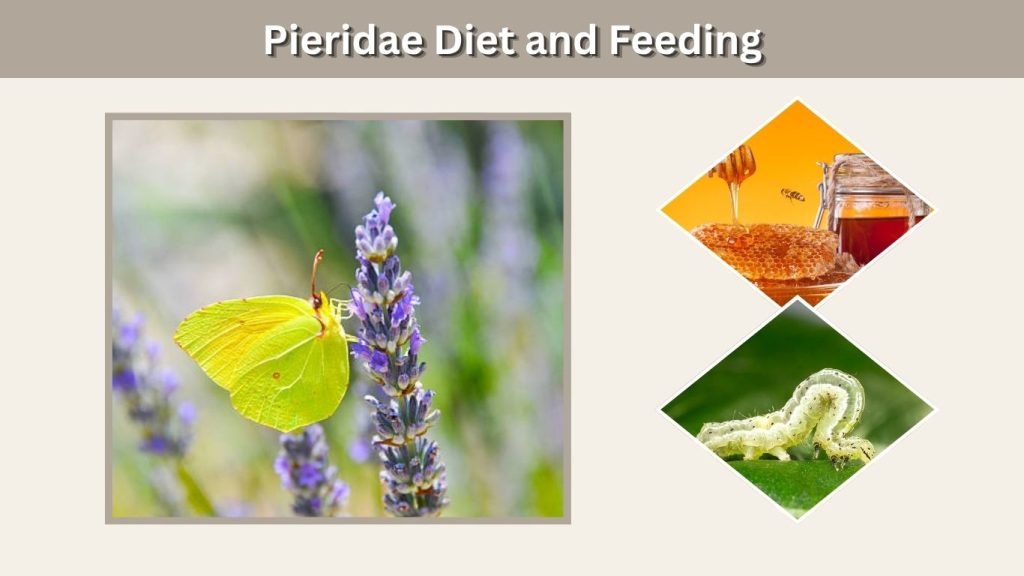
Pieridae butterflies feed differently at each life stage. Adult butterflies mainly drink nectar, while caterpillars eat plant material. This makes them both pollinators and plant feeders.
Adult butterflies use a long proboscis to sip nectar from flowers. They are often seen visiting wildflowers, garden flowers, weeds, and flowering shrubs.
| Life Stage | Main Food Source | Example Food |
|---|---|---|
| Adult butterfly | Nectar | Wildflowers, garden flowers, shrubs |
| Caterpillar | Leaves and plant parts | Mustards, cabbage plants, legumes |
| Pupa | Does not feed | Lives on stored energy |
| Female adult | Nectar and minerals | Flowers, damp soil, mineral sources |
Adult Butterfly Diet
Adult Pieridae butterflies prefer nectar-rich flowers. They often visit plants such as dandelion, clover, thistle, lantana, milkweed, verbena, aster, and many garden flowers. Their feeding helps move pollen between flowers, although they are not always as specialized as bees.
Some species may also take minerals from damp soil, mud, or animal droppings. This behavior is more common in males of some butterfly groups, as minerals can support reproduction.
Caterpillar Diet
Pieridae caterpillars are plant feeders. Their diet depends on the species. Cabbage whites and related butterflies often feed on mustard-family plants. Sulphur caterpillars may feed on legumes. Other species use different native plants based on their region.
Because some Pieridae larvae feed on crops, gardeners may consider them pests. However, many species feed on wild plants and play an important role in natural food webs.
Important Types of Pieridae Butterflies
Pieridae includes many well-known butterflies. Some are common garden visitors, while others are region-specific. Their colors and host plants vary, but they share the main features of the family.
Cabbage White Butterfly
The cabbage white butterfly is one of the most familiar Pieridae species. It has white wings with black markings and is often seen in gardens, farms, and open spaces. Its caterpillars feed on cabbage, kale, broccoli, and related plants, which makes it well known to gardeners.
Orange-Tip Butterfly
The orange-tip butterfly is recognized by the orange patches on the male’s forewings. Females are usually white with darker markings and may be confused with other white butterflies. This species often appears in spring and is associated with wild mustard plants and related flowers.
Sulphur Butterflies
Sulphur butterflies are yellow or orange-yellow members of Pieridae. They are often seen flying in sunny fields, roadsides, and gardens. Their bright color makes them easy to notice. Many sulphur caterpillars feed on legumes and related plants.
Pieridae Butterfly Meaning
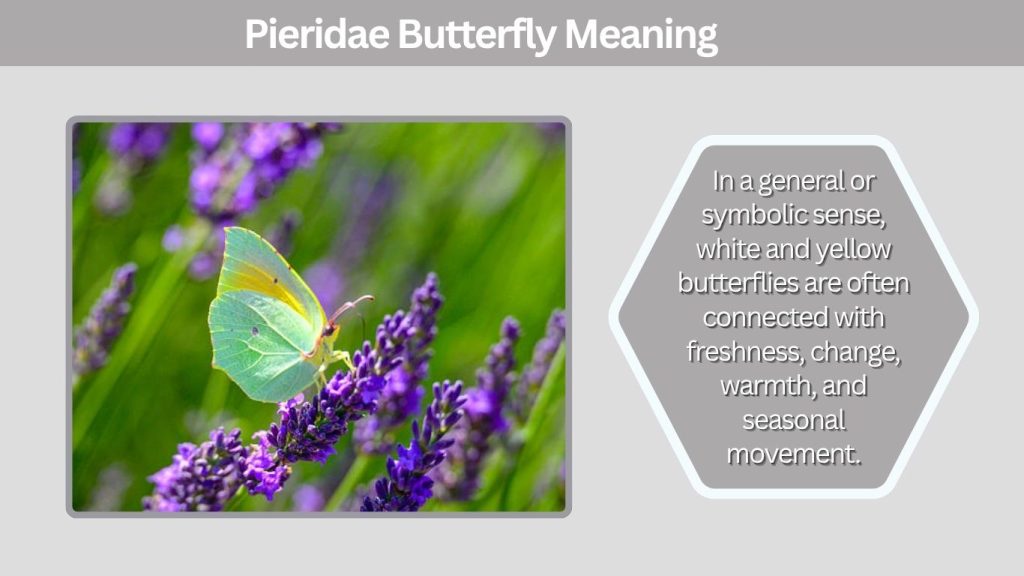
The meaning of Pieridae can be understood in two ways. Scientifically, it means a butterfly family within Lepidoptera. In a general or symbolic sense, white and yellow butterflies are often connected with freshness, change, warmth, and seasonal movement.
However, the true biological meaning is more important in identification. Pieridae is not a spiritual category or a single butterfly. It is a taxonomic family that includes many related species with similar physical and life-cycle traits.
Why Pieridae Matters
Pieridae butterflies matter because they are part of healthy ecosystems. Adults pollinate flowers while feeding on nectar. Caterpillars provide food for birds, wasps, spiders, and other wildlife. Even species that feed on crops are part of a larger natural balance.
They are also useful for learning butterfly identification. Because they are common and visible, beginners can use them to understand wing patterns, host plants, life cycles, and family-level classification.
FAQs
What is Pieridae?
Pieridae is a family of butterflies in the order Lepidoptera. It includes whites, yellows, sulphurs, and orange-tip butterflies. These butterflies are often recognized by their white, yellow, or orange wings and are commonly found in gardens, fields, meadows, and open habitats.
What is the common name of Pieridae?
The common names for Pieridae butterflies include whites, yellows, sulphurs, and orange-tips. These names usually describe their wing colors or markings. For example, white species are often called white butterflies, while yellow species are commonly called sulphur butterflies.
What do Pieridae caterpillars eat?
Pieridae caterpillars eat leaves and other plant parts. Many species feed on mustard-family plants, including cabbage, broccoli, kale, and wild mustards. Some sulphur butterfly caterpillars feed on legumes such as clover, alfalfa, and senna.
Where do Pieridae butterflies live?
Pieridae butterflies live in many habitats, including gardens, meadows, fields, forests, roadsides, wetlands, mountains, and agricultural areas. Most species prefer sunny places with nectar flowers for adults and suitable host plants for caterpillars.
Are Pieridae butterflies harmful?
Adult Pieridae butterflies are not harmful and help pollinate flowers. Some caterpillars can damage garden crops, especially cabbage-family plants. However, many Pieridae species feed on wild plants and are important parts of natural ecosystems.